This week the Group of 20 leading countries, G20, met in Pittsburgh on Sept. 24-25, to address two key issues: climate change and the fledgling global recovery. This meeting is important, because on Sept. 25, this forum announced that it will be the main one in which global business and economic policies are shaped, replacing the G8.

The G20 comprises the finance ministers and central bank heads of countries that account for 85 percent of world GDP, 80 percent of world trade and two-thirds of world population. The countries are: Argentina, Australia, Brazil,  Canada, China, France, Germany, India, Indonesia, Italy, Japan, Mexico, Russia, Saudi Arabia, South Africa, South Korea, Turkey, UK, U.S. The European Union is also represented, hence the “G20”. Last April  the group met at heads-of-government level in London — recall the TV shots of each Prime Minister entering 10 Downing St. with his gowned wife, one by one, in a fashion parade. Next year G20 will meet in Muskoka (a resort north of Toronto) and in South Korea. 

Politicians, economists, pundits and others all proclaim the crisis is over and the recovery has begun. But managers are not so certain. And it is managers who are in the field, daily, producing and selling the goods and dealing with clients. Here is what McKinsey Global Research found in their recent survey of managers worldwide:

In early September, McKinsey surveyed more than 1,600 business executives around the world about their current views on and hopes for the economy. Only 20 percent believed that a “normal” recovery starting in late 2009 would be the most probable outcome. Some 42 percent thought that 2010 would be a year of flat economic activity. About a third believe that an extended period of anemic global economic growth (below 1 percent per annum) is likely for the next several years. The remaining 7 percent felt that something akin to a double-dip recession was probable.

I think the real story of the Pittsburgh G20 is Pittsburgh, not G20. My sister and brother-in-law live there and I have been visiting Pittsburgh regularly for 55 years. I watched Pittsburgh transform itself from a dirty steel town (I recall touring the steel mills along the Allegheny River), permanently coated in soot, to a sparkling clean modern high-tech city with great universities (University of Pittsburgh and Carnegie Mellon), entrepreneurial energy and excellent mayoral leadership. Located at the confluence of two great rivers, the Allegheny and the Monongahela, Pittsburgh has escaped the decay and decline other cities experienced when their heavy industry disappeared. As a city that successfully reinvented itself — one of very few — Pittsburgh merits careful study by innovators and deserves a visit by tourists. Come especially to see what they’ve done to the old Union Station — it’s amazing.
Today’s BBC Business Daily reports on new and fascinating research by Professor Priya Raghubir Stern School of Business, NYU. Prof. Raghubir has found, in her research, that contrary to the economists’ assumption of rationality, how much money people spend depends on what jingles, or rustles, in their pockets. $50 in small notes and coins? We spend it freely. One big note, like $50? We hesitate to break it to spend it. 

Professor Raghubir notes:

We spend more in small denominations than with single large bill. Why? People fear, if they break large bill, they will have no control over it, it will go away. If they hold on to large denominations, they are more likely to maintain self-control.

This is only one of many mechanisms that we develop to control our own selves, and protect ourselves against ourselves.

Is this finding robust across different cultures?

We found it in 3 different countries: First, in the U.S., where we replicated it with children. Pre-schoolers were not prone to this effect, they think that lots of little coins is more money than paper…something called “numerosity.” But for older children, as with adults, five $1 bills, or coins were far more likely to be spent than one $5 bill. Second, we showed this in India, with a 500 rupee note vs. smaller notes. Third, I’ve shown it in China, with a group of housewives in Shiangtan, the effects were spectacular. There, people were far less likely to spend 100 yuan given in one banknote than when given 100 yuan in small denominations. 

All of us who travel know there is what Prof. Raghubir calls a foreign currency effect:

If I’m used to spending 1 dollar for cup of coffee, I will tend to spend 1 dollar for it in Canada, (worth only 67 U.S. cents), one pound in the UK, worth about $1.50, or one euro in Europe (also worth about $1.50). People inadequately adjust for exchange rates.  

So, does this mean we are dopes, and dupes? Not at all. Quite the opposite. It means that people are clever in devising ways to guard themselves against short-termitis, the tendency to spend and enjoy now rather than in the future.   

Do you also behave in this way? asked the BBC interviewer of Prof. Rughabir.

Of course, she said. 

Conclusion: In your business model, do sweat the small stuff. Because people do sweat (spend) it. Nickel and dime your business model, and you can boost your revenues.

Malaria is an infectious parasitic disease carried mainly by mosquitoes, in tropical and subtropical regions, including parts of the Americas, Asia, and Africa. According to Wikipedia, each year there are approximately 350–500 million cases of malaria worldwide, killing between one and three million people, most of them young children in Sub-Saharan Africa.

Had 3 million persons, mainly children, died in the West from anything, there would be massive investment to combat it. But for Merck, Pfizer, Novartis and other Big Pharma firms, there is no margin in innovative cures for malaria. Meanwhile, the mosquitoes are gaining — the parasites they carry are developing resistance to the current leading anti-malaria drugs.   

Now, a $3 b. program to combat malaria has been announced, led by 59-year-old Tanzanian President Jakaya Kikwete. The program is beautifully ultra-simple. Provide 250 m. mosquito nets (treated with insecticide) for Africans. Organize logistics to bring them (and related educational efforts) to the remotest of African villages.

Kikwete is one of Africa’s lesser known but more effective leaders, mainly because he is not involved in scandals or notoriety. In general Tanzania has had enlightened leaders, dating from its first President, Julius Nyerere. 

Let us wish Kikwete and his program success. Let us also ask: In our innovation efforts, why do we value some lives far less than others? Is not a life, a life?

The Jewish world celebrated its New Year on Saturday and Sunday, Sept. 19 and 20. By the Jewish calendar, the year 5770 began. In our tradition, Rosh HaShanah marks the day on which the world was created and the time when human beings were created. 

Ask 100 people about the Biblical account of how and when people were created, and 99 will tell you about Adam and about how Eve was created from Adam’s rib. This of course is accurate. But few know that there are two rather different accounts of Man’s creation, one in Genesis chapter one and the second in Genesis chapter two. The key differences between the two are explained clearly by the late Rabbi Joseph B. Soloveichik, the American prophet of modern Orthodox Judaism, in his 1956 article, “The Lonely Man of Faith”, published in Tradition, vol. 7, 1965. The two accounts are relevant for innovators and entrepreneurs.

The first account of mankind, Soloveichik notes, in Genesis 1, states that human beings were created in God’s image. “And God created man in his image; in his image God created man, male and female He created, and God blessed them…”. What does this mean, “in his image”? It means, the learned Rabbi says, that just as God is the Supreme Creator, so are human beings creative, just like their Creator. This first version of humanity speaks of how human beings — men and women, created together, jointly — seek to master their environment, by constantly asking the question “how?”, and come up with ideas that answer it in ways that make life better. This is the ‘feet on the ground’ aspect of innovation and entrepreneurship, whose roots are in Genesis 1. What are our needs? How can we meet them? Here, mankind is commanded “to fill the Earth and conquer it” creatively.   

But the second version of human beings’ creation is “significantly different”, Soloveichik writes. In Genesis 2, man is created by God out of the earth. Women are then created out of Man’s rib. And mankind is commanded by God not to conquer the Garden of Eden, but rather to preserve and enhance it. (In no time, we manage to mess up that mission badly). No mention is made here of God’s image. So, says Soloveichik, in this version, mankind asks metaphysical questions: Why? For what purpose? This version of mankind is “head in the clouds”, the thinkers, the questioners, the dreamers. Mankind questions everything.

Innovators and entrepreneurs fulfill both versions of mankind’s Creation. They are feet-on-the-ground innovators, creators. And they are head-in-the-clouds dreamers, questioners, who challenge every assumption and who break the rules.

Both qualities of mankind are vital if we are to endure and prevail on this earth. And both qualities are vital, if innovators and entrepreneurs are to succeed in changing the world by meeting real pressing human needs.

*This blog was inspired by a brilliant lesson led by our Rabbi, Dov Hayun, Rabbi of Moriah Synagogue, Haifa.

An interesting article in Business Week by Peter Coy, asks “can we protect consumers (from financial innovation) and still be creative?” [Incidentally — Business Week was put up for sale by McGraw Hill last week. There were few buyers.  Business Week’s famed investigative reporting has reportedly been hamstrung…].

His answer?   

In spite of the public’s mistrust, entrepreneurs and academics are plunging ahead. They’re working on ideas they hope will help the consumer borrow more safely and build wealth more reliably. Some are ambitious, like reducing homeowners’ exposure to declines in local housing prices. Others are fanciful, like an electronically rigged wallet that becomes harder to open when your bank account is low, an idea from the Massachusetts Institute of Technology.

Let us remember Joseph Schumpeter’s memorable phrase: Creative destruction. All creation involves destruction.  Old things have to die in order for new ones to be born. That is one interpretation. Another is: All creative things can be used destructively. It is not inherent in the innovations, but in the people who use them.  

Sub-prime mortgages in principle made housing affordable even for low-income people. A great idea, if used properly. But it was used to enrich unscrupulous thieves. It is not the fault of the innovation, but of those who misused it.

Financial innovation will continue. As it does, hopefully those who pioneer in it will remember that the foundation of capitalism is in creating long-run sustainable value for people,  in creating customer margin as well as company profit margin. The “I’ll be gone, you’ll be gone [before the earthquake we created happens]” principle that drove much financial innovation in the past is hopefully dead and buried.

All eyes are focused on the struggling UK economy, and on each quarter’s GDP numbers. TIM recently completed a fascinating benchmarking program in Britain, and what we learned will be the subject of several future blogs. Meanwhile, let us put Britain into perspective — three centuries of perspective.

The 1800’s were the British century. We had Globalization 1.0. The British Empire, on which the sun literally never set, created a global trading system far more durable, far more global, than the present one. There were fewer government restrictions and impediments to trade. We had the Victorian Internet — the telegraph. The gold standard ensured no country could issue excess currency. Britain set up the system to profit, often at the expense of its colonies. And Britain grew wealthy.

But by 1900 the Empire was waning and America was replacing Britain as the world’s dominant power. The 20th Century was American. America learned to do industrial R&D from Germany and from Britain, and did it better. Two world wars ended Globalization 1.0. Bad politics, not bad economics. But at Bretton Woods, in July 1944, 65 years ago, Globalization 2.0 was born. It worked fantastically until 2007. But it was flawed. The world currency was the dollar. But America overspent, undersaved, flooded the world with dollars and ruined the system. In 2007 it crashed. The UK suffered even more than America, because its financial services caused, and profited from, the bubble as much or more than America’s. Bad economics ended Globalization 2.0. Bad American economics.

The UK chose to join the European Union but not to adopt the euro. It left the European Exchange Rate Mechanism on Sept. 16 1992, under PM John Major, and never rejoined. At first this appeared brilliant. The flexible pound gave Britain elbow room to stimulate its economy. But after the global recession this decision seems flawed. The Euro countries are recovering much faster than Britain — especially Germany.  

Britain clearly needs to reinvent its business model. So far it has focused on short-term survival, rather than long-term competitiveness. 

So which country will dominate in the 21st C.? Will Britain continue to wane or will it recover? With a likely shift from Labor to Conservative government in the works, Britain desperately needs transformative change. But will it happen?   And how will Britain’s global companies endure and prevail within this atmosphere of uncertainty?   

Perhaps the best way to understand the British is by listening to  this song A British Tar (a tar is a sailor) from Gilbert and Sullivan’s H.M.S. Pinafore, 1878. Here is a portion of it:

A British tar is a soaring soul,
As free as a mountain bird,
His energetic fist should be ready to resist
A dictatorial word.

His nose should pant
and his lip should curl,
His cheeks should flame
and his brow should furl,
His bosom should heave
and his heart should glow,
And his fist be ever ready
for a knock-down blow

His foot should stamp, and his throat should growl,
His hair should twirl, and his face should scowl;
His eyes should flash, and his breast protrude,
And this should be his customary attitude,
His attitude
His attitude

Are there still “British tars”? Where? Will Britain’s attitude, energy and innovation continue to sink, behind China (#1?), America (#2) and even Germany (#3)? Or will the British tar make a startling comeback?

Stay tuned, and keep your eye on the long run.

TIM managers have just completed a remarkable benchmarking week in Britain, visiting 13 organizations, including LandRover, BT, BP, Virgin, Rolls Royce, RBS and Manchester United.

Our visit included a trip to the Prince of Wales Theatre in London’s West End, where we met with Richard Pulford, CEO of the Society of London Theatre, a trade association of theatrical producers.

We learned many things about the business of producing plays and musicals. The main lesson: It is not enough to create value. (London plays and musicals create enormous value, and memorable customer experiences, for 14 m. theatre visits annually!) Some shows have run for decades — Agatha Christie’s The Mouse Trap ran for 57 years,  Phantom of the Opera for 27 years, Cats for 21 years!.  

But you have to capture that value in order to sustain the business. London theatres are sustained only by the fact that producers tend to be wealthy and can afford to lose money. Only one play or musical in 10 makes money, two break even and 7 lose! Why? Market failure — inability to capture value. Here is how Richard Pulford explains it:

West End theatres are crucial for London. They bring in many tourists, who spend on restaurants, cabs and hotels.  For instance, total hotel revenue is £ 415 m. yearly. Much of this comes from theatre-goers. Perhaps £ 1 b. in tourist revenues is directly related to the theatres. Yet, the theatres cannot capture this revenue, it is an ‘externality’. [Perhaps they could, if they practiced market segmentation, like Manchester United…but they do not, and have not apparently benchmarked Man Utd.]. A rare strike in the theatres drastically cuts tourism.

We were convinced that with market segmentation, with the techniques used by Manchester United, BT and other businesses we visited, London theatres could be profitable. They could capture more of the value they create. Yet they appear to avoid benchmarking other businesses, because theatre is, well, theatre is artistic, not business. But why? In social entrepreneurship, powerful business principles are used to do good in the world and to help people. Why not do the same in theatres?

Every business begins and ends with creating value for its clients. But every business must also know how to capture a large portion of that value. Businesses that do not are doomed to lose money. They will disappear, unless, like the theatre, they have wealthy backers willing to lose money forever.

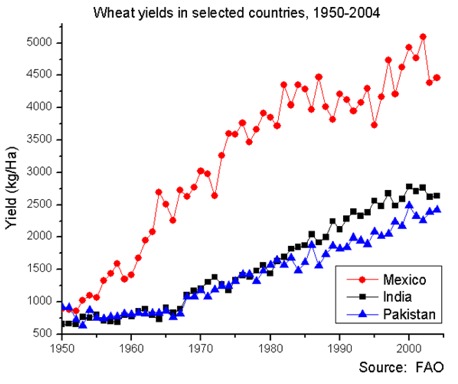
Norman Borlaug passed away on Sept. 12, at the age of 95. Borlaug was the innovator, an agronomist, who created the Green Revolution. He developed strains of wheat that had short stalks and were disease resistant. When the wheat puts its energy into its kernel, not into the straw, yield improvements of 100% (double) resulted. 

As a boy I grew up in Milestone, Saskatchewan, amidst fields of waving wheat higher than my head. Today that same wheat no longer waves. It is only a foot or so high. A simple yet powerful idea, that according to the Nobel Institute has saved hundreds of millions from hunger in India and Pakistan, primarily. Mexico became a wheat exporter in 1963 as a direct result. Borlaug was awarded the Nobel Peace Prize for his efforts in 1970. 

Borlaug was the great grandchild of Norwegian immigrants to America. He worked as a boy and teenager on the family farm in Iowa, and came to know farming at the ground level. Borlaug’s grandfather encouraged him to leave the farm and study at college. “If you want to fill your belly,” he told Norman, “go fill your head!” A Depression-era program that enabled low-income students to afford college made it possible for Borlaug to enroll at University of Minnesota. He failed the entrance exams, but persisted, and eventually ended up in the College of Agriculture.

Here is how Wikipedia describes just one of his innovations: “dwarfing”.

Dwarfing is an important agronomic quality for wheat; dwarf plants produce thick stems and do not lodge. The cultivars Borlaug worked with had tall, thin stalks. Taller wheat grasses better compete for sunlight, but tend to collapse under the weight of the extra grain—a trait called lodging—and from the rapid growth spurts induced by nitrogen fertilizer Borlaug used in the poor soil. To prevent this, he bred wheat to favor shorter, stronger stalks that could better support larger seed heads. 

The graph below shows the dramatic rise in grain yields Borlaug achieved. He developed the Green Revolution wheat varieties in remote Mexico, finding suitable strains of wild wheat, in difficult conditions, with low budgets and oppositions from those who directed his work. Few innovators can claim, as Borlaug could, that they saved hundreds of millions from starvation.

Wheat Yields

The September 2 edition of The New York Times carried a front-page article by columnist and Nobel Laureate Paul Krugman, about “how did economists get it so wrong?”. The article was the ‘most read’, #1, according to www.nyt.com
But — in what way did economists get it wrong? In two ways. One, they failed to foresee the global financial and economic collapse that began in 2007, and accelerated almost exactly a year ago, when Lehman Brothers collapsed;  and two, after the collapse, they had no clue, and absolutely no consensus, on what to do about it. Politicians and leaders like President Obama had to improvise, and made many many errors in their ‘stimulus packages’ and ‘bailout packages’. Seven Nobel Laureates were asked what to do, and, as the Bible says, “ran off in seven different directions”.

What was the problem? Krugman says: Economists abandoned Keynesian thinking, which denies that people are always rational, capital markets are always efficient, and free open unregulated markets always are optimal. It is time they returned to Keynes, he recommends.

So here’s what I think economists have to do. First, they have to face up to the inconvenient reality that financial markets fall far short of perfection, that they are subject to extraordinary delusions and the madness of crowds. Second, they have to admit — and this will be very hard for the people who giggled and whispered over Keynes — that Keynesian economics remains the best framework we have for making sense of recessions and depressions. Third, they’ll have to do their best to incorporate the realities of finance into macroeconomics.

I have a different view.

I am writing this in a hotel room in Nottingham, UK, where we have brought some 31 Israeli high-tech managers from five companies, on a best-practices (and ‘next-practices’) benchmarking trip, to London, Derby, Birmingham, and Manchester. This is the 37th such trip for TIM and its managers. The goal: Visit great companies, and learn from great leaders how they manage, then adopt and adapt what they tell us. We are visiting LandRover, Rolls Royce, British Petroleum, British Telecom, British Airways, Manchester United football team, and others. We are in the 3rd day of our 6-day trip and have learned enormously already.

Economists failed, because they sat in their offices and crunched numbers rather than spent their time in the field observing real people, real companies and real markets. If they had,  if they had seen what is truly going on, in housing, sub prime mortgages, derivatives, options, etc., they would not have been as sanguine. They might have built theories that hold water. 

So economists: how did economics go wrong? By seeking truth in the wrong place (under the lamp-post, goes the tale,  instead of in the dark corners where economists dropped the coin, or the ball…). Seek truth in the real world. Leave your office. Do your research on site, where the economy unfolds. THEN return home and recount what you saw, and build your theories based on it.

“Elegance”, MIT economist and Nobel Laureate Paul Samuelson has said, “is for tailors”. Economics’ elegant mathematical theories were beautiful and useless. Let’s deal instead with the messy real world, and try to understand it. I admit that I am an economist. I share my discipline’s faults. I believed the numbers told the story. They don’t. In fact, they often lie. I discovered this only after beginning to teach managers and hence to understand their world, the real world of economics and business. 

We at TIM are happy to lead a benchmarking tour for economists who wish to seek truth the right way — in reality.

Really, this is going too far. I mean, innovation is all well and good, but — innovating opera? And at London’s  Royal Opera House? After all, is nothing sacred? Good heavens. Who in the world thought of this ghastly idea?

Someone had the idea of asking the public to submit “tweets” (to the Royal Opera website). One month ago, the Royal Opera website presented the public a sentence on which to build a story: “One morning, very early, a man and a woman were standing, arm-in-arm, in London’s Covent Garden.” Some 900 140-character messages were received.  Composers Helen Porter and Marc Teitler set the tweets to music. If they all were used, they would be a full seven-act opera — even beyond Wagnerian Valkerie proportions. So instead, excerpts will be used, making a twenty-five minute opera. It will be performed as part of the Deloitte Ignite arts festival.

The BBC Music Magazine’s deputy editor called the exercise “an accident waiting to happen”. He said: “Whenever there is a new fad you know somebody in the art world is going to grab hold of it by the horns. They should be careful that it doesn’t overtake the serious stuff they do.”

In response, Sara Parsons, the publicity officer for Ignite, says, “It’s about getting people involved and interested in opera — and it’s certainly done that.” 

Talk about breaking the rules. Opera is opera. It ends when the fat lady sings, not when the last thin Tweet ends. Give us a break!

However, here is my own Tweet contribution, following on to the lead sentence. 

“Let’s tweek the twats,” the man said, “and Twitter Aida! Pyramids, shmyramids!”. 

Blog entries written by Prof. Shlomo Maital

Shlomo Maital

Pages