Is innovation related to the current Wall St. crisis, likened by many to 1929?

It is indeed. It is an example of creative destruction, but not in the sense Schumpeter meant.     

From Wikipedia: “The economist Joseph Schumpeter popularized and used the term to describe the process of transformation that accompanies radical innovation. In Schumpeter’s vision of capitalism, innovative entry by entrepreneurs was the force that sustained long-term economic growth, even as it destroyed the value of established companies that enjoyed some degree of monopoly power.”

Financial geniuses created complex new financial instruments with acronyms for names (MBS, CDS, meaning ‘mortgage backed securities’ and ‘credit default swaps’). These instruments were so complex few understood them.

Former Clinton Labor Secretary Robert Reich, an Obama advisor, relates once asking a hedge fund manager to describe the assets in his fund. He laughed, Reich relates, and said he had no idea. That means he had no idea what the risk was. And it turned out to be huge. That manager, if paid like the others, made 19,000 times more, on average, than the average American worker.

This type of financial-engineering innovation results in ‘creative destruction’ – it was creative, but the creativity went toward concealing the risk from other sophisticated players. The Wall St. bonus system meant, as the former vice chair of UBS noted, that the greatest fear was to underperform others (and miss the bonus), hence everything in the innovation system pointed toward taking and creating ever-greater risks.  And it was destructive, because ultimately the system had to collapse. 

No, all those fancy acronyms created a fog of complexity behind which lurked unsustainable and unacceptable risks. It was destructive innovation.

A major lesson: What you do not fully understand, do not invest in.

The greatest living practitioner is Warren Buffett. Ask him. His Berkshire Hathaway has $43 b. in cash. He just bought a major energy company for a song, $4 b., half of what it cost last week, simply because investors are utterly panicking. He buys companies he can understand.

Creative financial destruction was built on complexity. The lesson we learn is to avoid it by demanding simplicity. If we all do,  we will lift the curtain concealing risk and see it clearly enough to avoid it or manage it.

Prepared for The Marker Innovation Conference
Avenue, Ben Gurion Airport, Sept. 21/2008

How many of you in the audience are industrial designers?

I argue today that all of us are designers. And we are all, every one of us, working on the same project.

We are all designing our lives. Even the failure to design our life, because we fail to think about it, is itself a design, though always a poor one.

What is the single most powerful principle for design innovation, for optimally and innovatively designing our lives, our organizations, and our products and services?

It is, I would argue: Simplicity! Simplicity is simply wonderful. This is not just my view. It is the view of a brilliant MIT Media Lab computer engineer and video artist named John Maeda, who has now become the President of RISD – Rhode Island School of Design. His book is called The Laws of Simplicity* and it is only 100 pages long.

To follow the Simplicity Principle, I have shortened by talk from 30 to 20 minutes and eliminated many slides. 
  
In my short talk I aspire not only to interest you, the audience, but at least for some, to change your lives.  This is hutzpah but I will try anyway.

Systematic Inventive Thinking (SIT) uses five innovation ‘templates’. The first template they list is called “subtraction”**. Remove things. This is counterintuitive. Innovators usually assume that you innovate by adding features on to existing products and services. But the most powerful innovations are those using subtraction. Subtraction is a way to increase simplicity – and simplicity is an increasingly scarce value, in today’s complex world. Today one of the scarcest resources is “cognitive capacity” – space in our brain. If you can save yourself and the world brain energy by simplifying, you can achieve greatness.    
          
Author John Maeda suggests the following: Let every software company reduce the number of features in its software every year by 10 per cent, and charge 10 per cent more. Would this work? Would you pay more for less? Is this not a stupid idea? Have any of you tried Office 2007 – a ten-ton burden piled onto the back of a struggling donkey? Most of those ten tons of features are not useful or used. 

Think about your organizational chart. Can you eliminate one or more layers? If we have learned anything about innovativeness, it is that layers of hierarchy are its enemy. Flatten your organization. Simplify. Subtract layers. And you will quickly see not only savings but results.    

John Maeda offers 10 Laws of Simplicity***. I will describe only the first three of his Ten Commandments and the last one. They are: Reduce; Organize; Save Time; and Unify. 

Law #1. REDUCE. “The simplest way to achieve simplicity is through thoughtful reduction”. Ask yourself, about your lives, about your products, and about your organizations:

How simple can I make it?  

How complex does it HAVE to be?

Consider the iPod. It evolved from a wheel with four buttons, to a wheel with four discrete buttons, and finally, using Subtraction, into a single button or wheel. 

The First Law of Simplicity can change your life.      

I would like to ask each person in the audience to reflect on the following power question:

What single thing can you eliminate from your life, that would raise its quality?

Can you take away something, inessential, time-wasting, energy-wasting, and improve your life? Can you do it right now? If not, why not?

In innovating your products, how can you practice Subtraction? 

There are three ways. 

First, Shrink. Maeda says, “the smaller the object, the more forgiving we are when it misbehaves.” For instance, our children. 

Second, Hide. Hide the complexity. Maeda cites the Swiss Army knife. Blades not in use are hidden.  

Third, embody. Embed quality in the product so that it is perceived. Bang and Olufsen’s remote is thin and small, but is made heavy intentionally to convey quality.

Law #2. ORGANIZE. “Organization makes a system of many appear fewer.” Simplify complexity by organizing it. You do this by sorting, by grouping and by combining. When you do, you will naturally eliminate many things that are redundant. Disorganized complexity is chaos. Organized complexity, when done well, becomes simplicity. 

Law #3. TIME. “Savings in time feel like simplicity”. By shortening my talk by 10 minutes, I believe I make it simpler to understand. By shortening my sentences, I save you the reader time. By shortening the words, I save you time and effort. After writing this talk, I went over it and replaced long words with short ones.    

IBM’s Global Services division accounts for over half IBM’s global revenue. A decade or so, it did not exist. It is a good example of the simplicity laws. IBM has a customer-facing representative  diagnose the client’s needs, then build a virtual organization using a matrix system to tailor precisely the required services. The process is complex, but it is complex in order to deliver simplicity to the client, and to save the client’s time. We can only justify a complex organization if it makes our customers’ lives simpler.

Law #10. THE ONE. “Simplicity is about subtracting the obvious and adding the meaningful”. 

Consider Einstein. His equation E = mc2 was initially quite complicated. One by one, Einstein eliminated every variable that was not essential. The result linked energy and matter in the simplest, clearest and most powerful way possible****.   

Einstein himself warned us about simplicity.

Simplify as much as possible, he said – but not more so. 

If you subtract essential things from your lives, your organizations, your products, you oversimplify and create destruction. Think about this graph: 
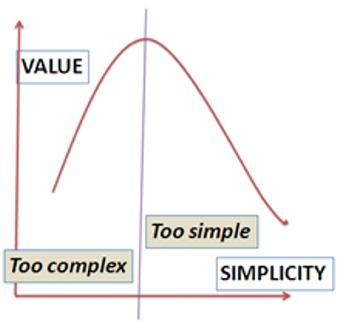
       

I strongly believe that in at least 90 per cent of all cases, in our lives, our organizations, our products, we are in the “too complex” area rather than in the “too simple” area. And if we err, better to err toward simplicity than complexity. The cost of error is far less.

In your lives, and in your products, you should allow “addition” – the usual procedure for innovation, adding features – if and only if it creates true value, and adds meaning for yourself and for your clients. Addition should be subject to very stringent hurdles. Every addition creates added complexity – for yourself, for your organization, and above all for your clients. Make certain that in your cost-benefit calculation, you consider  the hidden cost of added complexity, vs. the value it creates

The value and beauty of simplicity are old and eternal truths.  

– St. Thomas Aquinas said, “If a thing can be done adequately by means of one, it is superfluous to do it by means of several; nature does not employ two instruments where one suffices”.

– Scientists have long used the principle of Occam’s Razor: “All other things being equal, the simplest theory is the most likely to be true”.

– Da Vinci said: “Simplicity is the ultimate sophistication.” 

– The novelist Antoine de Saint-Exupery said: “Perfection is achieved, not when there is nothing more to add, but when there is nothing left to take away.” 

Subtract, my friends. Simplify. 

What can you take away?  

And what will you take away from our conversation?

_______________________
* The Laws of Simplicity (Simplicity: Design, Technology, Business, Life) (Hardcover) by John Maeda, MIT Press: 100 pages, 2006
** Jacob Goldenberg, Roni Horowitz, Amnon Levav, David Mazursky, “Finding Your Innovation Sweet Spot”, Harvard Business Review, March 2003
*** See his website:  www.lawsofsimplicity.com
**** See David Bodanis.  E=mc2: A biography of the world’s most famous equation.  Walker & Co.: New York, NY, 2000

We are currently in Switzerland, with a group of some 32 TIM managers, coaches and staff, conducting our 29th international best-practices benchmarking visit to leading Swiss companies and political figures. In our visit, we have met with the President of Switzerland, Pascal Couchepin, his Economics Minister Jean-Daniel Gerber, and with the Chair and CEO of Nestle, and the head of R&D of Novartis. We again learned: There is no substitute for learning ‘through the soles of your feet’ and through your own eyeballs. We saw global leaders first hand, saw great global companies, and the impact is hard to overstate or even describe.

At Novartis, Romeo Paioni, who heads R&D for this global pharma giant, explained the remarkable system he has built. He himself has been personally involved in developing many of Novartis’ blockbuster drugs, including Glivek, the drug that cures a virulent form of leukemia caused by a gene defect. He spoke about Novartis’ “open innovation” system. Procter and Gamble recently pioneered a different form of open innovation, based on replacing “not invented here” with “proudly found elsewhere.” At Novartis, a hybrid has been created. Some 70% of R&D is done internally, at Novartis’ R&D centers sited around the world – wherever the science is strongest.  

(Recently senior biomedical R&D staff at Novartis voted to move their operation from Switzerland, to Cambridge, MA, where Nestle bought the old NECCO candy wafer building and has placed a huge R&D center there, right next to the MIT campus, where biomedical and biotechnology research is at the leading edge in the world; and a second site was place at 250 Massachusetts Ave., housing hundreds of scientists). 

But another 30% of R&D investment is done through external sources – university laboratories and researchers, and independent researchers. Paioni weaves together a powerful innovation system, based on this internal/external system.

Big Pharma worldwide faces a major crisis. Wall Street financial analysts are discounting Pharma’s future growth, noting that the pipeline of new drugs is nearly empty, old drugs are coming off patent and are being shifted to generics,  and the number of new drugs is declining. Pharma companies are seeking a new innovation model, abandoning the old trial-and-error model, where some 10,000 to 100,000 compounds might be examined to find one winning molecule, to the new genetic engineering approach, where a target molecule is identified, causing illness, then ‘shut down’ by a ‘cure’ molecule. The old method was based on very small molecules; the new one, on sometimes huge molecules. This requires many new competencies in synthesis and discovery. Novartis, led by Paioni, is adapting and innovating its innovation process to meet the challenge.

Our participant, Yair Shamir, Chair of Israel Aerospace Industries, asked: Innovation is chaotic. Yet it requires discipline in Pharma, to bring drugs through clinical trials and to market. How does Novartis preserve the chaos and strengthen the discipline?

Paioni liked the question, approved the notion that innovation was ‘chaos’, and explained the transition from chaos to discipline. Later, at lunch, I asked Paioni about his own discoveries. One of them was remarkable. A long chain molecule was used, he said, to ‘capture’ target molecules, because at many places on the chain the capture could happen. Scientists all felt this was the best way. But Paioni thought ‘out of the box’. No, he said. This is wasteful. I am going to take this very long chain, which uses a lot of energy, and connect the ends, to make a single ring, and that ring will be much more efficient in capturing the target molecule. He was told he was utterly wrong… but he persevered, created the ring – and based on it, developed a powerful new drug. Chaos – in thinking otherwise. Discipline – in persisting in creating the ring, despite huge difficulties. 

One of our participants asked a senior Novartis manager, Michael Nohaile (who heads Corporate Strategy): What do you want your new employees to think and feel, when they first join your company?

One, he said: This is a powerful wealthy company, highly successful.

Two: This is a company that helps people a great deal.

Both of these elements are built on Novartis’ success at constant innovation, and lately, on its ‘open innovation’ system.

Many thousands of men die yearly from prostate cancer worldwide, and specifically in America and in Israel.  The reason: Denial. Men shy away from the consequences of treatment, which can involve impotence and incontinence. While women mostly welcome an annual checkup for breast cancer,  men tend to do the opposite, avoiding the annual examination of their prostate. The result: premature death for thousands.  Golfer Tiger Woods’ father died needlessly of prostate cancer.

Now a new/old technology has come to the rescue: GPS. The same technology that triangulates your location by using globally positioned satellites has been applied to treating prostate cancer.

How does it work? Small radio transponders are inserted into the cancerous tumor inside the prostate. These small radio stations send out continual radio signals. The signals are received by receivers similar to those used in the GPS system. They triangulate and locate the tumor inside your prostate precisely,  ten times a second. That enables radiologists to bombard the tumor  with precisely-aimed radiation, that hits the target while avoiding surrounding tissue. In some ways, this is like laser-guided bombs that zero in on a ground-based laser beam and hit their target precisely. This minimizes damage to the key nerve that supports sexual function or to the sphincter, the muscle that controls urine flow. 

Often innovation involves transferring technology used in one industry to an entirely different use, to meet an entirely different need. The same GPS technology that can help you find your way in Ladakh, across the Himalayas, can now help doctors fry your prostate cancer without collateral damage.
   
This new device is now being used by about a hundred hospitals in the United States.

The world’s population – especially in the wealthy, developed nations – is growing old rapidly. According to data from Wikipedia:

Among the countries currently classified by the United Nations as more developed (with a population of 1.2 billion in 2005), the median age of the population rose from 29.0 in 1950 to 37.3 in 2000, and is forecast to rise to 45.5 by 2050. The corresponding figures for the world as a whole are 23.9 for 1950, 26.8 for 2000, and 37.8 for 2050. In Japan, one of the fastest ageing countries in the world, in 1950 there were 9.3 people under 20 for every person over 65. By 2025 this ratio is forecast to be 0.59 people under 20 for every person older than 65.

How can innovators find success in this huge new market?  Remember, many older people have savings, assets and are willing and able to spend, provided they are offered services and products that are suitable for their needs and that align with their lifestyle.

Here are some principles, based on the fact that I myself am at the demographic borderline, and will turn 66 this November:

* Use empathy. We teach the power of empathic design: Think what you yourself might need, chances are others will, too. For 30-something innovators, it is hard to emphasize with older people. But not impossible.  Talk to them. Visit protected-living homes. Talk with grandma. Observe how they live. Remember they may not be able to articulate their needs, but you will need to discover them by observing them.

* Never patronize. Seniors hate to be patronized. Find ways to meet their needs without specifically segregating them as a market or relating to them as old. For instance, websites: Experts tell us websites should be designed in any event, for old or young, with large fonts, easy to read text and large click areas – both young and old will appreciate this user-friendliness. 

*  Nostalgia works: Research the fifties and sixties. Recycling successful products and brands from that era can work well. Become a social historian – it will be interesting as well as productive. Look at the huge success of nostalgia music and ‘60s rock bands, some of whose members have gray hair and, we suspect, false teeth…

*  Seniorize appliances: Cell phones, mouses, PC’s, TV’s, DVD’s, regular telephones, nearly every appliance can be made more attractive for seniors by meeting their specific needs. Think about innovating ‘add-ons’ that will achieve this, patent them, and market them to appliance companies. Enlist seniors as your partners, and always build mock-ups and prototypes to test. 

*  Forgetfulness: We seniors don’t remember things as well as we once did. This bothers us a lot. If you can innovate products and services that help us remember, that remind us, and that remember for us – you have a winner. Can you help us remember names? Remember medication? Remember phone numbers? Remember tasks and errands? 

As Joseph Coughlin, head of MIT’s Age Lab, says: “The new market is old age. Baby boomers provide a perpetually youthful market and are looking for technology to stay independent, engaged and vital*.”    Innovators will find success by meeting the needs of this large and growing market.
_________
*“Eric A. Taub, “Smoothing the way to a senior lifestyle”, Int. Herald Tribune, Aug. 28/08, p. 17

In boom times, when demand is growing, it is no trick for managers to boost their top lines (revenues) and bottom lines (net profits). But in bad times, when demand is contracting, that indeed is a great achievement.  Let us therefore look more closely at Honda.

In America, where high oil prices and the housing bust have mangled consumer spending, GM Ford and Toyota report large sales declines: 18 %, 14% and 7%, respectively. (International Herald Tribune, August 26, 2008, p. 11).

Honda? Its U.S. sales are up 3% this year and it is struggling to maintain inventories, as its cars ‘fly out of the showrooms’. Its U.S. operations remain highly profitable.

Why?

A brilliant combination of what Jerry Porras and Jim Collins, in their classic 1991 California Management Review article, call: “core values and purpose”, and “dynamic change”.

From the time Honda’s namesake founder Soichiro Honda built a fuel-efficient engine with his own hands decades ago, Honda has stuck to its core values of fuel efficiency. When GM, Chrysler and even Toyota chased the high-margin market for SUV’s and trucks, Honda stuck to its core values. Its new FIT hatchback, which uses only 7 liters of gasoline per 100 kms., is a huge hit, and its sales are up 79 % this year! Honda’s CIVIC and Accord models are also selling well. 

I sometimes use a yin-yang diagram to illustrate the key management dilemma, of retaining core values while implementing radical change. This is one of the toughest dilemmas in innovation management: What to keep, what to change. Some companies innovate away their core values. Invariably they self-destruct – GM, once the world’s largest industrial corporation, is diving toward single-digit ($ b.) market value and may be approaching bankruptcy. 

Honda innovates within its core values. And its bottom line proves why this is wise.

Urginea (“Hatzav” in Hebrew)

In large parts of Israel, a strange tall flower, whose botanic name is Urginea, is blossoming. Its Hebrew name is Hatzav. 

Wait. Run that by me again. Blossoming, during the driest season of the year, when no rain falls at all? In August and September? Flowers blossom in the spring, right?  

Not the Hatzav. Based on the principles discovered by Charles Darwin – natural selection, survival of the fittest — the Hatzav has discovered an evolutionary trick. If you blossom when no other flower does, you gain competitive advantages that help you survive and procreate. Bees and wasps fertilize your flowers, because there is little else around. When other flowers are more dormant, you get a bigger share of resources and groundwater.  

In innovation theory, we call this blue oceans innovation. Perhaps, viewing the fields of hatzavim, we should call it white oceans. 

Weird flower? Even Nature has discovered the value of being different, totally different – long long before human beings did.

Many years ago, Harvard Business School Professor Clayton Christensen developed the notion of disruptive technology: Technology that unobserved threatens the fundamental dominant technology in an industry, and quickly makes it obsolete. Now he and colleagues have applied this notion to education. In America, they note, faced with overwhelming constraints, schools are (under the radar, often unnoticed) innovating new models of schooling. 

The same, I believe, is happening in Israel. The vaunted “Ofek Hadash” (New Horizon) strategic innovation in Israel’s educational system was developed top-down, led by a consulting company, with little participation by teachers in the field. I spoke to some of those teachers. They showed glaring obvious flaws in Ofek Hadash, that could easily have been fixed had they participated in the formulation process. Despite this, innovative experimentation is going on in many schools. Problem is: There is a lack of a benchmarking process, in which great ideas spread rapidly from best-practice schools to mediocre ones.

Here is how Christensen (interviewed in Harvard Business School Working Knowledge) describes the process in America, whose schools are no less troubled than those in Israel:

…. on average, schools have done a better job adjusting to disruptions imposed upon them than have companies in the private sector. Our research shows that the classic signs of disruption are now occurring in the world of education, in the same ways they occur in the other contexts we have studied.

Computer-based or online learning is beginning to fill the void and plant itself and make inroads in the education system in classic disruptive fashion. Online learning has increased from 45,000 enrollments in 2000 to roughly 1 million in 2007, and shows signs of continuing to grow at an even more rapid pace.

Computer-based learning is an exciting disruption because it allows anyone to access a consistent quality learning experience; it is convenient since someone can take it virtually anywhere at any time; it allows a student to move through the material at any pace; it can customize for a student’s preferred learning style; and it is more affordable than the current school system.
 
In education, the tools of the software platform will make it so simple to develop online learning products that students will be able to build products that help them teach other students. Parents will be able to assemble tools to tutor their children. And teachers will be able to create tools to help the different types of learners in their classrooms. These instructional tools will look more like tutorial products than courseware initially. And rather than being “pushed” into classrooms through a centralized selection process, they will be pulled into use through self-diagnosis—by teachers, parents, and students who don’t have access to another tutoring option.

Can Israeli schools take up Christensen’s challenge and disrupt the misguided establishment’s “strategy”?

Here is a true mystery for our readers:

 • Ford has spent the last thirty years moving all its factories out of the US, claiming they can’t make money paying American wages.

 • TOYOTA has spent the last thirty years building more than a dozen plants inside the US. The last quarter’s results: TOYOTA makes 4 billion in profits while Ford racked up 9 billion in losses. Ford folks are still scratching their heads, and collecting bonuses. GM is essentially bankrupt.

Chrysler is dead in the water.

Why?

Simplify, Einstein counseled. 

What is the simplest of all explanations – which, according to the scientist’s principle known as Occam’s Razor (eliminate everything but the bare essentials from a theory), is generally the most powerful and accurate?

Success in making and selling cars rests mainly on making beautiful, appealing, sexy, lovely, and hard-to-resist cars. This is done by managers who love CARS, and the car business, not accountants who love bottom lines. The true bottom line is: Do you truly love cars? Do you have a passion for them? And do you know how to find people who share your passion and know how to design incredibly beautiful ones? 

Remember Chrysler? When bankruptcy loomed, along came Lee Iacocca, a true car man, who loved beautiful cars (he led development of the Ford Mustang, one of history’s most beautiful cars), and revived Chrysler, not with outsourcing and bean-counting but with design.

Toyota makes beautiful innovative cars that work, tailored to the needs and dreams and wishes of those who buy them. Low end, medium end, high end. Lexus trumps Mercedes. Corolla trumps Focus. 

Ford makes ugly cars tailored to the needs and dreams (as its managers perceive) of bottom-line quarterly-statement-focused shareholders.

Which company would you bet on, in the long run?   

And why does Ford simply not get it?

In 1990 the legendary rock band Deep Purple, a huge innovator, visited Israel during the first intifada. Soon they will return. Their leader, interviewed on Kol Israel, explains their vision.

Deep Purple was first formed 40 years ago, in 1968, in Hertfordshire, England. They have sold 100 million albums worldwide, and were once called “the world’s loudest band”. They refuse to label themselves as ‘heavy metal’ or any such tag. “We are musicians, not performers,” their leader says. “We play music on the stage, not put on a show”. This in part explains the huge and faithful following Deep Purple enjoys, decades after it was launched. They are real, they are authentic. 

In this, a key principle of innovation is revealed: Authenticity. Make sure your product is what it says it is, what it claims to be, and does what it claims to do. Today, there is so much fakery – the dubbing of the little Chinese girl’s voice at the Olympics opening ceremony is a tiny example, as is the revealing storm of protest that ensued — that people increasingly crave what is real.

In their new book, Authenticity: What Consumers Really Want (HBS Press, 2008), B. Joseph Pine and James Gilmour state the key principles of authenticity.

* The craving for authenticity is “getting more intense in an increasingly artificial world”.

* To be perceived as “fully authentic”, your company must “be true to itself and what it says it is to others”.

* Effective marketing today involves “placemaking experiences” which enable companies to be who they say they are.

* Authentic offerings should be rendered as: natural, original, exceptional, referential (referring to other authentic offerings) or influential. 

Even totally fake offerings, like Disneyland or Vegas, “can be perceived as authentic”, note the authors, if they are “honest about their fakery”.

So, innovators: Ask yourself – is your innovative product or service offering real, true, honest, or is their any element of dishonesty, hype, excessive claims, spin or deception involved? Is your marketing deceiving or honest? In the Age of Authenticity, you just cannot fool any of the people any of the time, despite what Abe Lincoln said. This is part of the explanation for Deep Purple’s abiding long-term success.

Blog entries written by Prof. Shlomo Maital

Shlomo Maital

Pages