What Unites People? The Real Moderate Agenda

By   Shlomo Maital

   It has been a long while since I wrote a blog about New York Times columnist David Brooks. Today’s NYT (Feb. 27) has a wonderful column, worth summarizing. The subject: What glues people together? And, based on this – what would a ‘moderate’ political agenda look like, neither extreme right nor extreme left?   In these days of vitriolic polarized toxic politics — moderate agendas seem either bland or non-existent.

   Here are Brooks’ four key elements of a moderate agenda – policies that bring us together.   The four super-glue elements that bind us together are: our children, our work, our communities, and our shared humanity.

  • Our children:   “Make sure children are educated by webs of warm relationships”
  • Our work: “Help people find vocations in which they can serve their communities”.
  • Our communities: “devolve power out of Washington (or your country’s capital city) to the local level”. All politics is local, it is said. But it is not. We can make it so.
  • Our shared humanity:   Let’s care about the elderly, the disabled, migrants, the ill, minorities…. People are basically good. Reject those who think and act otherwise. Reject politicians who seek power by appealing to base motives. Look for those who espouse good.


Can ‘left’ and ‘right’ unite under these ideas? Can this ‘center’ bring us together?

   It’s worth a try.


Why Rising Stock Market Is Bad News     
      By   Shlomo Maital

   The New York Times reports: “The US stock market is off to its best start (of the year) since 1987”. Good news? And then the bad news….”investors are expected to dump hundreds of billions of dollars of shares this year.” Bad news.

     So what in the world is going on? The article, by Matt Phillips ,has an uncharacteristically clear, simple explanation.

     Remember that Trump tax cut? The one that put billions of dollars into the pockets of the wealthy and the corporations? Well it made the corporaitons cash flush.

     What did they do with the cash?

     Invest it, in infrastructure, R&D, innovation?

     Not exactly.

     They mostly used it to buy back their own shares, massively.

     Why? Simply – to funnel that big tax cut directly into the pockets of shareholders, at low (capital gains) tax rates.

       Share buy back by corporations drove the market up.   Even at a time when armchair investors, funds, etc…. were selling.    Investors aren’t dumb. They will take their profits, before the market crumbles when the buy backs of corporations stop.

       I avoid the stock market. But for those who want to listen, I counsel, don’t hold shares of businesses that buy back their own shares. Why? If the best investment businesses can make, is buying back their own shares, rather than developing new and better products, well —   dump them. Share buy backs are abysmal.  They are caused by CEO’s seeking to look good, in the short years they hold the position, under pressure of myopic shareholders and Boards.

         Share buy backs have now cemented corporations as the leading source of demand for shares – their own. This is a fundamental change in the way the stock market works. It is a change for the worse. When companies STOP buying back their own shares, they will pull the rug out from under the market.

     This will happen, perhaps, when the US enters recession – something most economists expect to happen by 2021.


World Economy: Heading South West (That’s Not Good)

By   Shlomo Maital    

I know I am repeating myself.  I wrote about this just recently.  But, the latest Ifo (Munich think tank) survey reveals this:        

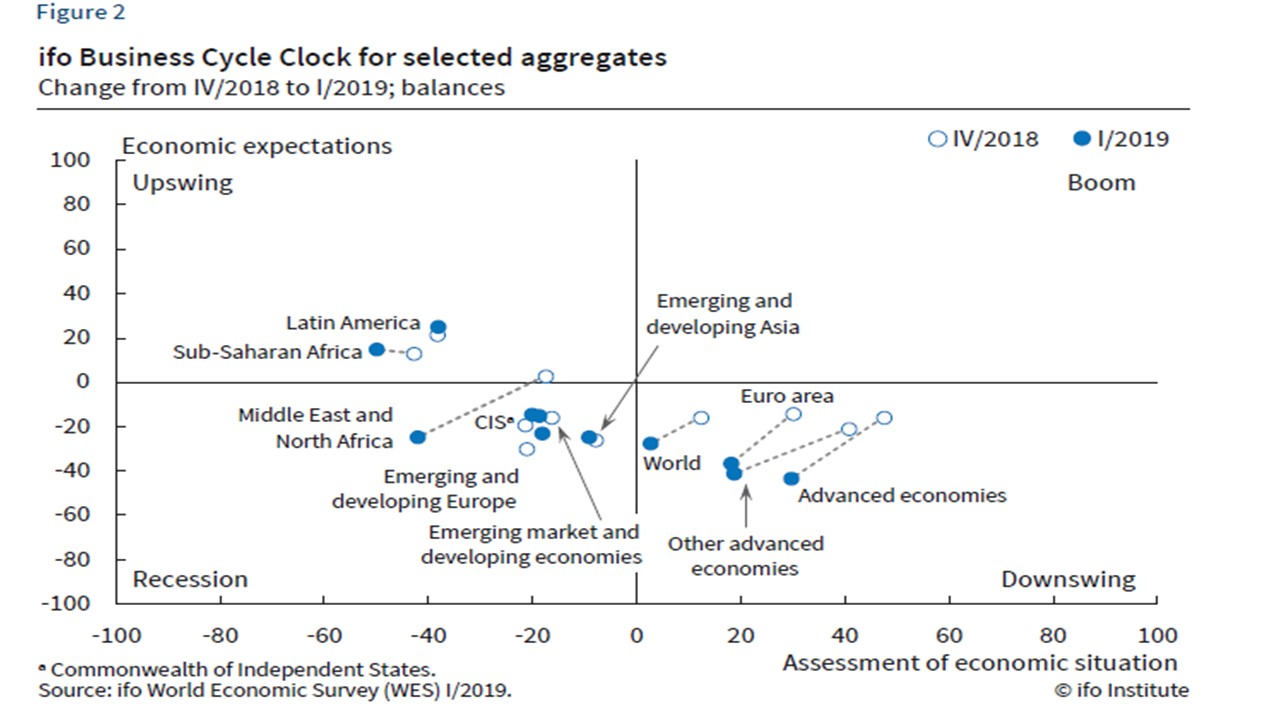
  “In the first quarter of 2019, the economic climate indicator for the advanced economies has tumbled to its lowest value since the fourth quarter of 2012” 

                                  
  The graph above shows on the x axis, “assessment of the current economic situation”  and on the y axis,  “economic expectations” (how you think the economy will trend in the coming 6 months). 
    The worst outcome is:  the ‘dot’ moves south west (i.e. the economy is declining, and it will continue to decline in the near future).
     Ifo Munich gathers data on the world economy, by region, by a survey of experts. 
     Look closely at the graph –the “world economy” moves strongly south west.  So do the Euro area and advanced economies.  Same for Mideast and North Africa.  Nowhere does any economy move other than west (down). 
      Why?   How about – US -China trade war, global uncertainty, Brexit,  EU disunity, and….   The list is long. 
       We can blame part of this on Trump.   He has thrown a monkey wrench into the world trading system, introduced massive uncertainty….and the world economy has cooled.    When the two largest economies in the world, US and China,  AND Europe, all cool at once….   We are in trouble.
       Fasten your seat belts.  It will get worse before it gets better. 

We Humans Took Nature 2.1 Billion Years to Create
By   Shlomo Maital


  2.1-Billion-Year-Old Fossil:  Evidence of Earliest Moving Life-Form

  A New York Times report, summarizing a paper in the Proceedings of the National Academy of Sciences, describes a 2.1 billion year old fossil, that could be evidence of the earliest living thing that actually moved.   According to this account:
   About 2.1 billion years ago, a blob-like creature inched along on an early Earth. As the organism moved, it carved out tunnels, which may be the earliest evidence of a moving critter on the planet.    Until this discovery, the earliest evidence of motility — that is, an organism’s ability to move independently using its own metabolic energy — dated to about 570 million years ago, according to fossils from different locations. That’s a good 1.5 billion years younger than the new finding.
    Here is why I find this so amazing.  We humans have been on this earth, more or less as we are now, for only about 50,000 years.  But that blink of an eye was preceded by 2.1 billion years of evolution, starting with ‘blob like creatures inching along” and evolving, through natural selection, patiently, inexorably, into what we are today.   From one cell, to multi-cell, to fish, to mammals, to us…. With infinite step by step patience.
Many religious people take issue with this view of Creation.  I find that it strengthens belief  in a Divine Creator, rather than weakens it.  What an incredibly brilliant, patient, focused system,  evolution, able to generate divinely-inspired human beings and patiently take its time doing so, for 2 billion years.   
 I wonder whether this system of evolution, constantly improving species and races, has come to an end for humans.  Are we improving, evolutionarily, or are we degrading?   


Global Slowdown – Beware!
By   Shlomo Maital


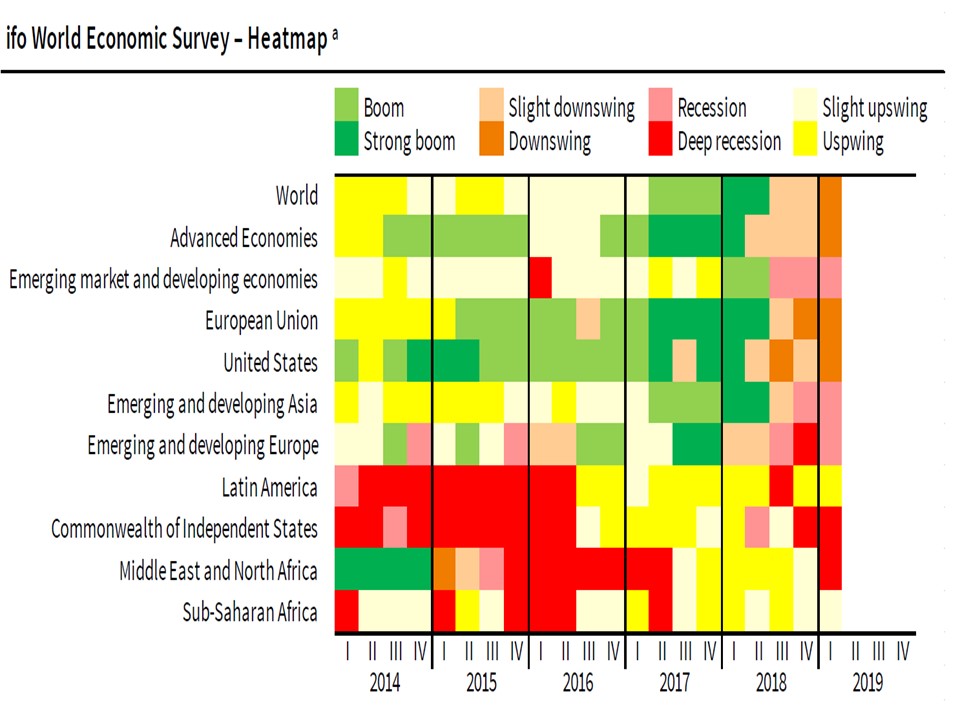
  I regularly participate in an economic survey run by a Munich-based research institute, that tracks how the world economy is doing.  The latest results are not good.
  The heat map shown above indicates whether economies are booming green or slowing yellow, orange, light red, dark red. 
    You can see at a glance looking at the ‘heat map’,  that the US, Europe and emerging and developing economies in Asia are all slowing.  Basically the whole world is slowing down, economically.
     Why?   The US is cooling, as businesses choose not to invest the tax windfall given by the Trump Administration but rather to buy back their shares.  China is cooling, owing to the trade war with the US.  Europe is cooling, owing to deep uncertainties about Britain, Italy, Hungary and other nations, and a growing spat between France and Italy.
    In short – look for a global slowdown, that feeds on itself —  US demand slows, hurts China, which hurts the Asian economic ecosystem..which in turns slows….
     A good time to set aside some savings, for rainy days ahead.

Our Two Brains – The REAL Deal!
By   Shlomo Maital  
 
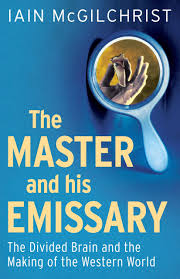
   On the latest Hidden Brain podcast, by Shankar Vedanta, the guest is a psychiatrist and brain researcher, Iain McGilchrist.  He speaks about his new book The Master and his Emissary.  I plan to read it very soon.
     There is enormous misleading hype about the left and right brains.  Much of it is wrong.  McGilchrist’s book is the real deal, and helps us understand our world.  The title comes from out an old folk tale. A “master” sends out an emissary to the countryside to gather information. The emissary gathers vast information, and tries to become the master, based on the knowledge he collected.  But he cannot. He fails. Because he has only facts, details (left brain/logic), and lacks big picture capability (right brain/holistic thinking). 
     Evolution helped humans survive. To kill and eat prey, we need right-brain big-picture thinking (the forest, trees, rocks, weather, etc.) and crucially need small-picture detailed left brain thinking (the deer is 20 yards to the left of the oak tree and is limping).  Of course, most crucial of all is the connecting link between the right and left brain.  Weird things happen, McGilchrist explains, when surgery has to sever the nerve path connecting the two brain hemispheres. 
      There is a serious message in the book, way beyond the research findings.  McGilchrist argues that increasingly we live in a left-brain logic driven world, based on algorithms and small details.  And on short run optimization.  What’s best for now.    I believe our political system is mainly driven by left brain messages.  Note, especially, that the emotion ‘hatred’ and ‘anger’ are actually cross-brain, not solely right brain (where most emotions originate),  Many political messages are now focused on hatred,  left-brain hatred. 
     “Meaning comes out of having consistent pictures of the world,” McGilchrist told Vedanta, based on knowing our past, not just our own but that of the world,  the past of others.”  A more right-brain world will focus on the long run, on the big picture, and on our interaction with our planet and with Nature. 
     Now,  how in the world do we achieve that?   A start, at least, is being aware that there is a right/left brain problem in the world.

Generation Z – There Is Hope!
By   Shlomo Maital  
 
   Generation Y is the generation of those born between 1981 and 1995.  They are also known as Millenials. They have been slandered as selfish, egoistic, live-for-the-present, and worse.  Today they are between 23 and 37.
    Generation Z is the generation of those born 1996 and later.  A New York Times column by Dan Levin, “Even young Republicans are drifting left on social issues”,  Jan. 25/2019,  reports on a Pew Research Center survey of American  Gen Z, some 12,000 of them.  Here are the main findings:
• Only 30% approved of Trump’s performance.  This is well below the average (Trump is deeply underwater in his approval ratings).
• 70% said they wanted government to do more to solve the nation’s problems.  [Levin says, those attitudes mirror those of Gen Y, which may mean that these two younger generations can powerfully combine to change the current bleak reality in the US].
• There are more than 68 million Americans who belong to GenZ.  This is 22% of the American population.  So more than one American in every five is GenZ.  This makes this group politically decisive, in the long run.  
• 2/3 of GenZ believe blacks are treated less fairly than whites in the US.
• GenZ believe government should play a more active role.
 

    This is not good news for Republicans; GenZ is more progressive than older generations.  But it is good news for those who seek a less conservative America.


T O O   M U C H   S T U F F  !
By   Shlomo Maital 
 
    From a recent article in The Guardian:
   The average ten-year-old child has toys worth almost £7,000 but plays with just £330 worth of them, a study has shown.  A typical child owns 238 toys in total but parents think they play with just 12 ‘favourites’ on a daily basis making up just five per cent of their toys.   The study of 3,000 parents also revealed one in two parents admit ‘wasting hundreds of pounds’ on toys their children never play with.   It also emerged more than half believe their children end up picking the same toys day in and day out because they have too many to choose from.

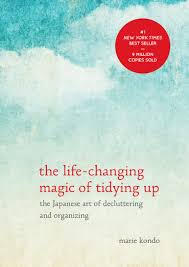
   Do we buy too much ‘stuff’ for our kids? We do.  But note – we also buy too much stuff for ourselves.  How else can you explain the amazing popularity of Marie Kondo, her book, and Netflix series? 
 
      Kudos to Kondo, for helping us reduce clutter and clean up.  Now, for a much tougher question —  instead of buying stuff and throwing it out,  how can we rewire our brains, defeat the consumer spend-and-borrow ethos and stop buying things that bring neither joy nor satisfaction?
    Kondo’s principle:  Does it bring joy?  If not, throw it out.
    Now, let’s take it one step further.  BEFORE you buy it —  will it REALLY make me happy, after the first 10 minutes?   No?  Forget it. 
     Is there a Marie Kondo out there, who can write the book on The Life Changing Magic of Not Consuming?     

Distraction – Our Greatest Threat
By   Shlomo Maital
 
      It is easy to identify a lot of things that have gone wrong in the world.  Britain is in a deadly stalemate, facing an urgent decision and with no majority for anything.  Right wing governments threaten democracy in Venezuela, Poland, Hungary and even Italy.  America is stuck in a stupid conflict between a stubborn President and stubborn Democrats.   Israel goes to elections on April 9 that according to polls will change absolutely nothing.
        But underlying all this is a little-noted problem. Distraction.  Small children are easy to distract; parents do it all the time.  Apparently world leaders are also easy to distract.
Trump obsesses over a wall, while America’s economy slows, and its infrastructure crumble.  Israel faces threats on its borders, but its Prime Minister obsesses about his impending indictment for bribery.  Europe struggles with migrants, and debt, but is totally distracted by Brexit and will be for months.  China and the US grapple over Huawei and cell phone technology, while their trade war causes the entire world economy to slow.
       
        The world has lost focus.  The 30-second news cycle has led to massive myopia, neglecting longer term problems.  Elections focus on personalities.  Try to find a comprehensive well-designed political platform for any political party anywhere. 
      I think the distraction of non-news and personalities is a major threat – if it continues, we will never even begin to grapple with the real major problems the world faces.
     So, let’s decide – Just because our leaders are distracted, and purposely try to distract all of us with pipsqueak inconsequential matters,  we don’t have to play.  Where possible, let’s find ways to refocus the political system on the things that really matter – saving, education, investment, schools, roads, corruption, equality, and overall creating a better world.
      Make America Make the World Great Again.

Why Do People Swallow Whole Fake News?
By   Shlomo Maital

 
   Why do so many people swallow whole fake news?  Why do we believe things that are patently false (like the 2016 rumor that Hillary Clinton was somehow molesting or kidnapping children in a fast food restaurant?)
     Today’s Global New York Times has an Op-Ed that has some strong answers. It is written by Prof. Gordon Pennycook, from my hometown Regina, Saskatchewan,  and co-author David Rand, MIT.*
      The bottom line:  Education is not the answer.  More educated people fall for fake news, too, especially fake news that agrees with their views.
       We fall for fake news, because we are unable or unwilling to engage in critical thinking – to challenge everythng we read critically, and subject it to the laws of reason and logic.
        Critical thinking is a key skill that is taught far too little in schools and universities.  At Queen’s University, long ago, I took a compulsory course in Philosophy, in the days when all university students were required to know some literature, philosophy and history.  It was the best course I ever took.  I learned about logic, about ethics, and about metaphysics.  And I learned about critical thinking.
       A critical thinker asks,  is this true?  Is it based on strong facts?  What are the facts?  Is it logical? Does the conclusion follow from the premises? What are the sources? 
        The enemy of critical thinking is the Internet news mania.  Internet news has a news cycle of seconds.  Everything is instant.  There is no time for reflection or challenging thought.  So – let’s slow it down.

     Build yourself a news microscope.  Focus it.  Zero it in on news.  Think critically.  Reserve judgment as you do so.  Just because Buzzfeed is in a big hurry does not mean that we all have to be.

•  “Why do people fall for fake news?”    Gordon Pennycook and David Rand.  New York Times, Tuesday January 22 2019.

Blog entries written by Prof. Shlomo Maital

Shlomo Maital

Pages