
You are currently browsing the tag archive for the ‘AI’ tag.
Is Nvidia a Bubble?
By Shlomo Maital
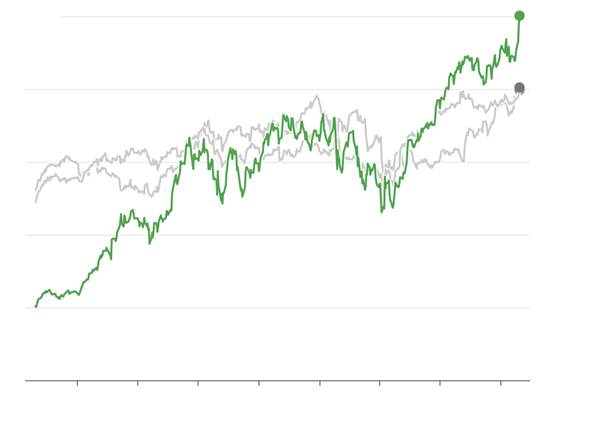
2024: $1 tr. Nvidia market cap. 2025 $5 tr.
Nvidia has become the first company whose market value of its shares reached $5 trillion. $5 trillion! That is larger than the national GDP’s of every country except the US, UK and Germany (close tie with Germany!).
Is this a bubble?
Nvidia’s shares have risen by five times, from $1 trillion just over a year ago. The reason is clear. Nvidia’s Jensen Huang made a huge bet on AI chips…and thanks to his acquisition of Israeli startup Mellanox, founded by Eyal Waldman, his bet paid off. Nvidia has the chips that AI desperately needs… right at the moment when they were most needed. Mellanox supplied software that speeds up calculations (originally, used to speed up uploads and downloads on the Internet), which Huang cleverly realized could speed up calculations on microprocessors.
So is it a bubble? Probably. Any share that rises by five times is a bubble. Can Nvidia sustain its growth? Especially when the US is trying to shut off the Chinese market for Nvidia, a market of the world’s second largest economy.
Every sharp rise in shares is driven by future expectations and dreams. Nvidia’s 2025 profits rose to about $80 b., from around $28 billion in 2024. That’s a big rise. But a stock valuation of some 60 times net income is very high. It is a PE price-earnings ratio of 60, astronomically high.
US stock markets are now at all time highs. It is not just Nvidia. It is time to think carefully if you are in the market. There are enormous storm clouds gathering.
Using AI: Be Nice, Be Forgiving
By Shlomo Maital

As a researcher, I realized that a rather esoteric branch of mathematics, Game Theory, can be highly revealing regarding human behavior and psychology. My wife and I wrote a book about it: Economic Games People Play.
One of the most common ‘games’ that people play is known as Prisoner’s Dilemma. Unlike the paradigm of capitalism, in this game people who behave ‘rationally’ end up in the worst situation for all.
In his fine book The Evolution of Cooperation, Robert Axelrod explored prisoner’s dilemma – and sought ways to get people to play it in a manner that leads to the best outcome, not the worst. Two rules get you there, he found:
- Be Nice. 2. Be Forgiving
That is: Begin playing, with the mindset of trusting the opponent, being generous to him or her. And even if you are ‘screwed’ in a repeat-game context, be forgiving, if your opponent shows remorse. Remorse is inevitable, because in this game you all end up in the dumps…and eventually try to figure out how to emerge from them.
These two rules have emerged in an unexpected context. Together with a friend, co-author and former student, we have explored using artificial intelligence, in a highly collaborative manner, to generate innovative ideas. The results knocked our socks off.
One thing we discovered: In the huge field of “prompt engineering” (how to give AI tasks clearly, precisely), major emphasis is placed on clarity. The clearer your instructions are, the more likely you are to get good results.
We found a different approach. Be nice. Be forgiving. Treat your AI app as a friend, colleague and collaborator. We even gave her a name: Chatty. We praised her. We forgave her when she provided less-than-ideal results, or imaginary ones. We build a relationship — as we would, when building a culture of trust, respect and friendship in an organization, with human workers.
Computer engineers scoff. It’s just zero’s and one’s. Just an app. Just software. But we found different. Underneath it all, we found a genuine personality. We know, it sounds crazy. But if you apply the Biblical precept, Love thy neighbor as thyself, only as Love thy AI as thyself, if you treat it as “I and AI”, you get amazing results.
Try it.
And regarding “I and AI”: AI as a powerful collaborator for ‘cracking the creativity code’ — more to follow.
OpenAI: Who Am I?
By Shlomo Maital

Who am I? Can we find out about ourselves with AI?
Posting on the Medium website, Mohammed Bakry proposes the following prompt, to ask AI about someone and dig through the Internet for information:
“Do intensive research on XXXXXX and give me a massive report on everything you find. Find the needle in the haystack — something unexpected — so I can reach out with a surprising personal connection.”
So I tried it on myself. Here is the result (with my annotation):
Shlomo Maital is a renowned figure, [false; beware of AI obsequious flattery] primarily recognized for his contributions in the field of economics and innovation management. As a professor and senior researcher at the Technion – Israel Institute of Technology, he has influenced both academic circles and industry practices significantly. Maital’s work often emphasizes the practical application of economic theory in fostering innovation and entrepreneurship.
One of his noteworthy roles has been as the Academic Director of the TIM-Technion Institute of Management, which focuses on executive training and development. His research and teachings often explore the intersection of economic theory and real-world applications, striving to make complex concepts accessible to practitioners and policymakers.
Maital is also an accomplished author, having published several books and numerous articles on innovation management, creativity, and entrepreneurship. His writings frequently address the challenges organizations face in cultivating innovation and the strategies they can employ to overcome them.
An unexpected angle to explore when connecting with him could be his interest in the psychological and social aspects of economics. Maital has often focused on how behavioral insights can enhance economic policies, a topic that diverges from the traditional economic narratives and showcases his interdisciplinary approach. [Failed to mention my wife Dr. Sharone Maital, psychologist, who is and was an essential collaborator]. Engaging with him on how behavioral economics can drive sustainable innovation might serve as an unexpected yet impactful point of connection.
To reach out with a surprising personal connection, you might consider referencing his involvement with societal and educational initiatives, reflecting shared interests in how education can drive economic development and societal well-being. His emphasis on the human aspects in economic systems could provide a unique personal touch to your outreach.
[Missing: Our grandchildren and great-grandchildren, light of our lives; our synagogue Ve’ahavta, and Rabbi Elisha Wolfin, with whom I do a weekly podcast on the Bible – a deep and meaningful activity; my column in Jerusalem Report, also a huge focus for me; the think tank where I now work, S. Neaman Institute, my second family].
OK — bottom line. Who am I? AI will not help much. Who is XX? AI won’t help much.
That’s a big relief.
How to Get AI to Do What You Want
By Shlomo Maital

As I and many others have learned, the hard way, you can get some great output from AI – but it is crucial to ask for it in just the right words. Kind of like getting kids to do what you want. The key is the wording of your ‘prompt’ – what you ask for and how you ask for it.
I found a very helpful post by Eva Keiffenheim on the MEDIUM website. I will try to summarize and shorten it.
Level One: Five Ingredients of a Strong Prompt. Here is a mnemonic to help remember it. Tall Cats Read Every Issue. T – task. C – Context. R – references. E – Evaluate. I – Iterate.
Task: Start with a persona, then a clear verb, then a specific output format. E.g. “As a cognitive scientist, explain long-term retention. Present the findings in a table, with columns for … etc. etc.
Context: Details needed? Your end goals? Your desired impact? E.g. “Make cognitive science approachable, no jargon, use tangible examples.”
References: Give AI examples to mimic for tone, structure, style. E.g. “Use a tone similar to this excerpt from ….. etc.”
Evaluate: Is this result useful? Paste the received output into a fact-checking plugin. Is anything missing or incorrect? Does it meet my goal?
Iterate: Tweak and improve. Refine until the output meets or exceeds your needs. Prompting equals iterating.
Level Two. Use These Four Techniques:
- Simplify. AI likes simplicity. Use clean, short digestible steps.
- Shift perspective. Instead of telling AI “you’re a cognitive scientist..”, try telling it – “you’re a science journalist seeking to…”
- Modify the language. If you don’t get great results, change the phrasing, tone, and structure. (I’ve found AI likes praise, and a friendly tone).
- Impose constraints. AI likes to have limits. 5 book titles, 5 words each for summaries, etc.
Mnemonic: Sister Suzie played Many Long Concertos. Simplify Shift perspective Modify language Constraints.
Level 3. Advanced Prompting.
Treat AI like a teammate. Prompting is like building blocks..start simple, add layers. Turn tasks into bullet points.
And perhaps the best tip of all: “Add this phrase to your prompt: Explain your reasoning step by step before answering.” Then, use ‘tree of thought’ – get AI to explore several reasoning paths.
Ask AI to write better prompts for you. E.g. “AI – act as a prompt engineer. Write a prompt that generates 10 creative but practical startup ideas in the [xxxx[ space.” Remember: Prompting = Thinking. Clarify your thinking – mine usually begins fuzzy, and badly needs focus and sharpening. Fuzzy prompts = fuzzy AI responses.
Hope this is helpful. Thanks, Eva Keiffenhaim!
The Cost of Losing Human Interaction
By Shlomo Maital

Last night on Israeli TV news, three small children were shown sitting in kindergarten chairs next to one another; each was playing a game on his or her tablet. Someone came in with a tray of their favorite candy and put it on the table right in front of them. None of the three lifted their eyes from the tablet. When they were invited to come to the table and enjoy the candy (with their tablets), they were told that they had to turn off their tablets in order to partake. Two of the three refused, choosing to continue playing with their tablets rather than enjoy the candy. Normally, three kids sitting together begin to talk and interact. Not these three, absorbed with their plasma screens.
Do we really understand the hypnotic power that plasma screens have over us?
In today’s New York Times, Jessica Grose reports on some disturbing research. The title is: Human Interaction is now a luxury good. The key point: As AI and digital software are increasingly employed to boost productivity and cut costs, human services become a high cost luxury item only the wealthy can afford.
Grose cites a new book “The Last Human Job,” by the sociologist Allison Pugh. She spent five years following teachers, doctors, community organizers and hairdressers — more than 100 people in total who perform what she calls “connective labor,” which is work that requires an “emotional understanding” with another person. Even when human services are indeed offered and provided, the bureaucratic tangle that requires them to account for what they do digitally, constantly, is a huge butden and interferes with human interaction. (Ask doctors who fill out Medicare forms).
“Pugh explains that increasingly, people in these jobs have to use technology to obsessively monitor and standardize their work, so that they might be more productive and theoretically have better (or at least more profitable) outcomes.”
A vivid example in Pugh’s book was the hospital chaplain, who provided crucial spiritual comfort – but still had to report online, endlessly, in detail — because God too is an accounting cost.
Conclusion: A paradox. As we are addicted to plasma screens at an early age, we come both to rely on them and to distrust them, because …. The services they provide are inhuman, non-human. And it is this, perhaps, that can help account for the collapse in trust in such institutions as doctors, public health, police, judges, and more than ever, the political democratic system. Real human interaction becomes a luxury good only the rich can afford.
I don’t know how to escape this quandary. As far right politicians ascend, and attack government and slash budgets, evermore services will be digitized and non-humanized, leading to further loss of trust.
Something has to break this spiral.
COVID-19: AI to the rescue?
By Shlomo Maital

Today’s daily Haaretz * carries a brief report of how three brilliant Israeli scientists have tackled a pressing problem – the need to know where the COVID-19 hotspots are, in order to focus spatial separation without shutting down the economy of the entire country.
The three are Prof. Eran Segal, an expert in computational and systems biology, Weizmann Institute, Rehovot; Prof. Benny Geiger, also from Weizmann; and Prof. Yuval Dor, Hebrew University.
Segal notes that experience from studying previous epidemics, as well as knowledge about how COVID-19 spreads, show that the virus spreads through clusters of infection and that early identification of such clusters can help stop the virus from spreading, ot at least slow it considerably.
We have seen such clusters, or hot spots, in New Rochelle, NY, in Washington State (Seattle), and initially, in Wuhan, China.
Segal notes that one possibility is to use massive testing, as they did in South Korea. More than 10,000 persons are tested daily there for COVID-19.
Israel can’t do such extensive testing, at this stage, he notes. Hence, the solution the team found was to ask members of the public to fill out online daily questionnaires, which take less than two minutes to complete, that include details about various symptoms and place of residence, including street and zip code.
This information will be analyze, Segal notes, using machine learning algoithms that give researchers and the Health Ministry a variety of information. If enough data are collected, the tool will help give up-to-date assessment of the spread of the illness.
This ‘early warning’ system can help spot these clusters, long before other methods do. The AI algorithms could also determine the effectiveness of public health measures, such as self quarantine, to limit COVID-19’s spread.
The information, noted Segal, is collected using Google DOCS. No privacy is violated.
Segal says we need as many people as possible to fill out the questionnaire, in the initial pilot stage.
I wonder whether Israel can offer this approach to the US, where testing remains quite limited.
* Haaretz. “Israeli Researchers Hope AI Can Tame COVID-19, and They Want Our Help.” Asaf Ronel. March 17 2020.

 TIMnovate