
You are currently browsing the tag archive for the ‘Alzheimer’s’ tag.
The Role of Lithium in Alzheimer’s: Breakthrough?
By Shlomo Maital
A paper just published in Nature (August 6, 2025) reports: “New hope for Alzheimer’s: lithium supplement reverses memory loss in mice. Studies in rodents and humans suggest that low levels of the metal contribute to cognitive decline.” Here is a summary:
“Replenishing the brain’s natural stores of lithium can protect against and even reverse Alzheimer’s disease, suggests a paper published today in Nature. The paper reports that analyses of human brain tissue and a series of mouse experiments point to a consistent pattern: when lithium concentrations in the brain decline, memory loss tends to develop, as do neurological hallmarks of Alzheimer’s disease called amyloid plaques and tau tangles. The study also found evidence in mice that a specific type of lithium supplement undoes these neurological changes and rolls back memory loss, restoring the brain to a younger, healthier state.”
“If confirmed in clinical trials, the implications could be profound. Dementia affects more than 55 million people globally; most have Alzheimer’s disease. Anti-amyloid therapies on the market slow cognitive decline, but “they don’t stop it. They don’t restore function,” says co-author Bruce Yankner, a geneticist at Harvard Medical School in Boston, Massachusetts.”
Alzheimer’s has been researched for decades. It has been “a tough nut to crack”, say the researchers – a vast understatement. If lithium holds the key, it would be a huge surprise. What in the world is lithium, a metal, doing in the brain? What role does it play anyway? What irony, if the world that runs on lithium iron batteries should find that our brains run on lithium, too!
And a postscript: Co-author Bruce Yankner’s research grant has been slashed by actions of the President of the United States.
Do Viruses Cause Alzheimer’s?
By Shlomo Maital
A third of those age 85 and over contract Alzheimer’s. I am 82 — hence, I have a keen personal interest in this disease. Despite massive research funding, very little progress in treatment and understanding the root cause has been made. And 32 million people worldwide now have Alzheimer’s.
But a stubborn, persistent and courageous woman named Ruth Itzchaki is at last being heard – according to The Economist. She has longed claimed that viruses causes Alzheimer’s. Scientists ridiculed the idea. But she may be right. She is in her 90’s – and still tireless in her research.
This is from the March 17 issue of The Economist:
“For years, most research into Alzheimer’s disease—the most common cause of dementia—has been laser-focused on two proteins, known as amyloid and tau. These build up in the brains of people with the disease, forming plaques and tangles that prevent neurons from functioning properly.
Most scientists assumed that these proteins are the primary cause of Alzheimer’s disease. But the shingles studies published in 2024, along with a host of new papers, add weight to an alternative decades-old idea—that viruses trigger the disease. Per this theory, plaques and tangles of proteins could, instead, be the body’s response to an underlying viral infection. If that is true, then eliminating the virus could prevent or treat Alzheimer’s.
Ruth Itzhaki, formerly of Manchester University and now a visiting professor at the University of Oxford, has championed this idea for almost 40 years. The bulk of her work has focused on herpes simplex virus 1, best known for giving people cold sores, which infects around 70% of people, most without symptoms. The virus normally lives outside the brain, where it can lie dormant for years. It is flare-ups that can lead to cold sores.
In rare cases, the virus can also lead to massive inflammation in the same brain areas that are most affected by Alzheimer’s. In experiments conducted in the early 2000s, Professor Itzhaki found that if she infected lab-grown human brain cells with HSV1, amyloid levels inside the cells increased dramatically. That led her to suspect a causal connection.
For decades she struggled to get her ideas accepted by the rest of the scientific community. “It was considered a left-field, crazy hypothesis,” says Or Shemesh, who researches viruses and Alzheimer’s at the Hebrew University of Jerusalem. Most scientists were focused on the role of amyloid and tau, assuming that they were the primary cause of the disease. Critics argued that the virus theory was hard to reconcile with the fact that Alzheimer’s has a strong genetic basis or occurs in almost all people with Down’s syndrome.
But growing disillusionment with the leading hypothesis for the cause of Alzheimer’s has led scientists to cast around for alternatives, such as viruses. Over many decades, for example, tens of billions of dollars have been poured into efforts to develop treatments to reduce the levels of amyloid and tau in the brain but the results have been underwhelming—existing amyloid-targeting drugs only have a modest effect on the disease. The discovery that pathogens can trigger other neurological diseases, such as the connection between Epstein-Barr virus and multiple sclerosis, has made the link yet more plausible.
In a bid to push forward Professor Itzhaki’s theory, a group of 25 scientists and entrepreneurs from around the world have assembled themselves into the Alzheimer’s Pathobiome Initiative (AlzPI). Their mission is to provide formal proof that infection plays a central role in triggering the disease. In recent years their work detailing how viruses trigger the build up of proteins linked to Alzheimer’s has been published in top scientific journals.
One new idea, supported by some AlzPI members, is that amyloid and tau may actually be the brain’s first line of defence against pathogens. These proteins are sticky, so they can grab hold of viruses or bacteria to slow their spread before more sophisticated immune responses kick in, says William Eimer at Harvard University. In small quantities, therefore, the proteins seem to boost brain health. The presence of active HSV1 or other pathogens, however, may send the immune system into overdrive, causing the proteins to stick to each other and create the plaques and tangles that damage neurons in Alzheimer’s.
What’s more, in 1997 Professor Itzhaki found that people with a genetic variant known to increase Alzheimer’s risk, ApoE4, were only more likely to get the disease if they also had herpex virus in their brain. In 2020 a group of French scientists showed that repeated activations of the virus … more than tripled the chance of developing Alzheimer’s in those with it.
Researchers at Tufts University, working with Professor Itzhaki, have probed why such reactivation occurs. In 2022 they found that infection with a second pathogen, the shingles virus, could awaken the dormant herpes virus and trigger the accumulation of plaques and tangles. This may explain why shingles vaccination appears to be protective against dementia. In another study published in January, the Tufts researchers also showed that a traumatic brain injury—a known risk factor for Alzheimer’s—could also rouse HSV1 and start the aggregation of proteins in brain cells grown in a dish.
The viral theory has promising implications for treatment. Current therapies for Alzheimer’s, which attempt to reduce levels of amyloid in brain cells, merely work to slow the progression of the disease. If viruses are a trigger, though, then vaccination or antiviral drugs could prevent future cases.
Around 32m people around the world are living with Alzheimer’s disease. If antiviral treatments can indeed slow, delay or prevent even a small subset of these cases, the impact could be tremendous.”
TB Vaccine Prevents Alzheimers
By Shlomo Maital
Science reporter Ruth Schuster, writing in the daily Haaretz, reports on new research, showing that a Tuberculosis vaccine – an old one – may prevent dementia! This is promising, hopeful – and crucial, because we don’t know how to reverse Alzheimer’s, or cure it, nor even diagnose it for certain until autopsy (after death).
What is the vaccine? It is called BCG – Bacillus Calmette-Guerin, developed to fight tuberculosis in the early 1900’s! It is a live vaccine, a weakened strain of bovine (non-human) TB. The vaccine has generalized immune-system-stimulating characteristics and is even used today for treating superficial bladder cancer. Researchers have found that bladder cancer survivors treated with BCG had lower rates of Alzheimer’s and even Parkinson’s.
Dementia is a huge problem. The WHO says 55 million people were diagnosed with dementia as of 2020 – and that’s a huge underestimate. It may double by 2050.
Two researchers – Prof. emeritus Charles Greenblatt, Hebrew University of Jerusalem, and Prof. Richard Lathe, Univ. of Edinburgh Medical School, have published two key papers in the Journal of Alzheimer’s Disease (so far, just the abstracts have been in print).
The authors review research and state: “Once one gets a BCG shot against TB as a kiddie, one has diminished risk of Alzheimer’s in old age”.
Think prevention! the authors state. Apparently, the weakened bacillus sticks around in our brains, from childhood, and helps the body fight off the amyloid plaque that gums up our brains and causes dementia. A small piece of evidence: Alzheimer’s rates are lower in the developing world, where the BCG vaccine is still widely used, than in the developed world, where BCG has been replaced by more modern TB vaccines.
Toward a Cure for Cancer & Alzheimer’s?
It’s About How Cells (Fail to) Take Out the Trash
By Shlomo Maital

Prof. Ido Amit
Prof. Ido Amit is a scientist at Israel’s Weizmann Institute, and heads an immunology lab there. On his website, he writes: “You don’t learn to walk by following rules. You learn by trying and falling over.”
In this weekend’s Haaretz magazine, science writer Asaf Ronel has a lovely cover article (in Hebrew) about a possible breakthrough by Amit, in treating cancer and even Alzheimer’s.
I will try to explain it.
In order for cancer cells to spread through our bodies, they have to evade and defeat our immune system – specifically, immune cells that attack and kill these foreign invaders. But how exactly do cancer cells defeat our immune system?
Amit’s lab has perhaps discovered how. Cancer cells, it is claimed, latch on to specific cells in the body, whose purpose it is to ‘take out the trash’ made by the body’s cells, as they consume energy and do their jobs. Cancer cells transform those kidnapped ‘garbage truck’ cells and turn them into cells that that deprive the body’s cells of energy ..basically, making the ‘garbage trucks’ collect energy from the body’s immune-response cells and not just the trash.
Immunotherapy helps the body’s immune-response cells to identify and destroy cancer cells. But cancer cells can neutralize those immune-response cells by using the ‘garbage truck’ cells to deprive them of much-needed energy. Without energy, the immune cells can’t do their job.
Amit’s lab believes it has a way to neutralize the kidnapped ‘garbage truck’ cells and disable them, so that the body’s tissues get the needed energy – in particular, the immune-response cells. Once the immune-response cells get the needed energy, they are able to successfully attack and destroy the cancer cells.
Several Pharma companies are at work on finding drugs that implement Amit’s approach. There is hope that as a result, many of the 10 million persons who die worldwide annually of cancer may be saved.
But wait. There is more.
We know that Alzheimer’s and other forms of dementia afflict 50 million people worldwide. Alzheimer’s is linked to plaque that forms in the brain and ‘gums up the brain cells’, like putting sugar into someone’s gas tank (don’t try this at home) that gums up the carburetor or fuel injection.
Amit believes the cause may be the same ‘garbage truck’ cells in the brain, that somehow become unable to ‘take out the trash’ and get rid of the plaque and waste generated by brain cells (which generally work very hard every minute of the day). As that trash accumulates in the brain, the brain ceases to function properly – more or less, like the streets of, say, Tel Aviv, when the garbage collectors go on strike and the trash accumulates in piles on streets and sidewalks..
Amit says if we catch early-stage dementia, and repair the ‘garbage truck’ cells, maybe we can delay or prevent the disease’s onset and keep the brain cells trash-free..
How soon will there be drugs that implement his finding? Amit believes – two to four years
Hang on there, Snoopy. Help may be on the way.
To discover this, Amit had to invent new technologies that enable the study of individual cells. He was told by experts that what he was attempting was impossible. As with many breakthroughs, he persisted.
I myself have survived prostate cancer, a close call, and the only thing I really fear in this world is having my brain gummed up with plaque. So I will follow Amit’s progress very closely. A lot is at stake.
New Hope for Treating Alzheimer’s
By Shlomo Maital

I have a very personal interest in Alzheimer’s and in general age-related dementia, for two reasons. First, my own age: At 74, I am moving into the dementia-prone zone. Second, family – like nearly everyone, I have known people who suffered and are suffering from it.
Here are some facts about Alzheimer’s:
One in eight older Americans has Alzheimer’s disease. Alzheimer’s disease is the sixth-leading cause of death in the United States. over 15 million Americans provide unpaid care for a person with Alzheimer’s or other dementias.
These figures apply equally to all societies that are aging, which is essentially all countries in the West, and even China.
Today’s New York Times has an Op-Ed by Pagan Kennedy, about new breakthroughs in Alzheimer research, disastrously underfunded (8,000 research papers every day are published on cancer! Frankly, the results are meager).
For years, researchers asked, how can we stop or dissolve the amyloid plaque that gums up the brain’s neurons and brings on dementia? That proved ineffective. Now, they are redefining the question (that is always a good approach when you cannot solve a problem): How come many older people die with their brains gummed up with amyloids, yet they show no sign of dementia?????
Answer: Must be the immune system. The body has proteins generated by the immune system that protect neurons from being damaged by those amyloids. Sometimes they are effective. Sometimes they are not. Why?
Initial results are promising. I wish they had framed this question much earlier. And I’m proud that Israeli researchers appear to be leading the way in this new avenue of research. A leading researcher in the US, Dr. Liddelow, at New York University, reports the new focus “will lead to a rapid production of effective treatments”.
I am hopeful that this is true. This, for me, is personal. I and those I love might well need it. So press on, Dr. Liddelow!
New Thinking on Alzheimer’s: Time for a Paradigm Shift?
By Shlomo Maital

Scientific breakthroughs come from iconoclastic researchers who are not afraid to smash consensus paradigms. Take, for instance, Prof. Michal Schwarz, of Israel’s Weizmann Institute. Here is what she told this week’s Haaretz (Hebrew) reporter:
The puzzle I pieced together is correct, and now I see the whole picture – how my research approach, for years against the consensus, has become one of the central focal points for research on all degenerative (neural) diseases.
The paradigm shift Schwarz has helped bring about is simple. Many researchers follow the “I dropped a coin” model – they look for it under the corner streetlight, instead of in dark corners, where it fell, because…. “that’s where the light is”. Alzheimer’s? Gooey proteins gumming up the brain and causing death? Look for cures that eliminate or prevent the protein directly, in the brain. Under the light.
But Schwarz? Let’s help the body’s own anti-immune system, outside the brain, fight those plaque accumulations that damage the brain. Last year the Daily Telegraph quoted Dr. Doug Brown, a leading Alzheimer’s researcher: “Repurposing drugs that already work for other conditions could provide us with a shortcut to new dementia treatments, and is a key aspect of our Drug Discovery programme.”
Here ‘s how the Daily Telegraph described Schwarz’s paradigm shift, in 2016: “The drugs, known as PD-1 blockers, effectively prevent the immune system from switching off, allowing a continuous cascade of soldier cells to fight disease and clear out damage in the body. In the case of Alzheimer’s disease sticky amyloid plaques build up which stop brain cells communicating with each other. But when mice, engineered to have Alzheimer’s symptoms, were given injections of the drug the amount of amyloid in their brains halved, and the animals were able to complete a maze task in the same time as control mice. Last year the first PD-1 blocker drug Keytruda was approved for use on the NHS by the National Institute for Health and Care Excellence so it is already known to be a safe treatment.
“Lead author Prof Michal Schwartz of the Weizmann Institute of Science, Rehovot, Israel, said that in Alzheimer’s a weakened immune system could be preventing the body from repairing itself. “We are extremely excited about our new study, we believe it is a game changer both conceptually and therapeutically,” she said.
Her research was published in the leading journal Nature Medicine.
Prof. Schwarz added: (in Hebrew): “In contrast to veteran old-time researchers, students have no history of believing dogma (existing paradigms)…they are fresh ears and eyes, without preconceptions. They were especially excited, with me, at our results, and joined my research and contributed to moving it forward, and some of them are continuing in my wake.”
As a (very) senior citizen, I have deep interest in breakthrough research on Alzheimer’s – half of those over 85 have it, at least early versions. Congratulations to Prof. Schwarz for becoming a woman scientist and for leading a paradigm shift that may help millions – including those in countries that despise Israel.
Hope for Alzheimer’s Cure?
By Shlomo Maital

Prof. Dan Michaelson
My family physician recently told me that about half of the elderly aged 85 and over have Alzheimer’s. That should make Alzheimer’s a top priority for research money. But it is far from it.
Today’s Hebrew daily Maariv reports on a major breakthrough. Tel Aviv U. Prof. Dan Michaelson, along with his doctoral student Anat Bam-Cogan, have found a drug that can combat Alzheimer’s in mice. Here is the story:
There are apparently quite a few ‘varieties’ of Alzheimer’s, just as there are types of cancer. Michaelson notes that 413 clinical trials, that tested 244 anti-Alzheimer’s drugs over the past 13 years, all failed! Why? Maybe because Alzheimer’s is many diseases, not just one, he reasoned.
Michaelson decided to tackle one type, related to specific genes ApoE3 and ApoE4. Lab mice that have this defective gene develop Alzheimer’s. Michaelson tested the theory that the key protein that the defective ApoE4 gene makes fails to attach itself to fat cells properly, leading to the Alzheimer “plaque”. He contacted a biotech company Artery, and got from it a protein (peptide) that helps ‘stick’ fat cells to the protein. And it worked. The peptide fixed the Alzheimer’s mice’s cognitive problems and repaired the plaque in their brains.
This is still a very long way from a drug that will help, or even cure, Alzheimer’s in humans. But it is a big step in the right direction. We await more news from Dr. Michaelson, with hope.
Alzheimer’s Breakthrough?
By Shlomo Maital

Alzheimer’s Disease causes some 70 per cent of all dementia. In terms of the numbers who suffer from it, the WHO (World Health Organization) estimates that in absolute numbers 26.6 million, with a huge range of 11.4–59.4 million, were afflicted by AD, in the world, and, most significant, the prevalence rate would triple and the absolute number would quadruple by 2050. So it would not be an exaggeration to call Alzheimer’s an epidemic.
According to Lisa Desjardins, PBS News Hour: More than five million Americans live with the degenerative brain disease that robs people of their memory. It is the sixth leading cause of death in the U.S Yet Alzheimer’s research is seriously underfunded. America’s National Cancer Institutes alone get some $5 billion a year. On pure economic grounds, a small fraction of that sum could be better invested in the causes of dementia. Few people today have been untouched by it.
New research led by Harvard scientists brings hope that the cause of Alzheimer’s, still unknown, will soon be unraveled:
“….a study led by Harvard University researchers and published this week in the journal “Science Translational Medicine” suggests that Alzheimer’s could stem from the brain’s past attempts to fight off infections.”
According to Rob Moir, a researcher at Massachusetts General Hospital: “Alzheimer’s disease and the neurodegeneration you see with it is thought to be caused by a little protein that forms this concrete like substance in your brain called amyloid. Amyloid, it turns out, is actually be an antimicrobial pit pod, that is to say it is a natural antibiotic that defends against infection in the brain, and if you get a virus or a bacteria that gets into the brain, it rises to do better with it and binds to it and then entraps it in these long fibers and eventually entombs it forever. And as they mount in number, eventually they start to be toxic to our own cells, and that leads to the neurodegeneration. So, that’s what I bet it does.”
In short – Alzheimer’s is caused by amyloid plaque. Amyloid plaque in turn appears to be a result of the brain’s efforts to fight infection.
So what? Notes Moir: “So if it does turn out to be an infection, there is a possibility of treating people before they get AD with vaccines, to target those particular bugs so that the pathogens don’t get a chance to infect the brain.”
Let’s follow this research closely. One day those 50 and over may get a vaccine, like those given to children, that protect their brains. As a senior citizen, few things scare me – but the idea that my brain may one day become scrambled is a major fear. The new Harvard research offers us hope.
Can Down’s Syndrome Help Cure Alzheimer’s?
By Shlomo Maital

About eight years ago, the BBC reported this:
Scientists believe they have found a possible cause for mental impairment in Down’s syndrome. They have identified a gene that, if over-produced, can cause some brain cells to stop working properly. The next step, say the US researchers in journal Neuron, is to find the mechanism for the process. This, they say, could ultimately lead to finding a way to “turn down” the gene expression so mental decline might be stopped or even reversed. People with Down’s syndrome have three copies of chromosome 21, instead of the normal two – this is called trisomy 21. ….Many people with Down’s syndrome go on to develop dementia, similar to early-onset Alzheimer’s disease, by the age of 40. In both Down’s syndrome and this form of Alzheimer’s, brain cells, or neurons, responsible for learning, memory and attention, wither and die. Lead researcher Professor William Mobley, director of the Neuroscience Institute at Stanford University, said: “We’ve been interested in those neurons and why they get sick for some time.”
Now, reports the BBC, in its excellent Science program, Down’s syndrome persons are making major contributions to Alzheimer’s research. Because Down’s syndrome individuals almost all develop the same type of ‘plaque’ dementia that afflicts Alzheimer’s sufferers, potential preventive drugs can be tested on Down’s syndrome persons well before they are 40, to see which drug actually works as a preventative, and whether such drugs really do prevent the brain’s neurons from being gummed up by protein.
It would be truly wonderful, if the Down’s syndrome persons willing to help scientists research Alzheimer’s really do help find a drug that acts as a preventative. Perhaps one day, just as many of us take 75 mg. of aspirin daily as a stroke preventive, we will take 75 mg. of a preventive drug daily– and the scourge of Alzheimer’s dementia will be defeated. Once the protein plaque has taken hold, little can be done. But clearly the direction for battling Alzheimer’s lies in preventing or forestalling it. Let’s hope.
Thanks, Down’s people. We love you.
A Cure for Alzheimer’s?!
By Shlomo Maital
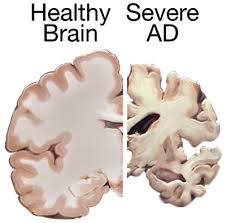
I’ve been closely tracking research on Alzheimer’s, as researchers try to identify the cause, diagnose the illness earlier and above all, find a possible cure. The photograph above shows just how awful an illness it is, literally shrinking and damaging our brain, messing up neural connections with ugly protein tangles, and damaging our lives and those of our loved ones who care for sufferers. By one estimate, there will be 75 million sufferers in 2030 and 135 million in 2050. So, Alzheimer’s must become a top priority for medical research.
On Wednesday a major new breakthrough by Harvard researchers was published in the journal Nature. Here is how the Boston Globe described it:
“… scientists identified a protein called REST that flips genes on and off and naturally increases during aging. REST, they found, represses genes involved in Alzheimer’s disease, and its levels are reduced in key brain areas of people diagnosed with Alzheimer’s or the mild cognitive impairment that precedes dementia. In laboratory tests, REST protected brain cells from dying when exposed to a number of stresses, including the beta amyloid protein that accumulates in the brains of Alzheimer’s patients. … “What I love about this study, first and foremost, is it’s some good news for Alzheimer’s, and it connects that good news with an immediate therapeutic strategy,”Scripps Institute researcher Jeffrey Kelly said. “There aren’t a lot of steps between this” and the development of experimental drugs.”
The Harvard researchers took a new approach to Alzheimer’s, and found amazingly that there is a protein, created at birth, that can repress genes related to Alzheimer’s and other stresses. Alzheimer’s patients seem to have too little of it. The natural next step is to create a drug based on the REST protein.
I think there is an important, hidden point to be made here. Harvard Univ. has massive funds for research, flowing from its enormous endowment, and from other funding sources including those from industry. Modern research is very expensive. And availability of funds enables Harvard to attract and retain the very best research talent. There are still Nobel winners out there who succeed with little money and poor equipment. But that is becoming increasingly more difficult.
 TIMnovate