
You are currently browsing the tag archive for the ‘Trump’ tag.
In Politics – Too Many Lawyers?
By Shlomo Maital

“98% of lawyers give the rest a bad name.” There are an infinite number of such jibes, most of them worse. I am an economist – Personally I think economists have done far more damage to the world than lawyers.
But after watching the Mueller testimony, before two House of Representative committees… I can make the case that lawyer-dominated legislatures generally miss the point.
The US House of Representatives has 535 members, of whom 168 are lawyers, by far the leading profession. In contrast there are only 11 physicians and three psychologists. Yet this body writes the laws for healthcare in the US.
The US Senate has 50 lawyers, fully half of the 100 senators. Only 3 Senators are physicians.
So what is the problem?
In the Mueller hearings before the House Judiciary Committee (naturally, mostly lawyers, it makes sense) and the House Intelligence committee (also, lots of lawyers), one question dominated what members asked Mueller:
Did President Trump break the law? Did he conspire? Did he tamper with witnesses?
That’s the wrong question. Even if he did break the law, he cannot be prosecuted. That is what the Department of Justice says. He can be impeached – but not convicted, because Republicans dominate the Senate.
So the legal approach is pointless.
Then, what IS the point?
Did President Trump act disloyally, treasonously, unethically, immorally? Did he act really really badly?
THAT is the question. THAT should have been the focus. It was, for a handful of House members. But mostly the lawyers dominated. And that played into Trump’s hands. Mueller was greatly limited in what he could say, because Special Counsel is a prosecutor – and prosecutors cannot say a whole lot. That in part is why his answers were hesitant. Plus – YOU try working long hours for 22 months, at age 74 and then testify for 8 hours before two committees, while having trouble hearing the questions (I really think Mueller needs hearing aids – vanity may prevent this, trust me, I know personally!).
We voters should expect our elected leaders to behave honestly, morally, and to speak wisely, respecting everyone, especially their opponents. When they don’t — kick them out.
2020 cannot come soon enough.
World’s First & Greatest Democracy: R.I.P.
By Shlomo Maital
This is a very sad, wrenching eulogy for Britain. The world’s first and greatest democracy is at a dead end. Rest in Peace.
I often watch Parliamentary debates on BBC TV, and enjoy the thrust and parry between the Prime Minister and her critics. Democracy at its best.
This is why I am saddened today, when crackpot Boris Johnson will be chosen Conservative Leader, and automatically Prime Minister – by 1% of the British electorate. The other 99% have no say. Why? That’s how the system was set up. It must be changed.
Johnson has vowed to take Britain out of the EU, come what may, by Oct. 31. This implies a ‘hard Brexit’ (exit without a signed agreed deal). Here is what Bloomberg thinks about this option:
The U.K.’s planned exit from the European Union may have already pushed the U.K. into a technical recession, according to the National Institute of Economic and Social Research. In a gloomy set of new forecasts, Niesr predicted that, even assuming a smooth exit in October, the nation will grow 1% in 2019 and 1% in 2020. There’s an around a one-in-four chance that the economy is already shrinking, the think tank said.
Britain may already be in recession, because of Brexit. Not a great time for a crackpot leader.
Crackpot? Isn’t that disrespectful, extreme, exaggerated? No.
Today’s New York Times: “Is Johnson how Britain will end?”
Tackling Britain’s deep divisions requires depth of character, conviction and principle, none of which its incoming prime minister has ever hinted at possessing….he prizes victory above government –his first ambition as a child was to be ‘world king’ – and his political career has been marked by ferocity of campaigning and indifference in office, both as London mayor and foreign secretary…
And another NYT article:
In his pursuit to become prime minister, Mr. Johnson has adapted his old habits – the theatrics, the polysyllabic putdowns, the outlandish plans –for the Brexit era…..his promise to extract Britain from the EU by the end of October has left many Britons worrying he will send the country hurtling toward a potentially calamitous no-deal Brexit.
While Trump ruins America, now Johnson will ruin Britain. Two of the West’s great economies and democracies, heading down the tubes because of a broken democratic process – Russian interference in the US, and an archaic totalitarian system for choosing the Tory leader in the UK.
Very sad.
US GDP Growth: NOT What It Seems!
By Shlomo Maital
I recently wrote a column titled: Why Can’t Economists Talk Straight?, in the Jerusalem Report. It was a book review of a book by a friend, an expert on behavioral economics. It explains why economists befuddle, use impenetrable jargon, and in general confuse and obfuscate.
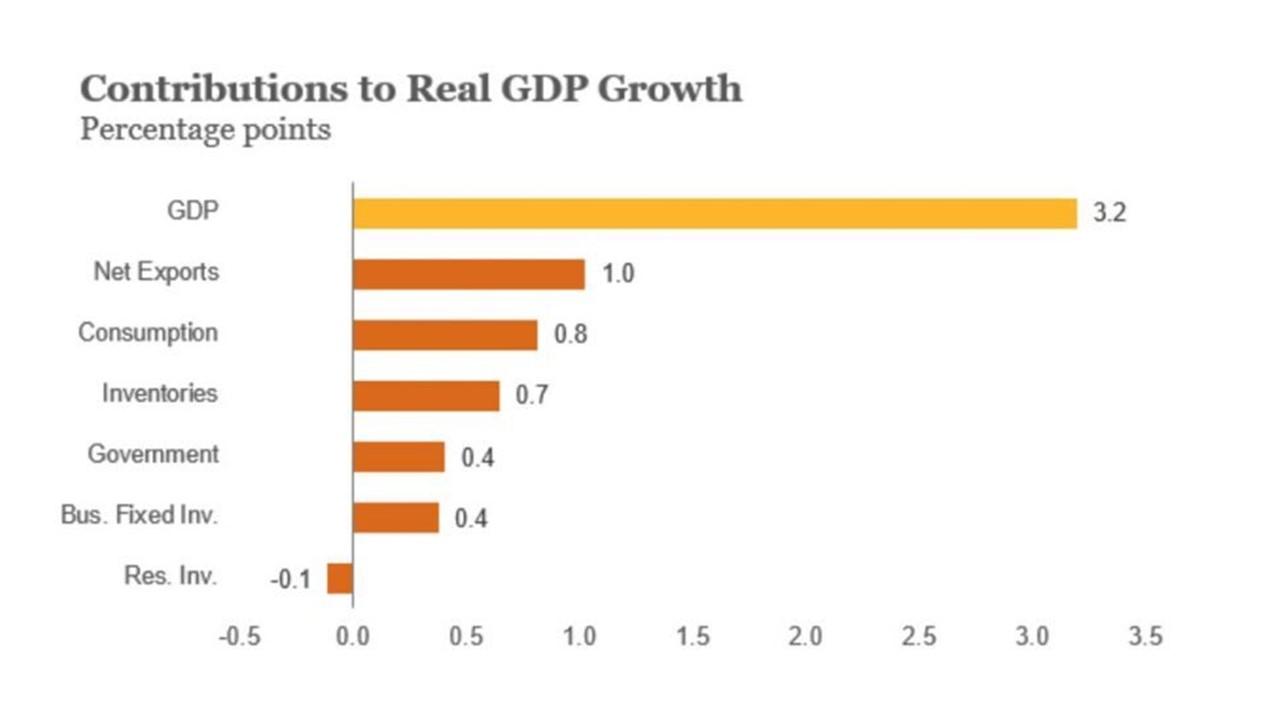
Here is a recent example. US First Quarter GDP figures were headlined as: US economy growth surprises! 3.2% growth. Way above what was expected. It was predicted that a recession was on the way. But it’s not! Yeeayyy! This is what journalists wrote. I can understand that. They are not trained to read the economic X-Ray data. But economists? Where ARE they? Nowhere.
The first quarter GDP news is BAD BAD BAD! Not good. Here is why.
A large part of that 3.2% growth was “inventories”. Nearly a quarter. Without that, growth would have been 2.5%. Much worse ….. But what IS that inventory thing???
Here is the straight talk. GDP growth reflects what is PRODUCED — not what is SOLD. Some of GDP is sold. Some is NOT. So it is put into warehouses. This is then called ‘inventories’ or ‘inventory change’.
A whole lot of stuff was produced in the first quarter – but companies couldn’t sell it. So cars, fridges, computers, motorcycles, appliances, etc. went into warehouses.
That is bad news. Because in the 2nd quarter, companies will sell off that inventory rather than produce new stuff. That will greatly reduce GDP growth rate. In 2nd quarter, we will see numbers that begin to herald a recession. Trust me. Set aside some money – we ARE heading for a slowdown.
Now, is that bad news? Or good? As we head toward elections in November 2020, a recession will help defeat Donald Trump. People DO vote their pockets, to some degree. And the likely Democratic candidate Joe Biden is running a campaign to enlist support of working people. Trump has not even begun to deliver on his promises to them. And they are beginning to get it. Moreover, Biden has pulled Trump’s chain, and got Trump to attack unions (dues-sucking!).
So bottom line: NOT 3.2% growth, but 2.5% growth (subtracting inventories), to reflect what people actually BOUGHT. They are buying less. This is a slowdown signal. I can find nowhere where this is widely and clearly reported. A great shame.
Why Rising Stock Market Is Bad News
By Shlomo Maital

The New York Times reports: “The US stock market is off to its best start (of the year) since 1987”. Good news? And then the bad news….”investors are expected to dump hundreds of billions of dollars of shares this year.” Bad news.
So what in the world is going on? The article, by Matt Phillips ,has an uncharacteristically clear, simple explanation.
Remember that Trump tax cut? The one that put billions of dollars into the pockets of the wealthy and the corporations? Well it made the corporaitons cash flush.
What did they do with the cash?
Invest it, in infrastructure, R&D, innovation?
Not exactly.
They mostly used it to buy back their own shares, massively.
Why? Simply – to funnel that big tax cut directly into the pockets of shareholders, at low (capital gains) tax rates.
Share buy back by corporations drove the market up. Even at a time when armchair investors, funds, etc…. were selling. Investors aren’t dumb. They will take their profits, before the market crumbles when the buy backs of corporations stop.
I avoid the stock market. But for those who want to listen, I counsel, don’t hold shares of businesses that buy back their own shares. Why? If the best investment businesses can make, is buying back their own shares, rather than developing new and better products, well — dump them. Share buy backs are abysmal. They are caused by CEO’s seeking to look good, in the short years they hold the position, under pressure of myopic shareholders and Boards.
Share buy backs have now cemented corporations as the leading source of demand for shares – their own. This is a fundamental change in the way the stock market works. It is a change for the worse. When companies STOP buying back their own shares, they will pull the rug out from under the market.
This will happen, perhaps, when the US enters recession – something most economists expect to happen by 2021.
World Economy: Heading South West (That’s Not Good)
By Shlomo Maital
I know I am repeating myself. I wrote about this just recently. But, the latest Ifo (Munich think tank) survey reveals this:
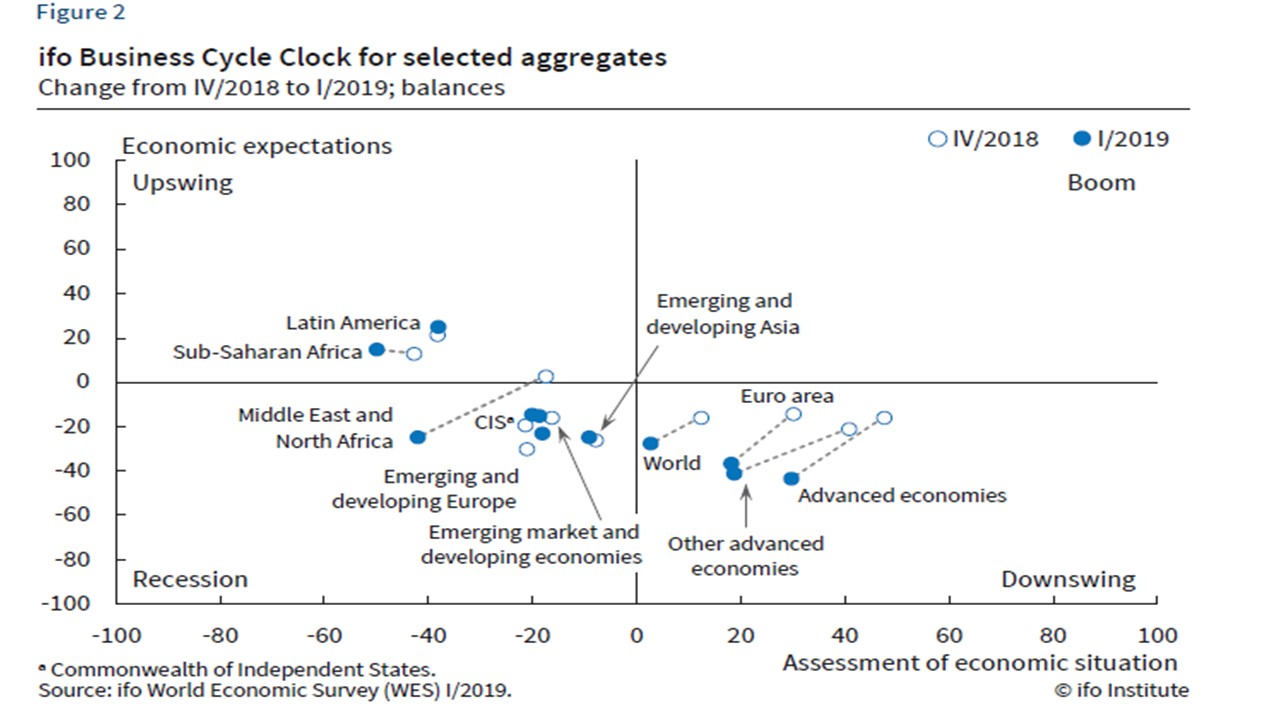
“In the first quarter of 2019, the economic climate indicator for the advanced economies has tumbled to its lowest value since the fourth quarter of 2012”
The graph above shows on the x axis, “assessment of the current economic situation” and on the y axis, “economic expectations” (how you think the economy will trend in the coming 6 months).
The worst outcome is: the ‘dot’ moves south west (i.e. the economy is declining, and it will continue to decline in the near future).
Ifo Munich gathers data on the world economy, by region, by a survey of experts.
Look closely at the graph –the “world economy” moves strongly south west. So do the Euro area and advanced economies. Same for Mideast and North Africa. Nowhere does any economy move other than west (down).
Why? How about – US -China trade war, global uncertainty, Brexit, EU disunity, and…. The list is long.
We can blame part of this on Trump. He has thrown a monkey wrench into the world trading system, introduced massive uncertainty….and the world economy has cooled. When the two largest economies in the world, US and China, AND Europe, all cool at once…. We are in trouble.
Fasten your seat belts. It will get worse before it gets better.
Global Slowdown – Beware!
By Shlomo Maital
I regularly participate in an economic survey run by a Munich-based research institute, that tracks how the world economy is doing. The latest results are not good.
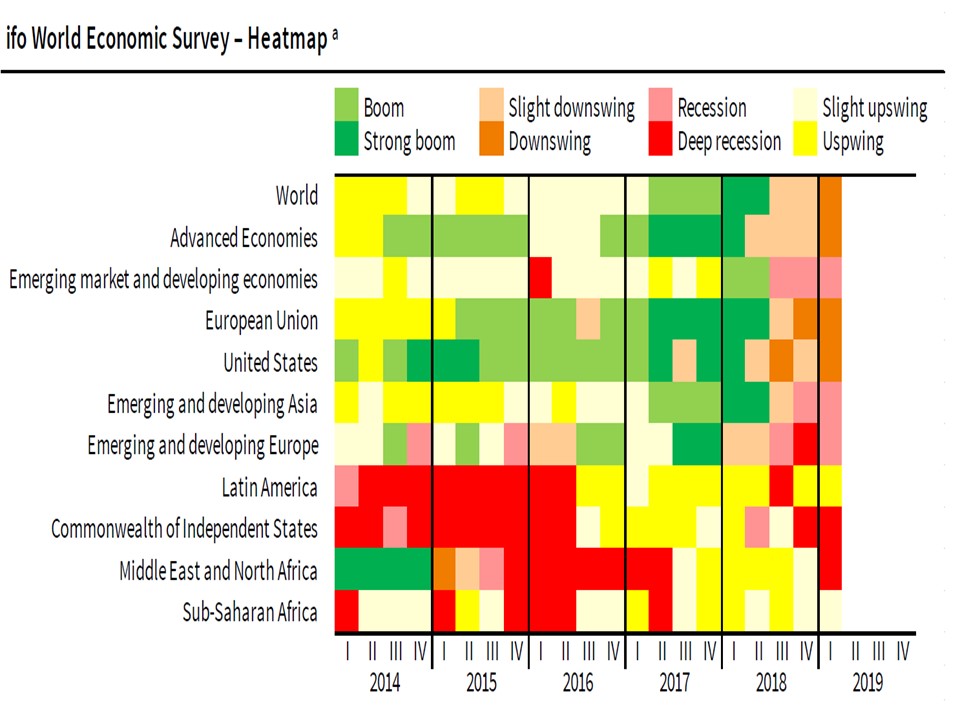
The heat map shown above indicates whether economies are booming green or slowing yellow, orange, light red, dark red.
You can see at a glance looking at the ‘heat map’, that the US, Europe and emerging and developing economies in Asia are all slowing. Basically the whole world is slowing down, economically.
Why? The US is cooling, as businesses choose not to invest the tax windfall given by the Trump Administration but rather to buy back their shares. China is cooling, owing to the trade war with the US. Europe is cooling, owing to deep uncertainties about Britain, Italy, Hungary and other nations, and a growing spat between France and Italy.
In short – look for a global slowdown, that feeds on itself — US demand slows, hurts China, which hurts the Asian economic ecosystem..which in turns slows….
A good time to set aside some savings, for rainy days ahead.
Distraction – Our Greatest Threat
By Shlomo Maital
It is easy to identify a lot of things that have gone wrong in the world. Britain is in a deadly stalemate, facing an urgent decision and with no majority for anything. Right wing governments threaten democracy in Venezuela, Poland, Hungary and even Italy. America is stuck in a stupid conflict between a stubborn President and stubborn Democrats. Israel goes to elections on April 9 that according to polls will change absolutely nothing.
But underlying all this is a little-noted problem. Distraction. Small children are easy to distract; parents do it all the time. Apparently world leaders are also easy to distract.
Trump obsesses over a wall, while America’s economy slows, and its infrastructure crumble. Israel faces threats on its borders, but its Prime Minister obsesses about his impending indictment for bribery. Europe struggles with migrants, and debt, but is totally distracted by Brexit and will be for months. China and the US grapple over Huawei and cell phone technology, while their trade war causes the entire world economy to slow.
The world has lost focus. The 30-second news cycle has led to massive myopia, neglecting longer term problems. Elections focus on personalities. Try to find a comprehensive well-designed political platform for any political party anywhere.
I think the distraction of non-news and personalities is a major threat – if it continues, we will never even begin to grapple with the real major problems the world faces.
So, let’s decide – Just because our leaders are distracted, and purposely try to distract all of us with pipsqueak inconsequential matters, we don’t have to play. Where possible, let’s find ways to refocus the political system on the things that really matter – saving, education, investment, schools, roads, corruption, equality, and overall creating a better world.
Make America Make the World Great Again.
Kids Sue Elders: Is This What We’ve Come To??
By Shlomo Maital

I recently wrote a column in the fortnightly magazine Jerusalem Report, titled “Waging War on our Children”. The title was a direct quote from Professor Larry Kotlikoff, Boston University. Kotlikoff pioneered economic studies of “intergenerational equity” – how one generation passes on a better (or a worse) economy and society to the younger generation.
Today, Kotlikoff’s meticulous studies show, it is …worse! Much much worse. Because, when you take the present value of US spending obligations (education, health, pensions), and the present value of US tax revenues, there is an enormous fiscal gap of $200 trillion, or 10 times US GDP. This is the debt burden the US is dumping on its young people. And this is true of other countries too, including my own, Israel. (see Kotlikoff.net)
In the latest issue of NATURE magazine (Nov. 8), I spotted this amazing short article. American ‘kids’ (young people) are suing the government (older generation), for ruining the climate and leaving them with a bloody mess.
This is a serious suit. Of course the Trump administration seeks to have it dismissed. But the Supreme Court will debate it seriously.
Is this where we’re at? Is this how low we’ve sunk? Our kids have to sue us, to get us to do something about the god-awful mess we’ve left them?
Hey kids. It’s not just the climate. It’s the toxic volatile divisive angry political situation, the hollowed-out economy (industry sent abroad), the spend-and-borrow society, the crummy schools, and much more. Broaden your suit. Sue us for the mess in general, not just climate change. Maybe that will wake us up?!
Peak America? The Numbers Say, Yes!
By Shlomo Maital
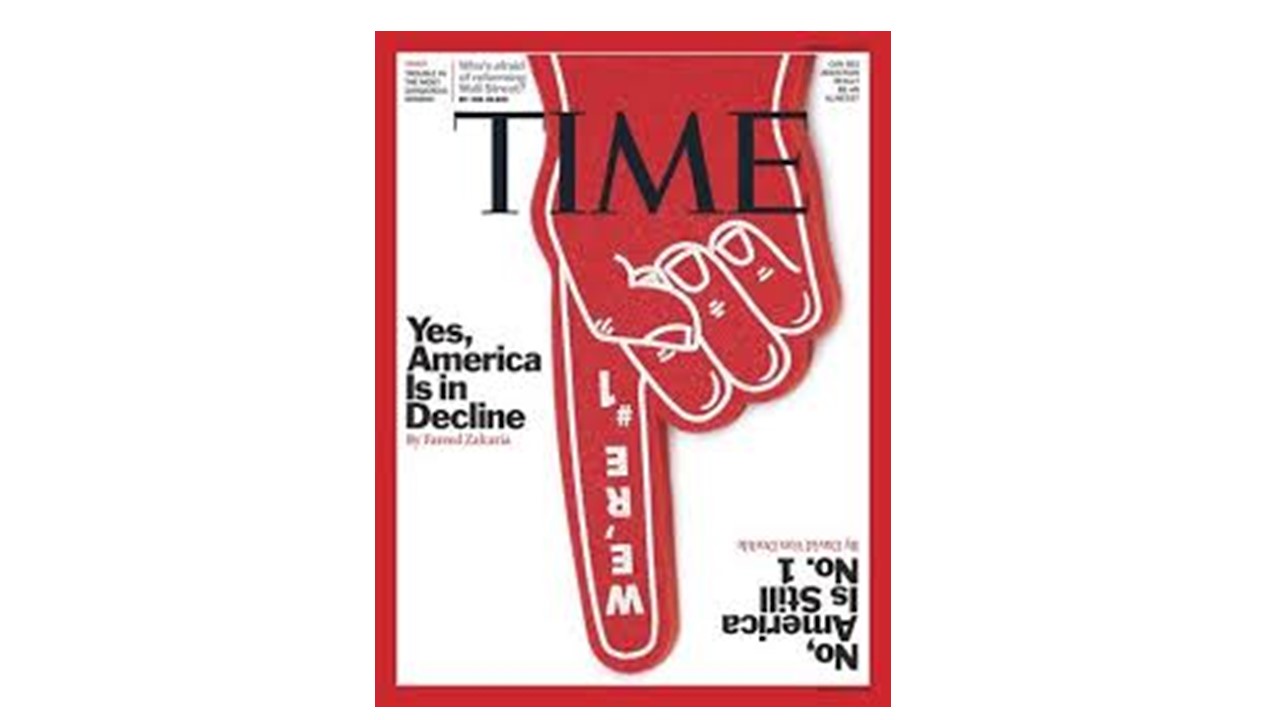
Writing in the Washington Post, (and on his GPS program on CNN), Fareed Zakharia cites Morgan Stanley expert Ruchir Sharma, who argues that America may at this moment be at its peak of economic and financial power – and heading downward.
“As Morgan Stanley’s Ruchir Sharma has pointed out, the global economy looks as if it’s at “peak America.” U.S. stocks have outperformed the rest of the world this decade, and that sort of trend rarely lasts. The current recovery is now the second-longest in history, and it is due for a downturn. Interest rates are rising, corporate profit growth is slowing, and budget deficits are surging. Even President Trump seems aware of the likelihood of a dip, which is why he has been preparing the ground for it, blaming the Federal Reserve for raising interest rates.”
Sharma notes this striking fact: US stock markets have tripled in value since 2010, while all other stock markets in the world have risen by only an average of 50%.
The last time such an imbalance happened? 1999 (just before the dot.com bubble burst). And before that? 1929.
Zakharia notes: “Anywhere one goes in the world these days, leaders talk about the United States’ retreat from the world stage. They note that it began before Trump. Most date it to the aftermath of the Iraq War, spanning the administrations of George W. Bush, Barack Obama and now Trump. And while the Trump administration is bellicose in its policies, especially on trade, they are all in service of a Fortress America mentality that seeks less engagement with the world, politically and economically.”
And he continues: “Foreign leaders also note that the United States is likely to be increasingly constrained by its mounting budget woes. The Financial Times’s Gillian Tett points out that the U.S. government now spends $1.4 billion a day on its debt, 10 times more than the next major industrialized country does. As interest rates rise and more Americans reach the age of collecting Social Security and Medicare, the federal government will be unable to fund much else. Ezra Klein has quipped that the American government is “an insurance conglomerate protected by a large, standing army,” and that is becoming truer every day.”
Many in the US and abroad loathe President Trump. They should not, however, gloat when he makes America decline (again) (MAD). A world with a declining America will be chaotic, violent and troubled.
Zakharia: “American retreat will not produce a better world. It will be messier and uglier. To get a glimpse of it, look at the Middle East today. As the United States has withdrawn from its traditional role as the region’s power-broker — maintaining relations with all sides and striving to achieve some degree of stability — Iran, Turkey and Saudi Arabia are all jockeying for influence. The United States has simply subcontracted its policy to Riyadh, encouraging the Saudis’ reckless behavior and resulting in the world’s gravest humanitarian crisis, the war in Yemen, where 12 million people are on the verge of famine.”
State & City Budgets:
Dangerous Hot Potato
By Shlomo Maital

US State and Local Budget Deficit/Surplus, 1960-2016
Amazon has just announced it will split its new headquarters buildings between Long Island City, Queen’s, and Northern Virginia, and a smaller center in Nashville. According to CNBC: “The company said it will receive up to $2.2 billion in performance-based incentives from the three areas: $1.5 billion associated with its investment in Long Island City, $573 million in Arlington and up to $102 million in Nashville. The incentives take the form of cash grants and tax credits, and some take effect over time.”
The announcement highlights an interesting fact. As MIT Dean Lester Thurow noted once, companies once paid taxes to cities, and now cities pay taxes to companies (like the huge grants Amazon received). True, Amazon will invest substantially – but giving over $2 billion to a company whose stock is worth $800 billion? That made $3 billion in profit in 2017? From city budgets that are already strapped? Amazon’s Jeff Bezos, of course, cleverly strategized by creating a competition among cities over who would give him the best deal.
And there is a much deeper problem, too.
The U.S. federal government recorded a $100.5 billion budget deficit in October, an increase of about 60 percent from a year earlier. That is the gap between what the federal government spent and what it earned in taxes, in just one month!. On a yearly basis, the federal deficit is headed for a record 1 trillion dollars, or over 5 % of US GDP. The cause? Mainly, the massive Trump tax cut passed in 2017. Most of it went to businesses, and they in turn spent it on buying back their shares and on dividends. Very little went to capital investment.
How will this deficit affect ordinary Americans? The press focuses on the massive $20 trillion US public debt that future generations will have to pay, as the federal government borrows tons of money to pay its bills. But there are deeper reasons for concern.
Many experts predict an imminent slowdown in the US economy – perhaps, a recession. What happened in the last recession that followed the 2008 financial crash?
According to Tracy Gordon, Brookings Institute, Washington, “More than in past economic downturns, state and local governments were a prominent casualty of the recent recession. States in particular saw their revenues plunge. Although state taxes have been rebounding, local property taxes have dipped, consistent with a two- to three-year lag between home prices and property tax rolls. These reductions coincide with state cutbacks in local aid, further squeezing local budgets.
[See Figure: State & Local Government Deficit/Surplus 1960-2016]
Why is this a potential serious problem? Gordon continues,
“These are critical issues because states and localities perform most of the activities we commonly associate with government. They undertake most direct spending on public goods and services (including their expenditures from federal funds), and they bear primary responsibility for investments in education, social services, and infrastructure that directly affect our national economy and quality of life. States and localities are also key economic players, comprising 12 percent of Gross Domestic Product (GDP) and employing 1 out of 7 workers – more than any other industry, including health care, retail sales, and manufacturing.”
In other words, state, local and city governments supply the things that underpin quality of life – health care, education, transportation, infrastructure. They generate one dollar in every 8 dollars of GDP and employ one worker out of every seven.
So, here is a scenario that is a cause for worry. The US economy goes into recession in late 2019. The trillion dollar federal budget deficit swells dangerously. The federal government slashes spending where it can – cutting financial aid to state governments. State governments (many are constrained by law to balanced budgets) in turn slash their grants to municipal, local and city governments.
And these, in turn, slash spending on the things that make life pleasant, or bearable, for most Americans. Potholes? Traffic jams? Dangerous roads? No money available to fix them.
This is a dangerous game of ‘hot potato’. And it’s not a pipe dream. It happened in 2010. Deficit hot potato passes from the federal government to the state government, which in turn tosses it on to local and city government. The buck stops there, and that hot potato burns our fingers. It happened before – it will happen again.
On a recent trip to the US, my wife and I made frequent use of WAZE. WAZE kindly told us about every pothole. And there were a whole lot of them. I don’t recall that feature in other countries.
Even in good times, city budgets are strained. Seeking re-election, mayors spend their money on the short-term, while costly long-term capital spending is neglected. (Why spend money to help some future mayor, maybe a rival, get elected?).
There is a solution. Let state legislatures require cities to build five-year capital expenditure budgets, to accompany the one-year operating budgets. Let the federal government help the states and cities pay for interest costs on debt that finances capital spending. Protect those five-year budgets zealously from ‘theft’ (shifting spending from long-term to short-term).
Conservatives will scream, socialism! Five-year plans are used, for instance, in China. OK – ever looked at China’s infrastructure? Fast trains, brand new airports?
Hot potato crises for city budgets make no sense. It’s time for a change.
Half the world’s population now lives in cities. By 2050 that will rise to 75%. How cities spend their money and raise their revenues will have a huge impact on the wellbeing of the people who live in them. And there is a ‘hot potato’ problem. It’s time to fix it.

 TIMnovate