
Why is Europe Repeating Churchill’s Horrendous Mistake?
“Those who forget history….” Chapter Two
By Shlomo Maital
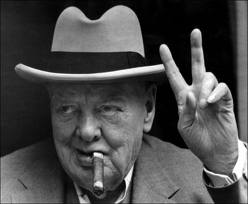
Winston Churchill
Santayana’s dictum, those who forget history are condemned to repeat it, is being proved true today in Europe.
Some 88 years ago, in 1924, Churchill was appointed Chancellor of the Exchequer in Stanley Baldwin’s Tory government. He was given the task of returning Britain to the gold standard, meaning, re-fix Britain’s pound sterling/dollar exchange rate at the old pre-war parity of one pound equals $4.86. Because there had been high inflation during WWI, the pound sterling wasn’t worth anywhere near $5. To restore this exchange rate, Churchill had to impose a disastrous austerity program (sound familiar?). Slash the budget, cut wages, drive prices down, tighten money, raise interest rates, and create a deep bitter recession or near-Depression. There were fierce strikes, and when the Army was called out to quell them, a number of deaths. (Churchill is reported to have recommended using machine guns on the striking coal miners). The overvalued pound sterling (worth, say, $2.50, but not $5) killed Britain’s exports. Driving down prices to validate a $5 exchange rate created huge suffering; it was a massive case of the tail (exchange rate) wagging the dog (people’s wellbeing).
Why was all this suffering imposed? Simply, because of a mythical exchange rate that was no longer valid. Churchill later admitted he regarded this policy as the greatest mistake in his life. Had he not been brought back to lead Britain against the Nazis, history would remember him as a cruel misguided Finance Minister.
How is all this relevant? Led by Germany’s Merkel, Europe is imposing austerity everywhere – all this, to maintain a currency, the euro, which is today overvalued, largely because of Germany. As with Churchill’s Britain, there is terrible unemployment in the countries imposing austerity – Greece, Spain, Portugal, even Italy. All this, to preserve a currency, instead of relating to the wellbeing of the people, the workers, the families, the children. Europe is imposing deflation, making people suffer to sustain the euro, instead of managing the euro to enhance people’s wellbeing. It’s that old déjà vu all over again.
In his book The Economic Consequences of Mr. Churchill J.M. Keynes, the leading British economist in 1925, bitterly blasted Churchill’s policy. To no avail. Churchill and the Tories did it anyway. One result was that by slashing defense spending, Churchill was responsible for the fact that Britain’s army was not ready to fight the Nazis. This endangered Britain’s very existence in 1940-41. It is an irony of history that Churchill had to fight a war that he himself had created by leaving Britain weak and nearly defenseless.
UK 1925. EU 2012. When will they ever learn?

 TIMnovate
2 comments
Comments feed for this article
May 24, 2012 at 10:18 am
Mike
As in the best police movies: ask who benefits from this choice?
Maintaining a high-valued Euro is great for wealthy people who will retire soon (as in a big aging country, for example)… Isn’t it simply a generation conflict??
June 6, 2012 at 6:11 am
gold price
This Budget saw Churchill reintroduce the gold standard – at the fixed exchange rate of $4.80 to the pound – which had been abandoned during World War I. The early Twenties had been a difficult time economically for the country, so when Churchill, who liked grand gestures, became Chancellor in Baldwin’s Conservative government, he aimed to restore Britain’s position at the centre of the world’s financial system. Ever since, his decision has been blamed for making British industry uncompetitive and intensifying the slump of the Thirties. This is unfair, I believe – the slump was a global one, exacerbated by the excesses of the stock-market boom, coupled with a U.S. banking collapse.