You are currently browsing the category archive for the ‘Global Crisis Blog’ category.
Global Crisis/Innovation Blog
Greece, Ireland, now Portugal: Why the Poor are Bailing Out Europe, NOT Vice Versa
By Shlomo Maital
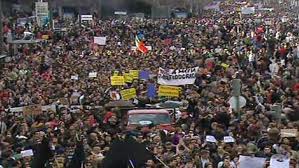
Portugese People Protest!
First, it was Ireland. Then Greece. Now it is Portugal. According to the press, the European Union, and its emergency fund, in cooperation with the International Monetary Fund, has arranged emergency loans for Portugal, amounting to between 75 and 110 billion euros. Bailouts for Ireland and Greece were similar in size and terms.
Portugal’s Prime Minister, whose name is Socrates, fought hard against the bailout, but he had zero chance. The global bond market kept raising the yields on Portuguese bonds, until the gap between Portuguese and German bonds exceeded 5 per cent, a level at which paying the interest and principal became nearly impossible. Portugal fell, like Ireland and Greece before it.
There is a fundamental misunderstanding about the bailout, and especially, about who is bailing out whom! In Ireland, the Irish people will have to pay heavy new taxes for generations, to pay off Irish government bonds, so that Irish banks and those to whom Irish banks owe money (Germany banks) will not go bust. So it is the Irish people who have bailed out German banks, not vice versa. Of course, the Irish people know this, and threw out the incumbent government in recent elections for this reason. Now the new government wants to renegotiate the draconian terms of the emergency EU loan to Ireland. This will happen eventually in Greece as well, and in Portugal. The result is total chaos.
Greece is an especially difficult case, because the involvement of the International Monetary Fund always brings desperately strict measures (raise interest rates, slash spending) as a condition for providing the emergency funds. And it is a self-fulfilling prophecy. The tougher the loan terms, the lower the country’s growth rate, the bigger the hit government revenues take – and the tougher it is to pay back government debt.
Europe has badly mismanaged the bailout of Ireland, Greece and Portugal, endangering the future of the 27-nation EU and the 16-nation euro bloc. And now, the outgoing head of the European Central Bank, Trichet, has begun raising interest rates, which will make it even harder for struggling peripheral nations in Europe to pay back their debts. Why did he do this? To fight inflation? Is there inflation in Europe? There is no sign whatsoever of inflation – Trichet is fighting the phantom of future inflation, in economies that are still stagnating and fighting DEFLATION!
The situation in which the poor people of Ireland, Greece and Portugal are scalped into bailing out the wealthy banks of Germany, France, Belgium is unacceptable. The result will continued social unrest and upheavals. Let the wealthy banks take the hit, they can afford it far better than the unemployed struggling people of the peripheral European nations.
Global Crisis/Innovation Blog
Power, War & The Power Law: We Need Double Loop Thinking Fast!
By Shlomo Maital
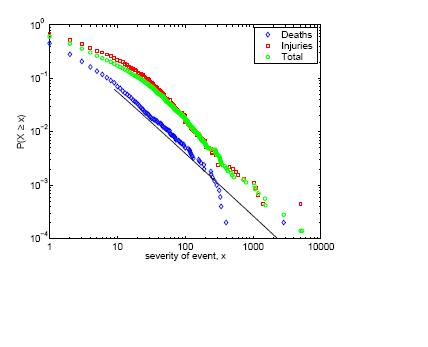
X axis: Casualties: Y axis: Probability
Organizational psychologist Chris Argyris once coined the phrase “double loop thinking”, to define thinking that seeks to change entire SYSTEMS, by utterly different thinking, not just parts of the existing system with in-the-box more-of-the-same thinking. In this he reflects Einstein’s “Law” that “you cannot solve a problem with the same thinking that created it”.
Now we have evidence from mathematicians and physicists, who have analyzed centuries of data regarding war and bloodshed. They have discovered the “Power Law” (originally noted by the physicist Lewis Fry Richardson) (see diagram), which says that when the ‘severity of the (war) event’ increases by a factor of 10, the probability it will happen declines by a factor of 10. In other words, the probability a terrorist attack will take 10 lives at a given point in time is 1/10, but an attack that kills 100 has a probability of 1/100. Thousands of data points fall very close to this ‘power law’ inverse line. and this “law” seems to have prevailed for centuries.
Why? According to one of the researchers working on this problem, Dr. Sean Gurley (Oxford U.):
“The fact that the power-law distribution seems to be constant across all long-term modern wars suggests that the insurgencies have evolved to find an ideal solution to the problem of how to fight a stronger force. Unless this structure is changed then the cycle of violence in places like Iraq will continue,” said Dr Gourley.” We have used this analysis to advise the Pentagon, the Iraqi government and the United Nations.”
Here in the Mideast, events seem to constantly confirm the Power Law. Recurring cycles of violence, revenge, counter-attack, revenge, etc. appear to create an endless Doom Loop of violence. There must be some way to ruin the Power Law and implement Double Loop thinking. But the problem is, those whom we elect to solve our problems and conflicts actually seem to be trapped in the Power Law and confirm it rather than disprove it.
Global Crisis/Innovation Blog
Stressed Out? Hard to Make Ends Meet? There Is A Simple Answer: Kick the Money Habit
By Shlomo Maital
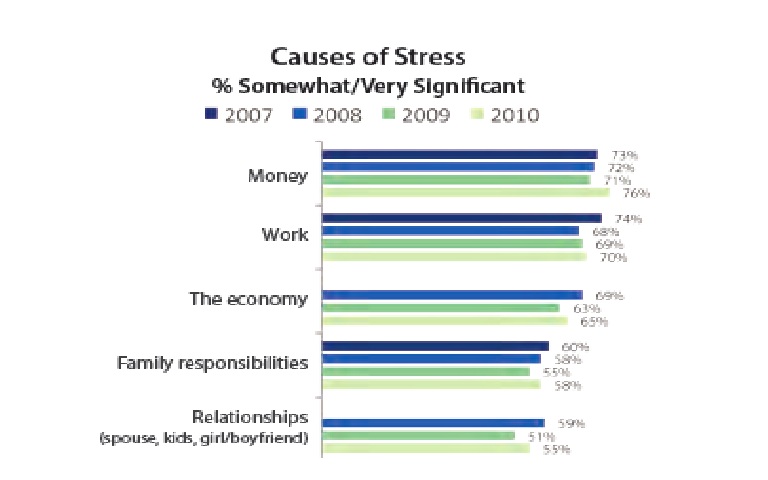
The results of the American Psychological Association’s 2010 Stress in America survey are now out. * The results compare a) the causes of stress yearly, from 2007 (pre-global-crisis) to 2010 (post-crisis, post-joblessness), and b) the physical symptoms of stress, yearly.
I am hugely surprised by the results (for reasons way different than the APA). Despite the earthquake of the financial crash, recession, loss of jobs, loss of homes, foreclosures, Lehman Bros., etc. – Americans are stressed by the same things in 2010 as they were in 2007, with insignificant differences. And the symptoms caused by stress also remain the same.
Here are the results: In order of importance for 2010: 76% are stressed by money issues (73% in 2007), 70% by work issues (74% in 2007 !); 58% are stressed by family issues (60% in 2007). The results of stress: 45% show irritability or anger (50% in 2007), 41% show fatigue (51% in 2007 !), 38% lack of interest or energy (45% in 2007), and 36% feel nervous or anxious (44% in 2007). Surprisingly: 24% in 2010 showed NO symptoms of stress, compared with only 16% in 2007.

I have a modest suggestion. If money is a cause of tension, and so is work (working at jobs we don’t like, so we can earn money and spend it on things we don’t need), why not tackle the issue head on? Kick the money habit. Start to reduce your spending. Cut it by 10 per cent (of course, on discretionary items) this month. See how you feel. If you feel OK, do the same in six months. Make it like a permanent diet – not a one-time crash that leads to weight gain almost at once, but a permanent change in behavior, a GRADUAL one. Attack the primal cause of tension by learning to do with less money, almost as addicts kick the drug habit by doing without it, cold turkey.
What, you say, will happen to the economy if everyone starts doing this? We’ll have a Depression to end all depressions.
Not at all. The capital markets will be awash with savings. The money will be borrowed and used to build infrastructure, technology, education, environment, alternate energy. We will replace spending (selfish and self-defeating, for those now alive) with investment (selfless, for those who will live in future). We will all feel much better. Over time, we will work at jobs we love rather than jobs we work at, for the paycheck. And then, man, will that APA stress survey take a hit!
* APA Monitor Jan. 2011, pp.60-61.
Global Crisis/Innovation Blog
Parag Khanna Knows How to Run the World: From Medieval Disorder to a New Renaissance
By Shlomo Maital

Parag Khanna is Director of the Global Governance Initiative at the New America Foundation, and is an Indian-American and author of best-selling books. His latest book is: How to Run the World: Charting a Course to the Next Renaissance. Parag’s main argument? The world today is in disorder, much as it was in medieval times, with no country or city-state able to dominate or exert global control. This book extends Khanna’s first book, The Second World, which was about the disorder stemming from a multi-polar no-superpower world. In this book, according to Publisher’s Weekly, Khanna claims “the “American Century” is over. …we are in for a fractured, fragmented, multi-polar world, a new Middle Ages of decentralized power where “corporations, powerful families, humanitarians, religious radicals, universities, and mercenaries are all part of the diplomatic landscape.” Here is an excerpt of Khanna’s own words, from an interview with Washington Notes blog
“Instead of a world of just great and lesser powers, the emerging landscape looks a lot like the Middle Ages of a millennium ago. That was the last time in history when, like today, both East and West were powerful at the time same time. Song dynasty China invented paper money (of which they have plenty today!), the south Indian Chola empire ruled the seas from East Africa to Indonesia, the Arab-Islamic community was at its peak as the Abbasid caliphate stretched from Andalusia in modern day Spain to Central Asia, while the Holy Roman Empire marked an uncertain and unstable period in Europe. The aftermath of the Crusades was a crucial turning point in history when Europeans began to focus on commerce to acquire commodities and spices, prompting voyages of discovery that created the first global trading system. Banking houses in Europe rose to finance long-distance naval expeditions, which were aided by the invention of the compass. Travelers such as Italian Marco Polo and the Moroccan Ibn Batutta covered tens of thousands of miles by land and sea, deepening understanding between East and West. Globalization was thus taking place on economic, strategic, and cultural levels just as it is again today. It’s also interesting that the participants in globalization were cities, corporations, churches, guilds, mercenaries, universities and humanitarians—very much like today. America’s footprint in the world is much greater than that of its government alone. American companies spread financing, technology and management know-how around the globe, American universities have set up campuses across the Middle East and Asia to educate the next generation of leaders, and American citizens and charities are the most generous in the world. So America needs to stay open and engaged in the ways that have made it the most respected leader in decades past. Where America builds relations among citizens and not just governments, such as with Europe, Japan and India, alliances are much more long-lasting and stable.”
How will this new Renaissance occur? The last Renaissance occurred when enlightened leaders liberally funded artistic creativity. This Renaissance will occur when the real powers in today’s world, global corporations, become aware of their obligation to the wellbeing of the world, the planet, the environment, not solely their own stockholders, and act together to make the lives of ordinary people, and future generations, significantly better.
Innovation Blog
Grow by Spending Less? Grow by Spending More? Economists’ Silence of the Lambs
By Shlomo Maital

silent lambs
In his latest New York Times column, Nobel economist Paul Krugman cites a recent report by “Republican staff members of the Congressional Joint Economic Committee titled “Spend Less, Owe Less, Grow the Economy”. *** They argue that “slashing government spending and employment in the face of a deeply depressed economy would actually create jobs.”
Krugman acerbically trashes this report’s argument: “ ‘A smaller government work force increases the available supply of educated, skilled workers for private firms, thus lowering labor costs.’ Dropping the euphemisms, what this says is that by increasing unemployment, particularly of “educated, skilled workers” — in case you’re wondering, that mainly means schoolteachers — we can drive down wages, which would encourage hiring.”
Slash wages to increase employment? Keynes long ago noted there are ‘price’ and ‘income’ effects. Lower wages cuts the price of labor and may boost demand for it. But lower wages reduce overall income, which reduces spending and demand and cuts demand for labor. And income effects almost always overwhelm price effects.
Moreover, there is the ‘confidence fairy’, which the Republicans invoke. Lower government spending will boost confidence, they say, and hence spending and employment. Really? Thousands more of unemployed teachers will boost confidence? With millions more in doubt if they have a job tomorrow?
* What is the evidence? Britain tried austerity and lower spending, and it is seriously weakening the British economy. GDP there fell by 0.5 % in Q4 2010, after a round of budget cuts by the new Conservative government.
The problem is, it is not crystal clear that HIGHER government spending will do the trick, either. Higher spending worries people because they know they will be passing on massive debt to the future generation.
* What is the evidence? Japan. Japan tried to spend and borrow its way out of recession, and now its national debt is a huge 2.5 times GDP. It didn’t work. People simply saved more to set aside funds to pay off the higher future taxes needed to repay the debt.
So – lower government spending doesn’t work. Higher government spending doesn’t work. What DOES work??? The silence of the economist lambs is deafening. My profession divided between “Republicans” (spend less), with no evidence, and “Democrats” (spend more), with no evidence, and nothing even slightly creative to say to resolve the dilemma?
*** Spend Less, Owe Less, Grow the Economy. Executive Summary March 15, 2011http://www.speaker.gov/UploadedFiles/JEC_Jobs_Study.pdf
Global Crisis/Innovation Blog
Quarterbacks Can’t Bet on Games: Why Should CEO’s? Roger Martin Knows How to “Fix the Game”
By Shlomo Maital
Warning: This blog is long. If you are in a hurry, read the underlined parts for the essence.
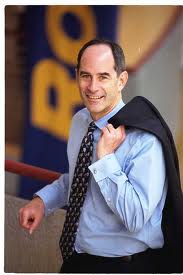
Roger Martin is the most creative business school Dean today, as head of University of Toronto’s Rotman School of Management. He reshaped Rotman’s curriculum, to teach managers how to come up with new ideas rather than analyze old ones. Now, in his new book “Fixing the Game” *, he offers a simple persuasive solution for fixing the broken global financial system. Problem is, his solution is so radical it will never be adopted – ban stock options for senior managers, just as athletes are banned from betting on their sport (on their own teams, or ANY teams). Here is a brief, fascinating interview with Martin by BBC Global Business’ Peter Day.
On Integrative Thinking: “Integrative thinking is the capacity to (when faced with choice) NOT select either or , but rather CREATE a better answer than either or ‘or’, and believe that is your job. This becomes your perspective: My job is to create new answers, rather than choose among old ones with analysis. Is A or B good enough? If not, my sole job is to create C, totally new. .. CEO’s should ask, what should I be thinking about? Be in a different industry? Make a different product? Abandon current products?
On Apple: “Steve Jobs is willing, on an ongoing basis, to step back and ask, are we thinking about the business in the only way you can think about it? No, we’re not. We were a computer company. No longer. We’re now Apple. We think differently. Every organization should think this way. It goes back to the tension between mastery and originality. If Apple couldn’t master supply chains and bring together components from all over the world, its originality would be of no value. I think business tries to escape from the tension, seeks ‘masterful’, it is not enough. You need creation and originality as well as mastery.”
On the Insights from Industrial Design: “My interest in design was to bring the best of design education into management education. Design throws at students one design challenge after another. Students get good at creating what does not now exist. In Business Schools students analyze what DOES exist, in case studies. Case studies constrain, create an artificial situation, exhibits contain all the day, come up with the answer somebody already though of. The method has some utility. It’s practice – but it’s not the real game.”
On his new book: My new book, Fixing the Game, means ‘repair the game’, and also ‘the game is being fixed, or rigged’, by managers and shareholders, at the expense of other stakeholders. The game is being run by those in the expectations game, not in the real game. It’s like football. There’s a real game, and there’s also an imaginary game, where people bet on the likely outcome of the game. The betting game, the expectations game, is the tail wagging the dog. What sports understands is that if you let the imaginary, the expectations game, run everything, you ruin the sport. In sport, players are not ALLOWED to bet on the game. In business, you MUST bet on the game and play the expectations game. In the past 35 years, we believed we should align the interests of management and shareholders by giving managers stock-based compensation.
You can date ‘fixing the game’ to 1976. It started with the most-quoted article in history, Michael Jensen, and William Meckling , ** ‘you have to align the interests of management and shareholders by giving managers stock options’, it made sense on the surface, written in 1976, but it has not worked out. [A short quote from the Jensen-Meckling article:
“The directors of … [joint-stock] companies, however, being the managers rather of other people’s money than of their own, it cannot well be expected, that they should watch over it with the same anxious vigilance with which the partners in a private copartnery frequently watch over their own. Like the stewards of a rich man, they are apt to consider attention to small matters as not for their master’s honour, and very easily give themselves a dispensation from having it. Negligence and profusion, therefore, must always prevail, more or less, in the management of the affairs of such a company.”]
[Maital: The ‘negligence and profusion’ blew up in 2007-8; they were a RESULT of letting CEO’s bet on the game, encouraging reckless short-term risk, not IN SPITE OF IT. The ‘real game’ is long run. The ‘expectations game’ is short run and is easy to manipulate. Let’s get management out of manipulation! And if you don’t believe ideas are powerful forces for good AND for evil – try to plough through the dense Jensen-Meckling article, in a mathematical academic journal, which changed the world!]
Roger Martin continues: “The ‘fixed game’ didn’t explode immediately. But what happened, the players in the game learned to “game” the game to their own benefits, to pay more attention to the ‘expectations’ game, they figured out, I’ll only make money if expectations about future performance rise, so the top managers talked to the analysts, then they said, I have to try to work on jerking up expectations quickly and then get out fast…before it crashes. It is not a stable system, it is getting more intense. “
“ Stop bonuses, and stock options? Yes! That is the answer! That would make a world of difference. It would be not unlike every organized sport, where you’re not allowed to both play and bet on the result. It would make a profound difference! The 1976 Jensen article had a real appeal, ‘they make more money, we make more money’ – the logic was far from wonderful in the end. ..At our school, Rotman, we want people to think how they think. They will be encouraged to think about this, and if they do that, they will go out into the standard world and do better! My ‘football’ metaphor helps me simplify and think about how to shatter the existing models that are not helping us at all.”
Here is how Adrianna Huffington, cofounder of The Huffington Post, summaries “Fixing the Game”: “Through his brilliant analysis of the National Football League (which will entrance even those who don’t follow the market), he shows us how we can get back to the real game of building for the present and the future. Fixing the Game is a must-read for all who care about business being a positive agent for change in the world. And that should be all of us.”
* Roger Martin. Fixing the Game: Bubbles, Crashes, and What Capitalism Can Learn from the NFL Harvard Business Press: Boston MA 2011.
** Michael C. Jensen and William H. Meckling, ‘Theory of the Firm: Managerial Behavior, Agency Costs and Ownership Structure,’ Journal of Financial Economics, Vol. 3, No. 4 (1976).
Global Crisis Blog
WTO – China Wins Again!
By Shlomo Maital
Here is a simplified account of U.S. vs. China in a recent ruling of the World Trade Organization’s Appeal Board, that decided against America in two key issues.
America claimed China subsidizes (illegally) certain products and industries. (It does and has for years. There is a smoking gun: Large Chinese trade surpluses with the U.S. that persist, despite recession in the U.S. and despite the falling dollar).
Using itsWTO rights, America imposes CVD’s (countervailing duties, or tariffs) and AD’s (anti-dumping restrictions on Chinese imports). (Dumping is the claim that export goods are sold below their domestic cost).
China, always aggressive in these matters, presses charges in the WTO. WTO rules against China.
China appeals.
1. WTO says the U.S. Dept. of Commerce failed to ‘prove’ that certain Chinese companies were ‘public bodies’ capable of conferring subsidies, even though the Chinese govt. held a majority of the shares!
2. Second, WTO says the U.S. applied both CVD’s and AD’s, without proving they had adjusted them to avoid ‘double tariffs’.
Another long legal wrangle will take place, delaying America’s efforts to balance its China trade and flatten the playing field.
I wonder who mismanaged America’s WTO defense. I wonder why China can win, even though it is patently obvious that many Chinese firms, even those without government shareholding, are powerfully subsidized by the Chinese government, e.g. through cheap plentiful credit. I wonder when the U.S. President will simply declare China is in violation of WTO and proceed accordingly, appeal board or no.
WTO rulings and cases are esoteric and are poorly covered by the media. But often they are crucial. It is high time that some high-profile journalist (Tom Friedman) should cover this topic, write clearly, and lead a campaign to get America some justice.
By the way – America’s trade deficit with China in 2010 was $270 b., the largest deficit America has ever had with a single nation. If ever there was a smoking gun, that is it.
Global Crisis/Innovation Blog
Pigment Panic! A Lack of Tuxedo Black! Or, Any Color BUT Black!
By Shlomo Maital
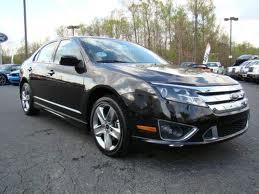
Tuxedo Black Ford..
In his famous 17th C. sermon, John Donne warned, “never ask for whom the bell tolls; it tolls for thee.” On Friday March 11, a powerful 9.0 magnitude earthquake and ensuing tsunami struck northern Japan, wreaking destruction and death and threatening a catastrophic meltdown of five nuclear plants in Fukushima. The bell tolls out a message: A crisis in even the remotest parts of the world affects us all, and not just emotionally.
Henry Ford once said famously that Model T buyers could have any color they wanted, provided it was black. Today, Ford Motor Co. announces buyers can have any color they wish, provided it is NOT “Tuxedo Black”. Why? Pigment and paint factories in the northern prefectures of Japan have shut down, causing a global pigment panic and shortage of some key pigments.
Many car factories have told their buyers their orders will be delayed, or shipment of parts will be delayed, because of the northern Japan disaster.
A major culprit is the “just in time” philosophy of Japanese manufacturing. In normal times, the idea is great – instead of warehousing huge stockpiles of parts, at high cost, organize the supply chain so the parts are delivered ‘just in time’ – just as the hand of the assembler reaches out to grab them, and install them on the vehicle. But when the delicate ‘just in time’ system is disrupted, anywhere, the whole mechanism breaks down.
Supply chain managers all know that ‘second sourcing’ is vital (having more than one source for key parts). But not all of them practice it.
We are just now learning from Japan how loudly the bell tolls for all of us, everywhere, anywhere, when the bell tolls in any remote place in the world. And the message is not just one of how humanity must care for everyone, but that globalization has created a highly delicate, sensitive system that easily breaks down.
We can survive without Tuxedo Black Fords. But China’s imposed scarcity of rare earth products is another more serious example. In future, a breakdown of the complex delicate global ecosystem will wreak far greater damage.
Global Crisis/Innovation Blog
America: Face the Brutal Facts: Linking Libya, Shenzhen and the Congress
By Shlomo Maital

Costly nuclear powered
aircraft carrier Nimitz
There is a clear causal link between an on-line Harvard Business School Working Knowledge publication issued today, a New York Times column by James Carroll, a former Catholic priest, and the US-led ‘no fly’ operation in Libya.
HBS Profs. Gary Pisano and Willy Shih, in Working Knowledge, make the following arguments, that readers of my blog know well: “There’s still a manufacturing base in the United States, and it’s quite large even though it’s a small percentage of the economy. But if things continue the way they’re going, I’m more doubtful. Manufacturing capability takes a while to erode. But the damage is almost irreversible; that’s the concern. So now is the time to be doing something about it before we get to the point where the answer is no. …. exporting manufacturing ultimately drains away American innovation. That’s the heart of our argument. …For any individual company, it is often better, in the short or intermediate term, to outsource production to an overseas supplier. The company can buy manufacturing services at a much lower rate if it goes to China or elsewhere, depending on the industry. But if everybody is doing that, you get a general erosion of the economy, which could lead to a decline in the standard of living. One of the issues in developing a national economic strategy has been confusion with the term “industrial policy,” which has been anathema in Washington. “Industrial policy” involves some degree of central planning. What we’re talking about is a discussion about strategic capabilities that need to reside within the country. Unlike other nations, we don’t have a national economic strategy. There’s this big debate about whether we should have one. My answer is absolutely yes. If you look at the United States in the postwar period, there was a very strong national economic strategy around using science to drive economic growth. We created the National Science Foundation and the National Institutes of Health, among others, and the government invested dramatically in building a scientific and technical infrastructure needed to fuel growth. That was the national strategy, but it was not industrial policy. There’s an important need today for having a coordinated national strategy at the policy level.
James Carroll argues: America can slash its defense spending to ‘only’ twice that of its nearest competitor – and still be a military superpower. The savings in resources will be immense – the State Dept. budget is only $50 b., compared with a Pentagon defense budget of $1 trillion ! And the Tea Party Republicans want to slash…the State Dept. budget.
When France’s Sarkozy and Britain’s Campbell pressed for a ‘no fly’ zone operation over Libya, the actual military operation was dominated by American aircraft and cruise missiles and still is, because, for example, America has eleven aircraft carrier battle groups, while no other country has more than one (Britain has none, because it has decommissioned its carriers, a few days before the Libya operation). So, while foreign countries shape policy and use America’s military might to implement it, America pays the bills, which it can ill afford. Because today America desperately needs those ‘aircraft carrier’ investments to re-industrialize and bring home its manufacturing from Shenzhen to Schenectady.
Those are the hard facts. Thanks to Profs. Pisano and Shih for again reiterating them.
But, hello Congress? Hello, Obama? Is anybody listening?
Global Crisis/Innovation Blog
Coffee, Facebook and Revolution
By Shlomo Maital

 Asmaa Mahfouz, Coffee..and Facebook
There is a surprisingly tight historical link between coffee, Facebook and revolution. And it is not because people drink coffee while fomenting revolutions on their laptops.
Coffee is over a thousand years old. It was allegedly discovered by an Ethiopian goatherd, who noticed his goats were especially lively after eating leaves and beans from a low shrub. He too tried it, the story goes – and the rest is history.
On Jan. 18, Asmaa Mahfouz, a 26-year-old Egyptian woman, made a video urging citizens to demand their “human rights”. The time and place of such demonstrations were coordinated on Facebook. Earlier the same was done in Tunisia, a brutal dictatorship defeated by the boundary-free nature of Internet. Facebook played equally important roles elsewhere, in Bahrain for instance, and continues to play this role in Syria and elsewhere.
But it is not widely known that the role of coordination and communication that Facebook filled in today’s Mideast evolutions was played 222 years ago, by …coffee. Though discovered in Ethiopia, coffee was actually brought to Europe from South America. Brazilian coffee, now a fourth of the world’s supply, originated with a few fertile stolen beans from Colombia. Coffee became hugely popular in the 18th C. in Europe as coffee houses spread. Europe sobered up – instead of drinking wine and beer in pubs, Europeans (including the British) began drinking coffee.
The French Revolution, culminating in the storming of the Bastille in July 1789, was planned and coordinated in meetings held in French coffee houses. At the time, coffee tasted awful! The beans were poorly roasted and boiled into a black sludge. But – caffeine is caffeine…. And the French Revolution was driven by caffeine and the conversations held as it was being drunk. Coffee houses and cafes were the Facebook of the French Revolution.
The same is true of the American Revolution, in 1776. The French middle class was inspired by the rebellious Americans, who had made tea the Tahrir Square issue. When the British tried to tax tea bought by Americans, they dumped it into Boston Harbor. The Tea Party was led by a brewer named Samuel Adams – you can still drink his beer. It then became patriotic to drink coffee. In fact, Americans identified their political leanings (British loyalist vs. American rebel) by the beverage they drank in coffee houses.
The final part to this Facebook coffee story, the missing link, is a man named James Folger, who left Boston and went to California in the 1849 gold rush. But he found gold not in ‘them thar hills’ but in coffee. He roasted coffee beans, then ground and packaged them, and brought them up to the miners and sold them for gold dust. Folger made more money than they did. And Folger’s remains a major coffee brand to this day.
The link? Facebook’s headquarters, like many such startups, are on Pagemill Road, in Palo Alto, California, where 26-year-old Mark Zuckerberg has struck gold, after drinking endless cups of coffee late into the night while writing code. So — coffee, Facebook, Revolution…the circle has closed.