You are currently browsing the category archive for the ‘Global Crisis Blog’ category.
Global Crisis Blog
No, the Global Crisis is NOT Over – and Europe and America Are Making It Much Worse, and May Yet Sink Our Boats!
By Shlomo Maital
How will historians record the 2007-11 era, 50 years from now? In a few short sentences:
European governments, led by Germany, pursued a wholly erroneous policy. They chose to bail out errant banks, by forcing draconian bailout terms on Greece, Ireland, and Portugal, impoverishing those nations so that the wealthy could be reimbursed for their disastrous and irresponsible mistakes. Europe chose deficit reduction over fiscal stimulus, thus prolonging the recession. America deepened the error, as Tea Party candidates pushed President Obama into deficit-reduction mode rather than economy-stimulating mode, further diminishing economic growth. Neither America nor Europe realized, at the time, that the only real way to reduce deficits was to stimulate economic growth, thus boosting tax revenues, by stimulating demand, and replacing weak private consumption and investment demand with public spending on infrastructure. It took many years of stumbling before America and Europe realized their utter stupidity. But by then, several years of unemployment and stagnation had inflicted enormous and needless suffering.
What are my sources to support this ‘extreme’ view?
- Nobel Laureate Paul Krugman, writing in today’s New York Times, excoriates Europe and America, for failing to spur demand and instead squeezing spending to battle fiscal deficits.
- Writing in Carnegie Foundation Policy Brief 90, Feb. 2011, Uri Dadush describes “global rebalancing” as a “dangerous obsession”. His main point: “rebalancing” is not needed, because the current account deficits in the West can continue to be financed. The main agenda, says Dadush, should be sustainable growth. He notes: “In the United States, short-term growth will be slower in the absence of additional fiscal stimulus; without medium-term fiscal reforms, growth will become unbalanced again and the economy will be vulnerable to a sudden loss of market confidence”. In other words: Another crisis, perhaps sooner rather than later!
It is frustrating to watch Europe, in particular, led by staid Germany and Chancellor Merkel, struggling to reduce electoral losses in regional elections, make crises worse again and again, with only the name of the peripheral country changing, from Greece to Ireland to Portugal. Substantial debt write-off must occur, inflicting pain on the wealthy and the bankers who bear most responsibility in the first place. It is simply unacceptable to make the poor of Portugal bear the burden.
Ireland, Greece and Portugal have a doomsday weapon – leaving the euro bloc. They would lose, but Germany would lose as well. If I were they, I would threaten to use this weapon.
Global Crisis/Innovation Blog
All-American, but – Made In China: America is #2, First Time in 110 Years!
By Shlomo Maital

American Barbie, “Made in China”
Writing in The Financial Times (March 18), Gillian Tett notes that despite the lower dollar, slightly appreciating yuan, and deep understanding that America must repatriate its manufacturing from offshore sites, to create well-paying jobs – many things that are labeled “American” are in fact still Chinese-made.
- At the American Girl store in Manhattan, the ‘all-American” dolls and clothes are Made in China. Including Barbies.
- Apple is American; however, according to Tett, “components for the iPhone are variously assembled in China, Korea, Taipei, Germany and the US, involving almost a dozen companies which are hard to pigeonhole with any ethnic label”.
According to Tett, “the economics consultancy IHS Global Insight calculated that in 2010 China displaced America as the largest manufacturer in the world – the first time that the US has lost this top slot for 110 years”.
The head of the World Trade Organization, Pascal Lamy, has recently (according to Tett) said that economists should stop paying attention to “imports” and “exports”, because so many goods have imported components that “made in China” or “made in America” has no meaning any more. There is a simple solution. Measure “net export value added” (the value added to imported components for export goods). Trade statistics are not arbitrary; it DOES make a huge difference where things are made, whether in China or America, to workers who make a living in factories. And for buyers, it should also make a difference whether American Barbie dolls are made in Shanghai or in Peoria.
Global Crisis/Innovation Blog
“Deleveraging”: It’s Really Happening! But: A Long Way to Go
By Shlomo Maital
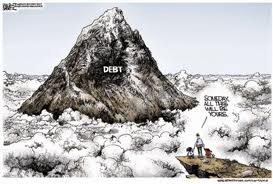
“Someday, children, all this will be yours!”
Earlier, in this blog, I noted why we should all read economist Martin Wolf, Financial Times columnist, carefully and regularly. To that, I would like to add New York Times business columnist Floyd Norris, who writes “Off the Chart”. Unlike most of us journalists, Norris does his homework thoroughly. He crunches data most of us shun.
In his March 19-20 column, Norris documents the remarkable deleveraging (debt reduction) process now going on in America. He does this by digging through Federal Reserve “Flow of Funds” statements going back to 1990.
He finds that the debt of the financial services sector, which grew by 600 per cent between 1990 ($2.6 trillion) and 2008 ($16 trillion), has fallen sharply, to about $14.2 trillion in 2010. Household debt also soared from 1990-2008, but has fallen sharply as well, for two reasons: a) debt holders are writing off bad loans, and b) households are borrowing less and are paying off old loans. The only institution that is still ‘leveraging’ is the federal government, whose outstanding debt is now $9.4 trillion.
Here are the underlying figures: (Total outstanding debt at year end, $ trillion)
1990 2010
Fed. Govt. 2.5 9.4
Households 3.6 13.4
Nonfinancial bus. 3.8 11.1
Financial 2.6 14.2
State & Local Govt. 1.0 2.5
TOTAL: 13.5 50 .6
% of GDP 169 % 385 %
Deleveraging still has a long way to go. Total debt in America in 2010 is nearly four times GDP, compared with less than twice GDP in 1990.
Had we tracked the Fed Flow of Funds data carefully, and observed the ballooning amounts of debt (especially in financial services), we would have realized that systemic risk has ballooned as well, and that the system is headed for a crash.
For brave souls willing to try crunching the numbers (they are presented simply and clearly), the URL is: http://www.federalreserve.gov/releases/z1/Current/z1.pdf
The data are updated every quarter.
Global Crisis/Innovation Blog
China’s Social Engineering 2011-15: The Mind Boggles
By Shlomo Maital

Affordable Housing in China
China’s 11th National People’s Congress has just ended, after approving a new Five Year Plan (2011-15). According to Alan Wheatley, a Reuters correspondent, * the Plan will build 10 million affordable homes this year, 36 million total over the entire period. This, Wheatley notes, is enough to house the whole population of France, Australia and Canada: Over 100 million people!
“It will spark the greatest consumption story in modern history”, says Stephen Roach, chair, Morgan Stanley Asia.
What is China up to?
China realizes that its three-decade-old growth model, built on making stuff and selling it mainly to America (about a $25 b. export surplus every month), is running out of steam. The solution is easy to define, but very hard to implement: Shift its growth engine away from exports and related capital investment, toward domestic consumption.
But how do you get the high-saving Chinese culture to change its ways and spend like Americans rather than save like Chinese?
Read Pearl buck’s wonderful 1931 best-selling novel The Good Earth, about pre-1949 Chinese peasants and their struggle to save to acquire land. You will understand how deeply rooted is the Chinese need to own a home and to save in order to buy one (rather than borrow to buy one, American style, and then struggle to pay off the debt).
China’s government will fight the housing and real estate bubble and at the same time re-engineer Chinese society and culture by providing affordable housing – apartments that middle-class workers can afford, so that they can divert more of their disposable income toward spending.
Will it work? Much depends on China’s success. If we believe the world needs rebalancing, with Asia doing more spending and the West doing more saving, China holds the key. Don’t count on America for any social engineering – the message “lower your standard of living, stop spending, start saving” is the last thing U.S. politicians will campaign on. Many people mock China’s Five Year Plans as outmoded socialist planning. In this case, by 2015, China may have the last laugh.
* Alan Wheatley. “China’s plan for creating consumers”, Global New York Times, March 15, 2011, p. 22
Innovation Blog
The Bigger the Bonus (Reward), The Lower the Performance:
Why Innovators Can “Choke” When Stakes are High
By Shlomo Maital
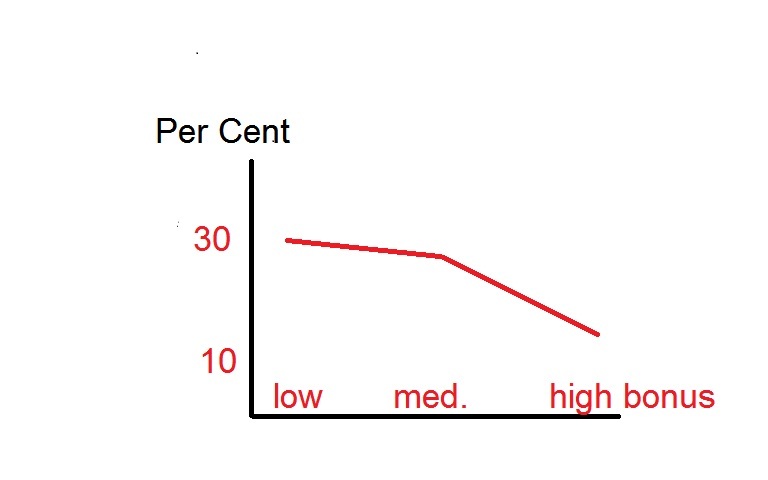
High bonuses cause lower % to attain
“very good” performance
Dan Ariely’s wonderful new sequel to Predictably Irrational is called The Upside of Rationality: The Unexpected Benefits of Defying Logic at Work and at Home.
As the title suggests, Ariely describes a variety of ingenious experiments he and his colleagues and students ran, to explore how we can actually gain from non-rational behavior.
In one of his experiments, conducted in India (because to do so in America would have been prohibitively expensive), he gave groups of villagers challenging tasks (Packing Quarters, Recall Last Three Numbers, Labyrinth, Dart Ball, Roll-Up), offering them low, medium and high bonuses for performance. In “Recall”, for instance, participants were given random numbers, stopped randomly and asked to recall the last three. Participants were given bonuses based on performance. The high bonus amounted to 2,400 rupees, a sum equal to about five months of the villagers’ regular pay. Medium bonuses were 240 rupees, and small ones, 24 rupees.
The graph shows the per cent of participants who reached “very good” performance levels, for each type of bonus.
It is interesting that performance dropped significantly for those who got the “high bonus”. Why? “The experience was so stressful to those in the very-large-bonus condition that they choked under the pressure”, note the researchers.
Bankers insist they have to have super bonuses in order to perform well. Ariely does not agree. All the bonuses seem to do is create risky short-term-profit seeking behavior, inimical to the bank and to society.
Economists are rational, Ariely notes wryly (and ironically); they know which incentives help improve performance and which do not. So do boards of directors and shareholders. Do they really? Are these super-bonuses truly rational? Or are they irrational? When you watch your favorite sport and team, do they play better when the stakes are super-high? Or do they get tense and play worse? And do wise coaches try to relax their players, rather than stress them out, in the dressing room? Innovators would do well to avoid over-stressing themselves and their colleagues, and avoid stressing how high the stakes are – focus on the task, on the process, and keep people laughing. You don’t want to be on the negative slope in Ariely’s curve.
Global Crisis / Innovation Blog
S**T HAPPENS! Resilience: We Have True Grit, in Spades!
By Shlomo Maital

Dung bettle: knows how to leverage S–T. So do we all.
Media have stressed the suffering, hardship and pain people suffered, and continue to suffer, during the global economic crisis 2007 – 9. They fail to stress the upside: People have showed tremendous resilience in bouncing back from great hardship, and always have, throughout history. People have “true grit”, just like the drunken, hard-nosed U.S. Marshal and a Texas Ranger in the 1969 John Wayne movie (and 2010 Coen Bros. remake) who help a stubborn young woman track down her father’s murderer in Indian territory. Even those born with silver spoons in their mouths show resilience, more often than not.
I asked a large sample of Israeli innovators what is the key driver of Israeli entrepreneurship. “Resilience” was #1 ! Israel has a culture of resilience, living in a bad neighborhood with frequent unexpected crises, wars, terrorism and hardship. People have learned to bounce back.
Research by Columbia U. Teachers College scholar George Bonanno has documented how people adapt surprisingly well to whatever the world presents – grief, loss, terror, war, disease. In his experiments, he and colleagues found that the Freudian notion that loss of a friend or relative left indelible scars and required therapy was untrue. Bonanno has a clipping posted on his inner door, from a German newspaper item about his work, headlined: S**T HAPPENS! It does indeed. And we clean it up, mostly.
In my trips to India, I found the people of India spectacularly resilient, because they get to practice resilience so often. Even high-income financial workers in Mumbai’s financial district are resilient – a flood there left waist-deep water, suspended transportation – so many of them simply walked home for miles through the waist-deep flood.
As Gary Stix observes in his March 2011 Scientific American article: “The new science of resilience shows that one size does not fit all in coming to terms with what befalls us. Sometimes the worst does happen, but our innate capacity to bounce back means that most of the time things turn out all right.” And by the way, belief in this sentence can often become a self-fulfilling prophecy. Hope is the world’s most powerful remedy, not penicillin.
Global Crisis / Innovation Blog
Hedgehogs vs. Foxes: Why Economic Experts Flunk Forecasting 101
By Shlomo Maital

The Fox and the Hedgehog: Which are You?
The famed philosopher Isaiah Berlin once wrote an essay, “The Hedgehog and the Fox”, which quoted ancient Greek poet Archilochus: (“the fox knows many little things, but the hedgehog knows one big thing”).
Turns out this explains why economists’ forecasts (and those of other experts) are so dreadful!
Writing in Scientific American (March 2011), Michael Shermer cites a study by U. Cal (Berkeley) Professor Philip Tetlock, who examined 284 experts and 82,361 predictions about the future. “They did little better than a dart-throwing chimpanzee”, notes Tetlock.
But why?
Cognitive style. Foxes, who know a little about a great many things, did far better in prediction than hedgehogs, who know a lot about one area of expertise.
Academic training, and doctoral research, makes scholars highly specialized and narrow – pure hedgehogs. Economists know about free markets. They tend not to know about sociology, politics, psychology, history and other disciplines. Result: Narrow wrong forecasts that miss the complexity of economic systems.
Want to become a great forecaster? Become a fox. Develop your curiosity about everything. And, at the same time, listen to forecasts of experts who you know are hedgehogs with wide interests.
Global Crisis/Innovation Blog
Would You Buy a Used America from This Man?
Or, Is America Bankrupt?
By Shlomo Maital

Mary Meeker
In our book Global Risk/Global Opportunity, my colleague Seshadri and I argue that a country is a business, and should be evaluated on the same basis used to do due diligence prior to an acquisition. A new 468-page study by Mary Meeker, from the leading venture capital firm Kleiner Perkins, claims that as a business, well, you would not want to invest in America. *
“Our review finds serious challenges in USA Inc.’s financials,” she writes. “The ‘management team’ has created incentives to spend on healthcare, housing, and current consumption. At the margin, investing in productive capital, education, and technology – the very tools needed to compete in the global marketplace – has stagnated.” “In effect, USA Inc. is maxing out its credit card. It has fallen into a pattern of spending more than it earns and is issuing debt at nearly every turn.”
Using standard business tools for evaluating businesses, Meeker finds that America’s current net worth is minus 44 trillion dollars (three times its GDP). Negative net worth means you owe more than you own. When the amount is huge, it means you are broke.
The introduction to Meeker’s report is signed by such knowledgeable, luminary economists and business leaders as George Schultz, Paul Volcker and Michael Blumberg.
Meeker does not simply claim America is broke. She offers a solution. “Technology plus infrastructure plus education investments drove 90% of labor productivity growth for past 30 years,” she writes. America will emerge from bankruptcy when it returns to investing in those three areas that proved so productive in the past. But where will the resources come from?
A tiny item from Associated Press today notes that last month’s tax cut gave U.S. consumers the biggest jump in their incomes in nearly two years. What did the American people do with the tax cut? Did they spend it, as they did the Reagan tax cut (1981-85)? No, they mostly saved it. Consumer spending adjusted for inflation actually declined 0.1 per cent in January. The American people get it. They realize the road out of bankruptcy is paved with savings that fund investment.
But do their leaders understand? And, by the way, would you buy a used economy from Obama?
* http://www.businessinsider.com/mary-meeker-usa-inc-tech-2011-2#ixzz1FL5sQ06w
Innovation Blog
Please sink my rubber duckies, so I can understand the oceans!
By Shlomo Maital

My friend Michael Neugarten sent me this item, published in Britain’s The Independent, by journalist Guy Adams, today, Feb. 27:
A new book by Donovan Hohn, titled Moby Duck, chronicles the journey of thousands of plastic duckies lost from a container ship some 20 years ago. This “flotilla of yellow plastic ducks, made only for bathtub use, has been hailed for revolutionizing mankind’s knowledge of ocean science”. According to Hohn,
They were in a crate that fell off the deck of a container ship during a journey
across the Pacific from Hong Kong in January 1992. Since that moment, they have bobbed tens of thousands of miles. Some washed up on the shores of Hawaii and Alaska; others have been stuck in Arctic ice. A few crossed the site near Newfoundland where the Titanic sank, and at
least one is believed to have been found on a beach in Scotland. Now the creatures, nicknamed the “Friendly Floatees” by various broadcasters who have followed their progress over the years, have been immortalized in a book. It not only chronicles their extraordinary odyssey, and what it has taught us about currents, but also lays bare a largely ignored threat to the marine environment: the vast numbers of containers that fall off the world’s cargo ships.
According to Adam’s account, Curtis Ebbesmeyer, “a retired oceanographer and enthusiastic beachcomber who lives in Seattle, used records held by First Years Inc to trace the ship they had been carried on. By interviewing its captain, he was able to locate
the exact point at which their journey began. He was able to track their
rate of progress on the constantly circulating current, or “gyre”, which
runs between Japan, south-east Alaska, Kodiak and the Aleutian Islands. ‘We always knew that this gyre existed. But until the ducks came along, we didn’t know how long it took to complete a circuit,’ he says. ‘It was like knowing that a planet is in the solar system but not being able to say how long it takes to orbit. Well, now we know exactly how long it takes: about three years.’
Woody Allen once said, “my wife is so immature – she used to sink my rubber duckies in the bathtub”. Today, 20 years after a container of rubber duckies fell overboard, we now better understand how the world’s currents work. I wonder why no innovative researcher thought about sinking rubber duckies on purpose, to study currents. Actually they did. On Dec. 21, 2008, I wrote a blog about this: “A while ago, NASA researchers dropped 90 rubber duckies onto a Greenland glacier, in an effort to trace where the glacier melt water went, as it disappeared under Greenland’s ice shelf. The duckies disappeared without a trace.”
Could they have joined the Moby Ducks?
Global Crisis/Global Innovation
Are Exports Really China’s Growth Engine? A Response to McKinsey
By Shlomo Maital
Writing in McKinsey Quarterly, Sept. 2010, * three experts in McKinsey’s strategy practice argue that if you measure China’s NET exports (exports minus imports of components used to reassembly), you find that domestic value-added exports account for only a third of China’s economic growth, not two-thirds as previously believed. The point is simple. Like Singapore, China imports components from other countries. This important demand is of huge importance to other Asian nations, who form part of China’s export ecosystem. But imports reduce China’s GDP, not increase it. So if you measure exports as ‘net’, not ‘gross’, you get a far different picture.
I would like to refute this argument. Exports still account for MORE than two-thirds of China’s growth. This is why China must cling to its undervalued currency and export subsidies fiercely in future, because they are the foundations of its economic growth.
Here is why. GDP is an ecosystem. Picture a flow chart. Capital formation (investment) is driven by exports, because much of investment goes either to infrastructure, to support export industries, or to investment, to build new plants and expand existing ones. Also, personal consumption is largely driven by exports, because export demand creates millions of jobs, high wages and enables the consumption spending that in turn drives GDP growth. So, if you take into account indirect contributions of exports to growth, using a systems dynamics approach, you find, again, that exports are the key to China’s continuing rapid growth. Take away exports, and you slash investment and consumption.
Don’t expect China to easily give up its export-driven model. The true picture shows that our original assumption, that China’s growth is principally driven by its export engine, is still valid.
* John Horn, Vivien Singer, Jonathan Woetzel, “a truer picture of China’s export machine”, McKinsey Quarterly Sept. 2010.