
You are currently browsing the category archive for the ‘Global Crisis Blog’ category.
Innovation Blog
Hu Jintao in America – U.S. vs. China
By Shlomo Maital
Here are a few brief observations about U.S.-China relations, as Chinese President Hu Jintao ends his U.s. visit, in Chicago.
- President Obama is a lawyer. Hu Jintao is an engineer. So is Premier Wen Jiabao. Whom would you choose to lead a nation into new technologies and innovation, a lawyer or an engineer? When was the last time America chose an engineer as President? (Answer: Jimmy Carter, 1976, but he was trained as a nuclear engineer, and never really practiced).
- What subject was studiously avoided during Hu’s visit? The trade deficit. America’s overall trade deficit shrank in October, last available data, to $38.4 b., but the trade deficit with China grew, to $25.6 b. In other words, two-thirds of America’s trade deficit is with China. Why? Because the U.S. no longer produces stuff China really needs. Containers from China return from Long Beach Harbor to Shanghai carrying…paper for recycling, or are simply empty.
- Look for China to be increasingly assertive, as its economy grows. According to a recent McKinsey Report by Gordon OrrUs : “China will step up its “invest out” program in the new five-year plan. The government may well seek to double the country’s cumulative outbound investment within the next five years. There will be resistance by governments in some countries (probably in Africa, Eastern Europe, and Latin America) where public opinion is not yet convinced that so much Chinese ownership of key assets is really attractive. This opposition will visibly upset China’s leaders, who may decide to sell the bonds of the reluctant governments and to increase the challenges that enterprises from these nations face in selling to Chinese state entities.”
Herein is the answer to America’s reticence about its trade deficit with China. China can crash the dollar, simply by ceasing to buy U.S. Treasuries at the weekly auction, let alone sell a tiny fraction of its $2.8 b. worth of dollar assets.
- A Times of India article [1] asks: Did China overtake the US as the world’s biggest economy in 2010? New numbers for the GDP of different countries at purchasing power parity (PPP) seem to suggest so. When you correct China’s GDP, by dividing GDP measured in renminbi (yuan) by the appropriate exchange rate (that accurately reflects the high purchasing power of the yuan), some experts find China’s GDP exceeds America’s (though, of course, its population is four times greater, so its GDP is still only about a quarter that of America. According to economic Arvind Subramanian, “the adjustments increase China’s GDP from the current estimate of $10.1 trillion to $14.8 trillion (an increase of 47%, of which 27% is due to the revision in the 2005 estimate, and the rest due to smaller-than assumed increases in the cost of living between 2005 and 2010. This $14.8 trillion figure exceeds US GDP of $14.6 trillion.” There is psychological significance to this number. The world’s largest economy conveys substantial geopolitical clout as well.
[1] 21 Jan, 2011, by Rukmini Shrinivasan.
Global Crisis
Guess Who’s Making Your Gasoline Bills Soar? Clue: Not OPEC
By Shlomo Maital
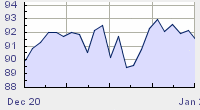
crude oil price volatility
A recent business commentary on Canada’s CBC radio made a great deal of sense.
An expert from Enfo, an energy consulting firm, discussed the recent spikes in the price of oil and gasoline, as petroleum soars over $90/bbl. Back in June 2010, oil was only $78/bbl.
Why? Geopolitical instability? OPEC? None of the above.
Speculators.
The crude oil market has become a favorite sandbox for speculators. With huge amounts of liquidity floating around the world, with banks reverting to old habits of ‘nostrum’ speculation to generate huge profits, and with very few opportunities to earn high returns, traders have put huge amounts of money into crude oil futures and options.
They are speculating that the global economic recovery, which will drive world GDP growth to 4.5 per cent this year (according to the IMF), will create demand for oil and hence drive up prices.
What is the problem with this?
It creates a kind of doom loop. The more speculative money that flows into petroleum trading, the higher the volatility. The higher the volatility, the higher the potential speculative profit from guessing right. The higher the potential profit, the more money this market attracts… and so on. We have seen this before in other derivatives markets.
The problem with this doom loop, or feedback system, is that we USE oil, to run our cars, heat our homes, produce electricity. So a relative handful of speculators can make energy more expensive, generate profits for Arab despots and in general fuel global cost-push inflation. The speculators and oil-producing countries, mostly non-democratic, share a common interest – make money, at our expense.
It appears that regulators are powerless to prevent it. What ordinary people can do, one at a time, is conserve energy, as best they can, and press their elected officials to spearhead policies that do the same.
Global Crisis Blog
Ragged Recovery – Where’s Waldo? by Shlomo Maital

Where’s Waldo (Recovery?)
A wonderful book titled Where’s Waldo? challenges us to find Waldo in a hugely detailed graphic. Today we play Where’s Waldo? with the American economy. Where is the recovery? Where is the opportunity? The answer is: It is there, but takes a powerful electronic microscope to spot it.
The reason stems from the title of our new book Global Risk/Global Opportunity: In every global crisis and downturn, there are opportunities; this requires managers and investors, first, to think in terms of finding opportunities, and second, to know where to find them.
Here are the latest data for fourth quarter 2010 revenues per share, for key American economy sectors, showing the per cent change relative to the same quarter in 2009. These data are from Howard Silverblatt’s blog in Bloomberg Business Week (Jan. 12).
Consumer discretionary 0.53 %
Consumer staples 5.46
Energy 22.88
Financials – 10.94
Health Care 6.5
Industrials 9.8
IT 11.97
Materials 3.66
Telecom 1.64
Utilities 16.65
S&P 500 Av. 5.96
Some sectors are still doing terribly (financials), having failed to find replacements for the immensely profitable nostrum trading now very limited. Consumer spending has not really recovered, but staples (the basics) are doing great, because consumers are spending mainly on ‘necessities’. Energy, utilities, both are doing very well. IT is doing well, I think mainly because companies desperately seek productivity tools. Telecom is flat. Health care is up, because, well, health gets high priority and has endemic cost inflation. But my main Where’s Waldo? point is this: The standard deviation of earnings per share growth is 9.33 per cent ! Look only at the simple average, 6.8 per cent, or the S&P 500 average, 5.96 per cent, and miss the opportunities.
So where are the opportunities? In times of uncertainty and pessimism, what will people buy, where will they allocate spending to things they perceive as essential? How can you position your product as essential? How can you rebrand it with a value-for-money proposition? Never believe the economists’ tales about a one-size-fits-all economy. No single phrase describing the economy (“weak recovery”) ever fits any single industry. Dig deeper, find the real story about each industry, and remember that there is exceptionally high variance in the year-to-year percent change in earnings per share, especially during transition periods.
Global Crisis Blog
How to Distort History: Pohl Points Europe toward Fracture
By Shlomo Maital
A newsletter called CESifo (from IFO, a research institute in Munich, Germany) contains an interview with former Bundesbank head Karl Otto Pohl, at one time the dominant figure in European monetary policy.
Pohl blasts the European rescue program paid for in large measure by Germany, that bailed out Greece and Ireland, and perhaps, eventually Portugal and even Spain: “I put no stock in the rescue programme for the euro area. It gives the countries the wrong incentives and violates the spirit and letter of the monetary union.” Policy is often the choice of less-bad alternatives. Not bailing out nations in trouble could have led to a euro collapse. Is this what Pohl thinks is desirable?
Pohl thinks Greece should have been allowed to sink and leave the euro. “Greece should never have been accepted into the monetary union. But it was. Now it must be possible to leave the union. Then, a haircut should have been carried out (partial debt forgiveness by the creditors), the Greeks would have devalued in order to improve their competitiveness.”
America fought a bloody Civil War partly over states’ rights, the right to secede from the Union. Pohl is unwilling to commit a small fraction of Germany’s resources to save the European Union.
What would Pohl recommend? For starters, appoint Axel Weber head of the European Central Bank, when the current head Trichet retires. Weber, of course, is a conservative, and also dislikes the bailout program. Pohl recommends changing the voting rules, weighting votes with the country’s size. “It is not acceptable for the central banks of Malta or Cyprus to have the same voting power in the ECB as the Bundesbank. This waters down the decisions of the European Central Bank. Voting rights in the ECB should be changed and weighted votes should be assigned according to the strength of the countries. This would help the ECB manage future crises more convincingly.” Such a voting scheme, of course, would also weaken or ruin the European Union, by telling small countries that they had no say in shaping key monetary policies.
Pohl was asked about Keynesianism and fiscal policy. He responded: “I don’t think that the return to Keynesianism in economic policy will be permanent. At least not to the simple state dirigisme of his time. Just image, in my final examination at the University of Göttingen in 1955 I defended the thesis that the amount of indebtedness is limited by tax revenue.”
The only thing holding up America’s economy at the moment is deficit spending – other demand components are very weak. Many experts believe the U.S. is on a knife edge, growing at 2.5 per cent, just enough to keep unemployment from soaring, not enough to reduce it. A radical cut in public spending would push the economy over the edge, perhaps toward renewed recession.
Pohl’s views are widely held in Europe. Appointing Weber as ECB head would push the central bank toward monetary conservatism and seriously weaken the European union. This cannot be good news for the world.
Innovation Blog
Goldman Sachs: Again, an End Run Around the Rules
Are the Regulators Impotent?
By Shlomo Maital
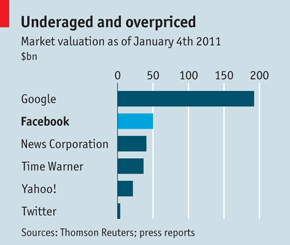
A report in The Economist, Jan. 6 issue, describes the following: Facebook is not a publicly-listed company, all its shares are privately held, by (allegedly) fewer than 500 investors, so it is not required to disclose any financial information. No-one knows for sure what its revenues or profits are. There are great competitive advantages Facebook enjoys, behind this veil of secrecy. But there is enormous interest in Facebook shares; Growing numbers of investors want to buy them. But Facebook CEO and founder Mark Zuckerberg do not want to do an initial public offering (IPO) of shares yet. They want to wait until Facebook’s soaring valuation peaks, perhaps at over $100 b. Yet Zuckerberg needs money, to expand his operations. How can you square the circle, sell shares without actually selling them?
Goldman Sachs to the rescue! This investment bank has valued Facebook at $50 b., and has set up an investment fund, investing $500 m. in Facebook and creating a fund that may invest another $1.5 b. Its partner in this venture is the Russian company DST. According to The Economist, “Clients considering signing up to its proposed Facebook fund are reportedly being asked to commit at least $2m each to it and to hold on to any shares they receive until at least 2013.”
This action clearly circumvents the intention of the regulators, that once there is wider public ownership of shares in a company, even if the shares are not publicly listed the company must begin to disclose financial information.
Is Facebook worth $50 b.? No-one knows. Certainly there is great value to having over 500 m. subscribers. But what is Facebook’s revenue model? Can it support as high a valuation as $50 b.? And what are Goldman Sachs’ motives? Are they, perhaps, interested, in setting up an inside track for underwriting Facebook’s IPO, a deal that could bring them many billions of dollars in fees?
And again, where are the regulators? Is Goldman Sachs and its Russian partner, along with Facebook itself, making a terrific speedy end run around the regulations, within the law but with dubious ethics? And have we seen this movie before, in 2005-9?
The Economist concludes: “ Regulators have a duty to protect investors and weigh the concerns of companies that wish to remain private. It is a delicate balancing act. But anyone who invests in a market this frothy must surely realize it is also risky. Meanwhile, Goldman and the other banks which hope to turn these vehicles into a big business should consider friending some good lawyers.”
**** postscript: Facebook, under pressure, has announced it will disclose financial results by April 2012 (probably a runup to an IPO), and the U.S. Securities and Exchange Commission has announced it will investigate Goldman Sachs’ “end run”.
Global Crisis/Innovation Blog
Estonia, the Euro, and National Contrarian Thinking
By Shlomo Maital
A few years ago, I visited Estonia, a small Baltic country with only 1.3 m. people, once a part of the USSR and now a dynamic and creative nation with strong political leadership. We were impressed by its commitment to innovation, not just at the level of startups (Skype was founded and developed by ethnic Estonians) but at the national or government level. For instance, Estonians file taxes on-line, usually submitting their annual tax report in 20 minutes or so, and it also votes on-line, the first nation to do so. Estonia’s Government meets on-line, often, with travelling ministers joining sessions by videoconference, dialing in to a start-of-the-art wired Cabinet room. Estonia has very low tax rates and is singlemindedly weaving its economy into the fabric of the European Union.
Now, as of Jan. 1, Estonia has happily, wholeheartedly, embraced the euro. Prime Minister Andrus Ansip slid a bank card into an ATM and withdrew some euros, at an ATM specially set up in front of the opera house in the capital city Talinn. With this, Estonia became the 17th member of the Euro zone. “Being inside is better than being outside” [the Euro zone], said a leading Estonian banker.
Why would Estonia want to join the Euro zone, when the euro has been so unstable, so troubled, its future in doubt? The answer is simple. It is a matter of alternatives. Which do you prefer, as a foreign investor, as the head of Estonia’s Central Bank, or as Estonia’s finance minister – the kroon, weak and unstable, with high risk, or the euro, known, and relatively more stable?
Estonia suffered a deep drop in its 2009 GDP. Part of this was self-inflicted. In order to defend the fixed kroon-euro exchange rate (part of the condition for officially adopting the euro), Estonia slashed its government budget and reduced its deficit by fully 9 per cent of GDP – a huge cut, one that other larger governments have been unable to even contemplate.
Estonia remains a poor country, with GDP per capita only two-thirds of the OECD average. But it has vision and determination, and sees Ireland 1987-2007 as its model. Estonians are ethnic Finns. They share the Finnish stoicism and toughness. Estonia endured centuries of foreign domination, and many now see the Euro as a key to future independence.
Estonia has a long road to travel. One in ten Estonians are unemployed, a fifth of the population lives in poverty and it is by far the poorest country in Euro zone. But it perceives of itself as the anti-Greece: the opposite of the profligate irresponsibly heavy-spending Socialist nation that took to the streets to fight necessary fiscal cuts.
“There is no reason to be afraid,” said one leading Estonian. “We have had worse experiences.” For Estonia, everything is relative. The tribulations of embracing the euro, however bad, cannot come close to what Estonia endured under the Soviets and other colonial powers. While other nations ponder leaving the Euro, Estonia practices contrarian thinking and embraces it with vigor. We wish Estonia well.
* based on: Jack Ewing, “As euro struggles, Estonia readies for entry in currency”, Global NYT, Dec. 30, 2010.
Global Crisis/Innovation Blog
China Patents A New Direction in Patents
By Shlomo Maital
In this blog, I have consistently argued that China is fiercely determined to move up the value-chain ladder into the realm of innovation-intensive products and services, and is acting aggressively to implement this policy.
Writing in today’s International Herald Tribune, Steve Lohr [“Building a more innovative society by government decree”, IHT Jan 3/2011, p. 14] reports on a Chinese government document defining goals for drastically raising China’s production of patents. US PTO’s David J. Kappos, the Director, says the Chinese targets for 2015 are ‘mind blowing numbers’.
China’s goal for annual patent filings by 2015 is … two million, including ‘utility-model patents’ or design patents, which cover items like engineering features and are less ambitious than invention patents. In contrast, in 2009, there were about 300,000 applications filed for utility patents, about equal to the total of invention patents.
Patent filings in the U.S. totaled about 480,000 in the year up to September 30.
China’s patent surge has been evident for many years. China has been expected to overtake the U.S. in patents this year, but it has happened faster than expected, Lohr reports.
China is not only ambitious for Chinese patents. It wants to double the number of patents that its residents and companies file in other countries. Chinese filings in the US PTO are soaring, and are focused on strategic areas China finds crucial, such as solar and wind energy, information technology, telecommunications, battery and manufacturing technologies for automobiles.
China’s government is offering incentives, including cash bonuses, better housing for individual filers, and tax breaks for companies that are prolific patent appliers.
Creativity expert John Kao told Lohr that “one day China will have the Chinese entrepreneurial equivalent of Steven P. Jobs of Apple and Mark Zuckerberg of Facebook.”
Kao takes comfort in the fact that American culture, more than any other, forgives failure, tolerates risk and embraces democracy. I wonder when America will begin taking seriously the ominous challenge “Made in China” poses for America’s wealth and wellbeing.
Global Crisis/Innovation Blog
“Beware of Greeks Bearing Gifts”: Michael Lewis’ Insights”
By Shlomo Maital
Michael Lewis is perhaps the leading writer able to expose the deepest darkest inner secrets of the financial services world, dating from his book Liar’s Poker. New York Times columnist David Brooks, in his annual “Sidney Awards” column, draws our attention to Lewis’ essay in Vanity Fair (Oct. 1), titled “Beware of Greeks Bearing Gifts”.
To show how financial bungling leads to moral rot, Lewis takes us to a 1,000 year old monastery, cut off from the world, in remote northern Greece near Mount Athos, accessible only by boat.
Greece’s banks and government conspired to plunder the public treasury. The Greek national railroad, lewis notes, earned 100 m. euros in revenues, but had a wage bill of 400 m. euros (!) plus 300 m. euros in other expenses. The country reported a budget deficit of 3.7 per cent of GDP, to gain EU entry, but in fact its deficit was really 14 per cent of GDP. But the real cause of Greece’s crisis was the remote monastery known as Vatopaidi.
“In late 2008, news broke that Vatopaidi had somehow acquired a fairly worthless lake and swapped it for far more valuable government-owned land. How the monks did this was unclear—paid some enormous bribe to some government official, it was assumed. No bribe could be found, however. It didn’t matter: the furor that followed drove Greek politics for the next year. The Vatopaidi scandal registered in Greek public opinion like nothing in memory. “We’ve never seen a movement in the polls like we saw after the scandal broke,” the editor of one of Greece’s leading newspapers told me. Without Vatopaidi, Karamanlis is still the prime minister, and everything is still going on as it was before.” *
The Vatopaidi scandal brought a Socialist government to power, headed by George Papandreou, son of an eminent economist and former Prime Minister. Papandreou’s government squandered money, in ways Karamanlis would never have dreamed. Had it not been for the moral rot that touched Vatopaidi’s monastery, Lewis explains, Greece would have avoided its virtual bankruptcy.
Remember the parable of how “a butterfly’s wings flap in a remote forest, and the result changes the world totally”? There is a strong similarity.
* Source: http://www.vanityfair.com/business/features/2010/10/greeks-bearing-bonds-201010?printable=true#ixzz19OUDR5T7
Global Crisis/Innovation Blog
Handling Freak Weather: The Wisdom of a New York Cabbie
By Shlomo Maital
An enterprising BBC reporter covered New York City’s blizzard, which dumped 75 cms. of snow (30 inches) on the city, by chatting with a New York cabbie (taxi driver). I’ve found that if you want to really know what is going on in a country, regarding its business energy and economic performance, ask a taxi driver. The same appears to be true about snow removal.
Former New York Mayor John Lindsay lost his job after the Feb. 15, 1969, snowstorm dumped 15 inches of snow on New York City and paralyzed it; Lindsay was widely perceived as incompetent. Today, twice as much snow fell on New York City and within a day the city was back to normal.
Cabbie Peter Franklin told BBC that Mayor Michael Blumberg reflected the spirit of New Yorkers. “The cost of snow clearance,” Franklin said, is “$1 m. per inch of snow”, or $30 m. for the 30 inches. But, he noted, “Mayor Bloomberg said, so what? So what if it costs $30 m.? Let’s just do it.” Bloomberg realized that you cannot shut down a city, and the cost of doing so, as Mayor Lindsay learned, is a thousand times more than the cost of clearing the snow.
New York City simply has a method – it takes all its thousands of garbage trucks, and puts snow shovels on the front, and sends them out to clear the snow, then hires day laborers at $14/hr. and has them shovel the snow from intersections. These two simple ideas together put New York City back into commission after a very short shutdown.
“To deal with problems,” cabbie Franklin says, “you need two things: Will and money. We in New York have both. So we did it.” He expressed price in the resilience of New Yorkers, and likened the snow removal to a “war” – enlisting money and energy, defining the goal (keep things functioning), and then…as the Nike mantra goes, Just Do It!
Other cities would do well to benchmark New York City. Meanwhile, cities in snowy climates treat blizzards as ho-hum – Helsinki, and Toronto, and Winnipeg, Canada, for example, while a few inches in London shuts everything down and sows panic.
Global Crisis/Innovation Blog
If We Have Global Warming, Why Do We Have Global Cooling?
By Shlomo Maital
Count on the global warming deniers to ask: if we have global warming, why do we have global cooling (freezing snowy winters in America and in Europe, closing airports, stranding travellers, and causing chaos)? And count on journalists to cover the results of the blizzards, but never to ask the core question, how are global cooling and global warming related?
Fortunately, Judah Cohen, a meteorologist who works for a weather forecasting company, has written a short essay answering this question. Here is a short summary of Cohen’s explanation.
1. Even as frozen areas like the polar caps shrink, seasonal snow cover has increased, across the high latitudes of the northern Hemisphere, especially in Siberia, and the Himalayas. As global temperatures warm, Arctic sea ice melts, creating more moisture available to fall as snow.
2. The sun’s energy reflects off the snow and escapes back to space, cooling the air; this creates an “unusually large dome of cold air next to the mountains”, amplifying the standing waves in the atmosphere.
3. The increased wave energy disturbs the jet stream, which, instead of flowing mainly west to east, as it does normally, meanders more north and south. In winter, this change in snow sends warm air north, but also pushes cold air south from the arctic and from Siberia.
4. “This is why Eastern US, Northern Europe and East Asia have experienced extraordinarily snowy and cold winters since the year 2000.”
Why did forecasts fail to predict them? “Because the primary drivers in meteorological models are the oceans, which have been warming…. They have ignored the snow in Siberia!”.
It’s all a “snow job”, concludes Cohen. We’re freezing not in spite of climate change but because of it. Looks like the meteorologists’ forecast models were as wrong as the financial experts’ models.
* Judah Cohen, Global New York Times, Dec. 25, 2010


