
You are currently browsing the category archive for the ‘Global Crisis Blog’ category.
Global Crisis Blog
The New Crisis is Now!
By Shlomo Maital
Within the 500-word discipline of a brief blog, is it possible to explain why the global crisis, often listed as 2007-9, is in fact ongoing and about to get much worse?
Let me try.
The crisis occurred because the world became imbalanced. America spent, consumed and printed endless quantities of dollars, scattered throughout the world, in order to import. The period 1980-2007 was an American party that lasted a whole generation. Asia saved, invested and exported, accumulated dollars (to keep Asian currencies and goods from getting too expensive) and grew rapidly, lending America the funds to keep the party going. Never in history have wealthy nations borrowed so much, so rapidly, from many poor ones. In such a tilted world, with goods flowing in one direction (east to west), and money flowing in the other (west to east), it was clear the situation could not continue (although it lasted longer than should have been possible, with the partying Americans conspiring with the nose-to-the-grindstone Asians to keep it going).
Now, it is time for rebalancing. That means: Americans save, invest and export. Asians spend, consume, and import.
It has to happen. But — it cannot happen.
To save, America must slash its government deficit. To slash the deficit, it must cut entitlements (Medicare, Social Security). Politically, this is impossible. Besides, in order to boost exports, you have to make something (goods, not services). But America long ago shifted its production to Asia; U.S. manufacturing is less than 10 per cent of GDP, mostly, items that do not enter into world trade.
To spend, China must boost its domestic consumption. For this to happen, China’s corporations must stop hoarding profits and reduce their investment. But why? The fundamental business model built on exports has created enormous wealth. It supports rapid growth. China must grow, in order to employ hundreds of millions of workers migrating from the farms in the West to the factories in the East. Why fix it, if it isn’t broken? (China, it will be recalled, continued to grow rapidly despite the global crisis).
The only chance for job creation in the U.S. is for exports to rise and imports to fall. But neither import substitution nor export growth can occur until America reinvents its manufacturing. But President Obama recently offered the Chinese to produce Boeing aircraft in that country. Brilliant! An American job creation program that creates jobs in Shenzhen. In America’s “cash for clunkers” program, widely praised, most of the clunkers were traded in for foreign fuel-efficient cars. Korea got the jobs.
If rebalancing cannot occur, then imbalance will continue, as will the ongoing crisis. And it will get worse. Germany pursues a self-interest policy of boosting exports, at all costs, ignoring American pleas to import more. European nations pursue an “every country for itself” policy, at a time when political unity is more vital than ever. Asian leaders listen politely to American lectures on how to restructure their economies, watch America’s economy stagnate, and smile politely.
A recent study of global risk by the World Economic Forum lists some 50 risky events, together with their magnitude and probability. Risks include social, political, technological, medical and economic. The five top risks are all economic, including the leading candidate — a risk of “asset price collapse”, causing trillions in losses, with probability exceeding one in five. Without rebalancing, asset prices will again collapse.
Readers, fasten your seat belts. Get out of debt, if you can. We will all need every ounce of resilience and courage we have.
Global Crisis Blog
What is the True Role of the CEO? Let’s Get Back to McCabe Basics
By Shlomo Maital
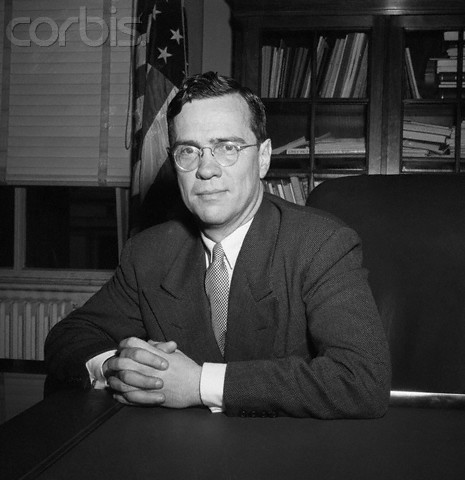
Thomas McCabe
What is the true role of the CEO? If you completed an MBA degree at Harvard Business School, MIT Sloan, Wharton, INSEAD, Stanford or any other leading school, within the past four decades, the answer is perfectly clear. Your objective is to make the maximum profit for your shareholders. Period. And since you will likely be CEO for a relatively few years, add the codicil: “maximum profit for the near term” — as in, “the next quarterly statement”. If you dare give corporate money to charity, Prof. Milton Friedman will say that this is wrong, you are giving away the money that rightly belongs to shareholders. In the era of militant shareholders, if you fail to bring short-term profitability, the Board of Directors will send you packing — and the CEO position has become a rapidly revolving door.
The result: Disastrous selfish short-term policies that turn out to be as ruinous for the company as they are for the nation in which the company is headquartered. CEOs have become expert at short-term policies that bring rising share prices tomorrow, but prove ruinous in the long run, long after the CEO is gone and forgotten.
Once, things were different, in the pre-MBA era. My friend Clyde Prestowitz, author of The Betrayal of American Prosperity, worked for years for Scott Paper, and for its legendary CEO Thomas McCabe.
McCabe graduated from Swarthmore College in 1915 and fought as a Captain in the US Army in WWI. He joined Scott Paper when he was 26 and became CEO at the age of 34. He built Scott Paper from a single mill employing 500 people into a global giant employing 40,000, at 60 locations around the world. He retired from the Scott Paper Board of Directors in 1980, when he was 87! In other words, he served Scott Paper for 61 years, most of which he led the company. During World War II, he took time out to serve his country, not in combat but in management. After WWII he served a stint as Chairman of the Federal Reserve Board of Governors, the job Ben Bernanke currently holds.
Prestowitz recounts that McCabe had a plaque on his wall, about “whom we [managers] serve”. At Scott Paper, McCabe insisted, we first serve…. our clients and customers. Next, we serve our employees. Next, we serve our community, the neighborhoods, towns and cities in which we are located. Next, we serve our nation — the men and women and children of our country. And last, perhaps even least, we serve our shareholders.
Why last? Because, McCabe said, if you serve the other four groups of stakeholders well and truly, then you will also serve the long-term interests of your shareholders. Emphasis on Long-Term! The McCabe credo must have worked — look at what McCabe created, in applying it — a first-rate enormous global company.
Are there any CEO’s around that would dare to follow McCabe’s credo?
Is there any way we can turn back the clock, to the McCabe era?
Would the world be in such deep hot water today, had its corporate CEO’s studied, memorized and implemented the McCabe credo?
Can capitalism return to its true roots, the McCabe credo roots, and reinvent itself in ways that fulfill its true destiny?
Can we please revise what we teach our MBA’s, to put shareholder profits last, rather than first?
Global Crisis Blog
The Next Crisis Is Now ! White Swan? Or Black Swan?
By Shlomo Maital


All the signs point to it — the next crisis is imminent, it is now.
Economist Nouriel Roubini, of NYU’s Stern School of Business, and author of Crisis Economics, says that financial and business crises are “white swans” — that is, they are predictable. Proof: He predicted the 2007-9 crisis, in a memorable talk to the IMF experts in 2005.
Mathematician Nassim Taleb, of NYU’s Polytechnic University, author of The Black Swan, says crises are unpredictable. Like black swans, we thought they could not, did not, exist — but once discovered (in Australia), in hindsight we saw how probable they were.
Do you believe that global crises are white swans? Or black swans? It matters a lot. If you think they are white swans, then you need to build the skills, knowledge, tools and capabilities to track global events, build worst-case scenarios and narratives, think independently, and above all detect asset bubbles.
If you think crises are black swans, then forget it, they are unpredictable, in timing and in causality. What you need to do is not build tracking skills, but rather to build resilience, quick thinking, and ability to act under extreme duress, instead of freezing or panicking (as many of our financial and political leaders did in 2007-8).
I recently surveyed a group of MBA students. I asked them, do you think crises are white swans, or black? About half said, “white”. And half replied, “black”.
It is entirely possible that both Roubini and Taleb are right. There are crises that telegraph their arrival and hence are predictable — white swans. There are crises that come from out of nowhere, out of the blue, that could not possibly be predicted. And indeed, every crisis has elements of white and black swan in it. No-one could have predicted that the Archduke Franz Ferdinand would be assassinated in Sarajevo. That was a black swan. But the geopolitical forces creating potential hostility between Germany, France, Russia, Turkey and Britain were clearly evident, as was the imminent demise of four empires (German, Russian, Austro-Hungarian, and Ottoman), and the impending demise of a fifth (British).
The message is that global managers need to know how to anticipate white swan crises, how to handle black swan crises, and how to tell the difference between them.
This is not a theoretical exercise. In the next blog, I will explain why I believe the next crisis is almost upon us, and what the causal narrative will likely be. It will be a zebra crisis — both black and white. And it will doubtless catch many by surprise.
Global Crisis Blog
The Looming Crisis: But Does Obama Get It?
By Shlomo Maital
Clyde Prestowitz, former chief trade negotiator for U.S. President Ronald Reagan and noted author of bestsellers (Rogue Nation, Trading Places, Three Billion New Capitalists, and, most recently, The Betrayal of American Prosperity), believes the global economy is heading for a looming crisis, suggesting the current global crisis is far from over.
He notes that everyone is discussing “rebalancing”. Rebalancing means — The U.S. saves more, and consumes less; Germany, Japan, China and Asia in general saves less and consumes more. But, he noted, for the U.S. to consume more means reducing government entitlements, such as social security. This is politically unfeasible. For the U.S. to export more means Germany, Japan, China and Asia need to import more from the U.S. But since the U.S. does not have much manufacturing (only 10 per cent of GDP in the U.S. is from manufacturing, compared to 25 per cent a generation ago), there is little for other countries to buy even if they wished to. Most of the high saving in China is done not by households but by companies. Companies, even privately held ones, seek to grow. Growth occurs through reinvesting retained earnings. So it is unlikely that China will have any incentive to save less. Moreover, Germany’s business model is built on exports. It is unlikely that Germany will abandon its fundamental business model, one that has worked well even during the current global crisis, simply because the U.S. requests it to do so.
And indeed — at the G20 meeting in Toronto, noted Prestowitz, President Barack Obama asked the other countries to help with rebalancing and assist the U.S. in reducing its trade deficit. If Obama is to avoid losing control of the House of Representatives in November elections, it is vital that the economy improve and the rate of unemployment decline. But this will happen only if the U.S. trade deficit falls sharply — given that a fall in the U.S. budget deficit is likely, and this will work to contract the economy and contract employment. For the U.S. trade deficit to fall, other nations must accept a fall in their exports to the U.S. But the reaction of the G20 nations to Obama’s request was highly negative.
The result: At some point, perhaps after a drubbing at the polls in November, Barack Obama will adopt drastic measures, perhaps protectionist ones, to limit imports and unilaterally curtail America’s trade deficit. Other countries will respond. And could we see a replay of the 1930’s, when America’s Smoot-Hawley tariff led to retaliation — and the virtual disappearance of world trade.
Mr. Prestowitz provides all of us with some serious food for thought.
Here is what he wrote recently (prior to the G20 meetings in Toronto) for Politico, a website that tracks the Obama presidency and American politics, as an open letter to President Obama:
As you prepare for this week’s G20 meeting in Toronto, you and your White House team are locked in debate with Congress and the punditry over the merits of more stimulus versus the demerits of the rising federal debt. While another shot of stimulus would be nice, even if you get it, it will likely be the last shot because the rising debt will become a real constraining factor. Moreover, the amount of stimulus you are asking for won’t be enough to create the jobs necessary to achieve full employment or to resurrect our past prosperity. There is an easy solution that no one is talking about for fear of offending the high priests of the reigning economic orthodoxy. Our trade deficit of roughly $500 billion costs us from 2.5 million to 5 million jobs. Thus, eliminating the trade deficit would get you back to full employment without any necessity of more debt financed stimulus. Indeed, the new jobs created by reducing the trade deficit would themselves create the best kind of self-regenerating stimulus. Nor would it be at all difficult or expensive to do. For one thing, the U.S. dollar is kept strongly over-valued by the constant buying of dollars by China and other Asian countries that keep their currencies undervalued by 25- 40 percent as a subsidy for their exports. China has just announced that it will begin to allow some flexibility in the exchange rate of its yuan. But the Chinese are thinking in terms of a 3-4 percent revaluation. You need an immediate revaluation of at least 25 percent in order to get anywhere near a real market valuation. You could do this by putting a tax on certain capital inflows into the United States. You could also direct your Secretary of Commerce to initiate countervailing duty investigations on a broad range of imported products that benefit from the subsidy of the currency undervaluation. You must also create a fund to match the tax abatements, capital grants, and other investment incentives that China and many other countries use to bribe U.S. companies to offshore their factories and jobs. Finally, you need to stop giving away economic goodies to get geo-political crumbs. Last year during you trip to China, you promised to help the Chinese develop the capability to build their own commercial jet liner. Why did you do that? Jet liners are one of our biggest exports. You have said you want to double exports. Well, you can’t do that by helping the Chinese beat Boeing. Get smart Mr. President. Cutting the U.S. trade deficit is the only way for you to create new jobs that are good and that will last. It is the only way for you to revitalize the U.S. economy and it may be the only way for you to get reelected
Global Crisis Blog
How Geithner Bungled the Bailout of AIG and Wasted $182 b.
By Shlomo Maital
On Oct. 3, 2008, the U.S. House of Representatives passed legislation authorizing the U.S. Treasury to spend up to $700 billion ” to preserve home ownership, and promote economic growth.” The authorization was given in a single vague line in a complex Act, The Emergency Stabilization Act, an act that was defeated once and passed only after desperate pleas by the Treasury and the U.S. Fed that a financial meltdown would result if it did not pass.
A report [1] by the blue-ribbon U.S. Congressional Oversight Panel (whose role it is to oversee the bailout of US banks and companies with taxpayer money) reveals a massively hasty and poorly-designed bailout program, implemented in panic, that has wasted many billions of dollars in taxpayer money and may have done more harm than good. The Panel members include Richard H. Neiman, Superintendent of Banks for the State of New York; Damon Silvers, Director of Policy and Special Counsel of the American Federation of Labor and Congress of Industrial Organizations (AFL-CIO); and Elizabeth Warren, Leo Gottlieb Professor of Law at Harvard Law School. According to this report:
At its peak, American International Group (AIG) was one of the largest and most successful companies in the world, boasting a AAA credit rating, over $1 trillion in assets, and 76 million customers in more than 130 countries. Yet the sophistication of AIG‘s operations was not matched by an equally sophisticated risk-management structure. This poor management structure, combined with a lack of regulatory oversight, led AIG to accumulate staggering amounts of risk, especially in its Financial Products subsidiary, AIG Financial Products (AIGFP). Among its other operations, AIGFP sold credit default swaps (CDSs), instruments that would pay off if certain financial securities, particularly those made up of subprime mortgages, defaulted. So long as the mortgage market remained sound and AIG‘s credit rating remained stellar, these instruments did not threaten the company‟s financial stability. The financial crisis, however, fundamentally changed the equation on Wall Street. As subprime mortgages began to default, the complex securities based on those loans threatened to topple both AIG and other long-established institutions. During the summer of 2008, AIG faced increasing demands from their CDS customers for cash security – known as collateral calls – totaling tens of billions of dollars. These costs put AIG‘s credit rating under pressure, which in turn led to even greater collateral calls, creating even greater pressure on AIG‘s credit. By early September, the problems at AIG had reached a crisis point. A sinkhole had opened up beneath the firm, and it lacked the liquidity to meet collateral demands from its customers. In only a matter of months AIG‘s worldwide empire had collapsed, brought down by the company‘s insatiable appetite for risk and blindness to its own liabilities.
AIG sought more capital in a desperate attempt to avoid bankruptcy. When the company could not arrange its own funding, Federal Reserve Bank of New York President Timothy Geithner, who is now Secretary of the Treasury, told AIG that the government would attempt to orchestrate a privately funded solution in coordination with JPMorgan Chase and Goldman Sachs. A day later, on September 16, 2008, FRBNY abandoned its effort at a private solution and rescued AIG with an $85 billion, taxpayer-backed Revolving Credit Facility (RCF). These funds would later be supplemented by $49.1 billion from Treasury under the Troubled Asset Relief Program (TARP), as well as additional funds from the Federal Reserve, with $133.3 billion outstanding in total.
The total government assistance reached $182 billion.
What was wrong with the way Geithner structured the bailout? The panel’s members observe these faults:
1. “The government failed to exhaust all options before committing $85 billion in taxpayer funds.“ There were many untried options that could have saved a lot of money.
2. “The rescue of AIG distorted the marketplace by transforming highly risky derivative bets into fully guaranteed payment obligations.“ Talk about “moral hazard” — AIG shareholders keep the profits, if there are any, and the U.S. taxpayer bears the loss, if the bet doesn’t pay off. A lot of companies and individuals would love to have THAT deal.
3. “Throughout its rescue of AIG, the government failed to address perceived conflicts of interest.“ People from the same small group of law firms, investment banks, and regulators appeared in the AIG saga in many roles, sometimes representing conflicting interests.
4. “Even at this late stage, it remains unclear whether taxpayers will ever be repaid in full. AIG and Treasury have provided optimistic assessments of AIG‘s value. As current AIG CEO Robert Benmosche told the Panel, “I‘m confident you‟ll get your money, plus a profit.” The Congressional Budget Office (CBO), however, currently estimates that taxpayers will lose $36 billion.“
5. “The government’s actions in rescuing AIG continue to have a poisonous effect on the marketplace.” The market now assumes there are businesses “too big to fail”. This will have a massive distorting effect on capital markets in the near and distant future. And it may prove wrong. Taxpayer anger at the waste of their money on AIG may indeed cause companies in future to be allowed to fail, when perhaps they deserve a bailout.
[1] Congressional Oversight Panel , June 10 2010: “The AIG Rescue, Its Impact on Markets, and theGovernment’s Exit Strategy”, Submitted under Section 125(b)(1) of Title 1 of the Emergency Economic Stabilization Act of 2008, Pub. L. No. 110-343.
Global Crisis Blog
A Country Is a Business: Where to Place Your Bets?
By Shlomo Maital
An article in The Irish Independent by Brendan Keenan helps answer the question: Which countries will emerge quickest and strongest from the global crisis? [1]
Ireland has taken an enormous ‘hit’ during the global crisis, because its banks were overleveraged and undertook huge risks. Ireland has gone from being Europe’s poster boy for strategic planning to becoming Europe’s basket case, with government debt threatening to destabilize the economy and with unemployment high and growing.
But don’t count Ireland out. After all, a country is a business. Ireland’s business is being well run. Recall that Ireland, as a nation, has several centuries of crisis-ridden history. Its people are used to crisis and are flexible, resilient and tough. The collective memory includes the Potato Famine of 1845-7, when a million Irish died or emigrated. Ireland now has a large trade surplus, as Keenan notes. And the Irish people have shifted from debt to asset accumulation, with an extremely high rate of saving.
The last piece in the strategic puzzle for Ireland is this: Businesses need to resume investment spending, in plant, infrastructure and R&D. So far they haven’t. When they do, they will find plenty of funds in capital markets, from the high savings of individuals. For banks to resume investment, two things need to happen: First, businesses need to be persuaded that the mid-term prognosis for the Irish and world economies is favorable (so far, it isn’t, especially because of the weakness of the Euro zone), and the financial intermediaries (banks) need to resume lending and stop hoarding cash to build up their shaky balance sheets.
Which country should we bet on, to emerge strongest from the crisis? The country that is run like a well-run business, and the country where businesses resume investing in the future. So far, it looks very unlikely that America will be able to fit that bill, in the foreseeable future. But Ireland? Well, it just might.
[1] “The Keenan View: Our trade surplus and huge savings make us different”, Irish Independent, Thursday July 22, Business section, p. 4.
Global Crisis Blog
From Crisis to Opportunity: Airline Leases Take Off
By Shlomo Maital
Our new book Global Risk/Global Opportunity (SAGE 2010) stresses that in every aspect of the current global crisis (which, we argue, has not ended, but has simply changed its form, shape and nature), risk can be transformed into major business opportunities.
Here is an example.
The Farnborough International Airshow opened Monday in the UK. It is the aircraft industry’s largest trade show. Wall Street Journal Europe reports that “demand for planes is rising” and “money is returning to the aviation market”. However, the industry is changing radically.
Global deleveraging (the desperate effort of individuals, families, businesses, banks and governments alike to reduce debt burdens) is making credit scarce. Airlines are finding it harder (and less worthwhile) to buy planes with borrowed funds, especially when nervous capital markets punish companies that have high debt-equity ratios (leverage) and banks are reluctant to part with their cash.
This has created a boom in aircraft leasing. It was predictable long ago. Just as most people now buy cars, in many countries, with leasing agreements, so airlines are shifting to leasing. According to the WSJ, fully a third of all aircraft are not owned by the airlines but are leased. In the ’70s and ’80s, that fraction was 10-15 percent. The leasing giants are GE Capital (world’s biggest) and BOC Aviation (a unit of Bank of China).
Aircraft leasing has many advantages. Airlines that fail to meet payments lose the planes in the wink of an eye; aircraft leasing firms are good at this. Unlike buildings, which cannot sprout legs and fly, planes can — so leasing firms can quickly sell foreclosed planes without loss. Look for leased aircraft to rise to fully half of all aircraft flying, within the next few years. Leasing companies buy large numbers of aircraft (GE Capital is about to do so), and borrow money with the aircraft themselves as collateral. Sound like mortgage-backed securities? Not quite. In the downturn, planes have maintained their value (unlike houses). And they can move anywhere, quickly.
If you are in financial services, and are looking for a growth engine within an industry that remains troubled, consider this one. It meets a major need of struggling airlines to renew their aging fleets, without putting massive amounts of debt on their balance sheets. Ask yourself, what are the core competencies needed to become a successful aircraft lessor? Do I have those competencies? How can I innovate within this industry? Where are their hidden niche markets?
Source: “Airplane leases take off”, WSJ Europe, by Daniel Michaels, Monday July 19, 2010, p. 1.
Global Crisis Blog
Dear Ben, Yes You SHOULD Have Seen It Coming,
And Yes, You CAN Prevent the Next One
By Shlomo Maital

NASA Rocket: Here comes the next bubble!!
Memo: to Prof. Ben Bernanke, Chairman, Board of Governors, U.S. Federal Reserve:
From: Shlomo Maital
Prof. Bernanke, I’m an over-the-hill former economics professor, who spent 20 summers teaching economics at the place you got your Ph.D., M.I.T. I admire the quality job you’ve done, battling to limit the consequences of the Crisis. What good fortune the Fed head is a scholar who knows what massive destruction a Depression can cause, and why we need to use everything we have, and then some, to forestall it.
But Ben, may I call you that? I still find your statement made on Monday Nov. 16, 2009, rankling. You said, exact quote, “It is inherently extraordinarily difficult to know whether an asset’s price is in line with its fundamental value.” In other words: We can’t predict bubbles, we can’t tell when a bubble is happening, hence, we can’t take vigorous action to prick them.
I know what you mean. In the end, there IS no fundamental value of an asset. Its value is based on supply and demand, and demand is based on perception, including irrational exuberance, which at the time seems highly rational.
But Ben, it is neither extraordinarily, nor inherently, nor difficult, to detect a bubble. What about a new paper by Prof. Jerome Stein, like me an emeritus economics professor, who makes the following case worthy of your close attention: [1]
The FED, IMF, Treasury and the market (including AIG and Citigroup) lacked the appropriate tools of analysis to answer this question: what is an optimal leverage of capital requirements that at the moment balances expected growth against risk? In other words, when are banks and other financial institutions over their heads in debt and in danger of collapse? Stein uses a technique used to guide NASA rockets, known as SOC stochastic optimal control (it optimizes the path of the rocket every milli-second, taking into account random disturbances and deviations). Rocket trajectories are not unlike trajectories of banks and financial institutions like Lehman Brothers — subject to unexpected buffets, always checking if the capital structure is over-stretched or okay, always re-optimizing and re-evaluating. (Goldman Sachs did this procedure, re-evaluating risk, every week or 10 days, and emerged more or less unscathed as a result).
Using SOC, a strong warning signal is generated, showing when the optimal debt ratio (leverage) exceeds (or greatly exceeds) the actual debt ratio. This is how to tell when a bubble exists. Stein notes that “the excess debt starting from 2004-5 indicated that a crisis was most likely”, using his tool. In other words: there were warning signals as early as 2004-5. No wonder the Queen of England asked, in Nov. 2008, “Why did no one (i.e. no economist) see this coming?”.
Can we use SOC so that next time, economists will not embarrass themselves and their profession, and so that I need not go outdoors in disguise?
[1] A critique of Alan Greenspan’s Retrospective on the Crisis. Applied Math dept., Brown University, Jerome_Stein@brown.edu
Global Crisis Blog
China’s G-String at the G-20
By Shlomo Maital
As the G-20 ministers meet in Toronto and Huntsville, Ont., creating massive havoc in downtown Toronto, China again shows its skill in sleight-of-hand diplomacy. China is dressing up its apparent willingness to contribute constructively to the global crisis and restore global balance — but in fact, all China is wearing is one thing G-string, and maybe even not that.
With exquisite timing, China announced prior to the G-20 and G-8 meetings that it will allow its currency, the yuan, to appreciate (rise in value) relative to the euro and to the dollar. This, in order to help reduce China’s huge trade surpluses with the West and restore balance to the totally unbalanced global trading system, a system in which paradoxically rich countries borrow heavily from poor ones (like China) by running persistent large chronic trade deficits. Despite the recession and the crisis, America’s trade deficit remains in the order of $500 b. annually, an unsustainable level.
With the announcement, the yuan appreciated by a miniscule 0.4 percent (China’s currency is undervalued by at least 50 per cent — in other words, if the current exchange rate is about 7 yuan per dollar, it probably should be 3.5, to reflect its purchasing power, a rate that would double the dollar price of all China’s exports. This tiny appreciation will indicate to the G-20 that China is indeed moving in the right direction and is working to contribute to global stability as a good citizen. But this is an illusion. China’s undervalued currency will remain undervalued, and once the G-20 meeting is over, watch the yuan-dollar rate freeze again.
Writing in The New Republic, Clyde Prestowitz argues this:
At the G-20 meeting, the administration’s first step should be for the President to ask his colleagues to cooperate in bringing about a 25 percent to 40 percent revaluation of manipulated currencies in relation to the dollar[i.e. yuan] within the next three years. The president should warn that if such an agreement cannot be reached, he will have no choice but to launch a full-scale effort in the IMF, WTO, and elsewhere to halt the mercantilist manipulation of currencies. He should leave no doubt that he will do whatever is necessary, including even taxing certain capital inflows, to achieve substantial currency adjustments.
What are the chances that President Obama will actually take such decisive action?
Less than zero.
Innovation Blog
CEO: Are You On the Sisyphus Treadmill? Can You Get Off?
By Shlomo Maital
In Greek mythology, Sisyphus was a King who transgressed and was punished. His punishment was to push a heavy rock up a steep hill, and then, just as he reached the summit, the rock tumbled down to the bottom again — and Sisyphus began all over, and continued doing this, until the end of time.
The modern Sisyphus is the CEO. Twelve years ago, in a typically insightful article, McKinsey Global Research revealed what I think is a fundamental flaw of capitalism and capital markets. I think this flaw ultimately helped contribute to the 2007-9 crisis. Here is what McKinsey described, in “The expectations treadmill.” (August 1998)
“… executives labor on a kind of treadmill, whose speed represents the expectations of future financial performance implicit in a company’s share price. Beat them and you not only raise shareholder returns in the short run but also accelerate the treadmill. The better you do, the more the market expects from you; you must pound the treadmill ever faster just to keep up. To learn more about why extraordinary executives often fail to deliver extraordinary share price increases, particularly in the short run…”
Put simply: Suppose you are a highly innovative CEO. You drive top-line and bottom-line growth up substantially. Shareholders are surprised, pleasantly. Your stock price rises, because shareholders factor this growth expectations surprise into expected future earnings, which drives today’s share price. So now, you are expected to continue the sterling outstanding performance you created, through innovation. Indeed, you are expected to accelerate it even further…a classic Sisyphus rock. At some point, even the greatest CEO’s will be unable to maintain accelerated growth. Stock prices then dive, the CEO is sent packing…and a new victim is found. But with vastly exaggerated compensation for short-term success, the CEO departs happy, with a huge golden handshake. He or she has done the job, rewarded himself nicely, even though this behavior endangers the long-run prospects of the company, its workers and even its shareholders. Unlike Sisyphus, the CEO can bail out of the system, leaving someone else to clean up the mess. An irrational system.
What is the solution? Changing capital market behavior, values and expectations, to focus on long-run growth, not short-term ‘surprises’, and to reward CEO’s able to build companies “built to last”, creating shareholder AND mostly customer value for the long haul.
What are the odds impatient shareholders will stop focusing on the quarterly P&L? Pretty small.


