
You are currently browsing the category archive for the ‘Global Crisis Blog’ category.
Innovation Blog
Memo to Political Leaders: Here is What You Face? Can You Handle It?
By Shlomo Maital
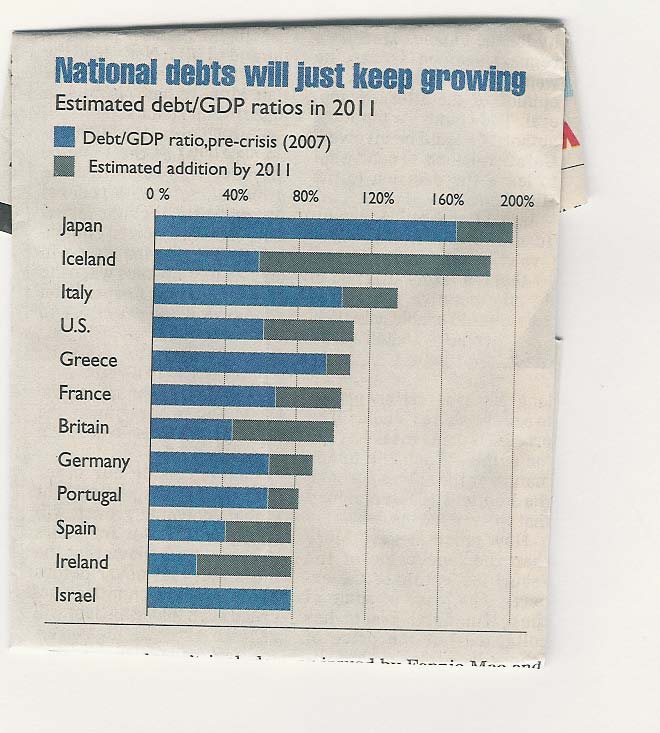
In a nutshell: The world is entering a new phase of the old global crisis, rather than a new phase of crisis-free growth. Here is why. Nations threw vast amounts of money onto the bonfire of recession, to douse it. The result: Enormous national debt. We now face a period of national deleveraging, as nations seek to reduce the enormous debt burden they accumulated. By definition, this will involve reduced public spending, and hardship for those who rely on government in any way for employment, welfare, health services, etc. In short: Social pain. No political leader anywhere has even begun to inform the electorate that this is in store. All prefer to defer this bitter message. One can understand, though not agree or approve.
Here is a short list of decision dilemmas that political leaders will face, in the coming period of deleveraging, 2010-2015. Each leader — Obama, Cameron, Sarkozy, Merkel, Papandreou, Berlusconi, Calderon, Harper, Medvedev, and so on — will be measured by how they manage these fierce dilemmas.
1. JOB CREATION VS. FISCAL SOUNDNESS
When governments slash deficits, while consumers and businesses still refrain from spending and global trade is still limping, demand will be deficient, unemployment may rise. This is a very difficult tradeoff. Fiscal soundness could lead to a renewed recession.
2. MARKET FREEDOM VS. PRO-ACTIVE INDUSTRIAL POLICIES
Governments will need to rethink their industrial policies, and become pro-active, because unregulated market freedom proved unreliable.
3. ATTRACTING FOREIGN CAPITAL VS. WAGE EQUITY
Workers will seek wage increases, which may threaten inward foreign investment. Maintaining balance between labor and capital will be tough; labor will ask, why should the workers pay the price for the destruction wrought by greedy capitalists?
4. SHORT TERM SUCCESS VS. LONG-TERM STRUCTURAL REFORM
Politicians will focus on short-term survival, while neglecting painful structural long-term reforms that are vitally needed.
5. INFRASTRUCTURE INVESTMENT VS. CONTROL OF SPENDING
Many nations desperately need infrastructure investment (e.g. U.S.), but fiscal tightening may prevent it. This would be a mistake — infrastructure creates assets that pay high returns.
6. AMPLE CREDIT FOR GROWTH VS. DEBT REDUCTION
Economic growth requires credit expansion; yet some Central Banks fear renewed inflation, and are tightening credit, while banks reduce lending to shore up their balance sheets and pay off debt. The next recession may occur in part due to shortage of credit for expansion.
Global Crisis/Innovation Blog
High Frequency Trading: One More Reason to Worry
By Shlomo Maital
Global markets and those who wheel and deal in them seem able to provide ordinary people with newer and better reasons to worry, far faster than regulators can bandage wounds and patch up the leaks. High Frequency Trading (HFT) is an example. HFT is an innovation, in which computer experts use super high-powered computers to identify small profit opportunities, and capture them within milli-seconds, far faster than human eyes, brains and fingers can move. These experts care nothing about fundamentals or companies, simply seek small arbitrage profits. HFT crashed the markets on Thursday May 6, now known as Hysterical Thursday. The US stock market fell 6 per cent…in 20 minutes! And it will likely happen again.
Here is what happened according to Nina Mehta, Lynn Thomasson and Paul M. Barrett
Bloomberg Business Week, Features, May 20 (“The machines that ate the market”):
“Once upon a time, human beings oversaw the trading of stocks. They’ve been replaced by a complex system of computers that can produce a scary new kind of mechanized panic. Hysterical Thursday did no apparent long-term harm. Some venerable stocks dropped to a penny apiece before bouncing back. Overall, the Standard & Poor’s 500-stock index declined 6.2 percent, from 1,136.16 to 1,065.79, in a 20-minute span—an $862 billion paper loss—before recovering to finish down 3.2 percent. The brief crash threw up a flare that illuminated a financial topography that was unfamiliar even to many experienced investors.
A Bloomberg Businessweek investigation into those harrowing minutes revealed the extent to which the market is now dominated by quick-draw traders who have no intrinsic interest in the fate of companies or industries. Instead, these former mathematicians and computer scientists see securities as a cascade of abstract data. They direct their mainframes to sift the information flows for minute discrepancies, such as when futures contracts fall out of sync with related underlying stocks. High-frequency traders (HFTs), as they’re known, set an astonishing pace. On May 6, 19 billion shares were bought and sold; as recently as 1998, 3 billion shares constituted a very busy day.
This is not the first time computers have wreaked stock market havoc. On Oct. 19 1987 the NYSE fell 20 percent in one day, because of ‘programmed trading’ — computers programs that traded spot (stocks for immediate delivery) and derivatives (options and futures). Problem was, the spot trading was on the NYSE and the derivatives, on the Chicago exchange. A doom loop was created in which falling spot prices triggered selling, and that in turn triggered derivatives selling, which triggered spot selling, etc… Eventually authorities put a stop to it with “circuit breakers”. On May 6: “The SEC and the Commodity Futures Trading Commission stated, ‘We continue to believe that the market disruption of May 6 was exacerbated by disparate trading rules and conventions across the exchanges.’ It’s that old déjà vu all over again.
I often ask financial traders and speculators what is the redeeming social value of what they do. I always get the same vapid answer: Liquidity. Apparently, HFT creates “liquidity”. Let me translate.
Liquidity means generating huge volumes of traffic, meaning that small profits on each transaction, multiplied by billions of transactions, yields huge profit. The activity draws in unsuspecting amateurs into the game, bringing new money, much like suckers pulled into a poker game manned by hardened professionals who take their money with glee.
Eventually the regulators will get control of HFT. Until they do, if you’re in the market, expect more Hysterical Thursdays..and Mondays, Tuesdays…… or simply, stay out of the market.
Global Crisis
Interlinked Markets: Strength and Weakness
By Shlomo Maital
The head of the European Central Bank, Jean-Claude Trichet almost always speaks in understatements. When he says “Europe is undoubtedly in the world situation since WWII, perhaps even since WWI. The markets stopped functioning!”, then things must be really bad.
But why? Greece is a tiny country of only 11 m., nearly all the other 27 EU countries are larger, and Greece’s population is only 2 per cent of the EU’s 501 m. people. Why should the downgrading of Greek Government bonds to BB (junk) status topple the euro?
The answer is found in Nelson Schwartz’s and Eric Dash’s fine reporting in yesterday’s New York Times (“Fears intensify that the euro crisis could snowball”). There is a powerful domino effect. One bank lends to another. One country lends to another. And another. Topple one domino, even a small one, and a lot of other dominos fall very quickly. Why was Citigroup bailed out? AIG? Because their failure would have toppled other institutions, who would in turn topple others…and so on, and no-one knew for sure where the falling dominos would end.
According to Schwartz and Dash, Portuguese banks owe $86 b. to Spanish banks, which in turn owe $238 b. to German banks and $220 b. to French banks. American banks, in turn, hold $200 b. of Spanish bank debt, according to the Bank of International Settlements (the Central Banks’ bank). A great many American financial institutions have lent money to a variety of European banks and governments. The fall in the euro, relative to the dollar, has already caused them major losses.
I doubt that anyone fully understands all the complex financial links among governments and banks worldwide. What we do know is that they are all tightly and closely intertwined. In normal stable times, an integrated global capital market is a powerful tool for spurring growth and credit. In crisis-ridden unstable times, it becomes a mechanism for spreading crisis from one small corner of the world to the entire world. That is why John Donne’s famous medieval sermon applies more powerfully than ever, today: “Ask not for whom the bell (euro) tolls. It tolls for thee.”
Global Crisis Blog
The Betrayal of American Prosperity
By Shlomo Maital
Clyde Prestowitz was President Reagan’s chief trade negotiator. Later he founded the Economic Strategy Institute. Clyde knows more about trade and trade negotiations than anyone. And he is deeply troubled by how American political leaders, Republican and Democrat alike, have sold America out, given away the store, and ruined their country. He expresses this forcefully in his new book, just published: The Betrayal of American Prosperity (Free Press, 2010). Here is a small taste:
“In The Betrayal of American Prosperity, I explain that in the 150
years between 1800 and 1950 America became the richest country the
world had ever seen by developing an economic strategy similar to
that of China today. The United States rejected Adam Smith’s call
for it to be primarily a supplier of raw materials and agricultural
commodities and set out consciously to build a business-government
partnership to overtake the industrial leadership of Great Britain
by promoting technology development, investment in American
production in key industries, and massive infrastructure projects
like the transcontinental railroad. In the past fifty years,
however, we have largely turned our backs on this approach while
our “brightest and best” have subordinated our economic development
to geo-political priorities and embraced false doctrines like
consumerism, efficient markets, Ricardian free trade, and
shareholder value that, in an era of companies without countries,
are rapidly eroding the bases of our prosperity and national
security.”
Consider this, Prestowitz notes. “China’s #1 export to the U.S. is computer equipment ($46 b.). America’s #1 export to China is waste paper and scrap metal ($7 b.).” Question: Which is the underdeveloped country?
“If we do not make dramatic changes quickly,” Prestowitz says, “we will confront a painful permanent slide in our standard of living.”
Think carefully about the probability that an American president, even Obama, will inflict pain in order to fix the decline and deterioration of America over 50 years. Then judge your own investments and business accordingly, in a world where America’s decline is drastic and irreversible.
Global Crisis Blog
Global Crisis Act Five: Everything You Always Wanted to Know But Were Afraid to Ask the Economists, in 400 Words
When I entered the exclusive Ph.D. Economists’ Guild, I had to take an exam, to see if I was skilled at mystifying, obfuscating and baffling by using incomprehensive jargon. I passed. It took me 40 years to resign.
As part of my Economists’ Anonymous weekly regime (“My name is Shlomo. I am an economist….”), here is a brief attempt to explain what in the world is going on.
Act One. Badly-regulated traders on Wall St. create junk assets, sell them to clients, then speculate against them by shorting them, knowing those assets (“sub-prime”) will collapse. This act ends badly with financial crisis, beginning in 2007.
Act Two. The financial collapse spreads around the world, creating economic crisis and recession, as financial collapses always do. Governments react by massive credit expansion and huge budget deficits, just as the economists prescribe. It works partly, by softening the depth of the crisis and by shortening it. But banks fail to cooperate, choosing to hang on to the government money rather than lend it. And …the act ends with deep worries, about Act Three…
Act Three. Jobs crisis. Companies worldwide engage in cost cutting, in reaction to the excessive layers of workers employed during the boom times. They discover, wow!, they can manage with fewer workers but equal or higher output. In the U.S. productivity growth soars, creating all the GDP growth (little GDP growth comes from added hiring). Unemployment soars and sticks stubbornly, despite GDP growth recovery. And, then comes Act Four, perhaps the worst of all…
Act Four. Just when you thought the play was going to have a happy end — Greece collapses, and world credit markets have a nervous breakdown. It turns out: By their deficit spending and massive borrowing, sovereign governments have panicked investors, who have become allergic to risk owing to the 2007-9 crisis. And traders, hungry for profit, do what they always do best — attack the weak, shorting assets of governments unable to control deficits and reduce their leverage. Europe proves inept at defending its currency by supporting its weaker members.
Act Five… Still being written. Could be very unhappy. If you think little Greece (population 11m., debt amounting to, say, $120 b.) is in trouble — wait ’til you see Britain, Spain, and Italy. Their outstanding debt is over $1.6 trillion.
Politicians everywhere face this dilemma: Inflict pain, slash deficits and reassure capital markets, causing renewed recession, because businesses and people still aren’t spending, while government demand is the main or only source of growth. Or fail to do so, and see capital flee your country and see your currency (if you have one) and your economy crash.
The worst job in the world awaits Britain’s new Prime Minister. People hate “doctors” who inflict pain, even when they know the medicine is vital to cure them.
That’s it. 400 words. I wish I could write the ending. But frankly, I have no clue.
Global Crisis Blog
Spain — Could You See It Coming?
By Shlomo Maital
There is a powerful domino effect in global markets. One nation dives into crisis, and as it solves its problem, crashes into another country, which in turn dives into crisis. Since 1994, the list of dominos falling has been: Mexico (1994), Thailand (1997), (Indonesia, and much of Asia), Russia (1998), Brazil (2000), Argentina (2001), U.S. (2007), now Greece (2010), and perhaps, next? Portugal? Spain? Greece is a small country, with only 11 m. people. Spain is a huge country, and if it goes into crisis, the magnitude of the problem will be orders of magnitude bigger. Spain has 40 million people and a GDP of some $1.5 trillion.
The basic problem with the European Union is that it has no non-crisis mechanism to help member countries in trouble — only emergency bailouts. Monetary policy is made for the whole EU. That leaves individual governments only with fiscal policy. But when deficits soar, that too is effectively neutralized, leaving no real way to stimulate the economy. With the EU very slow to engineer bailouts, largely because of German reluctance, crises become full-blown before the EU takes action.
This year, 2010, Spain’s GDP will decline, at a time when most countries are experiencing renewed growth. Spain’s budget deficit will remain at 10-11 per cent, its level in 2009. In the first quarter of this year, Spain’s unemployment rate topped 20 per cent, the highest it has been in 13 years. Like Greece, Spain’s government is socialist. Its socialist Prime Minister Zapatero has been slow to react to the crisis and to take the painful measures needed to address it. As a result, Standard & Poor slashed Spain’s credit rating on April 28, making Spain’s debt servicing costs even higher. You could see it coming.
Global capital markets are quick to punish countries unable to restore fiscal stability by inflicting pain. Like dominos, one country falls after another. This is especially true in the post 2007-9 global crisis, when owners and investors of capital are hyper-sensitive to risk. Governments must realize that unless they run their countries’ budgets in a sound and responsible way, unless they treat their country as a business and engineer turnarounds (as companies do when their revenues slump), they will face rapid flights of capital and soaring risk premiums.
Global Crisis
First Greece, now Spain: Can Countries Learn?
By Shlomo Maital
A key principle of benchmarking is to solve your problems by first studying carefully how others have avoided or solved them. Even as Greece’s crisis is being solved (with North Rhine-Westphalia elections upcoming in Germany, on May 9, Chancellor Merkel is fiercely resisting committing German taxpayers’ money to the rescue, even though it will be forthcoming — on May 10), new ones are emerging — Portugal, perhaps Spain. The size of Spain will make its crisis huge, dwarfing Greece, if it occurs.
Many nations, including America, Britain and Spain, face huge fiscal deficits and the need to slash them, while lacking the political will to do so. In Britain, just before a national election, in a television debate, not one of the three political leaders (Cameron, Brown, Clegg) was willing even to hint how they would slash spending and boost taxes. Yet one of them, whoever becomes Prime Minister, will have to do so, and fast. How duplicitous not to reveal what they would do, simply because it will cause pain — mainly, to their political party.
Here is my suggestion. After the UK election, let the Prime Minister-designate climb on a plane. First stop: Ottawa, Canada. Examine how Canada’s Stephen Harper slashed public spending, across the board, putting Canada’s budget into shape and avoiding the deep hole America has dug for itself. Next, fly back to Stockholm. Sweden, once socialist, and still highly social-welfare oriented, slashed its spending and especially public pensions; people in Sweden now retire at far older ages. Then fly to Seoul, South Korea. Here is what McKinsey Global experts write about South Korea and its strong performance despite the global crisis:
============================
South Korea sailed through the 2008–09 financial crisis with remarkable aplomb. Despite its heavy reliance on exports, South Korea registered only a single sequential quarterly decline in real GDP during the global downturn, thus avoiding full-fledged recession. By the third quarter of 2009, South Korean growth had bounced back to nearly 3 percent while unemployment—which even in the worst of the crisis never rose more than a singlepercentage point—had already begun to ease. Indeed, it took barely three quarters for South Korea’s production and consumption to regain pre-crisis levels. Among Asia’s “tiger economies,” South Korea suffered least from the crisis and recovered the most rapidly.
Why was the South Korean economy so resilient? Because its businesses and government leaders recognized the opportunity this crisis presented. The familiar rap on South Korea is that its economy is “stuck in the middle,” trapped between an advanced Japan and a rising China. South Korea’s great dilemma—or so it’s often said—is that it falls short of Japan on quality and can’t hope to match China on price. And yet South Korean producers’ performance in the wake of the financial crisis suggests the middle ground may offer advantages. In the post-crisis era, consumers the world over have turned cautious. The new mantra is value for money. South Korean companies are well positioned to capitalize on that new ethos with products that optimize the quality and price tradeoff. South Korean exporters have, in fact, gained market share during the crisis. South Korea’s global market share in phone handsets, for example, rose to 33 percent in the third quarter of 2009, from 22 percent at the end of 2007. In fact, in the US market alone, South Korean mobile phones are currently taking up almost 50 percent of the market share. Its LCD-TV global market share also jumped to 37 percent in 2009, from 27 percent at the end of 2007, and it will soon replace Japan as the world’s number-one LCD-TV supplier. South Korea’s automobile global market share climbed to 9 percent in the third quarter of 2009, from 6.5 percent in the final period of 2007.[1]
=================================
It is supremely easy to blame the global crisis for a nation’s woes. It is also supremely wrong. Some nations, perhaps only a few, navigated through the turbulence with great wisdom and skill. Most nations stumbled through it and rather than resolve the crisis, simply transformed it from a banking crisis, say, into a sovereign debt crisis (Greece, perhaps UK and Spain).
Let the bungling nations carefully study the wise ones and learn.
[1] McKinsey Quarterly. South Korea: Finding Its Place on the World Stage. April 2010.
Innovation Blog
Goldman Sachs: A Tale of Complexity
By Shlomo Maital
According to The Economist:
Wall Street was stunned as civil-fraud charges were brought against GOLDMAN SACHS. The Securities and Exchange Commission alleges that thebank deceived investors in a synthetic collateralised-debt obligation built on mortgage assets, by not disclosing that Paulson, a hedge fund that had some say in choosing which securities went into the product, would profit if the CDO performed poorly. Goldman vigorously denied the allegations.
Synthetic collateralized debt obligation? How many people know what that is? How many finance professionals understand what it is? There is a key point here, beneath the allegations of corrupt behavior.
Simplicity is a core principle, in strategy, business design, in finance, in life. Complexity can only be justified, if it exists within organizations in order to simplify life for clients and customers. For instance, IBM complicates its organizational structure, using a matrix structure and a customer-facing executive, who puts together a complex virtual organization, with the sole purpose of simplifying life for the client.
Allegedly, Goldman Sachs used the complexity of CDO’s (collateralized debt obligations) to obscure the fact that the “collateral” was not real — the sub-prime mortgages that comprised the collateral were worthless. They sold UDO’s uncollateralized debt obligations, allegedly, worth about as much as UFO’s (unidentified flying objects, or aliens). Very few people sat down and read the legal documents, that showed what “collateral” really underpinned the security. (One who did was the doctor with Asperger’s Disease, whose illness enabled him to carefully read the fine print, and profit vastly from it by selling them short!).
Complexity, when it serves clients by making their own lives simpler, is wonderful. Complexity, when it hides alleged nefarious manipulations, is contemptible.
In the end, it is caveat emptor. Buyer, beware! If you don’t understand it fully, and if they can’t explain it to you — run as far and as fast as you can. Why didn’t Goldman Sachs’ clients do this?
Global Crisis Blog
Nations as Brands: America Improves!
By Shlomo Maital
The BBC World Service regularly conducts polls about how people around the world perceive nations, asking whether Country X’s influence is mostly positive or negative.
The latest such poll was published on April 18. It covers people in 28 countries. Here are the results:
* Negative ratings of the U.S. dropped by a huge 9 points during the past year. The US is viewed positively, on balance, in 20 or 28 countries, with 46% saying it has a positive influence, while 34 % say its influence is negative. Much of this change can probably be attributed to the departure of George Bush and Presidency of Barack Obama.
* Germany is most favorably viewed, with a 59% positive rating, followed by Japan 53%, UK 52%, Canada 51% and France 29%. The EU is viewed positively by 53%.
* Iran is the least favorably viewed nation (15% positive), followed by Pakistan (16%), North Korea (17%), Israel (19%) and Russia (30%).
* The US has now overtaken China in terms of positive perceptions.
* Mexico has low ratings, perhaps owing to the drug-related violence.
* People in China and Russia have changed their views on Iran; far more see Iran in a negative light, far fewer, in a positive light.
Perceptions of nations have a direct measurable influence on countries’ trade and foreign investment. Israel’s negative perception has held true for years; its leaders do not seem overly concerned. Unless this image problem is dealt with head on, it will soon find expression in Israel’s economic wellbeing.
Global Crisis/Innovation Blog
Think Different — How to Turn Bad News Into Good
By Shlomo Maital
How many of us read the newspaper daily, and cluck our tongues at the continual stream of bad news, crises, disaster, looming disaster and violence? Why do we buy in to the untested and I believe wrong assumption of editors and publishers, that bad news sells more papers and gets more eyeballs than good? [A friend of mine, a journalist, wanted to write up a charity project I run, but said his editor said no, he wanted scandal, not do-gooders!].
Here is a suggestion for a brain exercise, that can transform bad news into good. We cannot change the editorial policy of the Herald Tribune, New York Times or Wall Street Journal. But we can change the way we USE the news.
1. Read, say, the Financial Times. Find the bad news stories.
2. For each, think about how they can be transformed from a bad-news crisis story into a good-news business opportunity.
3. Make this a permanent HABIT. Do it daily. You will be surprised at how many fine change-the-world ideas emerge from a constant stream of negative articles.
Just to make the point, here are some examples from Wednesday’s Financial Times:
* “Only rebalancing will revive Britain’s precarious economy” (Martin Wolf). Britons are in hock, and have overspent; they can’t resume spending, but unless they do, the British economy will remain weak.
Opportunity: A consulting service for individual families that does ‘turnaround’ plans for them, consolidates their debt, and makes them financially sound, something many families cannot do for themselves. It could be government-sponsored. Good result: Financially healthy families may feel more optimistic, better organized to resume spending.
* “IMF to weigh bank surcharges”. IMF wants banks to increase their capital. Opportunity: Money is going to get scarce. Banks will lend less. They are already leery about lending. Start a service helping CFO’s stretch their cash, and find unique creative ways to get working capital.
* “IAE says oil demand will rise to record levels in 2010”. Opportunity: anything and everything that can conserve fuel, electricity, energy, or create new forms.
* “Twitter starts ads”. Opportunity: How can you leverage Twitter for clever creative advertising?
* “Mongolia rail push”. Mongolia’s government wants to build 5,000 km. of rail lines. Opportunity: If you have any knowledge about railroads and related services: here’s your chance.
For more about this brain exercise, please read our forthcoming book Global Risk/Global Opportunity (Maital and Seshadri), SAGE India June 2010.


