You are currently browsing the category archive for the ‘Global Crisis Blog’ category.
National Happiness – 2013 Rankings
By Shlomo Maital

Three eminent economists – Richard Layard, John Helliwell and Jeffrey Sachs – combine to prepare an annual World Happiness Report. Their measure is based on self-assessed happiness, interpreted as “satisfaction with life” together with the perceived emotion of wellbeing. In their latest report, for the years 2010-12, (see above), Scandinavian and Northern European countries rank highest, along with Canada, Austria, and surprisingly, my country Israel (11th), despite the Mideast conflict, and Costa Rica, a relatively poor but serene and beautiful country. Note that Mexico, at 16th, ranks above the United States, despite the latter’s $50,000 GDP per capita.
Why? The answer is simple. Happiness, note the authors, is driven in part by the standard of living (per capita GDP), but also by life expectancy, social support, freedom to make life choices, and generosity. This is why Qatar, the wealthiest country in the world by far, with per capita GDP of nearly $100,000, ranks only 27th, because it is a rigid autocracy.
I am amazed at how poorly individuals and whole nations practice the simple art of best-practice benchmarking. If you are a political leader, and if your avowed goal is to improve the wellbeing of your citizens, the ones who elected you, would you not explore the world and visit the places in which people are the happiest, and try to find out why? And would you not try to bring home some of the “recipes” they use – income equality, social support, generosity, social cohesion?
I get this response very often when I make this argument: Israel is not Denmark. Followed by all the excuses. And my response is: Well – why isn’t it? Can we make it so?
There is a lesson for individuals in this Report, not just for countries. True, you do need a basic level of income to be happy. But you also need the love and support of family, the generosity of others, and good health (supplied, as a public good “health care”, by good governments, or at least they should). Even if you have high income, if you lack the other ingredients, the income may not help much. Keep this in mind.
Meltdown 2015 – 7 Reasons It May Happen
By Shlomo Maital

IMD (a leading European business school based in Lausanne, Switzerland) Professor Arturo Bris offers eight reasons why a financial and economic meltdown in 2015 is likely. He may be wrong – but we should all be aware of the underlying danger signals. Forewarned is forearmed, or, as the Boy Scouts say, “be prepared”.
- Stock market bubble: equities rose 18 percent between June 2013 and June 2014. Bob Shiller (Yale) says the gap between stock prices and corporate earnings is larger than it was in the crisis periods of 2000 and 2007. Why the bubble? Because there is just so much money, those who hold it are desperate to put it SOMEwhere… no matter what.
- Chinese banking system: Need more be said?
- Energy crisis: If the US Congress allows energy exports, it could crash the price for oil, and sink Russia and other oil-reliant countries. This could lead to violence.
- New real estate bubble: The housing bubble is back – low interest rates, rising real estate prices in many markets.
- Corporate failures: Corporate debt is now rated, on average, BBB. This means that in the next 5 years about 16 companies in the S&P 500 will go bankrupt. This could have major impact.
- Geopolitical crisis: The world is a huge mess, with civil wars raging in the Mideast and elsewhere.
- Poverty crisis: The number of people in the world living in abject poverty grows. This is dangerous; because desperate people may do desperate things.
- Cash crisis: There is simply too much money out there. Central banks have printed enormous amounts of cash, and it is floating around the world. Some banks and some companies are so rich they could buy entire companies (anyone want to buy Israel? Jamaica?). Right now that money is just sitting. If it starts to move, if its velocity rises, we may get huge problems.
- It is possible to prevent a meltdown, if a) politicians are aware it could happen, and b) begin taking action NOW. But both a) and b) are highly unlikely. We the people should therefore try to be aware of the meltdown danger, and begin taking our own steps to protect our families our incomes and our assets
How Competing For Grants Kills Science – and Scientists’ Motivation
By Shlomo Maital

This is the sad story about how a shortage of resources, and the system of competitive funding of research grants through peer-review, is ruining U.S. science and killing scientists’ motivation. I heard it today on America’s National Public Radio News, in a report by Richard Harris.
Ian Glomski thought he was going to make a difference in the fight to protect people from deadly anthrax germs. He had done everything right – attended one top university, landed an assistant professorship at another. But Glomski ran head-on into an unpleasant reality: These days, the scramble for money to conduct research has become stultifying. So, he’s giving up on science. Ian Glomski outside his home in Charlottesville, Va. He quit an academic career in microbiology to start a liquor distillery.
Why is he giving up????
Because to get grants, you need to ‘tweak’ safe existing ideas, so your peers will approve it; because if you have radical ideas, your peers who judge the grants competition will shoot them down, because if you succeed, those ideas will endanger the judges’ own safe, conventional, non-risky research.
“You’re focusing basically on one idea you already have and making it as presentable as possible,” he says. “You’re not spending time making new ideas. And it’s making new ideas, for me personally, that I found rewarding. That’s what my passion was about.”
Glomski wanted to study anthrax ‘in vitro’, in live animals, using scanning techniques. Today it’s done by analyzing tissues of dead animals. His idea might have failed. But if it succeeded, it could have utterly changed our understanding of anthrax and other such diseases.
In theory, peer-review of grants is fair. But it fosters extreme mediocrity. And as government funding of research declines, (20% cut in recent years), competition gets fierce (1 of 8 grant proposals is successful, and it takes long stretches of time to prepare one – so young scientists spend their time writing proposals rather than doing effective research).
Harris reports that “…. payoffs in science come from out of the blue – oddball ideas or unexpected byways. Glomski says that’s what research was like for him as he was getting his Ph.D. at the University of California, Berkeley. His lab leader there got funding to probe the frontiers. But Glomski sees that far-sighted approach disappearing today.” Playing it safe will never generate the creative breakthroughs we need.
As with many things in America, scientific research is utterly screwed up. And it is unlike to change in the near future.
Raise the U.S. Minimum Wage – Now!
By Shlomo Maital
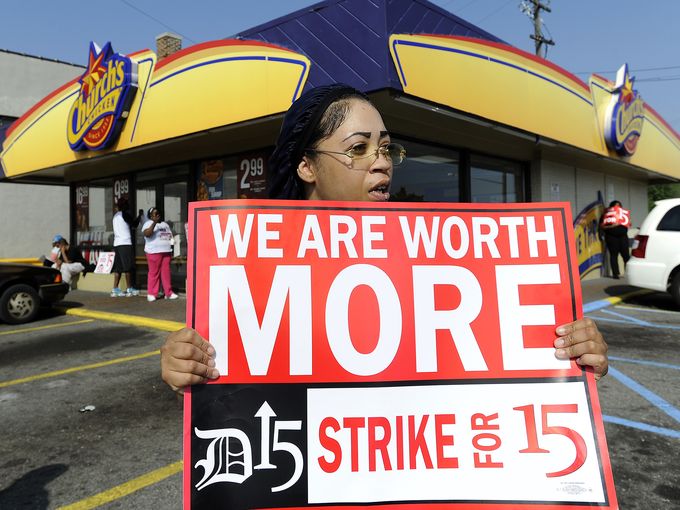
Have you wondered, why low-paid American workers, who lost well-paying jobs in manufacturing to Asia and instead got low-paying jobs in services, like fast foods, have been so passive under exploitation and poverty?
No longer. A spontaneous group of fast food workers has organized, using social networks, and have mounted demonstrations in major cities. Many earn minimum wage, which in some places is $7.50 an hour. That means you get $30 a week for a 40 hour work week, or $120 a month — $14,400 a year. Nobody can survive on that.
Is that what they are worth? Is that commensurate, as economists say, with the value of the marginal product of their labor? I doubt it, given Macdonald’s fat profits.
But wait! If you raise the minimum wage, you will cause more unemployment and hardship, because the higher the price of something, the less is the demand. Right?
Here is what Zeynep Ton writes in Fortune (he’s an adjunct associate professor of operations management at the MIT Sloan School of Management and the author of The Good Jobs Strategy: How the Smartest Companies Invest in Employees to Lower Costs and Boost Profits).
I studied four retail chains that manage (to pay workers more than minimum wages); Costco, Trader Joe’s, QuikTrip (a U.S. chain of convenience stores with gas stations), and Mercadona (Spain’s largest supermarket chain). They offer their employees much better jobs than their competitors, all the while keeping their prices low and performing well in all the ways that matter to any business. They have high productivity, great customer service, healthy growth, and excellent returns to their investors. They compete head-on with companies that spend far less on their employees, and they win.
Zeynet Ton notes: “Nearly one fifth of American workers work in retail and fast food, and they have bad jobs. They earn poverty-level wages, have unpredictable schedules that make it hard to hold on to a second job, and have few opportunities for success and growth. These are not just people who are uneducated or unskilled. In 2010 more than a third of all working adults with jobs that did not pay a living wage had at least some college education or a degree.”
It’s simple. To boost a flagging economy, put more income into the hands of those who need it; they spend it, creating demand, more jobs, and by Keynes’ multiplier effect, economic growth.
Does this sound more logical than the European no-brain austerity program? And, if nothing else, more fair?
How to Build Great Ideas On Key Facts
By Shlomo Maital

How do you develop great ideas for startups (whether social or business-oriented), that truly meet unsatisfied wants and change the world?
I got an idea about ideas, from the current issue of TIME Magazine, of all places (Sept. 8 and 15 double issue). This issue has an incredible number of interesting facts, presented creatively, visually.
You get great ideas from one key fact. That fact at one fell swoop demonstrates vividly the need, and sets the stage for thinking big, for tackling huge problems with huge impact, if successful.
Examples?
- At present, 2.4 billion people are connected to the Internet; 44.8 percent of them are in Asia. That means that 4.6 billion people have NO Internet connection. How can this pressing need best be met? Challenge: Find a way to bring the Internet to 4.5 billion people who currently lack it.
- At present, 2.8 billion people in the world cook over open fires; 4.3 million people die each year due to indoor air pollution, caused by open fires used for cooking. Most of the deaths are women and children. Challenge? Find a way to save millions of lives, lost through inhalation of smoke from indoor cooking fires;
- Half the world’s children go to schools without electricity. Challenge: Find a way to bring electricity to the 1.3 billion people in the world who have no access to it.
- Between 1998 and 2010, 463 children have died of overheating or hyperthermia in cars in the United States, the majority of whom were accidently left behind by caregivers. Challenge: Find a simple way to prevent this.
- 60 million plastic water bottles are used annually in the United States alone. Challenge: Find a biodegradable plastic, that degrades in 90 days, and that also fertilizes plants. (One of my students in Shantou Univ. China, is close to a solution).
* Apple has $158.8 billion in unspent cash reserves. Huge cash reserves are held (abroad) by Microsoft, Cisco, Google, Pfizer, and other U.S. companies. Challenge: Feasible legislation to get them to bring the money home and invest it in America.
And, one example of how this could work.
- Why don’t we get heart cancer??? Because tumors grow when cells divide and multiply uncontrolled – but heart cells never split and multiply, beginning shortly after birth, unlike other cells.
- Idea: Technion Prof. Yoram Palti thought that if you put an electro-magnetic field around, say, the brain, when brain tumor cells tried to divide, creating a narrow cell wall, you could explode them with the magnetic field. This could treat ‘untreatable’ tumors and stop them in their tracks. Basis: Cell division is largely by sick ‘cancer’ cells. Palti, who is over 70, and his startup now have a proven device that stops brain tumors in their tracks, as well as lung cancer (very hard to treat). Check out “Novocure”. Thanks, Prof. Palti!
Understanding the Mideast: A Guide for the Perplexed
By Shlomo Maital

Are you having trouble understanding what is going on in the Mideast? What leads one human being to behead another human being – twice? I LIVE in the Mideast, and have lived here for nearly 50 years. And I’m having real trouble getting the picture.
When in doubt, ask Tom Friedman, New York Times columnist, who does his research through the soles of his feet. Here is the best summary I know, (from his NYT column today), in just a few words, and it explains why President Obama is not a wimp, but is justifiably cautious, listening to his experts. There are not one, not two, but THREE civil wars ongoing. [ By the way, ISIS, Islamic State in Syria, is called ISIL by Obama, because the literal translation from the Arabic is Islamic State in the Levant, where Levant means the whole Near East…a one-letter different that is highly significant]:
“…. There are three civil wars raging in the Arab world today: 1) the civil war within Sunni Islam between radical jihadists and moderate mainstream Sunni Muslims and regimes; 2) the civil war across the region between Sunnis funded by Saudi Arabia and Shiites funded by Iran; and 3) the civil war between Sunni jihadists and all other minorities in the region — Yazidis, Turkmen, Kurds, Christians, Jews and Alawites.
Friedman might also have mentioned the festering conflict between Israelis and Palestinians, a century old, predating the establishment of Israel.
So, what does Friedman recommend for battling ISIL? “I support using U.S. air power and special forces to root it out, but only as part of a coalition, where everybody who has a stake in stability there pays their share and where mainstream Sunnis and Shiites take the lead by demonstrating that they hate ISIS more than they hate each other. Otherwise, we’ll end up in the middle of a God-awful mess of duplicitous allies and sectarian passions, and nothing good we do will last.”
Makes sense? In Israel, I live next door to a “God-awful mess of duplicitous allies and sectarian passions”. There goes my neighborhood…. if yours is much better, be thankful.
Why Totally Useless Information Is VERY Useful
By Shlomo Maital

I’m reading Don Vorhees’ 2012 book, The Book of Totally Useless Information. In it, he explains the ‘not-so-important’ questions in life, offering over 200 explanations. Such as: why Scottish Highlanders wear kilts, why there are 7 days in a week, why the British drive on the left, why a left-handed pitcher is known as a ‘southpaw’, why pregnant women crave pickles, why keyboards are arranged as QWERTY, why are teddy bears so named, and was Dr. Seuss really a ‘doctor’?
It’s all really interesting. And it belies what the Roman philosopher Seneca said 2000 years ago: What is the point of having countless books whose titles the reader could never read in a lifetime? We do not have information overload, or useless information, or superfluous information – we LACK useful relevant answers to key questions.
Innovative people, creative people, are infinitely curious. There is no such thing, for them, as useless information. Because, you never know what ‘useless’ piece of information will suddenly prove highly useful, in a totally unexpected context. So, remain curious, and learn all the ‘useless’ things you can.
And, if you’re curious – here are some of the answers: Scotsmen (never women) wear kilts, because they are practical, warm, and highly versatile. There are 7 days in a week, because that’s what the Babylonians decided. The British drive on the left, because the buggy driver sat on the right and used his whip – driving on the right endangered pedestrians, who might be accidentally whipped. Pregnant women crave pickles because they contain salt, and because pregnant women need more salt, for their embryo (who swims in a salt bath). Dr. Seuss never was a doctor. And QWERTY? So arranged, so that typists had to type slowly, so that typewriter keys would not jam, …
Any questions?
Which VC’s Offer Seed Money?
By Shlomo Maital


The tables above show VC funds and angels that invested in zero-stage startups in the period Jan. 1 2009 through Aug. 21 2014, in the U.S. and in Europe. If you have an early stage startup and are seeking funding, perhaps you should ‘pitch’ to one of these funds.
But notice: How very few investments were made, in two huge areas, U.S. and EU, in 2009-2014. VC funds, it is well known, have capital, but very little ‘venture’. Seed money, and zero stage investors, are scarce everywhere, because the risks are so high, and because it is so difficult to pick winners at such an early stage.
I recommend that you consider bootstrapping – get your business going with just your own savings. The farther along you are, the closer you are to a prototype, the more the VC’s will listen respectfully to your pitch.
Why I Live in the House by the Side of the Road
By Shlomo Maital

In Sam Foss’s famous poem, he explains why he prefers the ‘house by the side of the road’, rather than the road itself:
Let me live in my house by the side of the road,
Where the race of men go by-
They are good, they are bad, they are weak, they are strong,
Wise, foolish – so am I. Then why should I sit in the scorner’s seat,
Or hurl the cynic’s ban?
Let me live in my house by the side of the road And be a friend to man.
As a management educator, I live (by definition) by the side of the road, rather than on the road, and I try to teach those with courage, creativity and guts how to navigate startups on the road of life and be a friend to mankind.
I’ve done this for 40 years. By Oscar Wilde’s principle, “if you can do; if you can’t teach”…. I teach and admire those who actually do.
Today, by the side of the road, two events made me exceedingly happy.
- FDA approval was granted for the ReWalk device, by an Israeli, Dr. Amit Gofer and his Argo Technologies, an exoskeleton that enables paraplegics to walk and even climb steps. Dr. Gofer is a quadriplegic and cannot use his own device – but is working on a ReWalk version suitable for quadriplegics too.
An American veteran was interviewed on National Public Radio and he explained why it is so important for him to be able to stand upright – and how he dreams of himself owning a ReWalk device (it costs $70,000, at the moment – if America built one less useless aircraft carrier, every single one of thousands of U.S. paraplegic soldiers/veterans could have a device!)
- In downtown Brookline, part of Boston, MA., I saw a Big Belly solar powered trash compactor. (See photo). I teach this business case, about MBA student James Poss who won a business-plan contest and used the money in part to help launch this business. The Big Belly saves 3 out of 4 garbage truck trips, helps the environment, is very esthetic, and is simply cool. Poss thought he would sell them to ski resorts. None bought them – but the City of Boston did. Lesson: Get your product out into the market, as fast as you can, and people will tell you how they want to use it, and WHO wants to use it, and you will often be very very surprised. Until you get your product into the market, you will not have a clue about its true value-creating power. Remember: make your product an MVP – minimum viable product, and then launch it. If you wait for perfection, you will almost always be too late.
So — if I could, I would be on the startup road. But since I can’t, perhaps a house close by the side of the road is OK, too. On days like today, it feels great.
Can Down’s Syndrome Help Cure Alzheimer’s?
By Shlomo Maital

About eight years ago, the BBC reported this:
Scientists believe they have found a possible cause for mental impairment in Down’s syndrome. They have identified a gene that, if over-produced, can cause some brain cells to stop working properly. The next step, say the US researchers in journal Neuron, is to find the mechanism for the process. This, they say, could ultimately lead to finding a way to “turn down” the gene expression so mental decline might be stopped or even reversed. People with Down’s syndrome have three copies of chromosome 21, instead of the normal two – this is called trisomy 21. ….Many people with Down’s syndrome go on to develop dementia, similar to early-onset Alzheimer’s disease, by the age of 40. In both Down’s syndrome and this form of Alzheimer’s, brain cells, or neurons, responsible for learning, memory and attention, wither and die. Lead researcher Professor William Mobley, director of the Neuroscience Institute at Stanford University, said: “We’ve been interested in those neurons and why they get sick for some time.”
Now, reports the BBC, in its excellent Science program, Down’s syndrome persons are making major contributions to Alzheimer’s research. Because Down’s syndrome individuals almost all develop the same type of ‘plaque’ dementia that afflicts Alzheimer’s sufferers, potential preventive drugs can be tested on Down’s syndrome persons well before they are 40, to see which drug actually works as a preventative, and whether such drugs really do prevent the brain’s neurons from being gummed up by protein.
It would be truly wonderful, if the Down’s syndrome persons willing to help scientists research Alzheimer’s really do help find a drug that acts as a preventative. Perhaps one day, just as many of us take 75 mg. of aspirin daily as a stroke preventive, we will take 75 mg. of a preventive drug daily– and the scourge of Alzheimer’s dementia will be defeated. Once the protein plaque has taken hold, little can be done. But clearly the direction for battling Alzheimer’s lies in preventing or forestalling it. Let’s hope.
Thanks, Down’s people. We love you.