
You are currently browsing the category archive for the ‘Innovation Blog’ category.
Innovation Blog
Rewarding Entrepreneurs Who Leave School: Why “Stopping Out” Beats “Dropping Out”
By Shlomo Maital
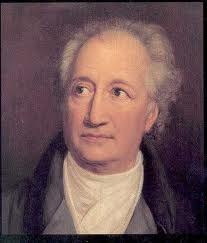
Goethe: ..but doing is best of all
College student: Do you have a business idea that can change the world? Want to get to work and tackle it? But, wait, you have a pressing exam in Medieval Shoelaces 101 and then another in Philosophy of
Navel-Staring in Ming Dynasty China? Oh well…you’ll have your degree in another two years of desperate boredom.
But wait! There is a solution. Facebook investor Peter Thiel has a foundation that gives grants of $100,000 to innovators – provided they leave school! Well, not exactly ‘leave school’ – that’s not a great idea. But ‘stop out’,
leave temporarily, for two years, to build a business idea, rather than ‘drop out’, forever. The story about Thiel
appears in Douglas MacMillan’s ‘top story’ in Bloomberg Business Week, May 25 issue.
Last fall, Princeton University sophomore Eden Full began to consider taking a break from school to turn her side project—a solar panel that rotates without using electricity—into a business. In April, Full got all the motivation she needed when she was told she had won a $100,000 grant. The catch: She has to leave school for at least two years. “It’s time for me to go out and try things in the real world and make mistakes and learn from those mistakes,” says 19-year-old Full. Full is one of two dozen young entrepreneurs named today to the 20 Under 20 Fellowship.
Naturally, educators hate the idea. Says Brian Rosenberg, President of Macalester College in Minnesota, “Mr. Thiel’s program seems not unlike luring college athletes out of degree completion with the promise of a career
in the NFL or NBA.” Ever heard of Lebron James, Mr. Rosenberg?
Among the grant recipients:
- Eden Full, “who will use her grant money to move to SanFrancisco in August and speed up the process of patenting and licensing her solar panel technology. Years of tinkering in science had led her to come up with a contraption for increasing solar panel energy collection by up to 40 percent, partly by removing the electricity commonly used to rotate panels toward the sun.”
- Gary Kurek, “a 19-year-old in Alberta, Canada, who was awarded a Thiel Foundation grant. “After
graduating from high school last year, Kurek was offered a full engineeringscholarship at the University of Calgary. Instead, he decided to take a year off and build his business, a maker of motorized walkers for the elderly called GET Mobility Solutions. Kurek plans to move to San Francisco in September and invest some of the $100,000 in testing and refining his walker product. Then he hopes to begin selling models to hospitals and assisted-care facilities.”
I like to think of Thiel’s program not as ‘stopping out’ but enrolling in Innovation University, a school where you learn hands-on, by doing innovation, where the lessons are sometimes tough and bitter, the rewards huge, and the learning? Well, which is a richer learning environment, a classroom, or the real world? Which is better, thinking, memorizing, or doing? As Goethe said: Thinking is better than knowing – but doing is best of all.
Innovation Blog
Get On the Lady Gaga Bus – Now! What We Can All Learn from Stefani Germanotta
By Shlomo Maital
 Lady Gaga’s ‘meat’ dress
If you believe the phenomenon known as Lady Gaga is not serious – think again! We can all learn a great deal from her. [See Jon Parels, “Lady Gaga’s Roaring Retort”, NYT May 21/22/2011, p. 17].
Most albums are recorded in soundproof high-tech studios, where electronic wizardry shapes
songs to perfection. This is how it is done. This is the rule. Rent time in a studio and make your
album.
But not Lady Gaga. She has just released her new album, “Born This Way”. Released in February, reached No. 1. She made it while on tour, in her Studio Bus. This is an extra bus filled with equipment and comprising a recording studio on wheels. Her engineer and two producers travelled with her on tour for a whole year. “Basically, after the shows [back-breaking energy-draining two-hour shows], I would go on the Studio Bus and I would work all night. Then we would pull the buses over and I would get back on my bus and go to sleep.”
Of course all the experts argued with her. “We can’t do your vocals now!”, because of the sound of the bus and the reverberations. Said Lady Gaga: “turn on the mike and let’s do this! I get so inspired and ready to go and I’m not the kind of person that can hold in my creativity. … Because of the thrill of the show and the crowd’s energy…I get so many ideas looking out into the crowd, like: I know what you want to hear. I know what you need.”
Lady Gaga is a powerful innovator. Have you noticed that music videos are choreographed to move on the 2nd and 4th beats of 4/4 time? Like – da DAH, da DAH… Not Lady Gaga. She moves on the 1st and 3rd beats, DAH da, DAH da. Partly for that reason, radio stations refused for six months to playher first single, Just Dance. But she
won.
Make no mistake. Stefani Germanotta is a 24-7 performer. She says her very life is “performance
art”. But at bottom she is an innovative musician. She never lip-syncs. And she writes her songs to meet what she understands her fans want and need – and she knows what they want, because she interacts with them almost every single night.
For innovators, a major lesson from Lady Gaga is to create the equivalent of her Studio Bus. Get your R&D people out of their sterile labs and into the real world. Get them to interact with the people who might or will use the stuff they create. Get them on the Lady Gaga bus. And, for a start, play one of her albums for your innovators. Despite what you think when you look at her fantastic costumes (like the famous ‘meat’ dress), beneath them there is the heart of a true passionate musician.
Innovation Blog
Innovating Economics: How to Do Research on Alleviating Poverty the RIGHT Way! Or
How to Keep Poor Kids in School with only a Few Pennies.
By Shlomo Maital
 MIT Professor Esther Duflo
Many people have been inspired by Greg Mortenson’s book Three Cups of Tea, about how he stumbled into an Afghan village after failing to summit K2, leading him to launch a huge project that built many schools in Afghanistan. The CBS program 60 Minutes attacked Mortenson, debunking many of his claims and claiming misuse of his funds, and he later responded.
In his New York Times Op-Ed column Nicholas Kristof, who covers the developing world, says the Mortenson affair raises a deeper issue – “how best to make an impact”. Increasingly Generations Y (the generations that followed the baby-boom generation) want to change the world as their life mission. But how best to doit? Do we know?
In my blog, I’ve been highly critical of my fellow economists for their narrow, greed-ridden detached-from-reality view of the world, shown in their mathematical equations that portray no recognizable human societies. But there is an exception. Today young economists are getting out into the field, applying the rigorous methods of scientific research (randomized sampling, control groups) to study how best to alleviate poverty. The two leading proponents of this approach are MIT Professors Abhijit Banerjee and Esther Duflo. Their new book * documents how their Poverty Action Lab uses randomized trials in countries from from Chile to India, Kenya to Indonesia, to show how to use resources efficiently to change the lives of the poor. A second new book, by Dean Karlan (a behavioral economist) and Jacob Appel (an aid workers), More Than Good Intentions: How a New Economics Is Helping to Solve Global Poverty, tackles the same topic.
Among Duflo’s key findings: ● microfinance, the poverty-reduction solution du jour, isn’t all it’s cracked up to be; ● the value of foreign aid is greatly overblown; ● entice parents to get their kids immunized by giving them free food. All these findings are tested in carefully-controlled experiments.
Karlan and Appel use psychology to assess aid initiatives . They recommend “small fixes with outsized payoffs”: ● “commitment” savings accounts that make depositors accumulate a fixed amount before they can
withdraw; ● well-side chlorine dispensers to purify water; ● paying parents to take kids for checkups; ● increasing the application rate to a microloan program by putting photos of beautifulgirls on the brochure.
Kristof supplies another powerful example: Deworming. “Prof. Michael Kremer, a Harvard economist, helped pioneer randomized trials in antipoverty work. In the 1990s, Kremer began studying how to improve education in Africa, trying different approaches in randomly selected batches of schools. One intervention he tried was deworming kids — and bingo! In much of the developing world, most kids have intestinal worms, leaving them sick, anemic and more likely to miss school. Deworming is very cheap (a pill costing a few pennies), and, in the experiment he did with Edward Miguel, it resulted in 25 percent less absenteeism. Even years later, the kids who had been randomly chosen to be dewormed were earning more money than other kids. Kremer estimates that the cost of keeping a kid in school for an additional year by building schools or by subsidizing school uniforms is more than $100, while by deworming kids, the cost drops to $3.50. (In a pinch, kids can usually go to “school” in a church or mosque without a uniform.)”
Bill Gates has put billions of his wealth dollars into health initiatives for the poor. He would do well to speak to
these researchers. Why not apply the same standards to philanthropy that are used in scientific research? The aid dollars would go much farther if we did.
* Abhijit Banerjee & Esther Duflo, Poor Economics: A Radical Rethinking of the Way to Fight Global Poverty. PublicAffairs (2011).
** Dean Karlan and Jacob Appel . More Than Good Intentions: How a New Economics Is Helping to Solve Global Poverty. Dutton (2011)
Innovation Blog
Innovation That Shoots Blanks
By Shlomo Maital

Blank Cartridge
Despite America’s ongoing economic crisis, weak currency and massive debt, the U.S. comforts itself that it is still the world’s most innovative, entrepreneurial nation. Most of its hopes for emerging from the crisis are pinned on its innovation.
There is new evidence this hope is misguided. America’s innovation cannon is firing blanks. This is the view of 2001 Nobel Laureate Michael Spence, from Columbia U., who in a new study with a colleague has explained why American innovation creates no gains for American working people.* The syndrome he describes afflicts Israel as well. The gains from Israel’s innovative high-tech sector accrue to a very small fraction of the work force.
It is not true that the U.S. economy fails to create jobs. Some 27 million jobs were created between 1990 and 2008 (the year the global crisis began). The problem is, all but two per cent of those jobs were in services. And most of service jobs were low-paying ones, such as Wal-Mart clerks, hotel maids or low-paid government jobs.
Almost no job growth at all occurred, according to Spence, in manufacturing, where high-paying jobs for workers once existed. The reason: outsourcing. And the few remaining American manufacturing jobs are threatened, because emerging markets are moving up the value chain. Moreover, though America has cut its trade deficit by half between 2007 and 2009, all of that gain came from import reduction, not from a rise in exports. The weaker dollar makes U.S. exports cheaper and more attractive – the problem is, America makes very few goods for export, at any price.
In 1979 manufacturing made up more than one out of every five U.S. GDP dollars. Today, it is about one in every ten GDP dollars, or proportionately half. The result has been disastrous for the average American worker, whose weekly pay peaked in 1974 at $709 (in 2010 dollars) and fell to only $649, a drop of 8.5 per cent, by the end of 2010. This means that an American, working at exactly the same job as his or her father, earned less, even though in the same 37-year period U.S. GDP per capita almost doubled. The cause is mainly America’s myopic transfer of its manufacturing jobs to China and South Asia.
Let us all learn America’s bitter lesson – innovation is fruitless if you only create ideas and let other countries make the products. You create a handful of billionaires, through massive exits, but no well-paying jobs. Moreover, innovation joined with on-site manufacturing is far more powerful than R&D isolated from production.
* Michael Spence, Sandile Hlatshwayo, “The Evolving Structure of the American Economy and the Employment Challenge”, Council on Foreign Relations, March 2011.
Innovation Blog
Nice Societies Finish First – Why Evolution is About Collaboration, Not Competition
By Shlomo Maital
Baseball manager Leo Durocher [Brooklyn Dodgers] said in 1939 about an opposing team, “Take a look at them. They’re all nice guys, but they’ll finish last. Nice guys. Finish last.”
“Nice guys finish last” is also a way to sum up Darwin’s Theory of Evolution. Survival of the fittest – those best able to compete, to kill, maim and injure, to overcome others in tooth-and-fang battle, they survive to procreate and pass on their genes. Nice genes finish not only last but disappear. Combative genes survive. This theory has been used as a metaphor for capitalism. Companies best able to destroy their competition endure and prevail, it is said, an idea promoted down to the level of the individual by Herbert Spencer.
Wrong.
Today’s Int. Herald Tribune carries a David Brooks Op-Ed, titled “Nice Guys Finish First”, citing powerful evidence that “we have an incentive to establish a reputation for niceness, so people will want to work with us”. For years, he notes, the “selfish-competitor model fostered the utility-maximizing model that is so prevalent in the social sciences, especially economics.” But there is a new view, the collaborative-cooperative one. In society, groups (like companies) that are more cohesive, more collaborative, will endure and prevail far better than groups of selfish people out for their own gain. This new view of evolution is supported by strong new evidence.
Evidence? Well, try Lehman Brothers, Fannie Mae, AIG, Goldman Sachs, 2007-9…!
Brooks notes that “for years, people tried to devise a rigorous ‘scientific’ system to analyze behavior divorced from morality. But if cooperation permeates our nature, then so does morality, and there is no escaping ethics.”
There is no escaping ethics. We need to build a new economics, one based on moral markets and permeated, soaked, with ethical values. Because, as we speak, the same selfish rapacious people who brought you the 2007-9 financial collapse are hard at work, creating the conditions that will generate the next collapse. Not until capitalism is run by truly nice guys and gals, will we finish, as a cohesive society, in first place.
- David Brooks. “Nice guys finish first”. IHT May 16.
Innovation Blog
The World is Incurably Optimistic – Especially Innovators
By Shlomo Maital

Tali Sharot
An excellent New York Times Op-Ed by Tali Sharot, a neuroimaging expert and author of The Optimistic Bias, reveals an interesting fact.
“Whether you are 9 or 90, male or female, of African or European descent, you are likely to have an optimism bias. In fact, 80 per cent of the world does.”
In many years of working with entrepreneurs, intrapreneurs and innovators, I have found that they are all especially optimistic. All of them believe strongly that they will succeed, despite statistical evidence that most new product launches fail and at least 9 in every 10 startup businesses fail.
How can one explain this inveterate optimism? After all, people learn. Things turn out worse than we hoped and expected. So why is it we fail to adjust and eliminate this optimism bias and become more pessimistic? Doesn’t evolution suggest that caution and pessimism fosters survival more than risky optimism?
According to Sharot, “with the development of non-invasive brain imaging techniques, we have gathered evidence that suggests our brains are hard-wired to be unrealistically optimistic. When we learn what the future may hold, our neurons efficiently encode unexpectedly good information, but fail to incorporate information that is unexpectedly bad”.
But this hard-wired optimism causes problems. “Take the red pill,” says Neo, in The Matrix. That is – face the brutal facts, vital for any innovator. So how can we resolve the paradox of hard-wired optimism and the need for reality? Sharot has the answer. “Believe you will live a long healthy life, but go for frequent medical screenings. Aspire to write the next Harry Potter series, but have a safety net in place too”.
This combination of sunny future optimism laced with close attention to present realities is a winning one. Great innovators have mastered it.
Global Crisis/Innovation Blog
When Will America Declare Bankruptcy? In 2020 – Or Before
By Shlomo Maital
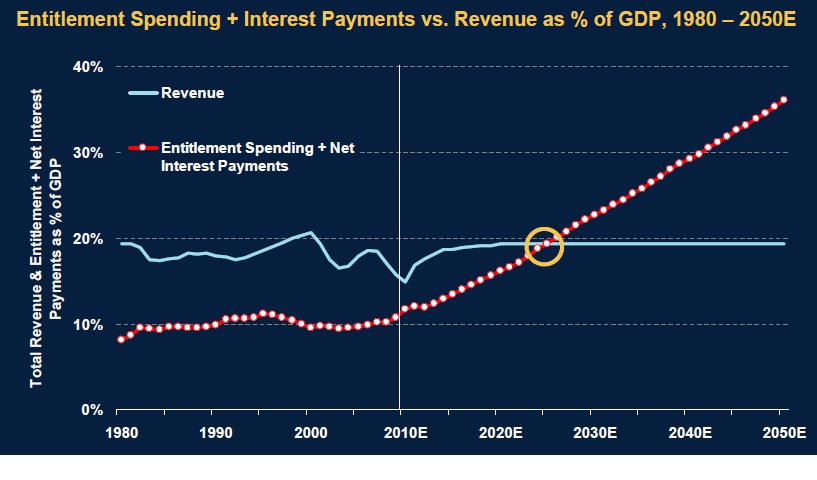
Source: MORGAN STANLEY
The blue line is Revenue as % of GDP;
The red line is Interest + Entitlements as % of GDP
A little-noticed report by the Congressional Budget Office (CBO) (“Long Term Budget Outlook, 6/10”) does the following: It projects revenue as a % of GDP (projected to be stable, at about 20%, mainly because of Republican pressure for tax cuts and no tax hikes), while two budget components only, interest payments and ‘entitlements’, will rise from about 10% of GDP today to 20% by 2020, owing to America’s aging and huge debt along with rising interest rates.
Note: the CBO is regarded as highly professional and credible.
A word of explanation: Entitlements include federal spending on Social Security, Medicare, Medicaid, based on current legislation.
What does this mean? It means that all tax revenue will be spent on interest payments and entitlements, leaving nothing for discretionary programs (such as defense, education, etc.).
At some point, between now and 2020, some American Administration will have to bite the bullet and slash entitlements, regarded politically as a “third rail” (especially Social Security). But who? Republicans show no inclination to this, nor does Obama. With Obama likely to be re-elected in 2012, and his 2nd term ending in 2016, he will have to deal with this issue during his second term.
But will he have the guts? And will the Republican opposition allow it?
The only solution is to raise taxes. Republicans are ferociously opposed. But the CBO study suggests there is no alternative.
Stay tuned. Without a major policy change, on spending entitlements and taxes, America is bankrupt by 2020.
Innovation Blog
Science Shows Women Are Superior Innovators to Men
By Shlomo Maital

I have long believed that in the context of 21st C. business, women make better managers than men – simply because evolution gave women skills at collaboration and communication, while it gave men skills in…well, killing animals and other men.
Now, science is showing that women are potentially superior to men at innovation. So, if you want to upgrade your organization’s creativity, add some women to your team of testosterone-soaked R&D engineers.
Here is some of the evidence, based on a great BBC PrimeTime program, “Secrets of the Sexes”.
The BBC did a web-based survey of sex differences, and 500,000 persons responded! They also ran a series of on-camera experiments.
* Empathy & Emotion Recognition: One of the key skills for innovators is empathy – sensing other people’s feelings and needs, as the foundation of creating innovations that meet unmet needs. Some 90% of the top scorers in the empathy test were women. The part of men’s brains used to sense emotions in others tend to be far less used than those of women. Reason? Evolution. Women had to be sensitive to other people’s emotions, since they survived on this skill, rather than with their muscles. An MRI scan of the brain of Craig, a man, and Liz, a woman, showed that while the part of Liz’s brain that deals with recognizing other people’s emotions was highly active, the same site in Craig was utterly inactive. Moreover, Liz was 40 per cent more accurate than Craig, in ‘reading’ other people’s emotions.
* Left-brain/Right-brain: Words were heard by men and women – a different word for each ear. For Tim, he heard only one of the two words, because he used mainly his left brain (logic). But Clair heard both words clearly, because she uses both her right brain (logic) and her left brain (emotion).
* Risk & Testosterone: In a Go-Kart race, men and women competed, and their testosterone levels were measured during the race. (Women produce testosterone as well as men). Men in general got a ‘jolt’ or ‘spike’ of testosterone in the competition, which led them to take big risks, which often ended in a spin-out. Women’s testosterone levels were steady. They took no big risks, they did not win the race, but finished well up. Alas, the world is run by testosterone-soaked men whose hormones spike when facing challenges, often leading to unreasonable risks. Global collapse 2007-9? Were any women at all involved? Innovation is ‘taking calculated risks’, as Gen. Patton said; women seem better at this.
* Caring, affectionate: Men and women were each asked to change a baby’s diaper. All the women picked the baby up, after changing it, instinctively. None of the men did. If you seek loving, caring, affectionate persons, who demonstrate their feelings, as part of your innovation process – choose women.
Men, there is hope. According to Science Daily, from November 7, 2008, research by Anne Grethe Solberg, researcher at BI Norwegian School of Management, finds that leaders with both masculine and feminine traits, are the ones who best succeed at creating a good climate for innovation. Again, support for adding more women to the R&D team.
[One of the wilder items was this one: measure the difference in length, in millimeters, of your second (index) finger and your fourth finger. The bigger the difference, the more testosterone you got in the womb, and the more male you are – because the same genes that turn on testosterone also drive finger development.]
To test yourself and your male/female brain: visit:http://www.bbc.co.uk/science/humanbody/sex/index_cookie.shtml
Global Crisis/Innovation Blog
Reforming America’s Banks: Dodd-Frank Act Got It Wrong –Why are We Not Surprised?
By Shlomo Maital
Andrew Ross Sorkin’s regular Global NYT column (May 11/2011, p. 20) summarizes the Michael R. Milken Annual Conference held recently in Los Angeles, on financial reform and the Dodd-Frank Act. You will recall, this Act, signed into law by President Obama last July 21, regulates “sweeping” financial reform, to prevent another meltdown like that of 2007-9, and in particular, preventing banks “too big to fail” from failing and needing bailouts.
Sorkin says the video clip from the conference is “riveting”; find it at the Milken Foundation website.
Critics at the Milkin Conference were fierce. Thomas J. Wilson, chair of Allstate (a huge insurance company) and deputy chair of the Chicago Federal Reserve Bank, said the new law “creates more uncertainty than certainty”. But the most damning critic is Kenneth C. Griffin, founder of a $15 b. hedge fund Citadel, who says the new legislation “will deeply entrench crony capitalism into the very fabric of the capitalist system”. Readers will recall, it was crony capitalism that got us into this huge mess in the first place.
The problem, Griffin explains, is that when the government liquidates a bank (as it did with Lehman Bros.), it decides which creditors it will make “whole” (compensate) and which it will punish severely. Griffin says, this means “companies connected to Washington that curry political favor will be favored at the expense of companies that do not have their business model “revolve around appeasing politicians and making campaign contributions”. Recall that Obama will spend $2 b. on his 2012 campaign, and so will his Republican counterpart. One way or another, they have to raise that money – and much of it will come from the financial services industry.
Remember that $50 m. check we wrote for you? Bank X will say, gently, to the ruling politicians, when it lands in trouble.
Wilson adds a doom loop scenario, noting that as soon as you declare a major financial institution insolvent, people are going to run from it (withdraw their money), and this will “actually accelerate people’s demise rather than stop it.” Of course this happened with Lehman Brothers.
The fighting head of FDIC (Federal Deposit Insurance Corp.) Sheila Bair has announced she is leaving. With her departure, and with Dodd-Frank, don’t look for serious fixes in the flaws that led to the 2007-8 meltdown. And for bankers who gripe at government “over-regulation” – ask them if they would swallow an unregulated pill or fly in an unregulated airplane. Why is regulation great for everything except where it really matters – banks and money?
Innovation Blog
Can Intel Innovate? Toward 3D Chips
By Shlomo Maital
Celebrating My 500th Blog!

Intel 3D Transistor
Can Intel innovate? Of course they can – they develop new microprocessors and chipsets every year.
But again – can they really innovate?
On a visit to an Intel building here in Haifa, I once chose to take the stairs instead of the elevator. In the staircase was a prominent sign: Hold On to the Handrail! And I thought – how in the world can an organization foster innovation and risk-taking, when it cautions its workers to hold on to the handrail? In innovation, there are no handrails – only chasms.
According to PCMag.com,
“Intel will begin high-volume manufacturing of chips featuring the world’s first three-dimensional transistor, the company said Wednesday. “The gains these transistors provide are really unprecedented,” said Bill Holt, senior vice president and general manager of Intel’s technology Manufacturing Group at a press conference in San Francisco. Intel will introduce its 3D transistor design, called Tri-Gate, as it transitions to its next-generation, 22-nanometer silicon manufacturing process at the end of this year and through 2012, Holt said. Tri-Gate transistors will be used in all of Intel’s product lines, from high-end server chips to the tiny, low-power processors that go into mobile devices like smartphones and tablets, including the Atom embedded processor. The 3D transistor will be a standard part of Intel’s 22-nm process, and its factories will be upgraded to support the new technology, executives said. “
What does all this mean in simple language? According to Intel Architecture Group Senior VP David (Dadi) Perlmutter, with the new 3D technology, the electrons go “up, left, and down.” Previously, they just went left or right. According to PCmag.com, “Perlmutter said that the improved transistor will result in improved processor performance, although he declined to say whether clock frequency would be increased as a consequence. Users should also expect Intel’s notebook chips to run at even lower power consumption at the same clock speed, potentially extending battery life further.”
Perlmutter has led two previous Intel revolutions. He and two friends, as relatively junior Intel engineers in Israel, persuaded Andy Grove to reverse a key decision and instead of going with RISC technology, remain with SISC and develop the Pentium, continuing backward compatibility with previous Intel microprocessors. Later, Pentium led development of the Centrino chipset, which reversed a cherished Intel business design by giving up some power for longer battery life and cooler chips (“Unwire your world”). Now, Perlmutter seems to be taking Intel toward 3D technology, trying to regain lost ground in the smartphone market in particular.
Can Intel innovate? Let’s watch carefully whether the 3D adventure yields bottom-line results.


