
You are currently browsing the category archive for the ‘Innovation Blog’ category.
Innovation Blog
Putting Capitalism Into Orbit: Can Private Enterprise Put Americans Back Into Space?
By Shlomo Maital
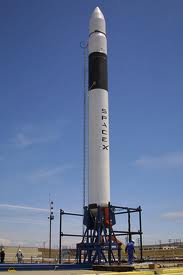 Falcon 1 Rocket (SpaceX)
A decision by President Barack Obama, desperately strapped for cash, has ended the NASA space shuttle program. The flight of Discovery this month , and a last flight in June, will mark the last time Americans will go into orbit in an American space vehicle. From now on, Americans will reach the ISS (International Space Station) on Russian Soyuz rockets. Last month, the U.S. House and Senate approved a spending plan for the remainder of the 2011 fiscal year that cuts NASA’s total budget by $241 million from 2010 levels, to $18.48 billion. Meanwhile, America continues to build costly aircraft carriers, at $6 b. a pop. Why does America need more aircraft carriers? Is this truly a good use of America’s now-scarce resources? Are Americans pleased that they need Russian help to get their astronauts onto the Space Station?
The theory is that the gap will be filled by private enterprise and innovation, driven by the profit motive. But it is an open question whether space can truly be profitable, in the near term. Many believe space is a public good – one governments must provide, because the spillover benefits, hard to capture by private capital, are very large.
One of the most interesting private initiatives is that of Elon Musk, PayPal entrepreneur, who is using his billions earned from PayPal (on-line payment by credit card) to launch SpaceX, a startup that is building space rockets. The launch of Falcon 1 last year was a big success, and showed Musk’s ability to put half a ton into space orbit. Eventually, Falcon 9 will be ready, and it will be capable of putting 25 tons into orbit! The key, it turns out, is saving weight. This is done by using carbon composite material, a kind of papier mache process that provides more than the strength of steel or aluminum with a fraction of the weight.
Meanwhile, Richard Branson’s Virgin Galactic is testing a vehicle aimed at putting people into space (not into orbit). It launches from a plane, at 45,000 feet, thus solving the high-risk stage of ground-based rocket launch. Already, some 400 people (including Elon Musk) have signed up for a ride into space, at $200,000 per person. Some have paid in advance, to ensure a ride on one of the earliest rockets.
Will private enterprise, capitalism and entrepreneurship keep America in space? Time will tell. Space is an expensive technology. The question is, can governments who want their nation to remain a technology leader afford not to invest in it?
Innovation Blog
How the Chocolate Chip Cookie Crumbles: How Ruth Wakefield’s Experiment Changed the World
By Shlomo Maital

One of the greatest inventions of all time is without doubt the chocolate chip cookie. Ever wonder where they came from? From an accident..like so many good things in this world.
An American woman named Ruth Wakefield opened a roadside lodge, in 1930, in an old tollhouse in Whitman, Massachusetts, on the highway between Boston and New Bedford. They served delicious Butter Drop Do cookies to their guests. But one morning, Ruth went into the kitchen to make the butter cookies – and discovered she was out of baker’s chocolate!
What to do?
Improvise. She found a bar of semi-sweet chocolate in the pantry and decided to use that instead. But to her surprise, the chopped-up chocolate chunks retained their original shape instead of melting into the batter, creating the famous soft and chewy Toll House Cookie.
According to Haaretz (Israeli daily newspaper), “the name of the game [for chocolate chip cookies] is freshness and good chocolate. Quality chocolate with at least 50% cocoa will balance out the dough’s sweetness and give the cookie its character. ..Refrain as much as possible from overworking the dough”.
Much of the world’s cocoa comes from Ivory Coast, a nation troubled until recently by civil strife. Let us chocolate chip cookie lovers rejoice that the dispute is settled, Allasane Ouattara has won, and hopefully Cote d’Ivoire’s great cocoa will soon resume its trip to the palates of us chocolate lovers.
Global Crisis/Innovation Blog
Commodity Price Collapse: Why Commodity Prices Are Becoming the New Las Vegas
By Shlomo Maital

Silver: Definitely not a gold mine for investors
On Thursday May 5, a startling decline occurred in the prices of commodities, fulfilling a short-term prophecy made by Goldman Sachs last month. Goldman Sachs’ chief commodity trader closed out long positions in April, causing ridicule and laughter. Turns out he was right, showing the huge advantages of strong independent thinking.
The price of oil plunged, with Brent crude losing $12 yesterday, or 10 per cent, to trade at around $109 a barrel. Silver, just a few days ago trading at around $50, is now back down to $35, having suffered its steepest crash since the 1980s. (Since 29 April, silver has crashed 23.3 per cent). London Mercantile Exchange tin is down 9.8 per cent, palladium has lost 10.4 per cent, gold lost 4.5 per cent and brent crude 9.1 per cent. In the US last night, the price of a barrel of oil was back below $100.
What in the world is going on? The explanation seems fairly straightforward. US and global economies are slowing. And commodity prices, which are always a play on excess liquidity (money) and future inflation, have suddenly done a U-turn, when that inflation seems unlikely to occur. According to Pulitzer Prize winning columnist Dave Leonhardt (NYT):
For the second straight year, the recovery seems to be at risk of stalling. The economy grew at an annual rate of only 1.8 percent last quarter — eerily similar to the 1.7 percent growth last spring, just when job growth started slowing down. Fully 80 percent of people say the economy is in fairly bad or very bad shape, according to a New York Times/CBS Poll last month. More people say it’s getting worse than getting better, the opposite of a few months ago. …The typical financial crisis has caused unemployment to rise for almost five years, according to historical work by the economists Carmen Reinhart and Kenneth Rogoff. We are well ahead of that timetable, thanks to aggressive action by the Fed, the Obama administration and, in its final months, the Bush administration. But our working assumption should be that this recovery will remain at risk for a long time.
In the American and global economies, we are going to be riding a seesaw for years to come. News will alternate between optimism (inflation) and pessimism (deflation), and commodity prices will become highly variable. Ironically, this variability itself will attract new players, because potential profit (and loss) rises in direct proportion with variance. In the Black-Scholes option pricing equation, the higher the variance of the asset price, the higher the option price. Look for commodity prices to become the new Las Vegas.
Innovation Blog
Back to the Future II — Jason Pontin: Futuristic Renewable Energy is Here!
By Shlomo Maital

Jason Pontin is editor and publisher of MIT Technology Review, a magazine that tracks new technologies and has some 2.6 m. readers worldwide. Here is his take on near-future advances in renewable energy, as presented to the MIT Enterprise Forum of Israel annual event, May 5, Tel Aviv:
“Carbon is the current product of the energy industry. Heat and light are byproducts. This will stop. Each year, 1,366 watts of solar energy strike every squ. meter on the earth. Yet today solar energy supplies only 1 % of US energy needs. The largest solar project in the U.S. is Exelon Solar City in Chicago. (Sunny Chicago? Related to the fact it is President Obama’s city, and the project was funded by stimulus package money, or 80% of the total $60 m. cost). There are 32,292 solar panels, covering 41 acres, generating 10 megawatts, enough for 1,500 homes. It costs $6/kilowatt to build – far too high to be profitable. All such solar energy programs are heavily subsidized.
“We need breakthroughs! Here are five blue-sky energy technologies that could provide such breakthroughs. They focus on new ways to generate, transport and store solar or nuclear energy:
- Plasmonic Solar: These are thin-film solar panels, developed by Harry Atwater at Caltech (California Institute of Technology). [According to Wikipedia: Plasmonic solar cells (PSC) are a class of photovoltaic devices that convert light into electricity by using plasmons. PSCs are a type of thin-film SC which are typically 1-2μm thick. They can use substrates which are cheaper than silicon, such as glass, plastic or steel. The biggest problem for thin film solar cells is that they don’t absorb as much light as the current solar cells. ]
- Artificial photosynthesis [Dan Nocera, MIT]: Research is being done into finding catalysts that can convert water, carbon dioxide, and sunlight to carbohydrates. This is a way of storing energy, a crucial element of capturing solar power. Nature does this with ease – it is called photosynthesis. Inventors are trying to replicate it. The cobalt catalyst from MIT’s Dr. Dan Nocera of MIT is “providing strong results.”
- Software defined Thermal Solar. In this technology, towers collect energy from mirrors. The mirrors are costly. Bill Gross (inventor of the original Google ad interest-related model) is the pioneer of this method; “his eSolar’s proprietary sun-tracking software coordinates the movement of 24,000 1 meter-square mirrors per 1 tower using optical sensors to adjust and calibrate the mirrors in real time. This allows for a high density of reflective material which enables the development of modular concentrating solar thermal (CSP) power plants in 46 megawatt (MW) units on parcels of land, resulting in a land-to-power ratio of 4 acres (16,000 m2) per 1 megawatt”. [This implies that 62.5 sq. miles (or a desert area of 8 miles by 8 miles) of reflectors could supply all of Israel’s electricity needs. ]
- Liquid Batteries: [Don Sadoway, MIT]; One of the biggest challenges currently facing large-scale solar energy technology is finding an effective way to store the energy, which is essential for using the electricity at night or on cloudy days. The primitive storage method today is to pump water up a hill during the daylight hours. In 2009, Sadoway proposed a liquid metal battery that could be used in stationary energy storage systems. “No one had been able to get their arms around the problem of energy storage on a massive scale for the power grid,” says Sadoway. “We’re literally looking at a battery capable of storing the grid.”
- Superconducting DC transmission: [Phil Harris, Tres Amigas]. Thomas Edison once observed that electricity is a way of TRANSPORTING energy, not creating it. How can solar power be easily and quickly transported? Tres Amigas has the answer. “The Tres Amigas renewable energy market hub will be a multi-mile, triangular electricity pathway of Superconductor Electricity Pipelines capable of transferring and balancing many gigawatts of renewable power between the three Interconnections. Similar to highway rotaries used for traffic flow control, multiple power transmission lines from each of the Interconnections will feed power into and out of the Tres Amigas SuperStation through multiple AC/DC converters, each connected by DC superconductor cables. Tres Amigas, which will be a balancing authority, will help ensure the efficient and reliable flow of power from multiple renewable generation sources in all three power grids to customers across a wide area of the U.S., Canada and Mexico.”
- And: a sixth, still-distant but amazing dream: Nathan Myrhvold’s Travelling Wave Reactor: from wiki: “A traveling-wave reactor, or TWR, is a type of conceptual nuclear reactor that can convert fertile material into fissile fuel as it runs using the process of nuclear transmutation. Once started, TWR’s reach a state after which they can achieve very high fuel utilization while using no enriched uranium and no reprocessing, instead burning fuel made from depleted uranium, natural uranium, thorium, spent fuel removed from light water reactors, or some combination of these materials. TWRs could theoretically run, self-sustained, for decades without refueling or removing any used fuel from the reactor.” Former Microsoft guru Myrhvold is putting his own fortune into this, and plans to build a TWR in China.
Innovation Blog
Back to the Future: “Where we’re going, we don’t need roads”
By Shlomo Maital
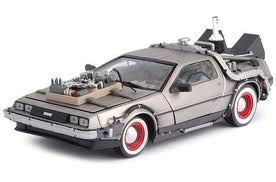
Doc’s Back to the Future DELOREAN car
Marty McFly: Doc, we better back up. We don’t have enough road to get up to 88 (mph).
Dr. Emmett Brown: Roads? Where we’re going, we don’t need roads.
In the hit movie Back to the Future (1985), Marty McFly (Michael J. Fox) goes back to the future with Doc and sees flying taxis, 3D ads (a shark), and many other inventions. Some have come true. Some have not. President Ronald Reagan adopted Doc Brown’s statement about roads.
At the annual event of the MIT Enterprise Forum of Israel, titled Back to the Future 2015, held today, May 5, several farsighted experts gave their vision of the near-term future. Here are excerpts of what they said:
The first speaker was Zeev Efrat, CEO, Frost & Sullivan (Israel branch), a global business consulting firm. He identified four key megatrends that experts defined a decade ago, in 2000: Emerging China; the Internet explosion; Information Revolution; and Outsourcing. All powerfully affected the decade 2000-2009. The megatrends that will dominate the near-term future, according to Efrat, are:
* urbanization: A megacity is a city with over 10 m. people; a mega-region has over 15 m. people; By 2025, half of all megacities will be in developing countries. Life in cities will be dominated by an integration of smart+energy+plan. Smart: ICT will be everywhere in cities, making them ‘smart’ (traffic management, power management, etc.). Energy will be green. And planning will be highly sophisticated. Some 40 global mega-cities will be “smart”, in this sense, by 2020; over half of them will be in Europe and in North America.
* convergence: In the late 1970’s, MIT Professor Nicholas Negroponte identified three converging industries: entertainment, publishing, computers. Now Efrat identifies another three converging industries: Energy, IT and automation. This convergence will lead to a wave of mergers, as companies seek to build competencies in all three disparate technologies.
* social trends: Gen Y. There will be growing personalization of all goods and services. Generation Y, the dominant generation, will seek goods that cater to values, beliefs, interest and lifestyle. This generation, aged 15-34, will dominate – there will be 2.56 b. people in this age bracket, out of a total global population of 7.56 b. people by 2020, and 61 per cent, six of every 10, will be from Asia! The middle class will also dominate. By 2020 52 percent of the global 7.56 b. population will be defined as ‘middle class’.
Some other trends Efrat identified, in only 20 minutes!:
- Technology: some 900 satellites will be launched in 2011-20.
- World War III will be an information cyberwar; it has already begun.
- 2020 will be a virtual world, where reality and virtual unite; this will feature in shopping, surgery (practice), entertainment, business conferences, and others. The interface between real and virtual will be highly fluid.
- Innovation to zero: There will be zero waste, with 100% recycling, and no emissions, in cars, factories, homes.
- E-mobility: 40 m. electric vehicles will be sold worldwide in 2020 (in one year), 30 m. cars and 10 m. two-wheelers. The related industry will have new components: new OEM’s, along with utilities, integrators, charging stations, govt. and battery manufacturers. Commercial vehicles will also become E-mobile, with 300,000 such vehicles by 2020.
- From illness to wellness: Focus shifts from curing illness to preserving wellness. Without this trend, health costs will soar by 2050 to 20-30 per cent of GDP (13 per cent already in the U.S.). The theme becomes: Live well, stay health. From fat to fit.
Innovators, identify the megatrend that excites and energizes you. Then, identify a micro need (a well-defined group with an unmet need) within this megatrend. Finally, build your innovation around it.
In the next blog, I will report on another speaker, Jason Portin (editor and publisher of MIT Technology Review), who reviewed startling futuristic developments in the realm of renewable energy.
Innovation Blog
From “Made in China” to “Owned by China”: Or What Can You Buy with Two Trillion Dollars?
By Shlomo Maital
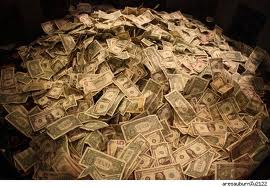
$1 b. in cash: now picture 2,000 piles
You have to hand it to the Chinese. They have a multi-stage long-run business strategy for China Inc. that is working to perfection. It is amazing that a group of former Communists have applied ‘modified free market’ strategy far better than the American blueblood capitalists, and have created an economy whose size will overtake America’s far sooner than we believed or expected.
Here is the simple version of the two-stage strategy ‘rocket’ China created.
Stage One. Attract huge resources from abroad, to create enormous state-of-the-art manufacturing capability, to generate a huge export surplus. Use the export surplus to accumulate enormous financial assets (mainly US Treasuries).
Stage Two. Use the pile of American dollars (growing daily, now equal to $2.5 trillion) to buy equity interests in companies and real productive assets around the world, to acquire control of resources, brands, and competitive advantage. Note: For only $1.5 b., Lenovo bought IBM’s Think Pad and leveraged it into near-market leadership in laptops. The transition from Think Pad to Lenovo branding was flawless and powerful.
Writing in the Global NYT, David Barboza says “flush with capital from its trade surpluses, China is spreading its newfound riches to every corner of the world..over the next decade, China could invest as much as $2 trillion to acquire overseas companies, plants or property”. The shift is amazing, Barboza says; a decade ago, China’s yearly equity investments abroad averaged only $2 b. a year, an inconsequential sum.
Just as we saw an almost panicky rush by global companies to shift production to China, we will now see a similar stampede by nations to vie for China’s money, by selling off national assets.
How much of that equity investment abroad will go to America? Very little, Barboza thinks. The study he cites suggests that because of political rivalry, America will benefit little from the Chinese direct investment. I hear a note of regret – alas, America will not ‘benefit’ from selling off its assets to China. For a nation that chants “USA USA, We’re Number One”, President Obama’s declared passion for welcoming Chinese equity investment, implicitly accepting “We’re #2—and we don’t even try harder” is impossible to understand.
As a business, China is exceptionally well run. Can’t say the same for America.
* David Barboza, “China’s cash goes global, but maybe not to US”, Global NYT May 4/011, p. 14.
Manny Pacquiao: What Innovators Learn from One of the Greatest Boxers in History
By Shlomo Maital

Pacquiao, in the Philippine Legislature
Manny Pacquiao, Philippine fighter, is arguably the greatest boxer in history. His achievements? He is an eight-division world champion, the first boxer in history to win ten world titles, the first to win in eight weight divisions, and the first to win the championship in four different weight classes.
I believe the wins in four weight classes are astounding. While gaining weight, Pacquiao somehow managed to maintain his speed and quickness. How? He reinvented how fighters box. Here is what boxing writer Greg Bishop says: *
Pacquiao’s trainer Freddie Roach said, ‘speed is the greatest asset [for a boxer] (and for an innovator) in the world’. [In the past] boxers mostly engaged straight on. [But Pacquiao created angles]. If Pacquiao shifted left, outside the right foot of his opponents, their natural instinct was to follow –into his left hand! If they chose not to engage, they had one option, to back away. Pacquiao improves his position with each angle created and makes it more difficult to counterpunch.
Pacquiao has extremely quick feet, feet that could qualify him for Riverdance. His style is “part performance art, part technical wizardry, unique to Pacquiao”.
Remember that innovation is intelligently breaking the rules. The unwritten assumption for boxes is that you square off and meet the opponent directly. Why? Why not step aside, create an angle, dance, do the surprising and unexpected, fight in ways opponents are unaccustomed? Pacquiao says his model is martial arts expert Bruce Lee, whose movies he watched endlessly as a child.
Pacquiao is now an elected official. But he continues to fight. He inspires his countrymen, and though many innovators are not fond of boxing, they can learn much from him.
- Channeling his inner Bruce Lee, Greg Bishop, NYT Global Edition, May 3, 2011, p. 15
Innovation Blog
Starbucks’ Turnaround: Howard Schultz Reveals All, Reinvents the Business
By Shlomo Maital
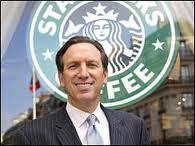 Howard Schultz returns!
Howard Schultz, who will turn 58 on July 19, is the legendary founder of Starbucks. After driving his startup to reinvent the concept of coffee (not just coffee, but ‘a third place’, outside home and work) and to achieve rapid growth, he turned over the reins of management to Jim Donald in 2005 – and had to return in 2008 when Starbucks stumbled. In 1987 Starbucks had 11 stores and 100 workers; at its peak it had 17,009 stores in 50 countries.
In a revealing interview in McKinsey Quarterly (2011, no. 2, p. 34), based in part on his new book Onward: How Starbucks Fought for Its Life without Losing Its Soul, Schultz tells all. Here are some excerpts about lessons learned:
1. Stop ‘comps’. Comps are comparisons of same-store sales, period-to-period, data demanded by Wall St. analysts, to reflect true growth of revenue without including the newly opened stores. Schultz found Starbucks store managers were driving up revenues any way they could, because they were measured and in some cases compensated, for their ‘comps’. Schultz halted use of ‘comps’ soon after returning in 2008. “We made decisions driving incremental revenue, not the brand equity”, he explains. Meaning: we sought money, not value and meaning. Lesson: Be careful what you measure! Is your ‘measure’ eliciting the desired behavior?
2. Build a new business design. Schultz is now trying to build a Starbucks brand sold in supermarkets and other retail outlets, while maintaining Starbucks’ own 17,000 stores. “Integrate ubiquitous channels of distribution with the retail footprint”. This is hard. Why should Wal-Mart sell Starbucks brands when Starbucks itself competes with it? This is based in part on the Starbucks card, which does 1 in all 5 Starbucks store transactions, and a reward system between the wholesale and retail channels.
3. Think Local, Act Local. China has 140 cities with over one million people! Starbucks is focusing on China. To do so, it will have to be very very local – black sesame muffins, rather than blueberry muffins, for instance. Far more new products will have to be invented locally, and not in Seattle headquarters. Starbucks has stumbled on its local message. Its 9 stores in Israel were closed in 2003, because local Israeli café chains were simply far superior. “We want to put our feet in the shoes of our customers,” Schultz says. Astonishing how great companies forget this simple lesson, again and again and again, and plunge into chaos.
4. Talent is the real constraint. What keeps Starbucks from growing? Not finance (it has $2 b. in cash) but management talent. And this shortage will worsen, as baby-boomer managers retire. Schultz wants to hire world-class people. He should also focus on how he will build such talent internally. Hired top talent tends to be mobile, leaping from firm to firm.
5. Discipline and creativity. Schultz seeks “real quantitative metrics to study the investments that we’re making across the board…– return on investment in stores, in advertising, new-product introductions, entry cost to new markets”. In other words: Make the lion of discipline lie down with the lamb of creativity. Schultz is keenly aware that such metrics – “comps” – ruined Starbucks’ value focus. The same issue of McKinsey Quarterly has a short piece about HR – how to use HR analytics as the basis of training programs. Measurement is not just technical, it is strategic – and often, badly managed.
Every global company grapples with this discipline/creativity paradox. Will Starbucks succeed? Stay tuned.
New MIT Media Lab Head: His Credential is a Total Lack of Any
By Shlomo Maital
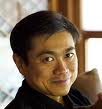 Joichi Ito, new MIT Media Lab Head
MIT Media Lab, the place that invents the future and combines academic research at the Ph.D. level with amazing gadgetry, has appointed a new head. Among other things, the MIT Media Lab invented Eink (used in Kindle), Aspen Movie Map, a forerunner of Google Street View, and the $100 Laptop.
The new appointee is Joichi (Joi) Ito, and he dropped out of Tufts Univ. and Univ. of Chicago because of sheer boredom. His formal credentials, therefore, are lacking – amazing, since the MIT professors, rector and President who make the appointment would normally seek someone with academic credentials.
Ito, as a VC, helped fund Flickr, Last.fm and Twitter, helped establish Japan’s first Internet service in 1994, and is chair of Creative Commons, which seeks to promote sharing of digital information. He is a board member of Mozilla Foundation.
This is a brilliant appointment, and closes a circle. When Nick Negroponte founded the Media Lab in 1985, he had a clear and simple vision. He drew three circles: computing, entertainment, publishing. These circles will converge, he said, though today they are separate. MIT Media Lab will explore the future of this convergence. American firms did not get what he said. They refused him funding. But Japanese firms came through at once. They wrote a check for $10 m. Negroponte was attacked for delivering American innovation to its Japanese competitors. But, hey – put your money where your mouth is. So Joi’s appointment is entirely appropriate, though he is as much American today as he is Japanese. A recent Media Lab Associate head, John Maeda (“Laws of Simplicity”), who is Japanese-American, left recently to head RISD, Rhode Island School of Design.
A slow stroll through building E15 on MIT’s campus, which is the Media Lab, is amazing. You will see incredible gadgetry in kitchens, computers, toys, and music. Yet all of this is supported by rigorous academic research that is done by doctoral candidates. It is funded by subscriptions – companies subscribe, for about $100,000 a year, just for the first-refusal right to ‘harvest’ ideas and commercialize them.
There were attempts to launch Media Labs in Ireland and Korea. I’m not sure how successful they are. There is something about the MIT campus culture that is infectious and energizing.
Kudos ! to MIT for its unconventional appointment. As I noted in my blog on April 19, titled “avoid innovation professors”, the best most-qualified persons to lead real innovation efforts, and thinking about innovation, are innovators, not professors. Joi will be a huge success.
Innovating in Dark Corners
By Shlomo Maital
Let’s run a psychological experiment, based on ‘stream of consciousness’.
Say the word ‘innovation’ out loud.
Say what pops into your mind.
Now – how many of the things that pop into your mind are related to products – or services?
Most? All?
Why?
Innovation is simply creation of novel ideas. Why should innovation be confined to product innovation? The truth is, the most powerful innovations are found in dark corners, where many people do not even bother to look. Here are a few examples:
Process innovation: Research shows that the rate of return on investment in R&D is far far higher for process innovation (innovation on processes that organizations use, such as production, marketing, quality assurance, supply chain management) than for product innovation – because many new product launches simply fail, and yield no return. Apply innovation to everything your organization does. How can it be improved? Process innovation cannot fail! Because – the worst that will happen, is that you use the old process when the new one doesn’t work out.
Business design innovation: In their HBR article, Ramon Casadesus-Masanell and Joan E. Ricart [“How to Design a Winning Business Model”] show that 7 out 10 companies are engaged in business-model innovation, meaning – innovations in the way they do businesses, rather than in the products they make and sell. Part of the motivation is the global business slowdown, the need to shift to emerging markets, and hence the vital necessity to radically alter existing conventional business designs.
Talent management: How does your organization choose, hire and develop talent? As the baby-boomers retire, a burgeoning shortage of talent is developing. Companies who excel at finding and developing talent will have a major competitive advantage. There is much room here for innovation. Conventional HR methods will simply not do.
Marketing: Writing in Market Leader (Quarter 4 2010), John Kearon (founder, CEO and Chief Juicer at BrainJuicer Group) writes provocatively that: “….the adoption of ‘marketing science’ is the reason why large corporations no longer seem capable of creating the kinds of new category innovations that made them big in the first place. ….. it is freedom from the constraints of marketing science that has enabled small startups to innovate and initiate new behaviours”. “The problem with putting the consumer first when it comes to originating new categories is that people instinctively reject new behaviours, and it takes inventors/entrepreneurs to ignore these reactions and do it anyway.”
If your innovation is driven by marketing, as it is in many organizations, perhaps you need to innovate your marketing-R&D link. And while you’re at it, innovate how you market your products.
MBA education: America has 4 million graduate students. Fully one in four, or a million of them, are MBA students! These MBA students study essentially identical curricula, from identical textbooks, case studies and articles. They are cookie-cutter managers. There is a huge need for innovative MBA programs that will generate managers who apply the Apple slogan: Think Different!
Career paths: Today’s MBA grad will need to develop at least 3-4 different careers, over their working lives. There is much room here for innovation, using the ‘adjacent possible’ idea – after excelling in Area A, what could I do, in Area B, which is far enough to be challenging and stimulating but close enough so that I do have a headstart on knowledge, skill and human capital?
The story is told of an economist who drops a $100 bill in a dark alley, then dashes out to the street lamp to look for it. Why? Of course – because that is where the light is. Don’t be like the economist. Look for innovation where others don’t – in dark corners, in places where the light of innovation doesn’t penetrate. You’ll be astonished at the results.


