
You are currently browsing the category archive for the ‘Innovation Blog’ category.
Global Crisis/Innovation Blog
Gene Sharp: Father of the Arab Revolutions? How Ideas Change the World
By Shlomo Maital
 Prof. (emer.) Gene Sharp
There are many examples of how obscure books change the world. Marx’s Capital is unreadable – and look what it did. F.A. Hayek’s slim The Road to Serfdom was read by two leaders called Ronald Reagan and Margaret Thatcher – and each dragged their countries toward free-market capitalism.
But few have heard of Gene Sharp, a retired American political scientist professor, Univ. of Mass., whose 93-page 1993 book on how to topple autocrats, From Dictatorship to Democracy, has become the Bible for revolutionaries from Bosnia to the Ukraine to Egypt’s Tahrir Square. Sharp offers 198 practical ways for ordinary citizens to use non-violence to bring down dictators. Available in 30 languages, Sharp’s slim book has a simple proposition.
“I have tried to think carefully about the most effective ways in which dictatorships could be successfully disintegrated with the least possible cost in suffering and lives. In this I have drawn on my studies over many years of dictatorships, resistance movements, revolutions, political thought, governmental systems, and especially realistic nonviolent struggle. “
According to Ruaridh Arrow, who has prepared a documentary film on Sharp soon to be released (speaking on the BBC): “Gene Sharp is the world’s foremost expert on non-violent revolution. His work has been translated into more than 30 languages, his books slipped across borders and hidden from secret policemen all over the world. As Slobodan Milosevic in Serbia and Viktor Yanukovych in Ukraine fell to the colour revolutions which swept across Eastern Europe, each of the democratic movements paid tribute to Sharp’s contribution, yet he remained largely unknown to the public. The Serbs who had used his books as a theoretical base for their activities founded their own organisation called the Centre for Applied Non Violence (CANVAS), and alongside their own materials have carried out workshops using Sharp’s work in dozens of other countries. When I met Srdja Popovic the director of CANVAS in Belgrade in November he confirmed that they had been working with Egyptians. ‘That’s the power of Sharp’s work and this non-violent struggle,” he says. “It doesn’t matter who you are – black, white, Muslim, Christian, gay, straight or oppressed minority – it’s useable. If they study it, anybody can do this’ .”
In Iran, the Ahmedinajad regime officially accused demonstrators of applying 100 of the 198 Sharp dictums.
Arab revolutionaries are of course reluctant to admit that an American professor has guided their revolutionary organizations. But his 198 step plan is remarkably practical, for a professorial scholar. Sharp’s passion, to remove autocrats without bloodshed, has changed the world. His 199th recommendation, however, is missing – how to deal with bloody tyrants like Syria’s myopic ophthalmologist Bashir Assad, who simply shoot demonstrators in cold blood, and then murder them again when they assemble to bury their dead.
It is worth reading his little book, available for download at: http://www.hermanos.org/nonviolence/dictodem.html
Innovation Blog
Innovator: Think Small! Think Fast! Think Bootstrap! The Story of “Joulies”
By Shlomo Maital
 Joulies…
We management educators encourage creative innovators to think big. Sometimes, it’s best to think small, think fast – and think ‘bootstrap’ (how can I do this without investors?). Here is a case study, based on Jenna Wortham’s piece in the New York Times (April 22/2011, p. 15):
Dave Petrillo and David Jackson are friends, and mechanical engineers, from Pennington, NJ. They had an idea. Ever find that your Starbucks coffee was too hot to drink? Or worse, you drank it and burned your lips? Well, they did. But, what’s the solution? Steam is hot, and you need steam to force through the coffee grounds. How about bean-shaped stainless steel shells, called Joulies (a joule is a unit of energy, named after a British physicist), filled with a heat-absorbing gel, that go into the coffee cup and cool the coffee just enough, but not too much, and can be reused. The two friends scraped together $3,000, built 100 prototypes by hand in Petrillo’s parents’ basement. They found a helpful process on You-Tube, on a silverware factory in upstate NY: apparently making knife handles is similar to making Joulies.
How did they scale up their imaginative idea? Instead of spending frustrating months courting arrogant VC’s, they went to Kickstarter, a NY startup that lets people present sales pitches to ordinary people who might invest small sums in a creative startup. They created a 3-minute video for Kickstarter, offering five Coffee Joulies to anyone who gave them $40. They raised…$177,000, in just a few weeks, and the total is rising.
What can we learn from this little story? At least five lessons:
1. Think small. No need is too small to build a business on, provided you can satisfy it well, feasibly, efficiently, and creatively. Often your own need is a great place to start. Unless you are totally unique, others probably have the same want and need.
2. Build prototypes. Until you do, you cannot test the market.
3. Think fast! If you dally, others will beat you to the punch. Imagine Yankee Stadium full of inventors trying to come up with the same thing you are.
4. Bootstrap. There is a major scarcity of venture capital these days. Use the tiniest amount of cash you can, and be creative about finding ‘angel’ investors, who are not VC’s. Use the 2008 Obama election campaign approach – raise small sums from many investors. Make a You-Tube video, a short one.
5. Democratize! According to the NYT article, “shoppers are increasingly looking for a more intimate connection to the creators and the sources of the things they buy”. Get your fans and potential buyers to help finance your ideas.
Social Websites are making innovation a lot easier and faster, especially for those who think fast, small and bootstrap. Why not try it?
Global Crisis/Innovation Blog
Goldman Sachs Chopped Down the Cherry Tree – And Denies It!
By Shlomo Maital
 George / Goldman Sachs
There is a legend about George Washington, that he chopped down a cherry tree, and then, when his father queried him about it, admitted doing the deed, saying “I cannot tell a lie!”. Naturally historians have cast doubt on the story. They miss the point. The fact that the story resonated throughout American history, and was told and retold, becoming part of American culture, is far more important than whether it really happened.
After a lengthy investigation by the U.S. Senate Permanent Subcommittee on Investigation, led by Senator Carl Levin, it is clear that while Goldman Sachs sold mortgage-backed securities short, and profited enormously from the 2007-9 global crisis, they consistently denied doing so. “We didn’t have a massive short against the housing market”, Goldman Sachs CEO Lloyd Blankfein told Congress. Yes, Lloyd, you did. You chopped down the cherry tree, and then denied it. What is hard to understand is why Goldman Sachs continues to deny turning the cherry tree into wood shavings. Isn’t it preferable to be seen as super smart, ahead of the curve, able to anticipate trends others cannot? Why is Goldman Sachs playing dumb?
According to the Senate subcommittee, they found the phrase “net short” (meaning, a position in which Goldman Sachs has sold more of an asset than they actually own) some 3,400 times, according to Andrew Ross Sorkin, writing in the Global NY Times (Wed. April 20, p. 18). Goldman Sachs wrote to the Securities Exchange Committee, in a letter, that “during most of 2007 we maintained a net short subprime position and therefore stood to benefit from declining prices in the mortgage market”.
Thanks, Goldman Sachs. What the Senate report does not say, is that you not only shorted the subprime market, you kept this a closely guarded secret – because if the rest of us had found out, we might have done the same, and then the cat would have been out of the bag. Your profits would decline, and perhaps the eventual collapse might have been precipitated earlier, and hence been much less disastrous.
For Goldman Sachs, 2007 was a record year because of its mortgage department. This, while everyone else was losing their shirt.
Take a bow, Goldman Sachs! You put one over on us. And now, by denying you vaporized the housing cherry tree, you are doing it again.
Why will anything Goldman Sachs says never be credible again? George Washington knows.
Innovation Blog
Innovators: Don’t Listen to Innovation Professors!
By Shlomo Maital

Professor of Innovation
In their latest Bloomberg Business Week innovation blog, Michael Maddock and Raphael Vitón caution against an alarming trend: the wrong people are making millions on teaching innovation – the professors. And I are one!
Here is their argument. Professors teach innovative risk-taking while themselves picking a safe, popular topic (innovation). Professors teach a highly pragmatic life-based experience-based evidence-based subject, without themselves having done it first hand. (“If you can, do; if you can’t, teach!”, said Shaw). Professors teach organizations how to create an innovation template, a button-down bureaucratic system that can kill innovation like warfarin kills rats. Companies (especially large ones) are already risk-averse; professors of innovation tend to strengthen that tendency, rather than battle it.
“We …. coach people to accommodate, even encourage, the fast-failures and messiness that ironically make great ideas happen most efficiently,” the authors say. Fail early to succeed faster, goes the IDEO principle. Professors of innovation do not teach organizations to welcome failure.
“So, instead of writing a six-figure check to go over a decade-old case study with a professor, who of course did not put his house on the line to back a big idea he had (like teaching innovation), what specifically should large companies learn from entrepreneurs?” The authors have three suggestions: a) get to ‘beta’ quickly. Experiment constantly. Recall Edison’s principle, that 10,000 failures were not failures but preparation for success in the 10,001th try. b) grab ideas from anywhere and everywhere. Professorial innovation processes tend to focus on internal idea generation. c) acknowledge, if you are elephantine, that mice are more agile, and acquire one. Buy a startup, give it room, air to breath, freedom to fail, and then turn it loose, and harvest its ideas.
Personally: I taught innovation for four decades, before actually plunging in to involvement with a startup. I’ve now been connected with two of them. It’s a great relief. I no longer feel like a fraud, when teaching students about how to generate ideas and launch them as businesses.
Global Crisis/Innovation Blog
Dollarocracy: A p.s. from Donald Trump
By Shlomo Maital
No-one could have possibly dreamed this up. Yet it is true.
Donald Trump is a candidate for President of the United States, running for the Republican nomination. He has promised to put up $600 m. of his own funds. But this is far from enough, because he will need another $1.4 b. in order to match Obama’s war chest. So he is fund-raising (!), asking ordinary Americans to give up their lunch money, to ‘invest’ in him.
Invest? In Donald Trump? The person who brought you Trump Hair, The Apprentice, and celebrity divorce? Is Trump the person to lead America back from the brink of mediocracy? So far, Trump’s main to-do list focuses on challenging the legitimacy of Obama’s birth in Hawaii. Trump thinks Obama was born elsewhere and has paid investigators to check it out.
Don’t count Trump out. I think that with enough money, you could elect George Bush’s dog Barney (or his companion Miss Beazley) as President. Just run enough 30-second negative ads disparaging the opponent’s birthplace.
How many millions of Americans will vote for Don Trump, just because they hate politicians and think an outsider could do a better job? How long will it take for a truly capable candidate to step forward (say, Paul Otellini of Intel, or Jeffrey Immelt of GE)? And when will dollarocracy end, and true democracy begin, in America?
Global Crisis/Innovation Blog
Power to the People: Blessings We Take for Granted
By Shlomo Maital

Fukushima Daiichi Power Plant
Easter and Passover religious holidays coincide, because the Jewish calendar is lunar, and Easter too is set according to the lunar calendar. Both holidays celebrate freedom and redemption and observe those values with time-worn rituals.
One of the elements of modern technology that has freed us from grinding labor is electricity – and it is something we all take for granted, an invisible blessing ignored and unappreciated, until there is a mishap and the lights go out.
Japan’s earthquake/tsunami took 25,000 lives and did massive damage. But according to David Pilling, writing in the Financial Times (April 14, p. 9), the loss of the Fukushima Daichi nuclear reactors will cause far more property and economic damage than the earthquake. TEPCO (Tokyo Electric Power Co.), which operates the reactors, supplies close to a third of Japan’s electricity, to 2 million businesses and 29 million households in Tokyo. Now, 13 of the company’s 17 nuclear reactors are out of action (not just those in Fukushima), and half of its 20 oil-fired thermal plants are out of action too, as well as the two coal-fired plants. The result is having a profound effect. This summer, there will be widespread blackouts in Japan, as Japanese try to air condition their homes and power use surges.
This in turn will damage huge swaths of industry – car parts, pulp and paper, steel, chemicals, breweries, computer chips, everything. All depend on a reliable plentiful supply of power.
“Modern Japan cannot function without TEPCO”, Pilling says. “Modern anywhere cannot function without electricity,” he might have added. TEPCo, he notes, is not a bad company. But it has been dogged by ‘moral hazard’ – by a long shoddy history of cover-ups and sloppy safety standards. And now the chickens have come home to roost. TEPCO has hugely mismanaged the Fukushima accident. And the Japanese government has bungled, in failing to nationalize the company and make the clean-up the responsibility of the government, which has far deeper pockets and resources.
An unceasing supply of electricity, because it is always just there, is ignored by nearly everyone. The people need power – and we need to bring power to the people, not just electric power, but power to regulate the electricity industry and make sure the electric companies (TEPCO is owned by shareholders) are run in a transparent, open and flawless manner. There is no room for error here. After BP’s disastrous oil spill, those who bought BP shares at the bottom made 70 per cent capital gains. This may happen with TEPCO as well. It is time to insist that basic necessities like water and power must be run on a pro-social, not pro-profit basis. Pilling asks, disturbingly, did TEPCO delay cooling the reactors with sea water, to avoid damaging equipment and suffering losses? Only managers who put shareholders’ interests first would even dream of such a calumny.
Innovation Blog
In Praise of Failure: Dyson, the Vacuum Cleaner Wizard, Speaks
By Shlomo Maital

Sir James Dyson & his “Cyclone” vacuum cleaner
We all know James Dyson from the TV vacuum cleaner ads. A faithful reader of my blog alerted me to Dyson’s recent piece in Wired Biz. (Wired, of course, is a wonderful source of new ideas for any entrepreneur, worth tracking closely). Dyson speaks “in praise of failure”. Here are excerpts from his piece:
“An inventor’s path is chorused with groans, riddled with fist-banging and punctuated by head scratches. Stumbling upon the next great invention in an “ah-ha!” moment is a myth. It is only by learning from mistakes that progress is made. It’s time to redefine the meaning of the word “failure.” On the road to invention, failures are just problems that have yet to be solved.
[Note: This is precisely what Thomas Edison said, as he struggled to develop a filament for the light bulb. He failed thousands of times in his laboratory, but never regarded a failure as a ‘failure’ but as a step toward the final solution].
For me, it started with a vacuum. When my bagged vacuum lost suction, I came up with the solution — cyclone technology. But having an idea is just the beginning. With a few rudimentary materials I mocked up the first prototype. Crude, but it worked (sort of).
From cardboard and duct tape to ABS polycarbonate, it took 5,127 prototypes and 15 years to get it right. And, even then there was more work to be done. My first vacuum, DC01, went to market in 1993. We’re up to DC35 now, having improved with each iteration. More efficiency, faster motors, new materials.
[Note: prototyping is crucial. If you have an idea, do a mockup, a rough version, no matter how crude – until you have a prototype, you don’t have a real product. And investors, by the way, love to see things they can touch and feel, instead of 200 Powerpoint slides].
There are countless times an inventor can give up on an idea. By the time I made my 15th prototype, my third child was born. By 2,627, my wife and I were really counting our pennies. By 3,727, my wife was giving art lessons for some extra cash. These were tough times, but each failure brought me closer to solving the problem. It wasn’t the final prototype that made the struggle worth it. The process bore the fruit. I just kept at it.
Instead of being punished for mistakes along the way, learn from them. I fail constantly. And I wouldn’t have it any other way.
By fostering an environment where failure is embraced, even those of us far from our student days have the freedom to make mistakes — and learn from them still. No one is going to get it right the first time. Instead of being punished for mistakes along the way, learn from them. I fail constantly. And I wouldn’t have it any other way.”
Global Crisis/Innovation Blog
Democracy? No – Dollarocracy: U.S. Elections Are About Money, Not Ideas
By Shlomo Maital
President Obama has announced the launch of his presidential candidacy for 2012. According to USAToday, the Democrat and Republican presidential candidates will each raise, and spend, $2 b. on the campaign! It’s a bright new era — the Age of Dollarocracy!
A stupid and disastrous Supreme Court decision has paved the way. In Citizens United vs. Federal Election Committee, the Court ruled in 2010 that independent groups not associated with political parties or campaigns can spend unlimited corporate and union cash on ads! The Republicans used this ruling effectively to outspend the Democrats in the mid-term 2010 elections and thoroughly drubbed the Dems. So the Dems are planning to try the same in 2012.
Election spending has been rising exponentially in the U.S. The elections have become a race to see who can raise more money for costly TV ads, not who can solve America’s myriad problems.
If you are really good at math, project these numbers into the future, and see where they lead. They definitely do not lead to an open democratic election where ideas compete, rather than corporate wallets:
(President, and his total campaign spending, by election): Clinton, 1992: $100.6 m. ; Clinton 1996, $108.5 m.; Bush, 2000, $172.1 m.; Bush, 2004, $356.4 m.; Obama, 2008, $745.7 m.; Obama, 2012, (est.), $2 b.
USAToday says Obama has asked 400 Democrat fundraisers to collect at least $350,000 each, by year’s end.
You may say that much of Obama’s money came from millions of small donations. Close inspection reveals, however, that it is the big corporate donations that drive fund-raising. And now, thanks to the Supreme Court, these are nearly unlimited.
Way to go, judges. You’ve helped ruin American democracy for many years to come, under the pretense that bankrolling candidates with unlimited millions is a constitutional right and part of freedom. Where is the freedom to elect the best candidate even if he or she takes positions that anger the big-money corporate interests?
Global Crisis/Innovation Blog
“Thunderous” New Nuclear Energy Technology
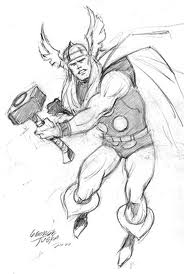
Thor God of Thunder
The current technology used to generate electric power from nuclear fission is a product of the Cold War. The nuclear reactors are derived directly from technology developed to power American nuclear submarines, by generating steam through nuclear fission, based on Uranium 235. This technology may be acceptable for nuclear subs, but after Japan’s disastrous mishap in Fukushima, it needs to be re-evaluated for civilian power stations.
There is an alternative. Kirk Sorensen, of Teledyne, and many top physicists, predominantly Nobel Laureate Carlo Rubbia (CERN), note that one ton of thorium can generate as much nuclear energy as 200 tons of uranium. But research on thorium reacts was halted in the 1950’s, when uranium reactors were built.
How would a thorium reactor work? Basically, if you use a small linear accelerator to bombard mined thorium (there is only one isotope, unlike uranium, which has several), with slow neutrons, Thorium 232 absorbs the neutrons and becomes Uranium 233. This fission reaction, which releases energy, creates heat that generates steam and turns turbines to make electric power. And the process can be designed so that the byproducts cannot be used to produce nuclear bombs. Moreover, the waste products deteriorate in a few hundred years, unlike thousands of years for plutonium waste. And the process can be halted instantly, in the event of trouble, unlike the uranium process, which requires cooling rods and cooling water (which tsunamis can disable). Just turn off the neutron-generating accelerator, and presto, the process halts. In the event of a disaster, the process stops itself in milli-seconds.
This is not theoretical. Pilot plants have been built in the U.S. and Russia, and China is currently engaged in large-scale research on thorium-based nuclear energy.
Thorium gets its name from the Greek God Thor, the god of thunder. A crash project to develop thorium nuclear technology could greatly help global warming, and alleviate the damage fossil fuels cause by generating carbon dioxide. It could be literally a thunderous development.
Global Crisis/Innovation Blog
Power, War & The Power Law: We Need Double Loop Thinking Fast!
By Shlomo Maital
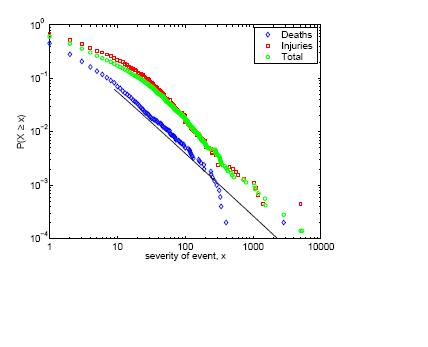
X axis: Casualties: Y axis: Probability
Organizational psychologist Chris Argyris once coined the phrase “double loop thinking”, to define thinking that seeks to change entire SYSTEMS, by utterly different thinking, not just parts of the existing system with in-the-box more-of-the-same thinking. In this he reflects Einstein’s “Law” that “you cannot solve a problem with the same thinking that created it”.
Now we have evidence from mathematicians and physicists, who have analyzed centuries of data regarding war and bloodshed. They have discovered the “Power Law” (originally noted by the physicist Lewis Fry Richardson) (see diagram), which says that when the ‘severity of the (war) event’ increases by a factor of 10, the probability it will happen declines by a factor of 10. In other words, the probability a terrorist attack will take 10 lives at a given point in time is 1/10, but an attack that kills 100 has a probability of 1/100. Thousands of data points fall very close to this ‘power law’ inverse line. and this “law” seems to have prevailed for centuries.
Why? According to one of the researchers working on this problem, Dr. Sean Gurley (Oxford U.):
“The fact that the power-law distribution seems to be constant across all long-term modern wars suggests that the insurgencies have evolved to find an ideal solution to the problem of how to fight a stronger force. Unless this structure is changed then the cycle of violence in places like Iraq will continue,” said Dr Gourley.” We have used this analysis to advise the Pentagon, the Iraqi government and the United Nations.”
Here in the Mideast, events seem to constantly confirm the Power Law. Recurring cycles of violence, revenge, counter-attack, revenge, etc. appear to create an endless Doom Loop of violence. There must be some way to ruin the Power Law and implement Double Loop thinking. But the problem is, those whom we elect to solve our problems and conflicts actually seem to be trapped in the Power Law and confirm it rather than disprove it.

 TIMnovate