
You are currently browsing the category archive for the ‘Innovation Blog’ category.
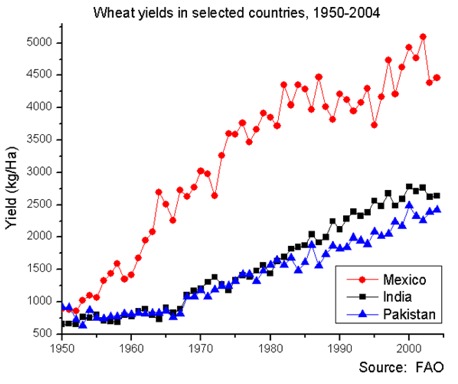
Norman Borlaug passed away on Sept. 12, at the age of 95. Borlaug was the innovator, an agronomist, who created the Green Revolution. He developed strains of wheat that had short stalks and were disease resistant. When the wheat puts its energy into its kernel, not into the straw, yield improvements of 100% (double) resulted.
As a boy I grew up in Milestone, Saskatchewan, amidst fields of waving wheat higher than my head. Today that same wheat no longer waves. It is only a foot or so high. A simple yet powerful idea, that according to the Nobel Institute has saved hundreds of millions from hunger in India and Pakistan, primarily. Mexico became a wheat exporter in 1963 as a direct result. Borlaug was awarded the Nobel Peace Prize for his efforts in 1970.
Borlaug was the great grandchild of Norwegian immigrants to America. He worked as a boy and teenager on the family farm in Iowa, and came to know farming at the ground level. Borlaug’s grandfather encouraged him to leave the farm and study at college. “If you want to fill your belly,” he told Norman, “go fill your head!” A Depression-era program that enabled low-income students to afford college made it possible for Borlaug to enroll at University of Minnesota. He failed the entrance exams, but persisted, and eventually ended up in the College of Agriculture.
Here is how Wikipedia describes just one of his innovations: “dwarfing”.
Dwarfing is an important agronomic quality for wheat; dwarf plants produce thick stems and do not lodge. The cultivars Borlaug worked with had tall, thin stalks. Taller wheat grasses better compete for sunlight, but tend to collapse under the weight of the extra grain—a trait called lodging—and from the rapid growth spurts induced by nitrogen fertilizer Borlaug used in the poor soil. To prevent this, he bred wheat to favor shorter, stronger stalks that could better support larger seed heads.
The graph below shows the dramatic rise in grain yields Borlaug achieved. He developed the Green Revolution wheat varieties in remote Mexico, finding suitable strains of wild wheat, in difficult conditions, with low budgets and oppositions from those who directed his work. Few innovators can claim, as Borlaug could, that they saved hundreds of millions from starvation.
Really, this is going too far. I mean, innovation is all well and good, but — innovating opera? And at London’s Royal Opera House? After all, is nothing sacred? Good heavens. Who in the world thought of this ghastly idea?
Someone had the idea of asking the public to submit “tweets” (to the Royal Opera website). One month ago, the Royal Opera website presented the public a sentence on which to build a story: “One morning, very early, a man and a woman were standing, arm-in-arm, in London’s Covent Garden.” Some 900 140-character messages were received. Composers Helen Porter and Marc Teitler set the tweets to music. If they all were used, they would be a full seven-act opera — even beyond Wagnerian Valkerie proportions. So instead, excerpts will be used, making a twenty-five minute opera. It will be performed as part of the Deloitte Ignite arts festival.
The BBC Music Magazine’s deputy editor called the exercise “an accident waiting to happen”. He said: “Whenever there is a new fad you know somebody in the art world is going to grab hold of it by the horns. They should be careful that it doesn’t overtake the serious stuff they do.”
In response, Sara Parsons, the publicity officer for Ignite, says, “It’s about getting people involved and interested in opera — and it’s certainly done that.”
Talk about breaking the rules. Opera is opera. It ends when the fat lady sings, not when the last thin Tweet ends. Give us a break!
However, here is my own Tweet contribution, following on to the lead sentence.
“Let’s tweek the twats,” the man said, “and Twitter Aida! Pyramids, shmyramids!”.
Managers know that ‘domain expertise’ — intimate knowledge of markets, clients, technology, competitive forces and industry structure — is vital. Trying new markets without such expertise can be fatal. Infosys, for example, sells its IT expertise with great success by first establishing ‘domain expertise’.
Now, Cisco’s legendary CEO John Chambers has announced his plans to lead Cisco into 30 (yes, 30!) new areas of business. His strategy is described in the latest issue of The Economist*. He calls them ‘market adjacencies’ — markets close to, or adjacent to, markets in which Cisco already operates.
In 2002, Cisco successfully pursued this strategy during the recovery, expanding into internet telephony, optical networks, and wireless equipment. These businesses now bring in 25% of Cisco’s profits.
Chambers again sees opportunity during the current weak, volatile and fragile recovery, and plans to pursue a similar strategy, while competitors remain risk averse and mainly pursue cost-cutting strategies. Cisco will tackle ‘virtual health care’, ‘cloud computing’, safety and security, and ‘routers in space’. To implement this strategy, Cisco uses a rather elaborate organizational system that involves councils (markets potentially reaching $10 b.), boards ($1 b.) and working groups. Cisco has some 50 boards and councils, involving 750 managers. They are fluid and change rapidly.
Will analysts’ fears that Cisco is overextending its capabilities be justified? I doubt it. After practicing its ‘moving up in a downturn’ strategy after the 2000-2001 recession, Cisco is well positioned to make it work during the much deeper current recession.
___
*Reshaping Cisco The world according to Chambers. The Economist, Aug 27th, 2009.
Who has the right to file a patent application? Is it, the first person to apply for a patent for that particular idea (first to file)? Or is it the first person who actually invented the idea (first to invent)?
Most of the world follows “first to file”. It is defined as: “the right to the granting of a patent for a given invention lies with the first person to file a patent application for protection of that invention, regardless of the date of actual invention.”
But the United States, in this as in other areas, is out of step with the world. There, it is “first to invent”, defined as: “Invention in the U.S. is generally defined to comprise two steps: (1) conception of the invention and (2) reduction to practice of the invention. When an inventor conceives of an invention and diligently reduces the invention to practice (by filing a patent application, by practicing the invention, etc), the inventor’s date of invention will be the date of conception.”
To make matters worse, America has indicated its intention to shift its patent legislation from “first to invent” to “first to file”, to get in step with the rest of the world.
But it has not yet done so.
The result: as a patent attorney acquaintance notes, “this causes much uncertainty, and indeed lengthy ‘interference’ cases.”
Get with it, America. Can we please have a consistent patent policy everywhere?
A column in the Financial Times on Sept. 2 asks, “is the time right for the return of the conglomerate”? In the 1960’s, and later in the 1990’s, it became fashionable for large companies to diversify their businesses by acquiring companies in a wide range of different industries. The idea was based on financial diversification and spreading risk. If retailing did poorly, well, perhaps media and entertainment would offset it. The core of the idea came from a Harvard Business School proposition that management is management — if you could manage an oil business, you could also manage a movie study, because the basic fundamental principles were the same.
This hubris (excessive pride) proved inaccurate. Management is not management universally, and there is a core competency of understanding deeply the industry in which one operates, based on long experience. Many conglomerates failed for this reason. Exxon, for instance, expanded into non-oil industries like high-tech and failed in them.
But — is it time to revive this conglomerate business model? And if so, what is the rationale?
The reason is simple. A key constraint limiting growth and expansion today is credit and finance. Banks are reluctant to lend, and even when the recovery picks up steam, banks will likely be far more stringent with their loans than in the past. Conglomerates, because of their size and clout and ability to generate cash, will be able to surmount this constraint and supply credit to their constituent businesses. This may prove a key strategic asset.
Consultant Ian Harnett notes: Companies that generate free cash flow for their group can provide risk capital for more widespread investment, when banks’ risk appetite disappears.
Look for the conglomerate to return. If it does, it will be a wise reaction to the paradigm shift in finance and financial services, that suddenly makes companies become their own financiers.
It’s now official. Mickey Mouse is The Incredible Hulk’s father-in-law.
This week Walt Disney acquired Marvel Comics for $4 b. Disney began when Walt Disney drew some sketches in 1928 in a rat-infested warehouse office in California (Mickey Mouse was inspired by a real mouse that eat some of Disney’s lunch crumbs). The Walt Disney Company bought the comic book company that had entered bankruptcy in 1996 when comic books no longer were sought and bought by kids, and later emerged from it.
Then, suddenly, movies based on Marvel comic book characters drew huge box offices. For example: (with the date and box office figures) Blade 1998 – $131 m., X-Men 2000 – $296 m., Spider-Man 2002 – $822 m., Incredible Hulk 2008 – $263 m., and so on…. Marvel tried to make some of its own movies, but generally was not successful — its core competency was in inventing some 5,000 comic book characters, not in making movies. Disney was great at making movies, and bought Pixar for animation skills, but perhaps lacked the soaring imagination of the Marvel comic book artists.
It is remarkable that adult viewers sometimes find imaginary comic book characters like Spiderman more realistic than the ‘real’ characters that appear in Hollywood scripts.
A management lesson is, I believe, the following:
One of Gary Hamel’s four ‘boxes’ that define a business is called STRATEGIC ASSETS. (The other three? Customer interface; Value network; Core strategy). There are companies that have utterly failed because they have been unable or unwilling to fully exploit a key strategic asset. These are prime targets for acquisition, because those strategic assets may be the missing piece in the puzzle for another company, such as Disney. Business opportunities arise when entrepreneurs see value in places where others do not.
Case study: K-Mart, a discount department store, in the U.S. and Puerto Rico. A hedge fund operator named Edward Lampert bought K-Mart for a virtual ‘song’ for only $300 m., after it went broke. Why? Lampert spotted K-Mart’s strategic asset: The real estate value (not listed at its proper value on K-Mart’s balance sheet) of its many stores, in shopping centres across the U.S. Lampert sold off K-Mart real estate, used the money to buy Sears, changed the holding company name to Sears (more respected), then relaunched K-Mart and Sears. Essentially, Lampert bought K-Mart with part of its own strategic assets others failed to see, and that historical book-value balance sheets failed to reflect.
Since I was a child, I have been myopic and won glasses. As a kid, I fought wearing glasses for years, even when I could not see the blackboard at all, for fear of being called ‘short eyes’ and worse.
Today, I see managers doing the same. They are myopically short-sighted, cannot see the future even as it unfolds clearly, and endanger their companies, even their industries, by doing so. Today, uncorrected myopia exacts a heavy price.
The media industry is a prime example. As Andrew Edgecliffe-Johnson notes in the Monday Financial Times*, “from the morning paper to the evening news, the media industry is in crisis”. PWC says global revenues from newspapers and their digital incarnations will fall 10% this year and will shed $20 b. in revenues between 2008 and 2013. Worse than airlines!
Why?
A report notes that the media industry “has failed to make the digital transition”. News organizations’ digital revenues were only 11% of total revenues, compared with 69% for the broader information industry (e.g. including legal and financial data providers like Reed Elsevier, a publisher, and Bloomberg).
Where were the industry leaders’ glasses? Were their curtains shut hermetically? Did they notice at all what happened to the music industry, which stuck to selling CD’s when the technology dictated downloads? Did they miss successful innovators in their own industry, like the Seattle Post-Intelligencer, which shifted from newsprint to a solely digital format [see this Blog, Paradigm Shift in newspaper: Sleepless in Seattle, March 2009]?
The warnings signals were clear and powerful. Craig Newmark founded Craigslist as a service to his friends in 1995. That was 14 years ago! Since then on-line classified advertising has exploded. Now, newspapers used to make much of their profit from their classifieds. Today, newspaper advertising, including classifieds, is down 29% in the U.S. I believe classified advertising revenues fell far more. When Craigslist appeared, did newspaper owners and managers grasp that this was a powerful paradigm shift, one they could not ignore? Why did they not see it? Did these industry leaders wait, like a condemned criminal on Death Row, for their businesses to wither and die?
A great many good people are going to lose their jobs, forever, in the media, because of the myopia of their leaders. Perhaps we should say, as did the broadcaster in Network, “I’m mad and I’m not going to take it any more!”. If your leaders refuse to put on corrective glasses, stand up and help them see the future. Save your own job and those of your friends.
______
* “Sacrifices made in hunt for new model”, Financial Times, Monday Aug. 31, 2009, p. 12.
The innovator and long-time producer of the CBS television program Sixty Minutes, Don Hewitt, has died. He left a massive legacy.
Hewitt produced CBS’s evening news under anchorman Douglas Edwards. He held a similar job under Walter Cronkite, then in 1963 launched Sixty Minutes, an hour-long program that almost always had three story segments. Until 1999 it was the #1 most watched program, and remains the longest-lived TV program in history.
What was Hewitt’s secret as an innovator? (Other networks, of coursed, imitated Sixty Minutes, including ABC — 24 Hours — and NBC, but never came close).
In preparing, initiating and editing the Sixty Minutes stories, Hewitt said he always tried to think about the average American viewer, on Sunday evening (the program’s traditional slot), after watching a football game. Nobody has to watch our program, he said. What will interest them? He applied the “Mabel” criterion. Will Herb call to his wife Mabel, hey Mabel! You gotta come see this?, he said, or will he say, Mable, where’s the remote? Let’s watch the basketball game instead, this is boring.
Hewitt hated being bored. And he desperately fought never ever to bore the viewer. His talented team of reporters and journalists — Morley Safer, Mike Wallace, Leslie Stahl, Ed Bradley, Steve Croft, and others — rarely did.
“Tell them a story!” Hewitt repeatedly said. People love stories. When you are a child, what do you say? Tell me a story. Grownups do too! Sixty Minutes segments were almost always great stories. And Hewitt knew how to prepare promos, 30 second ‘teasers’ that got people to watch later that evening.
“Tell them a story” is strong advice for innovators, too. Building a business plan? Focus not on Excel but on the story. What is the narrative? What is your product’s story? What need does it fill? Whose? Tell about the user, using it for the first time. A compelling story, in my opinion, is far more persuasive for investors and potential future hires than a forty-page business plan.
Edward (Ted) Kennedy’s funeral is being conducted as I write these words.
Kennedy was the youngest of four brothers. Joseph died as a pilot in WWII, Jack was assassinated by Lee Harvey Oswald and Bobby was shot by Sirhan Sirhan. He lived in the shadow of his older brothers’ memories. But in the U.S. Senate, where he served for 9 terms, as Senator from Massachusetts since 1962, a total of 47 years, he made his mark. He authored 300 bills and his name was on another 1,000. He may have been the great Senator since Daniel Webster. The Boston Globe wrote, “By the early 21st century, the achievements of the younger brother would be enough to rival those of many presidents.”
Kennedy was not a philosopher or an ideologue. He was not good at expressing sweeping visions or innovative ideas. But he was intent on changing the world. As one born into wealth, who had never known hunger or poverty, he was America’s leading champion of the poor, the sick, the immigrants, the underclass and the blacks. His innovative thinking found powerful expression not in ideas, but in implementation. He was able to win compromises against stubborn Republican foes. He used humor and good fellowship.
As President Obama related in his remarkable eulogy, Ted Kennedy once won over a Republican committee chairman by shoving toward him a partially open envelope with excellent cigars. When the negotiation went well, Kennedy inched the envelope toward him. When it went badly, he pulled it away a few inches. An acceptable compromise was soon won.
He had an endless string of personal tragedies, including one famous one that cost him any chance at the Presidency. But instead of using them as excuses for quitting, he fought on. He was substitute father to the children of his murdered brothers Bobby and Jack.
There are innovators who have sweeping ideas and who express them brilliantly. And there are those who are good at making things happen on the ground. Kennedy was the latter. If you have implementation skills, you are blessed. Because in the end, those who change the world are not always those with the ideas, but rather those with the staying power, courage, and common sense who can implement ideas.
In this space, more than once, I’ve argued that in developing new products or services, less is more. Eliminating needless features is a far more powerful route to market success than adding, endlessly, more and more new and unneeded features. What we want today, more than ever, is simplicity, not complexity. And erring on the side of simplicity is better than erring in excess complexity.
Now, Apple — according to Business Week, the company most admired as an innovator by other managers worldwide — has shown it gets it. Apple’s Leopard operating system, Mac OS X 10.5, has a new release, called Snow Leopard. And, surprise, it is smaller, faster and more refined. Less, rather than more. It beat its announced release date by a whole month. And, get this, it costs only $30 (as an upgrade, for those who have Leopard already).
Snow Leopard starts up faster — 72 seconds, rather than 100 seconds in Leopard — and opens programs faster — 3 seconds for the Web browser (Windows Internet Explorer, eat your heart out!) — and halves the opening time the second time the same program is run. And above all, Snow Leopard is half the size of Leopard!
Writing in today’s International Herald Tribune, David Pogue notes that “Apple and Microsoft realized that the pile-on-features model was unsustainable”. *
Microsoft will release Windows 7 in October. We may see a strategy similar to that adopted in Snow Leopard. If so, those of us who have followed Microsoft’s incessant pile-on-the-unneeded-features-and-charge-more-for-them will be pleased and surprised.
Pogue concludes: “The big story here is not Snow Leopard. It is the radical concept of a software update that is smaller, faster and better — instead of bigger, slower and more bloated. May the rest of the industry take the hint.”
And my prayer is, may all innovators everywhere, not just in software, take the same hint. Leopards everywhere — you CAN change your spots.
*David Pogue, Mac’s new Leopard: A lot more from a lot less. IHT Aug. 27, 2009, p. 15.


