
You are currently browsing the category archive for the ‘Innovation Blog’ category.
Kids’ Scores Rise When They Care About Other Kids & Teachers
By Shlomo Maital

It’s summer vacation time for school kids. A good time to reflect on what they will return to, in September.
In an Israeli weekly, psychiatrist Ron Berger, who specializes in helping children all over the world who suffer from post-trauma stress disorder, recounts an experiment tried at a small school in northern Israel. The school did poorly in national performance tests. Then Berger and colleagues introduced a program, “A call to giving”, which focused on two key elements:
- Mindfulness — “intentional, accepting and non-judgmental focus of one’s attention on the emotions, thoughts and sensations occurring in the present moment”. Simply being aware of one’s own feelings and thoughts in the present.
- Compassion — sympathetic pity and concern for the sufferings or misfortunes of others.
The idea? Create strong bonds among the schoolchildren, first by making each of them aware of their own feelings and identity, then developing a caring attitude toward others, include the teacher.
So – what in the world has this to do with test scores?
Well, apparently a lot. The school now scores among the highest, in Israeli schools, in national tests.
Why? The simple answer could be — kids study best when they like the place in which they go to school, like other kids, like the teachers, and find that the teachers like them. Apparently, children do not thrive in an environment where there is intense pressure to achieve high grades, and where each individual essentially is out for themselves, sink or swim, instead of being part of a tight-knit social community that helps one another.
Is this naïve? Innocent? Simple-minded? Perhaps. But at least at once school, it works. It’s worth a try.
Greece Collapses – Germany and the World Will Pay the Price
By Shlomo Maital
Two trucks speed toward each other on a deserted highway. They are 50 kms. apart. Each drives at 100 kms. an hour. They have 15 minutes before they meet. Plenty of time to slow down, stop, turn off the road.
Yet they still collide head on, with massive damage.
Then, the experts debate why this happened.
This is the story of Greece. Greece joined the EU in 1981. It joined the Euro in 2000, in time to implement paper euros and coins when all of Europe did.
Here is what former European Central Bank Chief Economist Otmar Issing said, in March 2011: “Greece was only able to join the euro through deception [its budget deficit was far above permissible levels] and the currency bloc’s leaders have been “too polite” ever since to deploy adequate sanctions that could have averted the region’s debt crisis. When I worked for the ECB, I suffered every time countries didn’t meet the criteria…Greece cheated to get in, and it’s difficult to know how we should deal with cheaters. … Greece will probably be unable to honor its debts as it grapples with insolvency. The country’s repayment ability remains questionable even after the government endorsed an accelerated asset-sale plan and a package of budget cuts necessary to draw a fifth tranche of its bailout.”
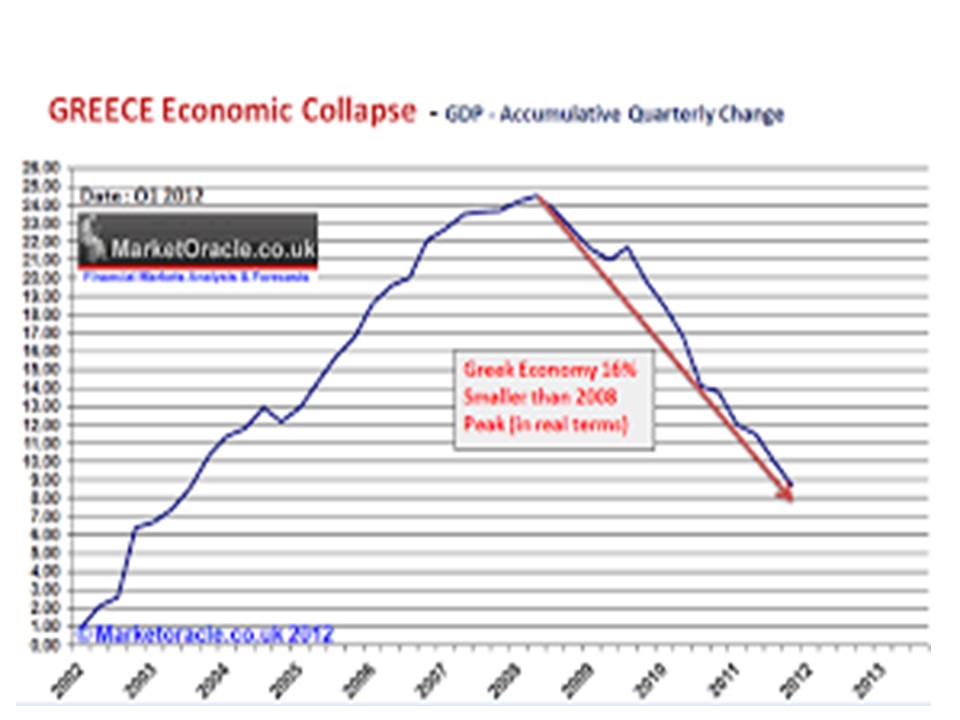
It was obvious in 2011, four years ago, that Greece could not pay back all that it had borrowed. Today its public debt is an unsustainable 177 percent of its GDP. So it is obvious – much of the debt has to be wiped out, one way or another.
Are Greece and its leaders to blame? Sure. But on the principle of “sunk costs”, the history is irrelevant. The question is, what to do today, to avoid the crash? We’ve seen it coming for years, according to Issing. Yet Europe and its blind leaders continued to torture Greece, imposing ever more severe austerity. You cannot grow an economy by shrinking it. And an economy can only pay back debt by growing. Grade 5 kids know that. But politicians and economists don’t. You cannot have a single currency, the euro, without a single united banking system throughout the euro zone with one set of rules. That never happened. It never will. So the euro will become a permanent chronic ongoing crisis, and it has been for years.
Yesterday German Chancellor Angela Merkel said, “if the euro fails, Europe fails.” Really? What has Chancellor Merkel done to recognize reality – Greece cannot, cannot, pay back its debt? She should have said, “The euro has failed, because I have failed, and I therefore tender my resignation. I failed to explain to the German voters, that even if we wipe out a quarter of Greek’s debts, Germany still has gained immensely”.
Who has been the big winner from Greece’s suffering? Germany.
Why? Because Greece has dragged down the external value of the euro, and the cheap euro makes German exports more competitive. If Germany under Merkel would give Greece 3 percent of all it has gained from the Greece-driven euro decline, the crisis would be over.
Some 37 % of Germany’s GDP comprise exports, or nearly $1.5 trillion (in 2014), just slightly behind that of the U.S., whose population is three times bigger. Even China exports only 23 % of its GDP. How strong will German exports be, when Greece leaves the euro, restores the drachma, bankrupts its citizens and its banks, crashes world financial markets, bashes the world economy — and then the euro soars, throwing Germany’s export-driven economy into recession?
Two trucks speeding toward each other for years. Could the crash have bene prevented? Sure, with common sense.
Was it?
No. History will be unforgiving to the hypocritical blind leaders who caused this.
New Thinking About Our Schools: It’s NOT Rocket Science!
By Shlomo Maital
A great many people the world over are troubled about what happens to our children and grandchildren in the school system. America’s No Child Left Behind Act (2000) has left most children behind, because America still scores poorly in international achievement tests, despite (because of?) billions spent on “Race to the Top”.
A simple principle says, if you want to improve, learn from others. Benchmark what others do, adapt it, and get better. But educational bureaucracies in most countries do not even know what global benchmarking is.
Take Finland, for example. Pasi Sahlberg, a Finnish educator, has shared Finland’s experience with the world in his 2011 book Finnish Lessons: What Can the World Learn from Educational Change in Finland? It has been translated into many languages already, including Hebrew.
Here are the four key principles Finland used to create a world-class world-leading educational system, for all Finnish kids, not just a handful of privileged ones in Helsinki.
- Guarantee equal opportunities to good public education for all. In the U.S., that means that schools in rural Louisiana and Mississippi should be up to scratch, as much as ones in Princeton, NJ.
- Strengthen professionalism of, and trust in, teachers. This is related to pay levels, teachers’ colleges, and in general, how society values those who educate our children. In Finland, it’s really hard to get in to teaching programs, as hard as getting in to engineering.
- Get parents involved, educate everyone about education and the key processes, especially assessment (and note: assessment is NOT just tests).
- Facilitate competition and innovation among schools; network them, help them learn quickly from one another, let them try experiments and scale up ones that succeed.
These principles are easy to state, hard to implement. But take #4, for example. President Bush’s very first Act, in 2000, brought free-market competition models to American schools by tying state and federal funding for schools to test performance of kids. Many countries have copied this dumb idea.
There is another way to introduce competitive forces into education. Let schools experiment, and share the results. This is the REAL free-market model. To do this, you need to abandon the insane obsession with testing, hated by kids, parents and teachers alike, and let kids learn to love learning, let teachers love to teach, and evaluate by what children can do, rather than what they can memorize and regurgitate.
In Finland, it worked. How come? What can we learn from it? How many American educators have spent time in Finland, observing their schools, talking to their educators? And how long will it take, before educational professionals all realize that No Child Left Behind left a great many kids behind, far behind, and that it is time to dump the whole bad idea, not only in America but everywhere.
How (and Why) You Should Prepare for a World of Very Slow Economic Growth
By Shlomo Maital
It is becoming more and more clear that in the next 50 years, the world economy (and probably, the economy in which you live and work) will grow more slowly than in the past. What was perceived as a temporary correction, due to the global financial crash of 2008, is now becoming chronic.
Why?
A study by McKinsey Global Research, “Global Growth: Can Productivity Save the Day in an Aging World” (available from McKinsey’s website) notes that “GDP growth was exceptionally brisk over the past 50 years, fueled by rapid growth in the number of workers and in their productivity.” But now, employment growth, which averaged 1.7 per cent yearly between 1964 and 2014, is set to drop to just 0.3 per cent a year.
And productivity growth is slowing too. “Even if productivity were to grow at the (rapid) 1.8 per cent annual rate of the past 50 years, GDP growth would decline by 40 per cent in the next 50 years – slower than the past five years of recovery from recession”. But productivity growth has declined and does not look like it will recover much. China’s economy is slowing. Europe and America grow slowly. Japan has slow growth. Looks like it’s chronic.
What can be done? “Catching up to best practice”, says McKinsey. In other words, if we all benchmarked the world and defined and captured ‘best practice’, productivity growth could nearly make up for the declining growth in workers.
Here are McKinsey’s 10 key “enablers of growth”. Can each of us look at this list closely, and figure out, what is my role? How can I become really skilled, expert, at one or more of these enablers? If McKinsey is right, and if you can, you will be in great demand – and create value for the world.
Here is the list. Which of thee suits you? What must you do, in order to become a true enabler?
- Remove barriers to competition in service sectors. 2. Focus on public and regulated sector efficiency. 3. Invest in physical and digital infrastructure. 4. Foster R&D demand and investment. 5. Exploit data to identify transformational improvement opportunities. 6. Improve eduation and skill matching and labor market flexibility. 7. Open up economies to cross-border economic flows. 8. Boost labor force participation among women, young people, and older people. 9. Harness the power of new actors through digital platforms and open data. 10. Craft regulatory environment, incentivizing productivity and innovation.
by Shlomo Maital

Navinder Singh Sarao
I read this story today in Bloomberg Business, and still just can’t believe it. But it’s true. *
The young man in the photograph is named Navinder Singh Sarao. Today he is in a 10 ft. by 6 ft. cell at Wandsworth Prison, one of Britain’s worst jails.
Why? Five years ago, his actions allegedly contributed to wiping more than $1 trillion in assets off financial markets. Trillion here, trillion there, pretty soon, you have a problem.
Here is the story. Sarao was a graduate trainee at Futex, a company that specializes in trading stocks and other assets. Here is their calling card: “We believe that keeping mind, body and intellect nurtured leads to overall well-being, which is essential for successful trading. Our approach keeps these in balance, and since 1990, when Futex was founded, has helped many traders reach their goals.” Translation? We make money, scads and scads of it, any way we can.
Sarao was an instant sensation. While other traders were eking out 500 pounds a week, Sarao was clearing 500,000 pounds! He always sat by himself. And he spent almost nothing. He was extremely frugal. On a good day, Sarao made $130,000, and even on a bad day, $70,000. He got to keep 90 per cent of the money he made for Futex. But he felt it was not enough. He ended his contract at Futex and went to CFT Financials, a firm that rented out space to private traders. He got backing and technology from MF Global Holdings, the now defunct firm run by former US Senator Jon Corzine that incurred enormous losses for its investors.
“I want to be the biggest trader,” Sarao said.
According to U.S. allegations, Sarao began “a massive effort to manipulate” stock futures on Globes, an electronic trading platform. This involved “spoofing”. It is an illegal technique that involves flooding the market with bogus buy or sell orders to drive prices up or down, then cancelling the orders. Spoofing is rampant today. Sarao built computer algorithms, in June 2009, to change the way his orders would be perceived by other computers. (A very large fraction of trading today, in financial markets, is done by computers, not by humans).
On May 6, 2010, there was a “flash crash”. More than $1 trillion was wiped off the markets in the space of a half hour. Sarao allegedly made $900,000, using an algorithm that gave a misleading impression of the volume of sell orders.
After this crash, suspicion fell on high frequency trading firms – firms that buy and sell assets, using super computers that identify opportunities and act on them in micro-seconds, far faster than humans can. In late April of this year, Scotland Yard knocked on his door in Hounslow, a Western neighborhood of London, and accused Sarao of helping to cause the flash crash.
Yes, a glorified day trader living with his mom and dad near Heathrow Airport nearly destroyed the world. Why don’t you buy a Bugatti? His friends asked. I don’t know how to drive, he answered.
Sarao will soon return to court, in his gray prison tracksuit, and for the 8th time sit in the dock, as the U.S. tries to extradite him on 22 counts, from wire fraud to market manipulation. Sarao denies the charges. Many doubt that he or anyone else singlehandedly caused the flash crash. The truth is, COMPUTERS, not humans, drive markets today. But you can’t put a super computer in jail. Sarao said last May, “I’ve not done anything wrong apart from being good at my job”.
“This guy had balls”, said a Futex trader who knew him. “He used to get into big positions, he saw the risk, he saw the reward, and he took the trades.”
If Sarao is guilty, we should worry about how one person can destroy the market. If he is innocent, we should worry that financial markets are unstable, prone to huge swings and are easy to manipulate, by those who operate in the shadows.
Either way, we are in big trouble.
The Purpose of Life? Little Things Mean A Lot
By Shlomo Maital

In a recent blog, “Disney Theory of Life” (April 14), I referred to David Brooks’ New York Times column about the purpose of life. I offered my own theory, based on the Disney World mantra, “Make People Happy”.
In today’s New York Times, Brooks returns to this theme and quotes emails he received from readers. “I expected most contributors would follow the commencement-speech clichés of our high-achieving culture: dream big; set ambitious goals; try to change the world. In fact,” notes Brooks, “a surprising number of people found their purpose by going the other way, by pursuing the small, happy life.”
Examples? Kim (apparently a therapist): “Now my purpose is simply to be the person who can pick up the phone and give you 30 minutes in your time of crisis”. Terence: “big decisions have less impact on a life as a whole than the myriad of small seemingly insignificant ones.” Hans: “At age 85, …I am thankful to be alive. If there is one thing that keeps me focused, it’s the garden. Lots of plants died during the harsh winter, but, amazingly, the clematises and the roses are back, and lettuce, spinach and tomatoes are thriving in the new greenhouse.”
So, bottom line? Follow the wise advice of a woman I read about (probably in the excellent AARP retired persons’ magazine): “Ask yourself each morning, when you wake: what will I do for others today? And what will I do for myself?” And, as you fall asleep at night, ask yourself, “what did I do for others today? And what did I do for myself?”
A kind word? A helping hand? A smile? Little things, tiny things. They add up to something really big. They give real meaning to our lives, one day at a time.
Here are the words to the lovely song, Little Things Mean a Lot,
Blow me a kiss from across the room
Say I look nice when I’m not
Touch my hair as you pass my chair
Little things mean a lot
Give me your arm as we cross the street
Call me at six on the dot
A line a day when you’re far away
Little things mean a lot
Don’t have to buy me diamonds and pearls
Champagne, sables or such
I never cared much for diamonds and pearls
’cause honestly, honey, they just cost money
Give me your hand when I’ve lost the way
Give me a shoulder to cry on
Whether the day is bright or gray
Give me your heart to rely on
Send me the warmth of a secret smile
To show me you haven’t forgot
For always and ever, now and forever
Little things mean a lot
Give me your hand when I’ve lost the way
Give me your shoulder to cry on
Whether the day is bright or gray
Give my your heart to rely on
Send me the warmth of a secret smile
To show me you haven’t forgot
That always and ever, now and forever
Little things mean a lot
And, here is the link to Kitty Kallen’s lovely rendition of it. http://www.oldielyrics.com/lyrics/kitty_kallen/little_things_mean_a_lot.html
How Teachers Ruin Inquiring Minds – And Why They Must Stop
By Shlomo Maital

Illustration by Avi Katz
Thanks to my outstanding colleagues at Technion’s Center for Improvement of Teaching and Learning, our MOOC (massive open online course), Cracking the Creativity Code: Part One – Discovering Ideas, launched on the Coursera website on May 18, and has over 6,000 students enrolled, worldwide, from Qatar, India, China, Iran, Iraq and Saudi Arabia, among others. The course is based in part on the book by the same name by Ruttenberg & Maital.
Part of the course involves “chat” forums, organized as ‘forums’ on topics the students themselves initiate.
Lizzie writes: “My 7th grade teacher’s response to many a question was ‘don’t show your ignorance by asking that’. Which didn’t reduce my ignorance but did get me to stop asking questions and start hating school instead of loving it.” Malgorzata responds: “Oh yes. I have suffered high school phobia because of it. Constant bullying by teachers was unbearable.”
How many teachers encourage questions? How many shut them off, destroying the spirit of inquiry and love of learning? Are teacher training schools helping teachers encourage students’ questions, rather than shutting them off?
Javier writes about how his teacher, in Barcelona, requires the students to copy verbatim a short story. He tried an experiment – writing with his eyes closed, to see if he could write straight lines without looking. The teacher ridiculed him before the class. End of experiment. Could the teacher have responded: Class! Javier is trying to write with his eyes closed. Let’s all try it. Let’s see what happens. Javier, thank you for this interesting idea.!
There are millions of superb, dedicated teachers all over the world, educating the next generation, overworked, underpaid, underappreciated. But there are still too many to believe they should be teaching the laws of algebra, rather than (in addition) why mathematics is interesting and fun to explore.
The Nobel Laureate in Physics Isidore Rabi tells this story: When he came home from school, his mother never asked him, what did you learn today in school? Instead she asked, Isador, did you ask good questions in class today? He attributes his success as a scientist to his mother and to her question. How many Nobel Prizes are we destroying, by shutting off kids’ questions?
Pop a Pill? No! There’s a Better Way
By Shlomo Maital
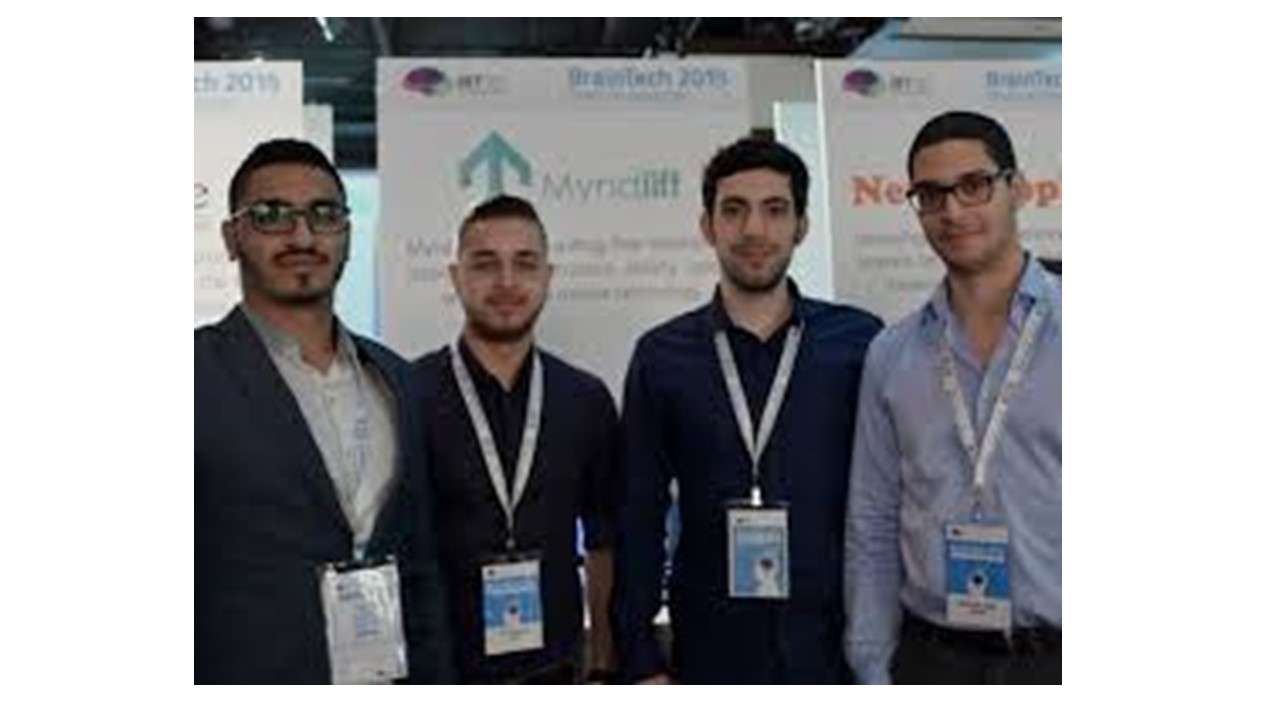
Aziz Kaddan, Amir Khalaily, Hilal Diab, Anas Abu-Mukh
Arab culture is highly entrepreneurial. Given the right opportunities, Arab entrepreneurs could transform the Arab world, shifting Western attention from ISIS and its vicious violence to IS (Innovation Startups). Here is an example (thanks to Sharona, my wife, who drew my attention to this story).
ADHD attention deficit hyperactivity disorder is widely treated with a drug, Ritalin. Novartis sells $350 m. worth of methylphenidate (Ritalin) each quarter. When kids have problems in school, it’s super easy for teachers to demand that they pop a pill – even if the problems could be addressed differently, with a little effort. In general, our pop-a-pill society plays into the hands of Big Pharma, and sometimes does immense harm to us all. Ritalin is now used widely as a recreational drug, too. For Big Pharma, it’s all just money.
NASA developed a computer-based technique to improve attention, focus and learning. Now, Aziz Kaddan, age 22, an Israeli Arab, and three friends have launched a startup, Myndlift, that uses biofeedback to deal with ADHD. It’s an app-based wearable solution, together with mobile games that work only through attention, and boost attention levels with only 10 minutes of play time a day. Kaddan is the son of a neurologist, and got a computer science degree at the age of 19.
Friends urged Kaddan to up the price of his app (it’s only $15 for the premium version), but he and the founders believe that to keep this solution accessible, it has to be quite cheap. (Big Pharma – don’t you just love it?).
Over the years, I’ve taught many students with ADHD. Most of them avoided Ritalin, and instead developed their own personal unique ways to focus and deal with their challenges. Sometimes, the ADHD was even a blessing, because it appears that those with ADHD happen to be very creative.
Next time you have a problem, and someone tells you to pop a pill, think about it for a while. Sometimes you really do need that pill. Sometimes, you can manage better without it.
Thanks to Aziz and his friends for showing us another way, other than pill popping. I hope their story will inspire other Israeli Arab entrepreneurs.
Why Boeing’s Dreamliner 787 Is a Nightmare
By Shlomo Maital

Yup, Boeing, one of America’s leading industrial exporters, is in trouble – again.
In 2011 it introduced the fuel-saving Dreamliner, a truly great and comfortable aircraft — but Boeing is still not making money on it. Normally, the learning curve lowers production costs dramatically, moving new planes into profitability. Why not the Dreamliner, which is a great airplane?
Reading between the lines in Christopher Drew’s New York Times article:
Boeing has not yet ramped up production to 12 a month. There are delays in supply of seats from a French supplier, Zodiac Aerospace.
But buried in the article is the real zinger: “Boeing has an aggressive stock repurchasing program; it spent $2.5 billion to buy back 17 million of its shares in the first quarter.”
Had Boeing used that cash to boost its production rate, and help Zodiac get those seats delivered, it could have moved down the learning curve faster. Instead it buckled to shareholder pressure and distributed the money instead of re-investing it.
I never give advice on the stock market. But here is one exception: Never invest in shares of a company that spends money to buy back its own shares. The reason: It proves the company knuckles under to shareholder pressure (bad sign), and proves the company has no other imagination or vision for using scarce resources.
And one more tip: Beware of the accounting numbers. Boeing apparently can book profits computed according to “average projected cost” (using the learning curve) rather than the actual cost of planes at the moment. This is highly dubious. And Boeing has used this method for ages. Where are the audit board and the auditors?
Financial Trading: They’re Still Ripping Us Off
By Shlomo Maital
 Sarao – The Guardian sketch
Navinder Singh Sarao
With the indictment in London’s Westminster Magistrate’s Court of Navinder Singh Sarao, we again become aware that financial traders and speculators are still ripping us off.
A criminal complaint filed against Sarao cites a practice known as “spoofing”, used to manipulate prices and make profits. Spoofing involves placing orders to move the price of a financial asset. When the price moves (up), the trader sells the asset, then cancels the original (fake) order. Apparently this practice is widely used by some high-frequency trading firms (i.e. firms that use super-computers to spot profit opportunities and buy and sell in a micro-second, faster than a human trader can spot them).
The spoofing method was apparently used in 2010, May 6, to move the Dow-Jones, which plunged some 1,000 points in moments and caused huge disarray in financial markets.
One of the markets in which spoofing occurs is the Chicago Mercantile Exchange, where traders can remain anonymous.
The information above is reported by Nathaniel Popper, in the New York Times.
Ordinary citizens are ripped off, because when asset prices are manipulated, the traders doing the manipulation take the profits at our expense, as we pay more for the assets we buy than we should.
There seems to be no end to the sleeze and crookedness in financial trading, and it is small comfort to hear they are ‘fringe crackpots’. The problem is, nobody knows how widespread these practices are, because there is almost no way to tell, especially with anonymous trading.
Why not end anonymous trading? It won’t end spoofing, but at least it will increase the risk the spoofers take. There is no crime in placing an order and then cancelling it. But when this is done systematically, it becomes suspicious. Proving criminal intent is super difficult. The only solution is, financial traders who don’t cheat. But, why not cheat, if enormous profits result from it?

 TIMnovate