You are currently browsing the category archive for the ‘Innovation Blog’ category.
Never Again? Sarin Gas Kills Syrian civilians
By Shlomo Maital

Is it nearly certain that Assad ordered the use of Sarin nerve gas, near Damascus, that killed over 1,000 civilians?
America and Israel both believe so. According to The Guardian newspaper, “Expert opinion is hardening behind attributing the deaths on Wednesday of hundreds of people in Damascus to a nerve agent such as sarin, with regional and western governments expecting to receive smuggled biological samples from the site in the coming days. Chemical weapons specialists, who have studied footage showing the dead and dying victims of the attack, said several symptoms offered strong evidence that a nerve agent was used; it would be the worst such attack anywhere in the world in the past 25 years. … The [missile] strike occurred around 2am Friday at a time when the Syrian military had launched an advance into the rebel-held area east of Damascus. The missiles bore similarities to those used in at least two previous attacks where a toxic gas was reported to have been used. … Eyewitnesses have described the missiles and rockets launched in the attack as having come from two areas of Damascus which are both under regime control – the Mezze airbase, south-west of central Damascus, and the October War Panorama military museum in the city.”
Has Sarin killed people before?
Yes, the Halabja attack, when up to 5,000 people were gassed in Iraqi Kurdistan by Saddam Hussein’s forces in 1988. In 1995, the Japanese Aum Shinrikyo sect released an impure form of sarin in the Tokyo Metro. Thirteen people died.
Has the Syrian army used Sarin before?
Yes. According to the Guardian: “Biological samples had been given to MI6 and to French intelligence members after alleged small-scale chemical attacks earlier in the year. Both governments, along with the US, then declared that sarin had been the agent used.”
What is Sarin? Who invented it?
Wikipedia: “It is a colorless, odorless liquid, used as a chemical weapon owing to its extreme potency as a nerve agent. It has been classified as a weapon of mass destruction in UN Resolution 687. Production and stockpiling of sarin was outlawed by the Chemical Weapons Convention of 1993.” Sarin was discovered in 1938 by two German scientists attempting to create stronger pesticides. In mid-1939, the formula for the agent was passed to the chemical warfare section of the German Army Weapons Office. Estimates for total sarin production by Nazi Germany range from 500 kg to 10 tons. Though sarin, tabun and soman were incorporated into artillery shells, Germany did not use nerve agents against Allied targets.”
How do people exposed to it die?
They are asphyxiated. Sarin inhibits how the body eliminates “acetylcholine”. “A build-up of acetylcholine in the synaptic cleft, due to the inhibition of cholinesterase, means the neurotransmitter continues to act on the muscle fibre, so that any nerve impulses are effectively continually transmitted. Death will usually occur as a result of asphyxia due to the inability of the muscles involved in breathing to function.”
Did the Nazis use Sarin in their gas chambers?
No. They used Cyclone B, a cyanide-based pesticide use by Nazi Germany to kill an estimated 1.2 million human beings, including approximately 960,000 Jews, in gas chambers of extermination camps during the Holocaust.
How do you, as a Jew and an Israeli, react to Assad’s use of Sarin gas to kill over one thousand Syrian civilians?
I am strongly pro-peace, pro-compromise, pro-two-state-solution. I also have not a shred of doubt, that if Assad and his Israel-hating equivalents are willing to gas their own citizens, would they hesitate for one second to do the same to us Israelis, if only they could?
Nearly every Israeli [including my wife and I] has a gas mask in his or her home, including versions for children. Is there any other country, among the 242 nations of the world, that has to store gas masks at home?
Russia and China, Assad supporters, are accomplices in Sarin war crimes. So is Obama, whose empty ‘red line’ words humiliate and demean all Americans. So are we all, who just sit silently and cluck our tongues. And where, by the way, are the demonstrators in Arab nations and abroad, who are quick to boycott Israeli-designed water meters sold in UK, for example?
The Global Crisis Never Ends – Here’s Why
By Shlomo Maital
 the mimic octopus
In Nature, there is an incredible ‘mimic’ octopus that can change its shape and its color, to imitate its surroundings. (See above). It does this, with only a pea-size tiny brain.
If you’re paying attention, dear reader, you may have noticed: The global financial and economic crisis has not ended. It simply keeps changing its shape – just like the mimic octopus. 
It started in 2007-8 as a subprime mortgage crisis, with banks and financial services companies requiring massive bailouts. Next, it became a government budget deficit crisis – when governments assumed the bad debts of the banks.
Then it metamorphosed into a ‘euro’ crisis, because weak southern European countries (Greece, Portugal, Spain, even Italy) skated close to defaulting, thus endangering the euro, because of the debts they subsumed.
Now? It’s become an emerging markets crisis. Ironic, because last time, the Asian contagion was a financial crisis that began in Thailand (1997) and migrated quickly to the rest of the world. Now it is an American crisis that has infected Asia.
According to Landon Thomas Jr., in a front page Global New York Times article (Aug. 21), “Fed policy poses risks to emerging economies.” Why? The American Fed printed enormous, massive amounts of dollars (quantitative easing) to stimulate the US economy. Because US interest rates were so low, a huge part of that money fled abroad, to emerging markets, fueling property bubbles in Turkey, China, India and elsewhere.
Now, with Fed chief Ben Bernanke hinting that it may soon be time to raise interest rates and end ‘quantitative easing’, much of that money is fleeing emerging markets and returning home, in anticipation of higher rates. The result: deep drop in the exchange rate of the rupee, and the threat of disastrous bursting property bubbles in Turkey, Brazil, and South Korea. China, too, is quietly struggling with enormous bad loans given by state-owned banks.
U.S. Treasury Secretary John Connolly said, in March 1973, “the dollar is our currency – and your (rest of the world’s) problem.” By focusing its monetary policy solely on American GDP, employment and growth, America is causing collateral damage to other nations. This is inevitable – it is the fatal flaw of the current global financial system.
The current global crisis will not be terminated, until the conflicted dual role of the dollar (it is the American currency and also the world currency) is resolved. The crisis will continue – it will simply keep changing its form and center of gravity. The world will continue to oscillate between “far too many dollars” (bubble) and “far too few dollars, or dollar flight” (bubble bursts).
Entrepreneurial Energy: It’s Everywhere
Sizwe (S. Africa) and Atef (Jordan/Syria)
By Shlomo Maital

Sizwe and his ‘capital’
My friend Prof. Dan Shechtman, Nobel Laureate for Chemistry (2011), has for over two years been trekking tirelessly across the globe, using his Nobel pulpit to deliver a message: Entrepreneurship can change the world. His infinite passion and energy, despite his age (72), reflects the infinite inexhaustible energy of entrepreneurs who seek to create value and build businesses, even in difficult circumstances. Here are two examples, both from the BBC World Service (I am a huge fan).
1. Sizwe Nzima: “Collecting medicine from a hospital or dispensary in some of South Africa’s townships can be a challenge- with the cost of transport and queuing times a problem for many people. Now one young man from Cape Town, Sizwe Nzima, has come up with a novel solution, which is not only helping patients in the community but has also seen him build a successful business.”
Nzima identified a need: People in South African townships spent hours in queues, losing valuable work time, to get medicines from hospital dispensaries. Why not get the medicine for them, and deliver it, with squads of bike riders? How did he get the idea? He had to get medicine for his grandmother. Like many great startups, his began when he identified a very personal need, and realized others had the same unsatisfied need as well.
Now, the 21-year-old has a successful business. Like all great ideas, you have to ask: Why didn’t we think of that before?
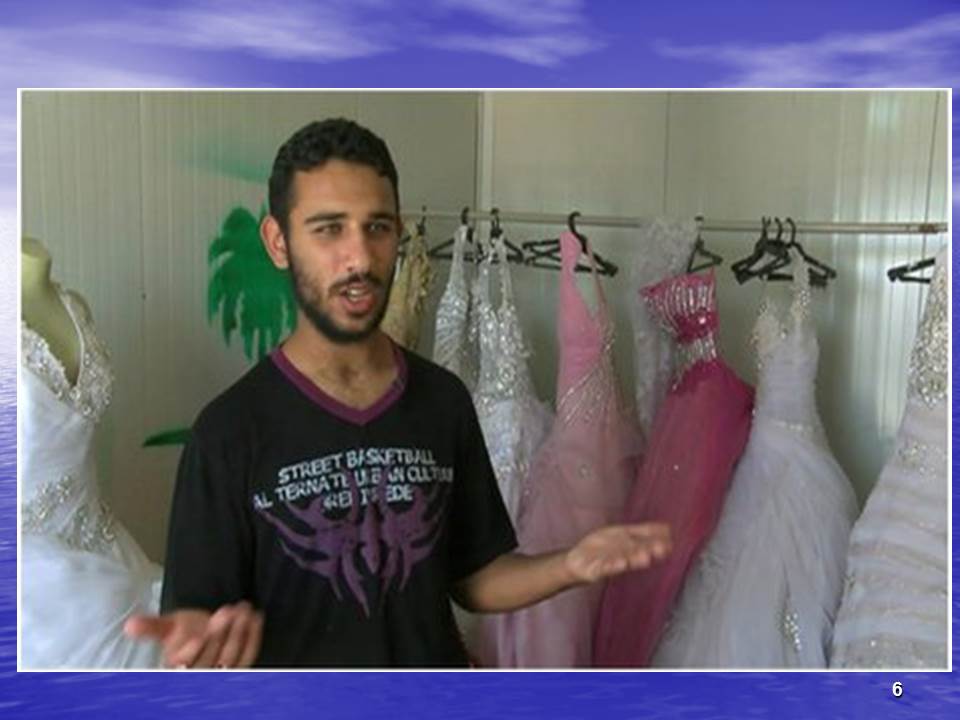
Atef and his inventory
2. Atef, wedding dress magnate: “The door of a metal cargo container creaks open to reveal a row of embroidered and bejewelled dresses in red, pink and white. I had stepped into Atef’s wedding dress hire shop, a business that serves as a reminder that romance blossoms in the bleakest of environments. Atef’s business in is the Zaatari refugee camp in Jordan, home to about 120,000 people who have fled the conflict in Syria. His container is located on a street that aid workers have nicknamed the Champs Elysees, due to the hundreds of shops and businesses. Atef has been in the camp for over a year now. He fled the fighting in Daraa, about 30km (20 miles) away in Syria. It is a city rich with businessmen thanks to a long history of cross-border trade with Jordan. “We started this as an abaya (robe for women) shop,” says Atef. “Women used to come here and say they had weddings but they couldn’t find dresses. So we bought two dresses for rent and it worked out well. “We have two weddings a day and there are people who come from outside the camp to rent dresses because it is cheaper here. “The profit is not that much but we are doing ok. We rent the dress for 10 dinars (around $14) whether it’s people inside or outside the camp. “Sometimes we even take 5 dinars from people who can’t afford to pay much.”
Over a million refugees have fled Syria’s brutal bloody civil war. They now know it will be a very long time before they can return home. Entrepreneurs like Atef are trying to make the best of it. His shop now serves not only the Zaatari camp but nearby residents as well. And he even has a Corporate Social Responsibility program, giving half-price discounts to those who lack the money.
The lesson here is so obvious. Governments everywhere: Stand back, get out of the way, turn loose the entrepreneurial energy – and let Atef, Sizwe and other dynamic men and women create value, for others and for themselves. If you can, governments, give them a bit of help, perhaps a few dollars. But at least, don’t interfere with them. (The Arab Spring began, it will recall, when a corrupt bureaucrat tried to extort a bribe from Mohamed Bouazizi in Sidi Bouzid, Tunisia, on Dec. 18, 2010, who scraped out a living with a vegetable cart).
Entrepreneurship is like flowers in the arid desert – they sprout and flourish even in the toughest of conditions. Why not give it a chance?
Should Our Political Leaders Drive Cabs?
By Shlomo Maital

Norway’s Prime Minister driving a taxi
There is a growing feeling, all over the world, that our political leadership is totally out of touch with the struggles of ordinary life that we endure. Prime Minister Netanyahu never buys milk or bread, fills out a tax form, or struggles to board a crowded train. Nor has he for many years. Nor has any senior political figure anywhere.
Except Jan Stoltenberg, Prime Minister of Norway, up for re-election on September 9 and well behind in the polls. According to Reuters:
Norway’s prime minister worked secretly as a taxi driver in central Oslo for a day in June, leaving his passengers wondering whether their elected leader had quit the day job. Wearing a taxi driver’s uniform and sunglasses, Jens Stoltenberg drove passengers around the streets of the Norwegian capital for several hours, confirming his identity only after his passengers realised who he was. The stunt, dreamed up by an ad agency as part of Stoltenberg’s campaign for re-election, was filmed on hidden cameras. A video of the event was published on Sunday by daily newspaper VG and on the PM’s Facebook page. Stoltenberg told the newspaper he had wanted to hear people’s honest views on politics. “If there is one place where people say what they really mean about most things, it is in a taxi. Right from the gut,” he told VG.
Alas, the whole thing was a “stunt”, dreamed up by an ad agency.
But – could we the people make this part of the job definition of every senior politician? Each week, he or she will be required to: shop for groceries; ride on a bus and on a train; drive his or her own car and park it downtown; take a small child to school and chat with a teacher.
Former American Joint Chiefs of Staff head Mike Mullen, a navy admiral, was told this by a close friend, just before he began the top job: “Mike, today is the last day anyone will ever tell you the truth.” Why? Because the bearer of bad news to the top honcho risks being the messenger who is beheaded for bringing bad news. It happens all the time. What Mullen did is pack his bags and travel the world, speaking directly to soldiers from the ranks. Few civilian leaders, if any, emulate him. Stoltenberg simply tried a publicity stunt.
I ride taxis a lot. Taxi drivers are a superb source of information about what is going on, far better than GDP numbers. If you want to know what is going on in Norway, Prime Minister Stoltenberg, ride a taxi once in a while, rather than drive one. And – leave the ad agency and the cameras at home.
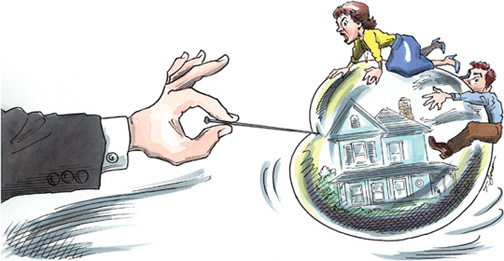
Subprime Mortgage Crisis? Hey – It’s About People!
By Shlomo Maital
On the day devoted to recalling victims of the Holocaust, in Israel, there is a moving ceremony in which the endless list of names of those who perished is read.
I wonder if we could organize a Wall St. Victims day, in which the names of all those who lost their homes are read. How many are there?
“Already some 5 million homes have been lost to foreclosure; estimates of future foreclosures range widely. [Moody’s Analytics chief economist Mark Zandi], who has followed the mortgage mess since the housing market began to crack in 2006, figures foreclosures will strike another three million homes in the next three or four years”.
That makes 8 million homes lost by families. Far more than in the Great Depression. And each lost home is a tragedy for a mother, father, children. Assuming 3 persons per household: 24 million people have lost their homes or will in the next few years, as they struggle to pay for mortgages whose value far exceeds the value of their homes.
Journalist Peter Eavis has done us a great service by tracking one single mortgage, with a family name, through the Wall St. machine that turned it into a toxic poison pill. (New York Times, Aug. 14, 2013, “A toxic bond that keeps causing pain”). Here’s how it goes.
The bond is GSAMP Trust 2007-NC1. GS is Goldman Sachs, who packaged the bond. NC is New Century, a mortgage lender which lent Wendy Fillmore and her husband $274,000 (in 2 mortgages), to buy a $276,000 house in Las Vegas. (Yes, 100% mortgage). “I was wondering how we managed to get approved,” Wendy told Eavis. NC didn’t care if Wendy and her husband paid their mortgage or not; because NC sold it right away to “GS”. GS packaged the Fillmore mortgage and others, as collateral for a mortgage-backed security, GSAMP Trust 2007-NC1, that got AAA credit rating so pension funds could buy it. GS didn’t seem to care much, either, if the mortgages backing the bond were any good. Those pension funds relied on their trust in Wall St. and in Goldman Sachs, which created the bond in Feb. 2007, when the housing market already had begun to look shaky. They didn’t, and couldn’t, check on every mortgage that backed GSAMP Trust 2007-NC1. The bond-rating agency didn’t, and couldn’t, check every mortgage either. That was the beauty of the whole game. The toxic poison was hidden. But it was there, for sure.
Three-fourths of the mortgage payers, whose mortgages back the GS bond, have fallen way behind in their payments, according to the Boston Federal Reserve Bank. Wendy still pays, but struggles, and is desperate, because the value of her house today is half the value of what she owes in the mortgage. And of course she can’t sell the house either, Las Vegas’ housing market is terrible. Why would you struggle to pay a $276,000 debt for 25 years only to own an asset worth half that? Well, Wendy wants to continue to live in the house. But others have simply walked away.
What about the GS people who created the toxic bond? Former GS senior manager Jonathan Sobel left GS in 2008. He is a defendant in a federal suit. He recently bought a duplex on Park Ave., NY, for $19 m.
According to the New York Times, former GS head of mortgages Daniel Sparks wrote in an email, a month before Wendy got her mortgage, that he was a ‘bit scared’ of New Century. That email will doubtless haunt him, and has been used in a Congressional investigation. He didn’t tell the pension funds that. He should have.
p.s. the monthly payment on a 30-year $274,000 mortgage, at 5.25% interest, is $1,524, or $18,000 a year. By the time Wendy and her husband finish paying their mortgage, in about 24 years, they will have paid (in principal and interest) $548,669.60.
 923 of the 1604 mortgages backing a high-yield 2006 GS bond were
“highly risky”. Guess what its credit rating was?
When the pill is the problem, not the solution
By Shlomo Maital

I’m afraid this blog very often sins, by becoming ‘preachy’. Even if blogs are meant to convey strong opinions, they can be tiresome if they incessantly preach.
This blog is about the criminal overuse of anti-depressant drugs, fueled by the greed of Big Pharma, with some doctors complicit as well.
Here are the data. Judge for yourselves. (source: Global New York Times, Aug. 14: “Medication blues”, by Roni Caryn Rabin).
* 1 in 10 Americans now takes an antidepressant medication. Among women in their 40s and 50s, it is one in 4.
* 2/3 of more than 5,000 patients diagnosed as depressive in the previous 12 months DID NOT MEET THE CRITERIA FOR MAJOR DEPRESSIVE EPISODE, according to the DSM, Diagnostic & Statistical Manual of Mental Disorders. Published in Psychotherapy and Psychosomatics.
* 6 of 7 elderly patients 65 and older diagnosed as depressive did not meet the criteria for depression.
* Most people stay on anti-depressants for at least two years; some take them for a decade or more. These drugs have side-effects. Some are serious.
* A NYC woman was prescribed an anti-depressant a few weeks after her husband died, even though she thought feelings of grief and sadness were appropriate.
Once, we knew that life had ups and downs. When you’re experiencing the downs, you fight through them. The drug culture that says, “pop a pill for every possible symptom of occasion” has led to a different drug culture, one that consumes a variety of drugs, mostly illegal, to make us feel good.
Recently a well-known Israeli doctor, speaking on TV, admitted that he had given testimony about certain drugs before a Knesset committee – but he admitted, he forgot to mention that he had received large grants from the drug company.
Can we trust our doctors, who get trips, junkets, research grants and other perks from drug companies? Can we trust the drug companies, struggling to maintain obscene profit margins with a dwindling pipeline of over-costly drugs? Are we over-medicated?
What is most angering is that American soldiers, struggling with post-traumatic stress disorder, and there are thousands of them, appear to get minimal care, if any. Why are some people popping pills for imaginary disorders, while others are not getting the treatment they need?
Who Will Bail out the German Banks?
By Shlomo Maital

As Europe’s biggest, wealthiest and most influential nation, Germany has played a dominant role in bailing out failed European banks and failed European governments in Greece, Spain, Portugal, Cyprus and Ireland. Germany and its leader Angela Merkel have frequently and sternly lectured the deadbeat southern European nations for overspending and over-borrowing, neglecting to mention that it was largely the German banks who did the lending.
Now it turns out that the German banks themselves are endangering Europe. According to Jack Ewing, in the Global New York Times, “where in Europe is one of the worst banking systems, with bad management, corruption, loans to political insiders that cost taxpayers billions of euros? Not Italy, Greece or Spain, but – Germany… the German banks invested in almost every bad asset they encountered — American subprime mortgages to Greek Govt. bonds”. According to the EU, $860 b. were spent in bailing out German banks from 2008 through Sept. 2012. Only the UK spent more taxpayer money on bank bailouts. Even Spain and Italy spent less.
Ewing reports that German banks lend 50 euros for every euro in capital they hold. This is considered excessive leverage. Perhaps the German government has been reluctant to bail out Greece, Portugal or Ireland, because it needed (and will need in future) to bail out its own banks.
Germany’s banks are enormous. According to the Global Fortune 500, the largest German banks are Allianz ($130 b. in revenues, in 2012), Deutsche Bank ($87.5 b.), Landesbank Baden Wurttemburg ($53 b.) (the Landesbanks are controlled by politicians), and Oz Bank ($34 b.). Their saving grace has been the strong German economy, and its huge export surplus, which kept their balance sheets strong because few loans had to be written off. But all agree that German banks need radical reform, and many still carry toxic assets on their books.
If I were the Prime Minister of Greece, Portugal or Spain, I would offer to advise the German government on fiscal reform, austerity and bank reform. All that “friendly advice” by Germany, to Greece and Cyprus, should first be applied at home.
Physician, heal thyself.
Governments DO do good things!
By Shlomo Maital

American Republicans would have us believe that nothing, nothing about government is any good. We need less government, maybe even (if you’re a Tea Party fan) NO government, they say.
But Clyde Prestowitz (Reagan’s trade advisor), in his latest Foreign Policy blog, says otherwise.
“… the truth is that virtually none of America’s great inventors and entrepreneurs did it on their own. In the overwhelming majority of cases, they received taxpayer supported federal help along the way. For example, sometimes I ask audiences if any of them know who invented the Internet. Answer: the Defense Advanced Research Projects Agency (DARPA) which was the real inventor and developer of the basic Internet technology. Nor does anyone ever mention the National Science Foundation’s long years of nurturing the Internet before it became commercially viable.
Shale gas, too, could not have happened without government help, as Prestowitz shows.
“… the U.S. government spent billions over three decades to make shale gas and oil a reality. The effort began in the 1970s as a somewhat quixotic, patriotic undertaking by the government’s energy agencies and then the Department of Energy to respond to the oil crises of the time and to prevent the United States from becoming dependent on imported energy. Long known as lacking in innovation, the private companies of the energy industry showed little or no interest when the feds showed up offering them funds for joint research and development. Mostly, the oil and gas companies turned it down and told the feds to get lost. [The Government played a key role, providing: *The Eastern Gas Shales Project, a series of public-private shale drilling demonstration projects in the early 1970s in response to the energy crisis; * Collaboration with the Gas Research Institute (GRI), an industry research consortia that received partial funding and R&D oversight from the Federal Energy Regulatory Commission; * Early shale fracturing and directional drilling technologies developed by the Energy Research and Development Administration (ERDA, later the Department of Energy), the Bureau of Mines, and the Morgantown Energy Research Center (later the National Energy Technology Laboratory); * The Section 29 tax credit for unconventional gas production, in effect from 1980-2002; * Public subsidization and cost-sharing for demonstration projects, including the first successful multi-fracture horizontal drilling play 1986 and Mitchell Energy’s first horizontal well in 1991; * Three-dimensional microseismic imaging, a geologic mapping technology developed by Sandia National Laboratories.
Prestowitz reminds us to pause for a moment to thank our great bureaucrats, as well as of course the late George Mitchell, the entrepreneur whose passion created the natural gas generated by ‘fracking’ in America.
Failure University: The Diploma We All Need
By Shlomo Maital

In my latest column for the fortnightly magazine Jerusalem Report (Marketplace, Aug. 26 issue), I write about Failure University – how almost all successful people have massive failures in their track record, and how failure is a stepping stone to success, as Michael Jordan always said. As the design firm IDEO says: “Fail early to succeed faster”.
Here are two examples: Dov Moran and Abraham Lincoln.
Who is Dov Moran? He is the Israeli inventor of the memory stick (also called thumb drive, or in Israel disk-on-key). His company M-Systems was sold to San Disk for $1.6 b., an exit that made him wealthy. Retirement? Uh uh. He then started Modu, which made the world’s smallest (and perhaps first) smartphone, only 3 inches long. But Modu had a competitor called Apple (iPhone)…. And investors wouldn’t back him. At 12 noon on a chilly November day in November 2010, Moran closed the doors of Modu. But he was unemployed for only 30 minutes. At 12:30, he was already in his new offices, of a company called Comigo (TV/mobile interface), with some of his Modu veterans. Moran, now 58 years old, still works 20 hour days and flies Economy to Japan, to show respect for investors’ money and “to hang out with my workers”. Modu’s collapse led to at least 15 other startups, by Modu ‘alums’.
And Abraham Lincoln? The man who led America out of the abyss of slavery, as the Spielberg movie shows brilliantly? Here is his record of failure. * In 1831 his business venture failed. * In 1832 he lost the election for the state legislature. * In 1833 another business venture failed. * In 1835 his future wife passed away destroying him. * In 1843 his election to Congress was defeated. * In 1848 Lincoln failed to win a seat in the Congress. * In 1855 he lost the US senate elections. * Trying for Vice President in 1856, he was defeated. * Another attempt to run for the state senate in 1859 once again failed. * Against all odds, he was elected the 16th President of The United States in 1860. All those failures tempered Lincoln’s stubborn steely resolve – he needed every bit of it to get the anti-slavery Amendment through Congress, after leading America in its bloody Civil War.
In Silicon Valley, it is well known – if you have 3 failures on your record, VC’s regard you more favorably than if you have a clean record. Same in Israel. It does seem that what separates Michael Jordan (huge failures in his past) from lesser athletes, and great entrepreneurs from mediocre ones, is not genius, but resilience and perseverance.
Harvard diploma? Great. Failure U. diploma? A lot better.
How America Creates Something From Nothing
By Shlomo Maital

Here’s a neat trick – Create something from nothing. America just did it. The Bureau of Economic Analysis has redefined how it computes GDP, and at one fell swoop added $560 b. (more than twice Israel’s entire GDP) to America’s GDP, or 3.6 per cent. How?
By creating a new category called “intellectual property products”, including “entertainment originals”, and treating them as part of capital investment. So not only will America’s GDP rise, so will its moribund gross capital formation (investment), which ranks a dismal 123rd in the world (at only 16.2 % of GDP, barely enough to cover obsolescence).
How does this work? As Jared Bernstein notes in the Global New York Times, long-lived TV shows like “Seinfeld” that generate a stream of revenues for many years will now be treated as investment. Makes sense – capital, after all, is simply a product that generates an annual flow of other products, or services.
So, not only did America get some GDP from nothing, it is now counting ‘nothing’ (by everyone’s clear admission, Seinfeld is a show about literally nothing) as investment.
The big problem with this, is that in modernizing the GDP national accounts, America has left behind the financial accountants, whose rules (GAAP Generally Accepted Accounting Practices) do not permit the same definitions. Intangible assets are hugely important in today’s high-tech world, yet find little expression in balance sheets. At some point, the accountants will have to fall in line with the national accounts GDP people.
Bernstein makes another good point. If we’re modernizing GDP, it’s time we also took into account the huge damage we do annually, through pollution, to our environment. That’s a negative investment. If you count Seinfeld, as positive, you should count all the CO2 belchers as negative. That, however, would make politicians look bad, and perhaps force us to face up to the damage we do daily to our environment. The economists aren’t yet ready for that challenge.