
You are currently browsing the category archive for the ‘Innovation Blog’ category.
Seek Wealth? Look to the Future!
By Shlomo Maital
You can use Google easily to spot trends (Google Trends), by seeing how many people are searching on a given word. You get an instant graph that shows ups and downs over the past months and years.
Now, according to Bloomberg BusinessWeek, two researchers have shown that: “The more a country is looking forward, the more successful economically the country is.” They are Warwick Business School associate professor Tobias Preis and Dr. Helen Susannah Moat of University College, London.
They found that countries where “Internet users … search for more information about the future tend to have a higher per-capita GDP,” says Preis, This makes sense. When the economy is humming along, it is easier to be optimistic—to plan vacations, buy season tickets, investigate investments, etc. The researchers simply checked, by country, the ratio of those who searched on ‘2013’ compared to ‘2011’.
Who are the most forward-looking nations! Well – Germany. “Of everyone, Germans are the most forward-looking, knocking Britons from the top spot. This year, the Germans are looking forward to a pivotal federal election. Preis, a German national, declined to say whether Germany’s exuberance bodes well for incumbent Angela Merkel.”
“Interestingly, the U.S. ranks 11th, up from 15th a year earlier. The 2012 findings showed that entering an election year, more Americans were looking backward to 2010. This year, Americans as a whole are more optimistic about 2013 than they were a year earlier, Preis says.”
Economic laggards Pakistan, Vietnam, and Kazakhstan round out the bottom of the list.
There is a lesson here. Political leaders must find ways to instill hope in their people, and the measure of success is simply whether people are looking to the future, or looking back at the past. Google helps us know whether people indeed are future-looking or are looking (with sadness) in the rear-view mirror.
Neat Trick of Clownfish (“Nemo”) : Changing Sex
By Shlomo Maital
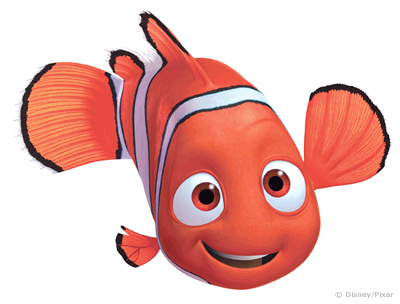
Remember the animated movie, Finding Nemo, starring the clownfish (or anemone fish) Nemo, and his Dad?
Clownfish are indeed amazing – but for reasons different than those in the movie. They can change sex, easily and quickly. According to curiosity.com, anemone fish stay very close to the anemones that are their natural environment. This limited mobility makes mating tough. It’s like, every eligible girl is sort of your sister. Nature has a solution, an amazing one. Because clownfish are ‘hermaphrodites’. And all are born male!
When a male clownfish pairs with another male clownfish (all clownfish are born male), one of them will simply turn female so that the two can spawn. When the female dies, the largest male in the area will take her place by turning into a female. Then, one of the more dominant non-mating males will begin mating with her.
With other hermaphrodite species, the sex-change process takes a long time, up to 30 percent of the lifetime of the creature. But not for Nemo fish. They do it very fast. Male sex organs, gonads, literally change quickly into female ones. Amazing how the random mutations of evolution create magic.
What if humans could learn the Nemo fish trick? The possibilities are endless.
Can US and EU Cooperate for Win-Win?
By Shlomo Maital
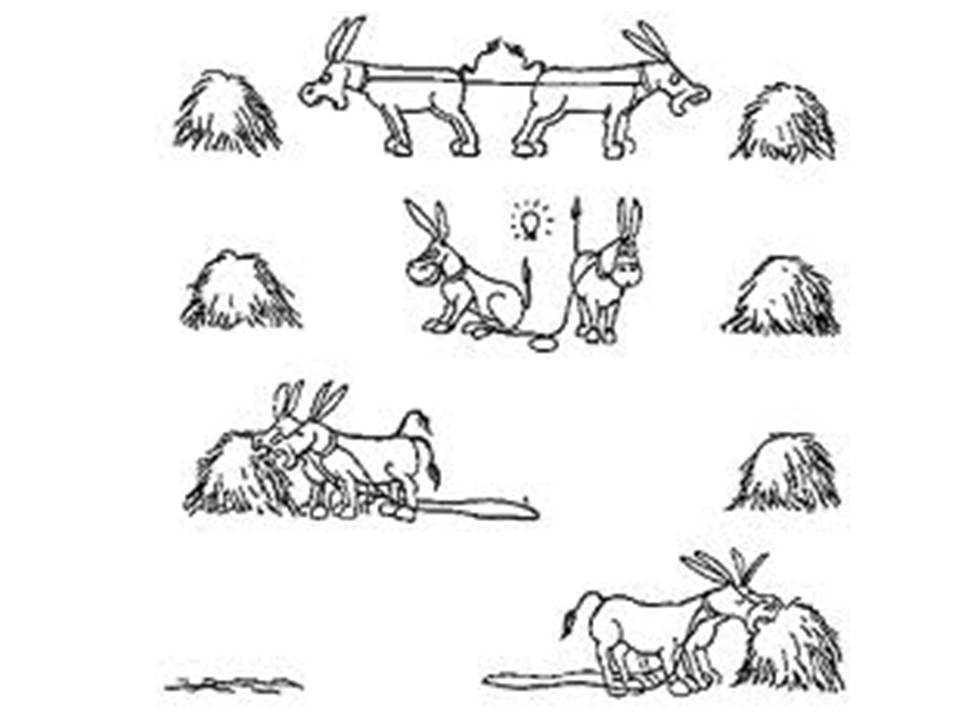
The world economy is emerging very slowly from the 2008-11 crisis, because of several doom loops. Domestically, fiscal austerity programs to slash deficits lower demand and slow growth, causing even deeper deficits. Globally, nations try to export their unemployment by limiting imports, and achieve the opposite (higher unemployment) when other nations retaliate and global trade slows. According to the Wall St. Journal (Oct. 1 2012):
“Global trade is stalling, dimming prospects that exports will buoy the U.S. economy in the coming months. Trade rebounded after its collapse in the recession. Now several indicators of export activity are flashing red as Europe’s recession, anemic U.S. growth and the slowing Chinese economy damp exports world-wide. The World Trade Organization just projected the global volume of trade in goods would expand only 2.5% this year, down from 5% last year and nearly 14% growth in 2010. A Dutch government agency, the CPB Netherlands Bureau for Economic Policy Analysis, estimates it fell outright in June and July.”
Global trade expansion may be the only win-win way to restore growth and cut unemployment globally. But how? Major nations shipped exports less than in 2011, last year. Only China, with an 8 per cent rise in exports, showed strong growth.
America is trying to build a free-trade pact with Asia, the so-called Trans-Pacific Partnership (TPP). At the same time, it is trying to build a free-trade pact with the European Union. The EU sees itself shut out of the TPP game and hence wants its own free-trade pact with the U.S. But negotiations will be tough, because both the EU and US have ‘sacred cows’ they want to protect, and they’re not the same cows. A key stumbling block will be the protected agriculture in each.
A lot depends on the success of the U.S.-EU pact. A successful one could add half a percentage point of GDP growth for each nation. This is huge. For the U.S. it is nearly $750 billion, almost as large as the budget deficit. For the EU, it is even more, $800 b.. America’s trade deficit in 2012 was the same as in 2011: $728 b. It won’t decline, without a free trade pact.
You would think that a win-win deal would be easy to attain. But alas, special interests may block it. Because a big overall win-win always has some small losers, and they and their lobbyists may fight hard. And voters, today, are even more wary and suspicious of ‘globalization’ than ever before.
Good luck, US-EU. Let’s see if reason triumphs over politics.
The Art Museum Security Guard Who Became …an Exhibit
By Shlomo Maital
 Valery Bikovsky
This is the story of Valery Bikovsky, a security guard at a Tel Aviv art museum, whose drawings now appear in a nearby art museum.
Bikovsky was born in Odessa. In 1941 his father was sent away to build barracks for the Red Army, and never returned. His mother took the family to Tashkent, where Bikovsky studied construction, like his father had. In 1991, Vikovsky’s wife’s brother encouraged them to come to live in Israel. Vikovsky was 49. Vikovsky found work as a security guard at the Tel Aviv Museum of Art, later working evenings and weekends. He has worked there for 21 years, lately as an usher. At the Helena Rubinstein pavilion, he has a small office.
In 2002, he began drawing, mostly by accident. He draws people, some of whom he sees from his windowed office. He is highly prolific, and gives away his sketches to the Museum workers, including its director, Prof. Mordecai Omer (along with poems – he is also a poet).
A photographer named Uri Gershuni, whom Bikovsky liked to sketch, has now curated a Bikovsky exhibition, at the Haifa Museum of Art. The exhibit is called Yekaterina The Great (named after his sister Yekaterina, who recently passed away) and comprises Bikovsky’s black and white sketches, drawn on old museum art paper, depicting figures from the art world that Bikovsky encountered at the Museum over the years. There is also a color collage he did, along with some of his poems.
The exhibit advertises Bikovsky as a security guard. Well, it’s a great story…but Bikovsky is much more than that. “It’s PR,” he says. He consults to artists who bring him paintings for his opinion. He fixes the air conditioning or electricity when necessary, and interacts with visitors. “I see who comes in the door, the right way to talk to him, how to explain things. It’s politics.”
What can we learn from Valery Bikovsky? Like many of those in his generation, he could not freely choose his vocation, but rather studied whatever enabled him to make a living. He was not demeaned by becoming a security guard. And he chose to work in a place, even menially, whose surroundings he loved. Now, he has become an exhibited artist. But he retains his position as guard/usher/handyman, which he loves. I guess the life lesson here is to work in a place you love to be in, even if you’re not doing precisely the very thing you love to do. Eventually, things will work out.
Special thanks to Ellie Armon Azoulay for her fine story, in Haaretz daily newspaper.
The World Economy Is Looking Up – At Last!
By Shlomo Maital
A German research center known as IFO regularly surveys a panel of experts, to determine the state of the economy at present, and expectations for the near term future. In January 2013 responses came from 1,169 experts in 124 countries. (The survey is conducted in co-operation with the International Chamber of Commerce in Paris (ICC).) I believe the survey is well done; I know it, as I am one of the panelists.
Here are the results.
I/2011 II/2011 III/2011 IV/2011 I/2012 II/2012 III/2012 IV/2012 I/2013
Climate 106.8 107.7 97.7 78.7 82. 95.0 85.1 82.4 94.1
Situation 102.8 108.4 99.1 86.0 84.1 87.9 78.5 76.6 80.4
Expectations 110.5 107.0 96.5 71.9 80.7 101.8 91.2 87.7 107.0
“The ‘climate’ (combining the current situation and expectations for the next 6 months) improved significantly. The increase in the indicator was mainly driven by significantly more positive assessments of the six-month economic outlook, while assessments of the current economic situation improved only slightly. After six months of stagnation, the prospects for the world economy seem to be brightening. The sharpest rise was for Asia, but the expectation (outlook) for Western Europe also improved a lot, even though the current ‘situation’ is bleak.
The rise in the 6-month expectation, nearly 14 points, resembles a similar rise in Q2 2012, optimism that quickly dissipated owing largely to the euro crisis. It is now clear that the euro will be preserved and Greece will remain within it.
We will have to wait and see whether the Ifo survey optimism about the world economy will be justified. It just may well be that the global economy is about to see a slow but stable improvement, not only in Asia but also in Europe and North and South America. This will be greatly welcomed.
Why Do We Need Sex? Ever Wonder?
By Shlomo Maital
One of my favorite BBC programs is Discovery. This week, Discovery is tackling a great question: Why do we need sex? Why did Nature invent sex? Plants and animals can reproduce without it. Hermaphrodites are both male and female (common in fish, jellyfish, and some flowering plants). So why did Nature invent male and female sexes, that copulate to reproduce? Ever wonder? Nature is always efficient. If it can reproduce with just one, why require two? Nature can reproduce itself through parthenogenesis (a form of asexual reproduction in which growth and development of embryos occur without fertilization). Why two cells (sperm and egg) to produce one? (OK –I know, three cheers for sex and for Nature…but we can still ask). Woody Allen once spoke about having sex with someone he loves – himself. Why two?
Biologists have shown that there are species which are capable of both asexual and sexual reproduction. These species time their sexual reproduction with periods of environmental uncertainty, and reproduce asexually when conditions are more favourable. The important point is that these species are observed to reproduce sexually when they could choose not to, implying that there is a selective advantage to sexual reproduction. (Or, simply because it’s fun? No – unacceptable answer. Evolution doesn’t select on ‘fun’. Nature doesn’t party.)
Humans are close to parthenogenesis. “On June 26, 2007, International Stem Cell Corporation (ISCC), a California-based stem cell research company, announced that their lead scientist, Dr. Elena Revazova, and her research team were the first to intentionally create human stem cells from unfertilized human eggs using parthenogenesis. The process may offer a way for creating stem cells that are genetically matched to a particular woman for the treatment of degenerative diseases that might affect her.”
Here is a partial answer to the riddle, why do we need sex?
“A sexual cycle is maintained because it improves the quality of progeny (fitness), despite reducing the overall number of offspring (the two-fold cost of sex). In order for sex to be evolutionarily advantageous, it must be associated with a significant increase in the fitness of offspring. One of the most widely accepted explanations for the advantage of sex lies in the creation of genetic variation. Sex creates new gene combinations that may be more fit than previously existing ones,”
What worries me is, biologists may through cloning eliminate the need for sex. As several science fiction books recount, sex could then be banned as inefficient. Take comfort – if a referendum were held on banning sex, it would be defeated, even in California.
Wearing Our Devices: Hello, Dick Tracy!
By Shlomo Maital

Nick Bilton’s New York Times blog reports on a new creative direction Apple designers are taking:
Apple is experimenting with wristwatch-like devices made of curved glass, according to people familiar with the company’s explorations…. Such a watch would operate on Apple’s iOS platform, two people said, and stand apart from competitors based on the company’s understanding of how such glass can curve around the human body. …Last year, Corning, the maker of the ultra-tough Gorilla Glass that is used in the iPhone, announced that it had solved the difficult engineering challenge of creating bendable glass, called Willow Glass, that can flop as easily as a piece of paper in the wind without breaking.
Again, science fiction beat us to the punch long ago. The cartoon detective Dick Tracy wore a radio watch that he used regularly to communicate.
Let your imaginations frolic. Picture your laptop, cell phone, computer, iPad, all your electronic devices, worn on your body, made of flexible bendable glass that ‘flops as easily as a piece of paper in the wind’.
MIT’s Media Lab long ago predicted, and built, wearable computers. It now looks like they have become real.
Now, we need to consult fashion designers, to do what the Swiss Watch Co, Swatch, did under Nicholas Hayek — make devices into fashion items. You may need a wearable fashion iPhone for each one of your outfits. And you may see Naomi Campbell wear fashion iPads down the fashion runway in Paris.
Apple is not alone. According to Bilton, “while Apple continues its experiments with wearables, its biggest competitor, Google, is pressing ahead with plans to make wearable computers mainstream. According to a Google executive who spoke on the condition that he not be named, the company hopes its wearable glasses, with a display that sits above the eye, will account for 3 percent of revenue by 2015. Olympus is also working on wearable computers. Google is holding private workshops in San Francisco and New York for developers to start building applications for its glasses.”
Choose Your Mindset: It’s All Up to You!
By Shlomo Maital
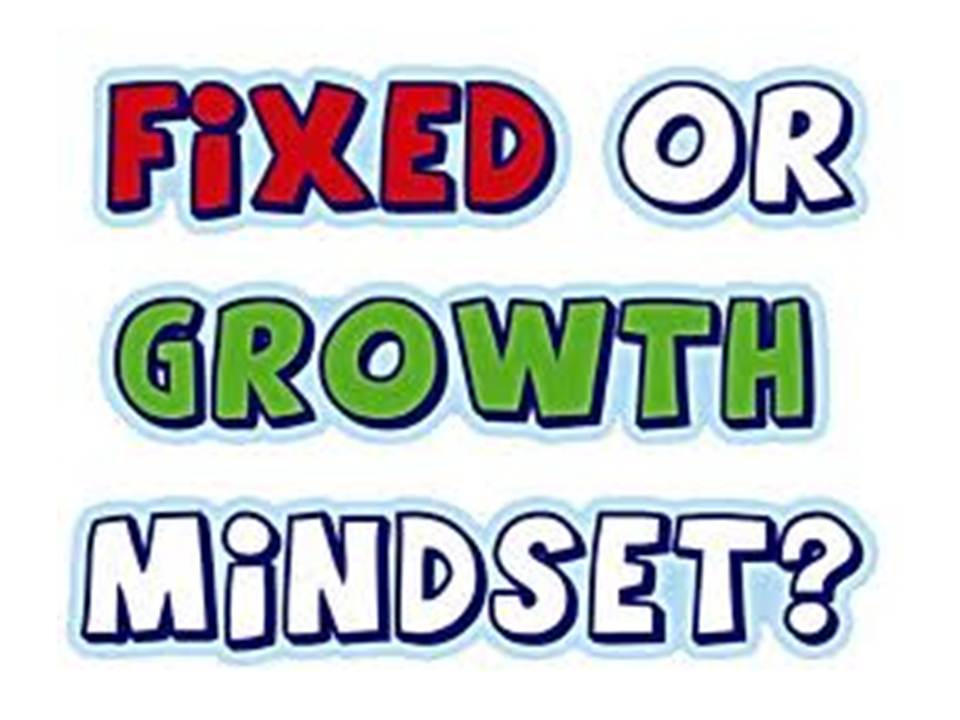
Psychologist Carol Dweck’s fine 2007 book Mindset: The Psychology of Success makes a simple but powerful point. Our fates are up to us. We choose our fate by adopting one of two mindsets. Pick the GROWTH mindset over the FIXED mindset.
“For 20 years my research has shown that the view you adopt for yourself profoundly affects the way you lead your life. It can determine whether you become the person you want to be and whether you accomplish the things you value. …Believing that your qualities are carved in stone – the fixed mindset – creates an urgency to prove yourself over and over. …Some of us are trained in this mindset from an early age… (with it)..every situation is evaluated: Will I succeed or fail?
There’s another mindset in which these traits are not simply a hand you’re dealt and have to live with…In this mindset, the growth mindset, the hand you’re dealt is just the starting point for development. This mindset is based on the belief that your basic qualities are things you can cultivate through your efforts. …People with the growth mindset believe that a person’s true potential is unknown and unknowable, that it’s impossible to foresee what can be accomplished with years of passion, toil and training.
- · Darwin and Tolstoy were considered ordinary children
- · Golfer Ben Hogan was graceless and uncoordinated
- · Photographer Cindy Sherman failed her first photography course
- · Actress Geraldine Page was advised to give up for lack of talent?
“The passion for stretching yourself and sticking to it, even (or especially) when it’s not going well, is the hallmark of the growth mindset. This is the mindset that allows people to thrive during some of the most challenging times in their lives.”
So – choose your mindset. Pick “growth” And when someone tells you that you can’t do something, turn that into rocket fuel – and DO it!
Why Did the FBI Want to See Marc Lombardi’s Drawing?
A Strange Story About How Interconnectedness Becomes Art
By Shlomo Maital
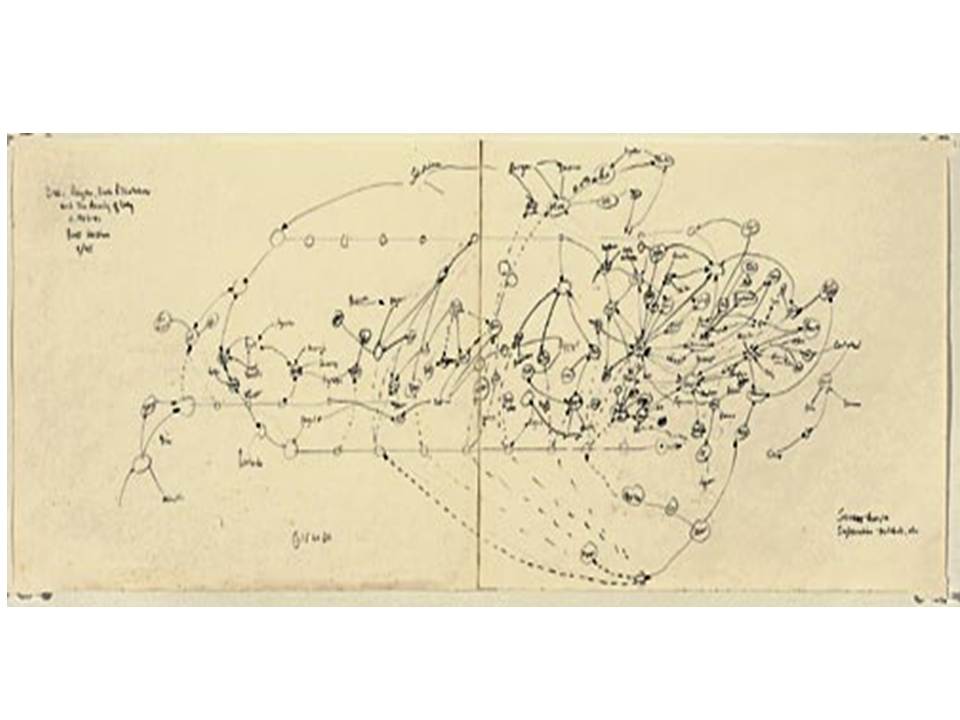 Shortly after the Sept. 11 terrorist attacks in New York City, an FBI agent visited the Whitney Museum of American Art. No, he wasn’t on a lunch break and he wasn’t an art lover. He was doing his job. He asked to see a drawing by the artist Mark Lombardi, on exhibit there.
Lombardi had tragically committed suicide the year before. Using a pencil and a huge sheet of paper, Lombardi had created a pattern of curves and arcs to show the links between global finance and international terrorism. He did this, by reading many books and articles, and by setting up an index card system of some 14,000 individual cards. All of his intricate drawings were based on meticulous, obsessive research.
An example of a typical Lombardi drawing is shown above.
A travelling exhibition of Lombardi’s work just opened at New York City’s Drawing Center.
So – what is art? Is Lombardi’s drawing art? Or is it just a systems diagram showing how interconnected the world is? Or is it both? Lombardi was deeply troubled and highly obsessive in his research. Is there a link beween eccentricity and art? Do artists have to be a bit nutty?
Lombardi was apparently deeply influenced by an early job he held. “While still an undergraduate, Lombardi had a job as chief researcher for a 1973 art exhibit Teapot Dome to Watergate – a multimedia collage, all of whose elements focused on various US governmental scandals; it was motivated by the then-ongoing Watergate scandal.” He spent his whole life pursuing the resulting obsession, working mostly as an archivist and librarian, an ideal occupation to facilitate his research of interconnectedness that took many thousands of hours.
He killed himself one day before his 49th birthday.
The Middle Class Is Moving to Asia: Why We Should Care
By Shlomo Maital
Some 2,362 years ago, the Greek philosopher Aristotle wrote [in his treatise Politics] that “the most perfect political community is one in which the middle class is in control… where the middle class is large, there are least likely to be factions and dissensions.” Today, the middle class in Western countries is an endangered species. The result is a growing threat to both our economies and our democracies ‒ divisive growing inequality in wealth and income and increasingly fractious interest-group politics.
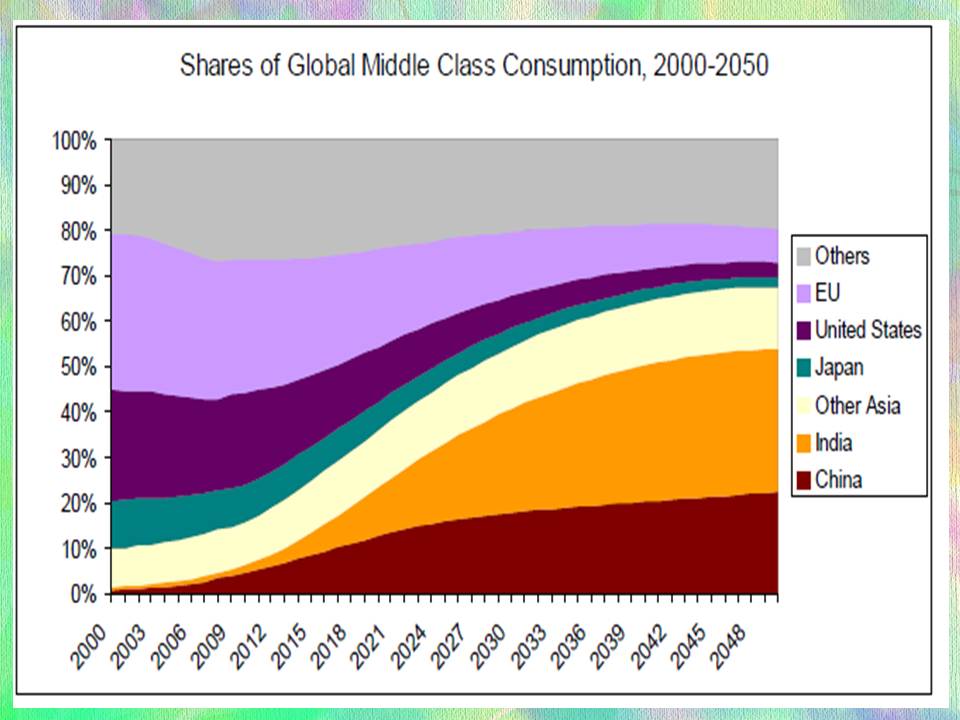
Why is this happening? Mainly, collapsing job security. A survey by the American Pew Research Center found that 86 per cent of Americans consider a secure job to be “the most important part of the middle class”. The middle class used to be anchored by high-wage manufacturing jobs. No longer. Many of the $24/hr. jobs of American auto workers have migrated to Asia. As a result, the middle class once dominant and thriving in the West has not disappeared; it has simply migrated to China and to India. According to a 2010 OECD working paper by Homi Kharas, today nearly 60 per cent of total global middle-class consumption spending is done by Americans and Europeans. But in 2050, that figure will shrink to a miniscule 10 per cent, while the proportion accounted for by middle classes in China and India will exceed 50 per cent. (See graph). According to New York Times columnist Thomas Friedman, India alone has 300 million middle class people and another 300-million-person ‘virtual’ middle class comprising those who will soon qualify.
As Europe and America offshore their manufacturing to Asia, they have become service economies. Services are bipolar. Either you are a highly-paid software engineer, or a low-paid Wal-Mart worker or McDonald’s worker, at near-minimum wage. Services are a major destroyer of the middle class, as they displace the once-high-wage manufacturing jobs the middle class held.
Aristotle foresaw long ago, “where some possess much and others nothing…a tyranny may grow.” But the endangered species status of the middle class is not inevitable. In the Nordic countries, for example, high taxes on the wealthy, a solid social safety net providing comprehensive services for all, strong educational systems and job retraining programs have maintained the middle classes and achieved a high rate of social mobility. And Denmark, for instance, has per capita GDP of over $50,000. If we do want to sustain our middle class, we must benchmark the Nordic nations and learn from them. But there is little sign this will happen, even in Europe, where the Scandinavian model is on their northern doorstep.


