Technology comes LAST

By Shlomo  Maital     

Tangle

  My wife and I are in Brazil; yesterday I gave a seminar at Univ. of Sao Paulo, titled “Technology Comes Last, Not First”.  This was hutzpah, impudence, because it was a seminar for Management of Technology.  When you see a surgeon with a medical problem, they often recommend surgery. Naturally. When you study Management of Technology, they teach you – well, how to manage technology. 

   But the audience got the message and understood.  And it is so simple.

   Great startups begin by identifying an unmet need.  This is done not by asking people what they need, but by keen close detailed zoom-in observation and listening – not a skill engineers tend to have.  Only after a clear unmet need is identified, should technology be pulled in,  and only technology that can simply, quickly and appropriately be applied to meet the need, as part of a sustainable business. 

   I’ve seen countless startups driven by genius engineers, who create magical technology (recall Arthur Clarke, “truly advanced technology is indistinguishable from magic”),   and launch a startup, and – their technology meets needs that do not exist at all.

    How do you find a true need?  Maybe, you YOURself need it.  And if so, others do too.  Spanx started when Susan Blakely needed something to tuck in her bottom. The technology?  Spandex.  She made a batch and knocked on doors until it began to sell. She’s now a billionaire.  Lady Gaga records new songs after exhausting performances, in her bus.  Technology? Her engineers insist, you cannot record high-quality sound in a bus.  Lady Gaga?  DO IT!!  Because she needs the inspiration and immediacy of her audience.  Sound studios are sterile.   

    The paradox is:  Technology-driven startups cannot be led by, driven by, and directed by, technology, even though they are generally led by engineers.  The principle is:  Start with Why!  Why make this?  Who needs it? Why do they need it?  Only if you have very strong clear answers, can you proceed to the technology that will satisfy it.  This is so simple. Yet violated by many businesses and entrepreneurs,  for big and small companies.

  Think B I G

By Shlomo  Maital

think-big_

 Yesterday I spoke to a group of entrepreneurs, at University of Sao Paulo, hosted by Prof. Fabio Kon.  The gathering was initiated by students, and it was organized in an interesting manner.  Each participant identified himself or herself in one of three categories, using colored badges:  criacao (creative ideas); negocios (manager or business person); and desenvolvedor (developer, or entrepreneur).  There were very few “criacao’s”, but lots of negocios and desenvolvedor.

   My main message to them was “think big”.  If you’re going to invest years of your life in working on implementing an idea,  it should be a big one,  not an 8 per cent improvement in something that already exists. 

   There are three avenues for ‘thinking big’.   I illustrate it using diagrams:

       X axis:   number of people you affect.   Y axis:  amount of value you create for each, on average.

    One:   Make a huge improvement in life, create huge value, for a huge number of people.   Example:  Jack Noyes inventing the integrated circuit. Or a cure/preventative for malaria.

               #########################

               #########################

               #########################

               #########################


 Two:  Make a huge improvement in life, create huge value, for a relatively small number of people.  Example:  Vaccine for a rare disease.

              $$$$

              $$$$

              $$$$

              $$$$

              $$$$

              $$$$

              $$$$


  Three:   Create fairly small value for a very large number of people. Example: iPhone.

            **************************************************** 

            ****************************************************

 In other words:  a huge fat rectangle;  a thin tall rectangle; or a short wide rectangle.

    But somehow – SOMEthing needs to be big, either the value you create or the number of people you affect, or both.   Why?

   Because big ideas attract people with big abilities. Because big ideas generate energy and passion you need to implement them.  Because we need big ideas to fix big problems, when small ideas will just not do the job.

   Persuaded?  Do you have a big idea?

  Weapons Kill People

By Shlomo  Maital

police armored car

Anaheim Police Armored Car


 Weapons kill people.  The more weapons, the more people will be killed. Many of them will be innocent.  Conclusion:  Somehow, stop making so many weapons. Pretty simple. But, in a world with $1.8 trillion in defense spending, it seems impossible.  Too many countries make too much money for too many companies.

  Here is what Bloomberg Business Week reports, on the massive amount of weapons sent home by America from Iraq and Afghanistan – what do you do with all that great useful weaponry?  Give it to the cops, of course!  Genius.  Ferguson, Missouri erupts in rioting, as an unarmed black teenager is killed by police —

   ” The heavily militarized police force in a St. Louis suburb is hardly an anomaly. Local police departments across the country deploy not just military-style equipment but actual castoffs from the U.S. military.  Federal grant programs fund the police acquisition of military weapons and vehicles, and a U.S. law has sent more than $4 billion of surplus Pentagon gear to law enforcement over the past 17 years. Now protests following the fatal police shooting of unarmed teenager Michael Brown in Ferguson, Mo.—and the heavily armed response by local police—seem likely to spark a national debate on the militarization of law enforcement. Do local cops from from Maine to New Mexico need military rifles and armored personnel carriers to do their jobs?

    Once, believe it or not,   British police, called “bobbies”, were unarmed, using only a truncheon.  And they kept the peace.  Now, they are heavily armed, many of them, and there is more violence in British streets, not less. 

     Weapons are like addictive drugs.  If they are out there, they will be used, and they will kill people.  And when one side gets more of them, the other side has to have more of them, too, and then the first side needs more, and the other side, and soon…..


 Anat vs Eric: Take Your Pick

By Shlomo  Maital

  Cantor      Admati

Eric Cantor                                             Anat Admati

  Yesterday’s (August 10) New York Times has an editorial, along with a business section article, that offer stark contrast between two people, two world views, and what is wrong and right about America today.

   Eric Cantor is the former Republican House Majority Leader.  He lost a primary election in his district last June, in a stunning and almost unbelievable upset, despite his high visibility and infinite money.   Why did he lose?  Because from Day One, says the Times, he “courted the favor and donations of Wall Street”, becoming the “top congressional recipient of its generosity”. In other words, the top money raiser in Congress lost a PRIMARY (not even an election).  His close ties to big money led to his defeat, apparently, as his opponent focused on that issue.

    Now, Cantor is about to cash in.  He resigned his seat as of August 18, even though he has several more months to serve until the new Congress convenes in January.  Why?  He’s going to work for the same Wall St. firms that he helped so much, as House Leader. He’s going to make money.  He has little real financial genius. But connections?  Infinite.  And Wall St. will pay big money for that. Eric Cantor will be a multi-millionaire faster than you can say,  Public Service?????

   Admati is a Stanford University finance professor, and an Israeli.  She did complex financial modeling until 2008, and published in academic journals.  When the financial system collapsed (or WAS collapsed by the banks, and Wall St.),  she became a powerful advocate of tighter government regulation, battling weak regulators and the incompetent Obama administration.  Admati, says the Times, even took a course on how to write opinion articles that people understand.  She has lunched with Obama and has a powerful simple explanation of what is broken on Wall St. and how to fix it.  And Wall St. despises her.  Guess why.

      Here is what she claims.  1.  We the people lend money to the banks by depositing it.  We don’t worry about how the banks use our money, because the Federal Deposit Insurance Corp. insures each deposit account for up to $250,000.  FDIC is of course the government, which is us.  And FDIC uses OUR money; when it runs out, in bad times, the government refills the coffers.  2.  The banks take large undue risks with our money when they lend and invest it, as they did during 2001-2008,  investing in sub-prime mortgages for instance, because they are “too big to fail” and because if they get in trouble, as they did in 2008-10, they know the government will bail them out.  They get the profit from their risk taking, if it works out; and they dump the losses on us if it doesn’t.  Good deal.  And nothing really has changed in this crackpot system since 2008.   3. The solution?  Regulate not how banks lend and invest their money, but how much they borrow (from us).   

Wall St. absolutely hates that idea, because the money machine that borrows from us at 1 per cent and lends at 5 per cent is a sweetheart of a deal, especially when government bears the risk of that 5 percent. So they deeply dislike Admati as well.

      Admati vs. Cantor.  From public service to millionaire overnight; and from academic professor to public advocate, serving the public, also overnight.

       Take your pick.  Which do YOU prefer?    


 Noona the Mind Reader – What About Us?

By Shlomo  Maital   

  Noni very small

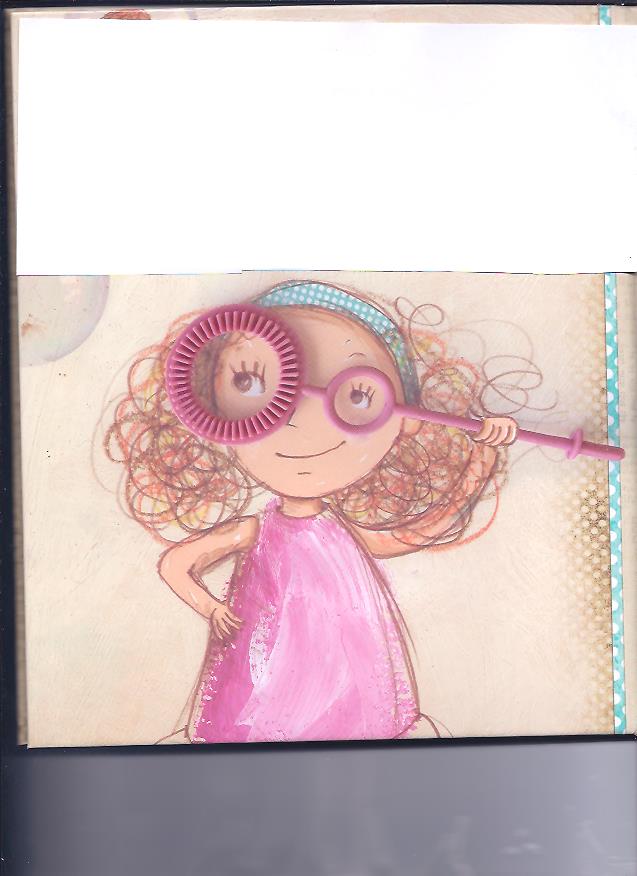
  In Orit Gidali’s new children’s book, Noona the Mind Reader, illustrated by Aya Gordon-Noy,  a little boy says to Noona, “You have the legs of a flamingo!”   And Noona, “even though she does not know exactly what a flamingo is, she is insulted.  A lot.”   (For now, it is only in the Hebrew language).

     Her mother hugs her, and goes to find “a magical device”, for days when there is not enough magic.  

    “Noona picks up the magic device that her mother gave her, and suddenly she can see behind everything people say, what they are thinking, but not saying”.

     Noona sees that people do not always say what they think.  Or think what they say they are thinking,  or say what they think they are saying.  

     “I understand!”  Noona shouts.

     “You have the legs of a flamingo!”.   The little boy means, according to Noona’s magical device, “when you’re around everything is rosy”,  and “wow, am I smart, to know how to say ‘flamingo’ “.  

     “Nya, who wants to be friends with YOU!”, means “I do”.   “I don’t want to play soccer” means “I don’t want to lose again.”

      And so on.

      Years ago, Harvard psychologist Chris Argyris pointed out that people have two columns on their pages.  In the right hand column,  what they say. In the left hand column, what they mean.  And he ran clever exercises, getting people to reveal their left hand column – which many people found very distressing. 

     What if we all had Noona’s mother’s magical device?  What if we knew what people really meant, not just what they said?  What if we knew BOTH their left hand and right hand columns?    People would then have to tell the truth.

     It’s not necessary to injure or hurt people by always saying what  you think.  You don’t have to say,  Yuk, that’s an ugly dress!    You don’t have to say it.  But maybe the world would be better, maybe there would be more trust among people, if we pretended that we all had Noona’s device.  If we built trust by telling the truth and saying what we mean. 

     There are countries where it is regarded as polite to be oblique, obtuse or even say the opposite of what you mean, to spare people’s feelings.  I live in a country where people are usually quite blunt.  Those who don’t understand us find this very rude, sometimes.  I think, in the end, it is good.

        What if Noona’s device were replicated and distributed, say, to the European Parliament or the U.N. General Assembly?    Or to the press at Obama’s press conferences?     What would we hear?  What would we understand?  And how would politicians and politics change forever?!

Paul E. Singer and U.S. Hedge Fund Rules the World (And May Destroy It)

By Shlomo  Maital

           Singer

 If you believe as I do that increasingly, money rules the world, not ethics, policies, governments, or ordinary people,  then this week you got confirming decisive evidence.

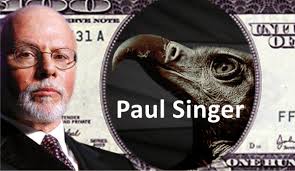
  A hedge fund manager named Paul E. Singer, right-wing libertarian and Republican, who runs Elliott Management, a $25 billion hedge fund,  bought up large amounts of Argentine government bonds after Argentina defaulted on its bonds in 2001 (because the IMF wanted to impose stringent conditions on a bailout loan, a huge mistake).    Then he went into U.S. District Court in Manhattan (like a fixed prizefight, he got to choose the venue most convenient and most likely to get a favorable decision) and won a decision from a judge, stating: “unless Argentina pays up the face value of bonds bought by Singer, it cannot legally pay interest on its bonds to its main bondholders”. 

   The result:  Because a $539 million interest payment was not made (it could not be made, because of that District Court Judge, who by the way is ELECTED!), by Argentina,  S&P rating agency declared Argentina in default.  This likely means that the government of Argentina is barred from raising capital in global capital markets.   Argentina’s economy is in recession,   in large part due to the Sterling law suit.  You cannot run any business, or any country, without borrowing money in capital markets.

    Singer has won.  Argentina and its 41 million people lose, and so does the world. Why?  Because investor panic regarding Argentina will impact other nations, like Portugal, and make their borrowing more expensive. 

    Argentina’s President Cristina Fernandez de Kirchner has made many mistakes.  But this time, the villain is not her but Singer.   And America, whose courts allow him to do whatever he wants for personal gain, damn the whole world.

     If we do not get control of our lives and our money  back from capitalists like Singer,  some day Occupy Wall St. will seem like a kindergarten birthday party.  

Alexandra Scott & the $80 m. Lemonade Stand

By Shlomo  Maital

Alex ScottAlexandra Scott

   The next time you think about tackling a hard problem you really care about, but hesitate because the odds are long – I hope you’ll remember this story.

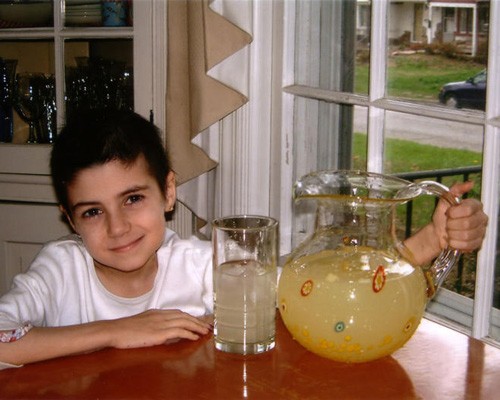
       Alexandra “Alex” Scott was born in Connecticut in 1996.  Before she turned one year old, she was diagnosed with infant neuroblastoma,  a type of childhood cancer that attacks nerve cells and is hard to treat. 

      In 2000, just after turning 4 years old, she informed her mother she wanted to start a lemonade stand to raise money for doctors to “help other kids, like they helped me.”   

       Her first lemonade stand raised $2,000.  It led to  Alex’s Lemonade Stand Foundation.     Alex continued her lemonade stands project throughout her life, and eventually she raised over $1 million toward cancer research!

      Alex lost her fight.   She died in August 2004;  she was only  8. Today, Alex’s Lemonade Stand sponsors a national fundraising weekend every June called Lemonade Days.

    Each year, 10,000 volunteers at more than 2,000 Alex’s Lemonade Stands around the nation make a difference for children with cancer.  Some $80 m. has been raised so far.   As they say – that’s not chopped liver.   

    Life gave Alex lemons…and she literally made lemonade, giving new meaning to that old cliché. 

The March of Folly Never Ends: A $1.8 Trillion Travesty

By Shlomo  Maital   

   Folly

 Barbara Tuchman’s book The March of Folly, about historical stupidity of leaders, starts at Troy and ends at Vietnam.  But the March continues, unabated, ever stronger.

   In 2012, according to the Stockholm Peace Research Institute,  the world spent about $1.8 trillion on weapons and defense spending.   Imagine what we could do with those resources, if the world declared peace instead of war? 

   According to TIME magazine, America’s new Ford class aircraft carriers cost $13.5 billion each!  They are outfitted with F-35 fighters, which each cost….$160 million! 

   And they are probably worthless.

     Because these carriers are built to stand against China.  China has DF-21D missiles that have a range of 1,500 km. and can easily sink a carrier.  So the carriers have to stand off China, out of range.  But that puts their F-35 aircraft out of range of China, because F-35 planes have a range of 1,100 kms. 

     So, where is the folly?   We are building very very expensive aircraft carriers, which have even more costly airplanes, that from the outset are of no use. 

     The March of Folly continues.

     And we are all culpable, because we all pay taxes, and support those leaders who see wisdom and caution in folly.   

 Geopolitics: The enemy of my enemy is my enemy? My friend? Both?

By Shlomo  Maital   

   enemy

  Are you having trouble understanding what’s going on in the world today?  Global geopolitics?  You’re not alone.  Most of us are out to sea. 

   Writing in the International New York Times today, Peter Baker explains why.

  ●  America battles Russia over the Ukraine, but joins with Russia to get Iran to de-nuke. 

● America tangles with Iran over its nukes, but supports Iran in its battle against the Sunni ISIS insurgency in Iraq.

 ●  America battles Egypt over its lack of democracy, but John Kerry flies to Cairo to get Egypt’s help in arranging a Hamas-Israel cease-fire. 

● Israel bashes Hamas, but, not TOO much, because removing Hamas would bring Salafi or Sunni ISIS extremists, who might be worse. 

● America spies on Germany, but seeks Germany’s help in battling Russia in the Ukraine. 

    The list is endless.   Is the enemy of my enemy my friend?  Well, sometimes – that’s an Arab proverb, it is said, and it doesn’t always work.  Who is my enemy anyway?  My enemy is sometimes my friend, on some occasions.  And my friend is sometimes my enemy.  As Tom Lehrer once sang, the Letts hate the Latts, and…I don’t like ANYone very much…

     How in the world do you run a coherent foreign policy in this jumbled complex confusing world?

      If you think President Obama looks rather tired and perplexed these days,  perhaps you can understand why.   

       Two more years, Barack.  And then, you can REALLY improve your golf game.

Understanding China and Asia

By Shlomo  Maital     

 Kausikan

Bilahari Kausikan 

One of the wisest persons I know is Biliahari Kausikan, formerly Permanent Secretary of Singapore’s Foreign Ministry, and now Ambassador at Large.  He has an exceptionally clear view of global and Asian geopolitics; I’ve been ranting and nagging him for years to write a book, or at least a regular blog.

    Here, for my readers, is an excerpt from his recent document “A World in Transformation”. 

    The world is undergoing a profound transition of power and ideas. The modern international system was shaped by the West who prescribed its fundamental concepts, established its basic institutions and practices and influenced all major developments. That era is now drawing to a close. No one can predict the future and we do not know what will replace the western dominated system. But we can at least glimpse some of the issues that will have to be confronted.

      Washington and Beijing are now groping towards a new modus vivendi. Neither finds it easy and establishing a new equilibrium will be a work of decades and not just a few years. Sino-US relations are already the most important bilateral relationship for East Asia, setting the tone for the entire region. As the 21st century progresses, Sino-US relations will become the most important bilateral relationship for the entire world influencing almost every aspect of international relations, just as US-Soviet relations did during the Cold War.

    The Chinese government and people are rightly proud of what they have achieved. Never before in history have so many people been lifted out of poverty in so short a time. Still it would be a dangerous mistake to try to understand the global and regional transitions that are underway by simplistic slogans such as ‘Asia rising, the West declining’ as some Chinese intellectuals and even some officials occasionally come close to doing.  The changes in the distribution of power that are occurring are relative not absolute. The global patterns of trade, finance, investments and production chains that have evolved as a result of East Asian growth cannot be characterized by geographically defined dichotomies. Many economic roads now pass through China and many more will in the future. Nevertheless the final destination is still more often than not the US or Europe. China is certainly rising. But it is always a mistake to believe one’s own propaganda and the west and in particular the US is not declining. All who have underestimated American creativity, resilience and resolve have had cause regret it.

   Two competing visions of regional order are in play: a Sino-centric vision built around the ASEAN plus Three (APT) forum which comprises the ten Southeast Asia states with China, Japan and South Korea, and a broader and more open architecture built around the East Asia Summit (EAS) which is the APT with the addition of the US, Russia, India, Australia and New Zealand.

     Given the growing centrality of East Asia in the world economy and the strategic weight of the US and China, the outcome of the debate over a new East Asian architecture will be the single most important influence on the global architecture of the 21st century. This is the strategic significance of what has been dismissed by western observers who do not really understand what they observe, as talk shops. No option has yet been foreclosed. Both the APT and EAS are experiments. But China’s preference is clear.


Blog entries written by Prof. Shlomo Maital

Shlomo Maital

Pages