Making Eureka! Happen:  On Inviting Ah-hah Insights!

By Shlomo  Maital        

      eureka1

    All of us have experienced a “eureka” moment – a sudden flash of insight that yields a creative solution to a problem.   Eureka is Greek for “I have found it!”, allegedly shouted when Archimedes discovered his famous displacement principle.

   Can you do things that make ah-hah! moments more frequent and more powerful?  Apparently you can.  In researching neuroscience for an upcoming conference, I found an article, “The Aha! Moment: The Cognitive Neuroscience of Insight”, by John Kounios (Drexel U.) and Mark Beeman (Northwestern U.).  [Recent Directions in Neurological Science, 2009].  

   The authors use EEG (electromagnetic imaging) and fMRI (functional MRI imaging) of the brain to physically map eureka moments.  They give subjects a ‘compound remote association’ problem:  e.g., Find a single word, that can form a compound word or familiar 2-word phrase with EACH of three words.  E.g.,  crab, pine, sauce.    One answer: “apple” (applesauce, crabapple, pineapple).  They map brain patterns while subjects tackle the problem.  They then ask the subjects to say whether the solution “popped into their minds” (eureka) or resulted from analysis (e.g. ‘cake’…crabcake, but pinecake no; reject cake; crabgrass…no, applegrass doesn’t work..etc.).  

  Here is what they, and others, have found:  Eureka problem-solving “can be influenced by the prior preparatory state”.  As Pasteur said, “chance favors the prepared mind.”  Eureka comes to those who prepare for it.  A relaxed, pleasant state of mind is far better for eureka than tension. (Attention, companies that put workers’ feet to the fire to develop ideas).  Humor is very conducive to eureka.  And most important:  “individuals high in creativity habitually deploy their attention in a diffuse rather than a focused manner”.  I.e., we get to eureka, not in a straight linear line, but zig-zag. 

    The authors believe you can organize ‘eureka’ thinking, as a ‘cascade of processes’ that generate aha!    I agree.  Zoom in!  Think hard about a problem.  Then let your mind wander. Soar into the clouds. Zoom out!  Think of wild ideas that make you laugh.  Bring a shopping cart with you, and dump all the possible ideas into it.  At some point – pause.    Zoom in again.  Take your shopping cart and start to empty its contents.  Choose one solution in it you think will work.  Listen carefully to your gut.  This could be a eureka! Or aha!  Moment.  If it is – listen to it!  And then – get to work. 
 

The Creative Brain: It’s NOT Left-Right!

By Shlomo  Maital   

    creative brain

   There is an amazing explosion of resources and people studying the brain these days, and new results are sure to come.  Here is one, summarized in Scientific American (Aug. 19/2013) by Scott Barry Kaufman, “The Real Neuroscience of Creativity”. 

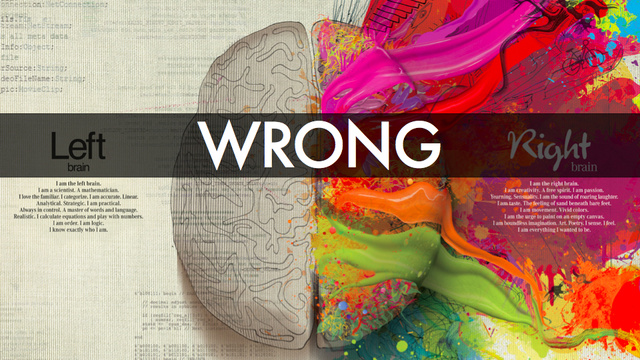
   Remember that left-brain-right-brain idea?  Left brain, is “L”, logical analytic, organized, rational.  Right brain is “R”,  creative, passionate, sexual, colorful, poetic, even irRational?

   Forget it.  The L-R distinction is “not the right one when it comes to understanding how creativity is implemented in the brain”, notes Kaufman.  “Creativity does not involve a single brain region or single side of the brain.  Instead, the entire creative process – from preparation to incubation to illumination to verification —  consists of many interacting cognitive processes and emotions.”    Different brain regions are recruited to handle the task, depending on the stage of the creative process.

  Many of these regions “recruit structures from both the left and right side of the brain”.

  To simplify and summarize:  There are thre large-scale brain ‘networks’ critical for creativity.  1.  Executive Attention Network – recruited when a task requires that the spotlight of attention is focused like a laser beam.  Active when you’re concentrating on a challenging lecture, or solving a problem.  2. The Imagination Network:  used when “imagining alternate perspectives and scenarios”.  3.  The Salience Network:  monitors both external events and internal stream of consciousness and “flexibly passes the baton to whatever nformation is most salient to solving the task at hand.” 

   The key to understanding creativity, according to neuroscientists, is recognizing that “different patterns of [thinking] are important at different stages of the creative process.

  So, what can we do with all this, to be more creative?  According to Rex Jung:  a) allow your mind to roam free, imagine new possibilities, and SILENCE THE INNER CRITIC!  Reduce the Executive Attention Network a bit, increase the other two.  Then, bring back the Executive Attention Network, to critically evaluate and implement your creative ideas.  In other words:  Zoom In, to understand the problem; Zoom Out, imagine, to seek many alternate possibilities; then, again, Zoom In, to choose the optimal alternative.  Organizing these stages is important. Skipping a stage will damage the process. 

      I am amazed that this neuroscience model fits precisely the model of my friend, colleague and former student Arie Ruttenberg, known as Zoom In/Zoom Out/Zoom In,  and presented in our forthcoming book The Imagination Elevator.  Ruttenberg derived his model by simply intuitively taking apart, and reconstructing, the ways he reached his own creative ideas.
 

If You Can Subtract, You Can Innovate!

By Shlomo  Maital   

             subtract

Innovation is breaking the rules.   But often, the rules most rewarding to break are unwritten ones, ones we assume are true in our heads, ones we never challenge.

 One such rule: “Innovation is about addition” – adding new features onto old things.   Nothing could be more wrong.

   Innovation is about subtraction.  Taking things away. Yet we use addition far more often than we use subtraction, in creative endeavours.

   Here are some examples, drawn from Ruth Blatt’s wonderful blog in Forbes magazine (Dec. 26/2013). 

  *  Led Zeppelin made an album, with no writing on the cover. Nothing, no band name, nothing.  It was their best-selling album (Led Zeppelin IV).  And they did it by subtracting.

* Composer John Cage wrote a piece called 4’ 33”,  a four-minute 33-second piece in which a full orchestra sits down..and remains in perfect silence for over four minutes.  A concert, minus the music.  Insulting? Ridiculous?  Usually, the orchestra gets strong applause when they stand up and take a bow.

* In 1966 the Beatles made a key decision.  They decided to be a rock ‘n roll band, that does not perform for live audiences.  By subtracting the ‘live performance’ from their art, they created new possibilities. They did not have to reproduce live what they did in the recording studio.  They climbed new artistic heights in this way. 

     Ruth Blatt advises, “Next time you feel blocked, try doing like the Beatles and take out something you used to think was essential.”   You’ll be amazed at the results. 

Breakthrough:  Vaccine Against Cancer!

by Shlomo Maital

cancer vaccine

   Cancer immunology [use of the body’s own immune system to kill cancer cells] has been chosen as the “Breakthrough of the Year” by the editors of Science. A fascinating report was published in the December 20 issue. (This blog is longer than usual, because the topic is so important).

   For example: According to the U.S. National Institutes of Health: The photo shows an aspirin-sized disk, the first therapeutic cancer vaccine implanted beneath the skin. “We know it can eradicate melanoma in mice—the deadliest form of skin cancer—with impressive efficacy . Now, it’s being tested in human trials.”

One day, hopefully, chemotherapy may be replaced by immunotherapy. Instead of poisoning cancer (and our own body), we may be able to trick cancer cells, which are good at defeating the body’s own T-cell immune system, and enable our T-cells to kill cancer cells before they become tumors or even after.

What is the science here? According to the NIH, vaccines prevent illnesses, like smallpox, by introducing dead or weakened germs, to teach the body to create antibodies if it does appear. We already have vaccination against the human papilloma virus (HPV)—a powerful way to prevent cervical cancer. The new anti-cancer vaccines work differently. They’re given to patients who have already been diagnosed with cancer. Once given they “behave like traditional vaccines—by teaching the immune system how to seek out and destroy a target—in this case, a tumor. “

“ A couple of cancer vaccines have already been approved by the FDA. However, producing these vaccines is typically a cumbersome, time-consuming, and expensive process. First, immune cells are taken from a patient. The cells are modified and reprogramed in the lab, and then they are injected back into the patient. In the vaccines approved to date, this elaborate production line has extended patient life—but only slightly. And so, some researchers began to look for a simpler, and perhaps more effective, way to make therapeutic cancer vaccines. About four years ago, an NIH-funded, multidisciplinary team based in Boston and Cambridge came up with an approach that would modify and reprogram patients’ immune cells—inside the body, not in a lab!! The team first developed a porous polymer implant, made from the same material as biodegradable sutures and meshes. Then they infused the disk with a collection of three immune stimulants that recruit the immune cells, activate them, and imprint them with a chemical signature of the tumor that is targeted for destruction.

“The first of the three immune stimulants is a drug called leukine (also known as GM-CSF), which summons millions of dendritic cells, key immune cells, to enter the implant. The second is DNA that mimics viral and bacterial DNA and sends a danger signal that activates these cells. The third ingredient is the personalized part of the recipe: a combination of proteins made from the patients’ own tumor. It gives the dendritic cells the unique signature of that person’s tumor, which they share with the warrior T-cells. The “educated” T-cells are then primed to hunt and obliterate the tumor.”

The new approach is metaphorically like training cancer-killer cells to a) spot cancer, and b) kill it, by first teaching them to recognize the enemy and then, giving them ‘martial arts’ skills to destroy it.

Some of the most advanced work in the world on cancer immunology is done in my country, Israel. Prof. Leah Eisenbach, at the Weizmann Institute, Rehovot, has done breakthrough work. A company known as Compugen has developed antigens proven useful against cancer, and sold two of them for hundreds of millions of dollars to Bayer.

We know today that there are more than 120 different types of cancer. Each requires its own variant of chemotherapy. While survival rates have risen enormously, there has to be a better way than ‘tailored poison’. There is. Immunotherapy may point the way. If you know someone who has cancer, or whose loved ones have it, draw their attention to this new breakthrough. There is definitely hope, and the progress may be relatively rapid.


BRIC is so 2013! Now It’s…Want to make a MINT?

By Shlomo  Maital

       Slide1

Slide2                  

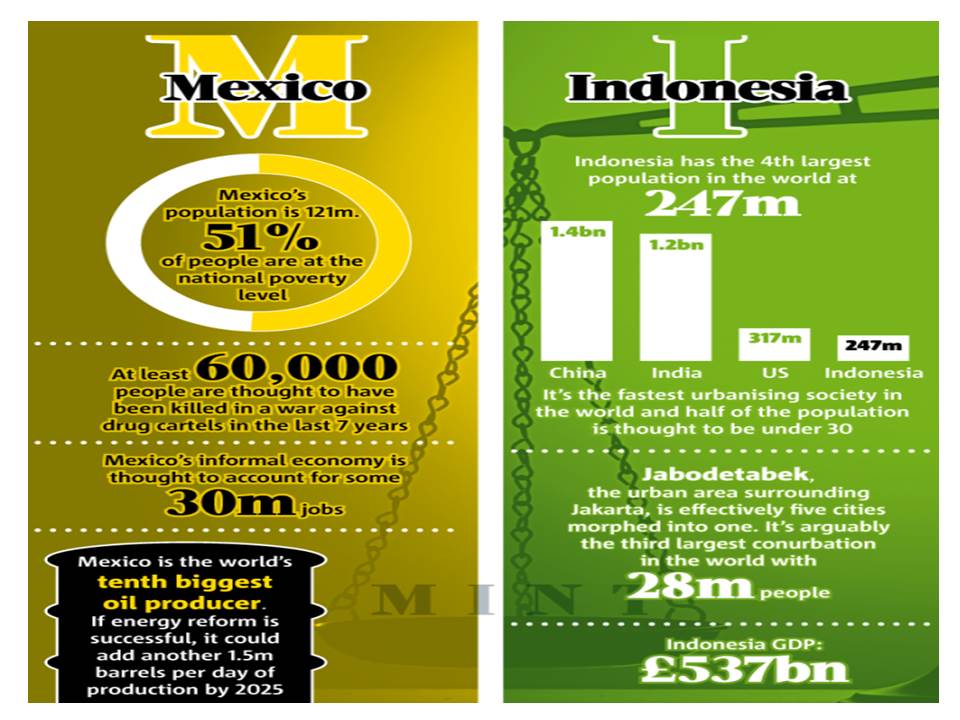
       There’s nothing like a good acronym to catch the eye of those seeking new places to make money.  That’s why Jim O’Neill, former head of asset management at Goldman, Sachs, coined the term BRIC 13 years ago – Brazil, Russia, India, China – to name the four up-and-coming nations.  He got China right. Brazil is struggling. So is India.  Russia still doesn’t have a true economy other than oil and gas.  So – one out of four.  Pretty good, for a global banker.

   Now comes a new acronym.  Remember it:  MINT.  Mexico, Indonesia, Nigeria, Turkey.   If you want to make a MINT, then invest in MINT.  According to   www.metro.co.uk:    

     ‘If they get their act together, they’ve got the ability to get so much bigger,’ said O’Neill of the MINT countries.  It will be the subject of an upcoming BBC radio series, MINT: The Next Economic Giants.   ‘If not as big as the BRICs, then not that far off.’    Mexico, O’Neill argues, previously lost out to China on cheap exports and labour. But with wages increasing in China, Mexico can capitalise, especially with its proximity to the US.  ‘It’s probably the most competitive OECD country at the moment,’ said O’Neill. ‘And these guys have a bunch of young reformers who make Maggie Thatcher look like a pussycat.’

O’Neill argues convincingly that Nigeria is THE MINT country to watch:

“Indonesia has a chance to boom, like Mexico, because of a large, willing workforce and a rapidly urbanising population, said O’Neill. ‘There are 240m of them in Indonesia, the third largest populated country in the world.’  Turkey, meanwhile, benefits from its geographical position between East and West and ‘because they know how to deal with us in the West, with the Middle East, with the Russians’.   But the most exciting MINT country is Nigeria. ‘The place is complete madness, of course, and one can’t be 100 per cent sure, given its challenges, that it will be one country in four years. But after India, it’s the best in the world in terms of useful population. By 2050, Nigeria will have more people than the United States. If you get those young people in productive jobs, that place will arguably be the most exciting country in the world in the next 30 years. Linked to that, there are so many creative entrepreneurs there and, interestingly, so many educated Nigerians returning from the US because they smell this opportunity to be the next big thing.’ Nigeria is also rich in resources, including oil.

  There are at least two ways to take Jim O’Neill’s acronym.   1.  Given his 1 out of 4 record in the past:  Search elsewhere.  Or 2.  Bet big time on Nigeria.  

    What are your thoughts, readers?  
 

 Why Latvia Loves the Euro

By Shlomo  Maital     

       Latvia


  Tomorrow, Jan. 1, Latvia becomes the 18th nation to adopt the euro,  following Estonia’s euro adoption in 2011.  A third Baltic nation, Lithuania, will adopt the euro in 2015. 

   Why would any country willingly choose to shift to a currency in so much trouble?  It is simple, according to Richard Milne, writing in today’s Financial Times.

   According to Finance Minister Andres Vilks, ““Russia isn’t going to change. We know our neighbour. There was before, and there will be, a lot of unpredictable conditions. It is very important for the countries to stick together, and with the EU.   We have completed our mission” of joining all the main institutions in Europe from the EU to Nato….. “We will be more integrated and protected in case of troubles, and we can see what is happening in Ukraine today.”

     Russia has exerted tremendous pressure on Ukraine, not to sign a free-trade agreement with the EU, and has supplied an enormous $14 b. loan as a tempting bribe.       

    The adoption of the euro came despite huge Latvian opposition to the idea, among the public. A poll last October showed only one Latvian in five favored the euro.   The people of Latvia seemed to believe that along with the euro came austerity, which is partly true. 

    Vilks noted that Russia (and Putin)  “is nervous about losing partners and influence. That is one reason why the Baltics and Finland were so eager to go to all institutions, including Nato. It’s not so easy for small countries to deal with these issues; we need help.”

    According to Milne, Latvia still has close ties with Russia, with about 40 per cent of the bank deposits in the country coming from ex-Soviet states, while about a quarter of its population is ethnic Russian.

     As a small nation, Latvia has little leverage on Russia. But, on the other hand, it also has little importance.  Ukraine, a huge country, is crucial for Russia; Latvia is almost a ‘rounding error’. 

   Latvia’s euro adoption shows the importance of strong political leadership.  How many Western political leaders would face a hugely unpopular decision, and proceed with it anyway, knowing they could well be tossed out of office in the next election.  Kudos to Vilk and little Latvia.  Obama, Netanyahu – do some homework on the Baltic states.  They know things about leadership that neither of you do.

 Technology in 2014: What’s Ahead

By Shlomo  Maital    

        2014


 What does 2014 hold in terms of new technology?  According to New York Times columnist Nick Bilton, 2013 was a yawn.  Apple just updated its existing devices all year.  Nothing much happened.

   2014 may be different.  Technology is like sprinters – they pause, prepare, crouch – and then dash, only to repeat the process.  

   Smartwatches will grow rapidly.  Today the global watch industry totals $60 b.  Smart watches could add greatly to that.  They could change the way we relate to the device on our wrists. 

   Cell phones will change.  Improved location sensors mean our phones will start letting us know when we need to look at them, and actively suggesting things we need to do, based on where we are.  

    Corning has developed new flexible screens for TV.  These screens could wrap around poles, even wrap around our clothing or “the packages we buy”, notes Bilton.

    Use of drones will expand.  The FAA will issue rules that enable expanded use of drones for farming, rooftop inspections and a thousand other uses. 

   3D printers will begin to become home appliances.  Gartner says companies and consumers will spend $600 m. on 3D printer related products in 2014.  One key use might be to ‘print’ parts for broken appliances, with instructions downloaded from web sites.

   Most of this still sounds rather humdrum.  Technology often surprises. Maybe, just maybe, some great innovator will think of something truly novel and useful – or perhaps, simply revive something old that has sadly disappeared.  Will YOU be that innovator?

 How to Create Great Memories – And Why We Should

By Shlomo  Maital

            memories

Very few readers will recall the American comedian Bob Hope, whose radio theme song was Thanks for the Memory:      “Thanks for the memory,  of sentimental verse and nothing in my purse, And chuckles when the preacher said, “For better or for worse”,  How lovely it was…”  

   Today’s New York Times has a fine op-ed article by neuroscientist Kelly Lambert.  She observes that “neuroimaging evidence indicates that when certain events are recalled – presumably after being triggered by familiar sights, smells or sounds – emotional brain areas are activated as well as visceral responses. You relive the feelings you experienced in the past.”  I think this is a crucial observation.  Great memories are like a perpetual feast. You experience them once, you remember them many many times.  So it is crucial to shape HOW we remember things. 

   When you are about to make a decision, ask yourself,  how will I recall this?  Will I recall it as one of my finest moments, as an action true to myself, to my values? Or will I relive it, in shame, in sadness, in regret? 

   “Thanks for the memory, Of rainy afternoons that pulls me by the case,  And how I jumped the day you trumped my one and only ace,  How lovely it was…”

    According to Kelly Lambert, “addicted rats experience pleasure when they anticipate receiving cocaine, even if they don’t actually consume it.”  There is another key point here about how to live.  Don’t rush to seize pleasure.  Defer it.  Because the anticipation itself brings pleasure.   

    “We said goodbye with a highball   Then I got as high as a steeple  But we were intelligent people, no tears, no fuss,  Hooray, for us”

      What this means is:   Life is about before, during and after.    Before – if before a happy event – is full of pleasure and meaning.  Don’t rush it.  Create events that you anticipate and look forward to, well in advance.   Then during.  Seize the moment.  Enjoy.  Shape the memory!   And finally after.  Relive the good memories that you were wise enough to create. 

     “So, thanks for the memory, Of sunburns at the shore, darling, how are you?, You might have been a headache, but you never were a bore, I’m awfully glad I met you, cheerio and toodle-oo,  And thank you so much…”

       Lambert notes that there are “benefits of trying to assure that my girls have an emotional holiday portal for their future adult brains”, referring to Christmas.

 Why (and How) We Truly Care About Others – the Amazing Mirror Neurons

By Shlomo  Maital

          mirror neurons

       One day, an Italian neurophysiologist named Giacomo Rizzolatti, Parma University,  will win the Nobel Prize for his amazing discovery of mirror neurons.

  Here is what he found, by accident, like so many great discoveries, and why it is important.

   Rizzolatti and colleagues were studying the nerve cells that controlled hand movements and seizing of objects. 

    The research was very monotonous, as it required the researchers to follow neuron patterns in the brains of macaque monkeys, who were holding peanuts and bringing them to their mouths.  As the monkeys moved their hands, the nerve cells in their brains that controlled the movement fired electrical impulses, which could be seen in the electroencephalogram printout. 

     At one point, one of the researchers picked up a peanut.  He was amazed to see that the same neurons activated in the monkey’s brain, when the monkey itself picked up the peanut, were fired when the monkey saw someone ELSE pick up a peanut.  It was an astonishing finding. How could a neuron, responsible for hand movements, fire when the hand did not move, but someone else’s hand moved? 

   The researchers realized they had stumbled on a revolutionary finding.  The brain possesses unique cells that respond to an animal’s own movements, but also to the SAME movement when performed by other animals.  How come the monkey’s own hand did not move, when the neuron fired? Because other neurons inhibited motor ‘imitation’.  Mirror cells only SENSE the motion, they do not initiate the same motion.

    Humans too have mirror cells, we now know.  This enables us to feel empathy, and to be social animals, to cooperate, to help, to be a team member.  Probably, those mirror cells were created by evolution – humans possessing them were better equipped to survive and procreate than those who lacked them.  And soon, all humans had them.

    Some neurophysiologists deny there are such things as mirror cells. But there are, and they do exist.  They explain much of our human-ness. 

    Some selfish people ignore what their mirror cells tell them; they broadcast very quietly.  But some people increase their sensitivity to the ‘firing’ of mirror cells and become exceedingly caring empathic people.   And since empathy is a key part of innovation, my theory is that great innovators have heightened sensitivity to what their mirror cells tell them about what other people feel and need.

    Kudos, handshakes, to Rizzolatti and the other researchers who refused to say, nuts! to a remarkable, perhaps impossible, observation.  They deserve the Nobel.   


 Raise the Minimum Wage — Now!

By Shlomo  Maital

         Mcdonalds workers

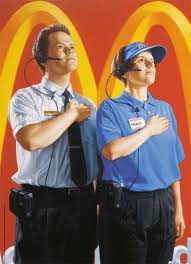
   America and Israel both have a chronic poverty problem.  President Obama now speaks of “a relentlessly growing deficit of opportunity” in the U.S.   In Israel, three end-of-year poverty reports reveal a bitter picture of hungry children, a fifth of the population under the poverty line and persisting lack of mobility across income classes.    Most distressing is the working poor.  Many of those in poverty, in America and in Israel, are hard-working, with jobs. But they still can’t make a living, because they are not paid living wages.

   A simple solution?  Raise the minimum wage.   Economist disagree on this.  Some studies show it would hurt employment and actually hurt the working poor. Some studies show it would help.  And of course, you can use econometrics and statistics to show anything you wish.

   Two Princeton Univ. researchers, Alan B. Krueger and David Card,  found a ‘natural experiment’ that helped resolve this issue.  Some 20 years ago, notes Annie Lowrey in her New York Times column, during the 1990/1 recession,  New Jersey raised its minimum wage to $5.05 an hour, from $4.25, while neighboring Pennsylvania chose not to.  Card and Krueger surveyed fast-food restaurants along the NJ-Penn. Border and surveyed them twice, during 11 months, to see how many they employed.  Economic theory says, when labor gets more expensive, you buy less.  But to their surprise, there was no change in employment in the N.J. restaurants, relative to the Pennsylvania ones.  Low-wage work went up in price, but demand for it stayed the same.  McDonalds workers today earn $7.25 an hour, the federal minimum.  Their real wage has gone down since 1992. 

    Despite this study, economists still disagree.  A survey shows that a third of economists thinks raising the minimum wage to $9/hr. would make it harder for low-skilled workers to get a job, a third thinks it wouldn’t, and a quarter don’t have a clue.  So – forget the economists. Do the right thing.  Listen to Card and Krueger.  Raise the minimum wage to $10.  It’s the right thing to do.   

  For the 9 months ending Sept. 30/2013, McDonalds had $21 b. in worldwide revenue,  $6.6 b. in operating profit and $4.2 b. in net income.  Yes, that’s a 20% net margin!   They can afford a small rise in the minimum wage.   And don’t let them tell you they will fire any workers as a result. 

* D. Card, A. B. Krueger, “Minimum wages and employment: a case study of the fast food industry in NJ and Pennsylvania”,  NBER working paper, no. 4509, Oct. 1993.

Blog entries written by Prof. Shlomo Maital

Shlomo Maital

Pages