Record Bank Profits:  Good News, Bad News

By Shlomo Maital   

     good news bad news

   Dear readers, you’re probably tired of the old ‘good news, bad news’ format.  But there’s no other way to explain American bank profits.

   The good news:  The net income (profit) of the six biggest American banks (J.P. Morgan, $6.5 b.; Wells Fargo,  $5.5 b.,  Citigroup, $4.2 b., Bank of America, $4.0 b., Goldman Sachs $1.9 b., Morgan Stanley, $1.0 b.) in the 2nd quarter of 2013 (April May and June) totals $23.1 b.  Note: that’s for THREE MONTHS.  For a whole year, multiply by four:  over $100 b.!   

   The bad news:   The banks are raking in the money again, back to what they did before 2008, before the crash,  making piles of money mostly from ‘nostrum’ trading (buying and selling assets for their own accounts), taking advantage of near-zero interest rates that they pay when they borrow, charging relatively high rates to us poor customers.    Big-bank profits are back to what they were before the crash,  in mid-2007.  Way to go, banks! 

    The good news:  Because the banks are making so much money, efforts of U.S. Treasury Secretary Jacob Lew,  and others, to re-enact a version of Glass Steagall (putting a Chinese wall between commercial banking and investment banking, thus keeping banks from illicitly mixing the two, at our expense) are more likely to succeed.  The banks are strong, making money – they cannot plead the legislation will ruin them.  Lew is talking tough.

    The bad news:   The banks are back in the drivers’ seat.  When Fed Chair Ben Bernanke just HINTED he MIGHT at some distant point in the future MAYBE possibly just a tad raise ..perish the thought….interest rates, but ONLY if unemployment fell, GDP boomed, and Pope Francis went on tour with the Rolling Stones…. Wall St. bashed the price of stocks down, so fiercely, that Bernanke had to crawl to Congress and explain he was …misunderstood.  He basically sang that old Animals song,   “But I’m just a soul whose intentions are good. Oh Lord, please don’t let me be misunderstood.”   There is no way, he promised, that the Fed is going to help the banks break their permanent addiction to infinite quantities of near-zero-interest-rate money.  The Fed will continue to buy $85 b. worth of bonds every single month for the foreseeable future.  Buying bonds raised their price and thus lowers their yields. 

    If you find all this very tiresome, believe me so do I.  There seems to be no possible way that we the people can get control of our destiny back into our hands, and the hands of our leaders, away from the banks and Wall St.   With big-bank profits back to their previous highs, before the crash, we the people will probably fall asleep again – until the next big crash, until the next bank cries that it is “too big to fail”.    We ordinary people may be hooked on Ritalin (see previous blog).  But the banks are hooked on cheap money. 

Ritalin  Surpasses Cocaine

By Shlomo Maital   

           Ritalin

   Methylphenidate (brand name  Ritalin) is a psychostimulant drug approved for treatment of ADHD or attention-deficit hyperactivity disorder, developed by Novartis.  For some kids with ADHD it is without doubt helpful.   But the capacity of society to misuse drugs seems limitless.  Illegal Ritalin users outnumber by far those who use cocaine.  Here are some facts, published in an investigative report in the Israeli daily Haaretz:

  *  In 2011, the U.S. Department of Health and Human Services estimated that 5 percent of Americans in the 18-25 age bracket were using the substances illegally. According to a study whose results were published in the online community Her Company ‏(on the Huffington Post website‏), the number of illegal users is more than the percentage that use cocaine and LSD combined.

  *  The increasing use of Ritalin is a phenomenon that is occupying American universities. The extensive research being conducted about the use of the medications we know as Ritalin, Concerta or Adderall has led them to be dubbed “study drugs” or “smart drugs.” A staggering number of college kids in the US (and elsewhere) pop Ritalin before exams.

  According to the authors of the investigative study,   :

  “The present generation, particularly adolescents and children, is constantly subject to attention and concentration disorders. Accordingly, some will argue that this generation requires Ritalin as a steady diet.    In fact, this form of disorder is built into modern life. The extensive culture of screens, working on different subjects simultaneously − which is part of almost every field − the rapid shifting from Facebook to email to news sites and so on: all this requires parallel attention. The phenomenon is well known; in fact, it’s likely that while reading this article, you started to tap your foot nervously, checked your email from time to time and possibly also looked at a newly posted Facebook status.”

    So here is the dilemma.  Modern life involves serious multitasking…multiple screens, smartphones,  computer screens, conversations, all at the same time.  This creates massive stress.  To help us deal with the stress, we pop a pill,  Ritalin.  The pill is widely available, because some kids legitimately need it.  But the rest of us? 

   What about changing the underlying causes  in our lives that make   Ritalin helpful?   The fact you can pop a pill means that fewer and fewer people will bother to think about why they need it in the first place.   

Haaretz,  “Class A drug: Affluent Israeli highschoolers are taking Ritalin without doing their homework”    By Sivan Klingbail, Shay Fogelman, Naomi Darom and Shanee Shiloh.    Jul. 20, 2013

Rethinking GDP: Counting Creativity

By Shlomo Maital   

               GDP            

    We have long known that the key measure of our wellbeing, known as Gross Domestic Product, invented by J.M. Keynes, is flawed.  Now, America’s Bureau of Economic Analysis is rethinking GDP measurement.  Among other things, spending on innovation, known as Research and Development, will now be reclassified.  No longer will it be a mere business expense, as generally-accepted accounting procedures.  Instead, as it should be, R&D will be included in gross capital formation or investment.   As Bloomberg Business Week notes, in its latest edition:

    On July 31, the U.S. Bureau of Economic Analysis will rewrite history on a grand scale by restating the size   and composition of the gross domestic product, all the way back to the first year it was recorded, 1929. The biggest change will be the reclassification—nay, the elevation—of research and development. R&D will no longer be treated as a mere expense, like the electricity bill or food for the company cafeteria. It will be categorized on the government’s books as an investment, akin to constructing a factory or digging a mine. In another victory for intellectual property, original works of art such as films, music, and books will be treated for the first time as long-lived assets.

The effect of the change on America’s GDP will be quite small.  The impact will largely be a morale-booster.   For gross capital formation as a per cent of GDP, America ranks 123rd in the world (!) out of 142 countries, according to the Global Innovation Index 2013.    America invests only 16.2 % of its GDP.  If you account for depreciation and obsolescence, and deduct it from that 16 % (which is ‘gross’,  to get ‘net’), about 15% of GDP,  you find that America barely increases its capital stock at all.  U.S. infrastructure (roads, bridges, airports, public transportation, trains)  all show it.  Now, U.S. infrastructure will still look Third World. But at least the investment number will look a bit better.

Too Many MBA’s in the World?

By Shlomo Maital

          MBA Dilbert

Yesterday’s (Monday July 19 2013)  Financial Times, p. 8, has a report on business schools (Emma Boyde, “A degree of relevance for the 21st C.?”   p. 8).  

   According to FT,    there are 15,673 institutions worldwide offering business degrees at all levels.   “Are many students wasting their money on an irrelevant qualification?”  asks the article.  As someone who teaches MBA students, I am deeply disturbed by this issue. 

   The MBA degree accounts for 2/3 of all graduate business degrees in the US.   Basically, America invented the MBA.  In 2011-12,  some 156,400 students were enrolled in US MBA programs.  Outside the U.S., 110,002 students were enrolled in MBA programs.

   That means that worldwide,  there were a over  a quarter of a million MBA students worldwide.  Assuming the vast majority of MBA programs are now 12 months in duration,  this suggestions that over a decade,  there will be 2.5 million new holders of MBA degrees, added to the millions of existing MBA’s.

    The article asks,  “The world has moved on, the question is have business schools moved on and the answer is, not yet!”.

    The fundamental problem?  In an age when new creative innovative thinking is needed on the part of managers, bizschools all teach more or less the same material, the same tools, the same approach to management.  

   What then is the value of an MBA degree, if the holder has no unique differentiator?  Why study strategy, about creating unique value, if the MBA graduate or his or her expensive degree brings no unique value? 

    Why do we MBA professors teach our students that “this is the right way to manage, the way everyone manages,  read these case studies”,  when we should be teaching them, “here is how everybody manages, now, you can YOU do it better, differently, more creatively?  How can you BREAK the rules, after you learn what they are?”


More Fatal Flaws of Capitalism….

By Shlomo Maital

                capitalism

…and, while we’re at it…a few more fatal flaws of capitalism.  (from TIME, July 8/July 15,  2013). 

    *  A third of Americans say they want to earn a lot more money…yet studies show, being free of debt is a far more powerful contributor to happiness.  Capitalism is based on consumer spending financed by debt.  The more you own, the more you owe….

   * One American worker in 10 commutes an hour or longer a day.  Commuting is among the activities Americans hate most.  Yet many continue to do it.  Why? To earn the money to buy stuff they don’t need, that doesn’t bring happiness, so they can continue to squeeze onto stuffed commuter trains.  Makes sense.

 *  One American in 10 takes antidepressants.  Many don’t work.  Many have bad side-effects. Drug companies profit hugely.

  *  People are happier when they spend on life experiences, like travel,  yet the capitalist system is based on buying the latest and greatest ‘stuff’.


     The happiness capitalism promises, based on filling our closets and homes with more and more ‘stuff’ we really don’t need or even want,  is nonexistent. 

     One of these days, the people are going to realize it. 

    What happens then?   Don’t ask the economists.  They are still promoting capitalism.


Capitalism’s Fatal Flaw: Wealth Makes Us Selfish (and Unhappy)

By Shlomo Maital

             Piff

  I’ve always suspected it.  Now I know.  Capitalism’s fatal flaw is that wealth makes us nastier, more selfish, less ethical and less happy.  (Thanks to Facebook Friend Vic Nurcombe’s post, directing me to this material.)

   In his 2012 article published in the prestigious Proceedings of the National Academy of Sciences *,  Berkeley Scholar Paul Piff (and associates) find the following, based on extensive experimental research:

   “Seven studies using experimental and naturalistic methods reveal that upper-class individuals behave more unethically than lower-class individuals. In studies 1 and 2, upper-class individuals were more likely to break the law while driving, relative to lower-class individuals. In follow-up laboratory studies, upper-class individuals were more likely to exhibit unethical decision-making tendencies (study 3), take valued goods from others (study 4), lie in a negotiation (study 5), cheat to increase their chances of winning a prize (study 6), and endorse unethical behavior at work (study 7) than were lower-class individuals. Mediator and moderator data demonstrated that upper-class individuals’ unethical tendencies are accounted for, in part, by their more favorable attitudes toward greed.

   Piff even found that wealth causes people to literally take candy from a baby (from a dish on a table, said by the experimenter to be for “children in a later experiment”).   Those who drive a BMW are far less likely to stop for pedestrians at a cross-walk than those who drive a Kia. 

    And the key cause of all this?   Something known for many years, from behavioral economics.   The causality fallacy.   Human beings need to understand the world and how it works. So  THEY ATTRIBUTE CAUSALITY TO THINGS THAT ARE INHERENTLY RANDOM.   A great deal of wealth is due to luck.  Was Facebook founder Mark Zuckerburg super-brilliant (he was),  super-astute, super-creative, or did he have a great deal of luck in the viral manner in which Facebook spread, from a local Harvard class project to a global world-changing phenomenon?    People who are wealthy attribute their wealth to their own brains, creativity, energy, innovativeness (even though a huge portion of wealth is simply inherited);  so naturally, they attribute the plight of poor people to the inadequacies of the poor (they are dumb, lazy, stupid, lack hard work, and in general are worthless).  Even in Monopoly game situations, this effect occurs.  Those given favored wealthy positions in Monopoly behave AS IF they were wealthy in real life.  Those given disadvantaged positions in Monopoly behave far more generously and altruistically.

    Everyone knows that poor people tend to help one another a whole lot more than do wealthy people.  Now we begin to understand why.   

   And the ultimate irony?  As Piff notes,  those who are generous and altruistic are happier and live longer.   So all that “greed is good” stuff makes society more fractious, less cohesive, and makes the wealthy less happy. 

   This is the fatal flaw in capitalism.  Either wealthy people need to change their DNA, or we need to find a much better ‘hybrid’ system.     I urge you, dear readers, to download and read the original article in full.

 ——————-

* Paul K. Piff, Daniel M. Stancatoa, Stéphane Côté, Rodolfo Mendoza-Dentona, and Dacher Keltner. “Higher social class predicts increased unethical behavior”.   March 13, 2012.

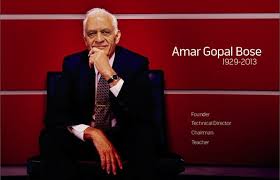
Amar Bose, 1929-2013

By Shlomo   Maital

             Bose


   We can all learn many things from Amar Bose,  founder of the speaker and earphone company, who just passed away at the age of 84. 

  1.  In a 2004 interview with Popular Science, he said:  “I would have been fired a hundred times at a company run by M.B.A.’s. But I never went into business to make money. I went into business so that I could do interesting things that hadn’t been done before.


 2.   Build the change you seek.      Dr. Bose (he holds 3 degrees from M.I.T.) was disappointed by the bad sound of a costly stereo system he bought when an M.I.T. engineering student in the 1950s.  He realized  80 percent of the sound in a concert hall bounced off walls and ceilings before reaching the audience.  This was  the basis of his research.    In the early 1960s, Dr. Bose invented a new type of stereo speaker based on psychoacoustics, the study of sound perception:  many small speakers aimed at the surrounding walls, rather than directly at the listener.

 In 1964,  his mentor M.I.T., Dr. Y. W. Lee urged him to found his company, The Bose Corporation.


3.   Persist!    his first speakers fell short of expectations, but Dr. Bose kept at it. In 1968, he introduced the Bose 901 Direct/Reflecting speaker system, which became a best seller for more than 25 years and made Bose  a leader in a highly competitive audio components marketplace; the 901s used a blend of direct and reflected sound.    Later   Bose Wave radio and the Bose noise-canceling headphones became market and technological leaders.


4.  Give back.  Dr. Bose had a  passion for teaching.  He returned from a Fulbright scholarship   in New Delhi and joined the M.I.T. faculty in 1956.   He taught there for more than 45 years.  In 2011, he  donated a majority of his company’s shares to the school. (Bose never ‘went public’, in order not to lose control of his company’s direction).  The gift provides M.I.T. with annual cash dividends.   M.I.T. cannot sell the shares.   Bose got a lot from MIT – mainly its culture that drives graduates to start businesses.  And he gave back a lot too.

TWINKIES are Back!

By Shlomo  Maital  

             Twinkies

  Yes, it’s official!  USAToday (July 13), p 7A,  informs us that as of July 15, 2013,  Twinkies are back!  And with a bang!   There is a giant billboard of a Twinkie in Times Square.  A new Hostess website with a countdown clock…   A social media campaign in which people share their love of Twinkies.  And a huge chocolate CupCake sign on the side of the Los Angeles Figueroa Hotel.

    The Hostess Facebook page has 440,000 likes!  

  “It’s the same Hostess, but with a different attitude,” says Dave Lubeck, executive director for client services at Bernstein-Bein Advertising, which created the ad concept. 

   A truck tour is on the way.   Promoters will travel the country passing out free Twinkies.  It starts at Times Square on Monday.  You will see Twinkie the Kid, the mascot, on the tour.    Street teams are handing out “prepare your cake face” T shirts and “I saved the Twinkie” buttons. 

    Life can’t be all bad, if Twinkies are back.   Which would YOU choose?  Austerity?  Or Twinkies?  Maybe we should send a few dozen to the sourpusses who run our governments.   


Why Bubbles Burst, Why Creativity Withers

By Shlomo Maital

 economist

  In the latest edition of BBC’s Global Business, Peter Day chats with UK economist Paul Ormerod, who knows what’s wrong with economics and why it has failed.  If you don’t want to read this long blog account of their conversation – here is the essence.   

     In 2003 Nobel Laureate Robert Lucas (he won it in 1995) said this:  “Macroeconomics … has succeeded. Its central problem of depression prevention has been solved, for all practical purposes, and has in fact been solved for many decades.”   Really?  Is the global Depression that started with the Lehman Bros. bankruptcy in 2008, and is still ongoing,  chopped liver?   If it is solved, Nobelist Lucas, why did former European Central Bank Governor   Jean Claude Trichet say, “at the time of crisis policy-makers felt abandoned by economic theory, which was of no use whatever”.  Why did Ben Bernanke recently say that economic theory is wonderfully good only at explaining why we made mistakes in the past….  Why would an intelligent human being EVER say any complex social problem was solved forever?  So what is wrong with economics?  Ormerod, in his new book  Positive Linking: How Networks and Incentives can Revolutionize the World, explains it simply. Economics ignores other people. Decisions are made by one rational, highly rational, person.  In reality, we copy others.  We do what they do.  That means that there are persistent bubbles, because people do what other people do, as all of us belong to networks, groups of persons who influence one another.  That’s why so many people destroyed themselves and their companies by investing in credit default swaps and mortgage-backed securities.  Everybody else was doing it.  So the lesson here is, while you are copying others, THINK INDEPENDENTLY.   And if you want to remain creative, reserve part of your brain for creating NEW CHOICES, rather than just blindly going with existing ones everyone favors.    

 This is an account of the conversation between Peter Day and Paul Ormerod:

   “ What on earth  is wrong with economics?   Storm clouds, the boom comes to an end, economies fall, companies fail, banks go bust, and despair, uncertainty and turmoil affect ordinary people caught up in a Depression.  It happened in 2008; the effects are still with us.  Were the people in power steering by the wrong stars?   Paul Ormerod’s  first book, 20 years ago,  was  The Death of Economics; next he wrote Why most Things Fail.  Recently : Positive Linking: How Networks and Incentives can Revolutionize the World.   (“Network” here refers not just to the Internet, but to all forms of social communities – any grouping of humans who influence each other’s behavior). Ormerod says:   “There are serious limitations in the way conventional economics is taught and written about.  Most serious:  It treats people as if they were operating in complete isolation from each other.  You make choices solely based on your own views, as if you were Robinson Crusoe.  With the development of the Internet, it is a poor description of the world.    Macroeconomics models weren’t just academic, they had traction among Central Bankers, based on the idea of a single individual. When the financial crisis came, it was a NETWORK problem; the financial viability of one bank impacted on others,  we worried about the cascade effect.  Economists’ models omitted from the models this network effect.    Big companies have rebuilt their balance sheets. They’re sitting on cash. Nobody wants to be the first one to move. As soon as one starts spending, others will follow– we’ll get an investment boom. But when???“

    “When we think of any market where there is popularity, e.g. fashion, books  (e.g. 50 Shades of Grey –not a great book, but it became popular because it WAS popular…),    Crowd effects.  We are like sheep. Investment markets behave like this.    The book The Madness of Crowds was written 172 years ago! (Charles Mackay, 1841!).  Keynes called it ‘animal spirits’.   This governs how the economy performs. It is the job of policymakers to intervene, to counteract animal spirits when they go bad.  How do you make people more optimistic?   The analysis here is psychological.” 

     “Herbert Simon, Nobel Laureate in Economics, was at his peak in the 1950’s.  The essence:   He observed how firms really took decisions.  He developed an alternative theory – he is the founder of the behavioral economics school.  In 1955 his article built the foundation for it.  In general, firms do not behave as economists say, rationality. The world is too complex.  They use some reasonable rules and use them until they fail.      Jean Claude Trichet, former ECB governor, said, “at the time of crisis policy-makers felt abandoned by economic theory, which was of no use whatever”. 

      “Rational copying person:  should replace the rational economic agent.  Copying is the way the network effect works.  The number of choices available today are phenomenal. McKinsey (consulting firm) says: on any single day, in NYC a consumer faces 10 billion potential choices!   That cannot be done in an economically rational way. You cannot gather information on all these 10 b. choices.  So you do what Herbert Simon said, you form short-cuts, heuristics, simple rules.  If you choose a restaurant, you ask your friends.  Copy what they do.  It’s a short-cut to deal with the world’s complexity.  Get a group of people whose opinion you trust, and you copy them.   There is a lot of this on the internet.  It is visible now:  “those who like this, bought that…”      This is left out of conventional macroeconomics.  In the macro model, one person makes decisions, a representative agent.  He/she represents the entire economy. They have to take rational decisions. 

  “In the U.S. choice is regarded as a badge of freedom.   A part of democracy.  But this bewilders people.  Choice has now exploded, grown exponentially.  In the 1950s, Simon discussed this – there are so many alternatives, how can I decide?  Even looking back, in most situations I can never know if I have made the best decision. All I can do is to hope to make a reasonable decision. The way to do that is to copy people’s behaviors whom I respect.  

     “Mid-price laptops in the German market:  There are 3,500 possibilities. How can you possibly choose?  How do you choose a smartphone?  Ask a couple of young people, what’s yours, and …I’ll have that.  More sensible than trying to evaluate 3,500 possibilities.   When people copy, when their behavior is driven by networks and social effects, we get cascades, bubbles…and sometimes collapse.”

Deficit, Shmeficit: Get People Back to Work

By Shlomo  Maital  

GREECE-DEBT-FINANCE-LABOUR-STRIKE-EUROPE

    Tomorrow night my wife and I leave for a conference in Portugal.  Lately, social protests in that country have recurred, the finance and foreign ministers quit, and Prime Minister Coelho faced a disintegrating government.  He managed to avert it, narrowly.  The sign in the photograph tells it all.  Austerity kills dignity.  It is also killing Europe.

      Today’s Global New York Times reports that “fewer than 10 per cent of people surveyed in the European countries hardest hit by the region’s debt crisis say that their leaders are doing a good job at fighting corruption”, according to Transparency International.  “The results reflect a crisis of faith in government”, the report continues.  Half of the 114,000 people surveyed viewed political parties as the most corrupt institutions; half thought their governments are run by “special interest groups”. 

    According to the Portuguese member of the Transparency Intenational board, “the near unraveling of the Coelho government is an example of how focusing solely on the fiscal aspect of Portugal’s problems led to public frustration”. 

    According to the TI report, “19 of 25 European countries do not regulate lobbying at all.”  Big money buys big lobbies, which protect the moneyed interests.  And the people lose faith.

    The macroeconomics of austerity is truly simple.  People, without jobs or hope, stop spending.  Businesses, as a consequence, also stop investing.  Exports are down, as nations try to protect their home markets to export unemployment and their imports decline.  Result: The only source of growing demand is government spending. But under austerity, that too disappears.  It’s like all the air is let out of the GDP balloon, because there is no source of strong demand.

     Deficit, Shmeficit.   As Keynes said in 1936, in a Depression, governments must supply the demand.  When they do, confidence resumes, unemployment falls, and the economy picks up.  Governments can THEN tackle the deficit problem, which by the way cures itself as growth spurs tax revenues.  It’s so simple.  WHY don’t the rich European nations (i.e. Germany) get it? 

   Deficits can be fixed. But destruction of people’s faith in their leaders is much much harder to repair.  And without such faith, the low-key Depression, as Paul Krugman calls it, will go on, in Europe and in America.  And the people will continue to suffer and protest.   

*  Melissa Eddy, “Weary Europeans Lose Faith in Government,” Global New York Times, July 10/2013, p. 13.


Blog entries written by Prof. Shlomo Maital

Shlomo Maital

Pages