Here is a test of your knowledge of acronyms.

What does “GM” stand for? If you answered “folly,” 10 points. The folly of a CEO who, 3 years ago, signed an agreement giving 90% of his United Auto Workers employees most of their salary even if the production lines shut down. (The CEO of Chrysler did the same). What business promises to pay its employees even if they are not working? Today a Chrysler worker complained bitterly on BBC’s World Service, that he was laid off, got paid for 36 hours of work a week anyway, drew unemployment insurance (!) – and was worried lest Chrysler run out of money. How many businesses would not run out of money if they paid their workers without producing and selling anything? Perhaps GM stands for Gross Mismanagement.

What does BYD stand for? Don’t know? Never heard of it? You will. It stands for Build Your Dreams. And – it stands for an upstart car company that plans to be #1 in China by 2015 and #1 in the world by 2025, according to its President Wang Chuanfu.

Wang is a genius. He invented a revolutionary battery that powers a third of the world’s cell phones. And now, he has leveraged his knowledge of battery technology to build electric cars, that can charge in as little as 15 minutes. 

Founded in 1995, BYD employs 170,000 workers in 7 huge plants, and has 10,000 engineers and scientists in its R&D centers. Evidence that BYD is on the right track? An investor named Warren Buffett bought a 9.89% interest for $230 m.  

BYD hopes to make 200,000 cars this year, and double that number in 2009, despite the global recession.  

How did BYD transition from making cell phone batteries for Nokia, to making cars? It bought a Chinese car manufacturer four years ago. Car production, according to BYD, is rather low technology. BYD uses its high-technology experience, to upgrade the technology of car production. 

BYD is a sort of Chinese role model. According to the New York Times, 

“In April, Credit Suisse forecast that one-third of all export-oriented manufacturers could close within three years. And a study released in March by the American Chamber of Commerce Shanghai and Booz & Company, the consulting firm, says foreign investors are growing bearish on China and that rising costs are driving American manufacturing out of the country.”

Look for America and Europe to bring back home some of its manufacturing. Look for China to respond, by moving up the value chain and upgrading its factories, to build branded high-quality high-technology products, like BYD’s electric cars. This has been China’s vision from the outset. We will all watch closely, now, to see if they can implement it.  

FO Car

BYD's FO Car

“Look after the world, child!” sings Israel’s remarkable contra-tenor David D’Or. “Because…we [adults] cannot.”

Perhaps our children will take better care of our world, its markets and its climate, than we did. They cannot do worse.  But they will have help from amazing robots. And Israel is leading the way. 

While modern Israel may not exactly be a “light unto the nations,” as the prophet Isaiah promised, it may be becoming  a source of ‘robots unto the nations.’ Some of these robots have military uses; some are civilian. All  have the potential to save or improve our lives and to make warfare more moral. The era of moral machines has begun, perhaps constraining immoral humans.  

Israel already has pioneered pilotless drones, a mainstay of air forces in Israel, U.S. and elsewhere. Now, according to the Associated Press, the IDF (Israel Defense Forces) has The Guardium, an unmanned ground vehicle that never sleeps while on guard duty and carries 300 kgs. (660 pounds) without whining. And its family does not miss it when it is on reserve duty. The Guardium is operated from a control room far from the battle scene and navigates through complex urban areas that could endanger live soldiers. The Guardium was developed by an Israeli company, G-Nius, headed by Erez Peled.  

Last Spring, Channel 10 reported that the IDF was about to introduce an unmanned jeep into the Gaza conflict. It was developed jointly by Elbit Systems and Israel Aerospace Industries. 

Not all the robots are military. An Israeli company called Friendly Robotics, founded in 1995 by Udi Peless and Shai Abramson, developed a robotic vacuum cleaner, a robotic lawn mower and a robot that could take out the trash. The little lawn mower, called Robomow, is amazing. Its owner sits in a lawn chair with a cool mint julep, watching the machine mow her lawn. It once starred on the cover of the famous Hammacher Schlemmer gift catalog. But the robots, though Friendly, might be a tad too expensive. Robomow costs $1,599.

Will robots help us make a better world? Georgia Institute of Technology researcher Ronald Arkin thinks so. He told the International Herald Tribune that robots “can behave more ethically in the battlefield than humans currently can.” Arkin is writing software that could make fighting robots operate within ethical bounds, something human soldiers find difficult in the heat and emotion of battle. Arkin is a religious Christian. He thinks you could build the Geneva Convention into the machine’s mental architecture.  

This idea is, of course, old hat. The science fiction writers thought of it long ago. In his 1942 sci-fi short story Runaround, Isaac Asimov promulgated the moral laws that would govern the behavior of robots.  

The first law? “A robot may not injure a human being, or allow a human being to come to harm.” Imagine a world where all human beings followed that law, not just robots. If both humans and robots followed it, it would be very difficult to stage wars or genocides. 

Some of the world’s most advanced work on robotics is done at Ben Gurion University. There, researchers have built “robot snakes” able to slither on the floor and pass through pipes. And, notes Dr. Amir Shapira, they have built a “cat-bot” or “dog-droid” that scales walls by releasing glue through its wheels. Had the IDF possessed them in 1994, perhaps they could have saved the abducted soldier Nahman Wachsman, who unbeknownst to the commandos sent to rescue him, was held prisoner on the second floor. That lack of knowledge cost Wachsman his life. The cat-bot could have found it out. 

The word robot was invented by the Czech playwright Karel Capek in his 1921 drama R.U.R.  His hugely popular play showed how humanity could be dehumanized by technology, in the form of robots. Capek himself did not believe in moral machines or machines that could live and love. (Asimov did – his fictional robots do fall in love). Capek felt robots would be a “grave offense against life.”

Perhaps. But perhaps not. Let’s face it. Morally, we humans are a mess. Just look around the world. Perhaps machines could do better. And Israel is at the forefront of the innovators who supply them. Could this be what Isaiah had in mind?

Remember that old belief about innovation being, Inspiration! Eureka! I’ve got it!

Well, forget it. An article in today’s International Herald Tribune, citing serious research, debunks it. Those flashes of insight that seem like inspiration actually arise from complex interactions with other people. The implications for entrepreneurs are crucial. If you want to build a powerful innovation process, that generates more than a one-time idea (which in itself is never enough for sustained business success) – build a powerful team. Make teamwork a part of your company’s innovation culture and DNA. And, by the way – forget about this brainstorming notion.  Brainstorming – unfocused ideation – fails to generate usable business-grounded ideas. 

Here is an excerpt from the article:

Despite the enduring myth of the lone genius, innovation does not take place in isolation. Truly productive invention requires the meeting of minds from myriad perspectives, even if the innovators themselves don’t always realize it. Keith Sawyer, a researcher at Washington University in St. Louis, Missouri, calls this “group genius,” and in his book of the same name he introduces a scientific method called interaction analysis to the study of creativity. Through studying verbal cues, body language and incremental adjustments during team innovation efforts, Sawyer shows that what we experience as a flash of insight has actually percolated in social interaction for quite some time.

“Innovation today isn’t a sudden break with the past, a brilliant insight that one lone outsider pushes through to save the company,” he said. “Just the opposite: Innovation today is a continuous process of small and constant change, and it’s built into the culture of successful companies.”

It’s a perspective shared broadly in corporate America. Ed Catmull, president of Pixar Animation Studios and Disney Animation Studios, describes what he calls “collective creativity” in a cover article in the September issue of Harvard Business Review.

“Creativity involves a large number of people from different disciplines working together to solve a great many problems,” he writes. “Creativity must be present at every level of every artistic and technical part of the organization.”

So, we all should brainstorm our way through the day, right? Wrong. That tool, introduced by Alex Osborn in 1948, has been proved in a number of studies over the last 20 years to be far less effective than generally believed.

“He had it right in terms of group process,” said Drew Boyd, a businessman based in Cincinnati who blogs and speaks often about innovation. “But he had it wrong in terms of the method.”

Brainstorming, Boyd says, is the most overused and underperforming tool in business today. Traditionally, brainstorming revolves around the false premise that to get good ideas, a group must generate a large list from which to cherry-pick. But researchers have shown repeatedly that individuals working alone generate more ideas than groups acting in concert.

Instead of identifying a problem and then seeking solutions, Boyd suggests turning the process around: Break down successful products and processes into separate components, then study those parts to find other potential uses. This process of “systematic inventive thinking,” which evolved from the work of the Russian engineer and scientist Genrich Altshuller, creates “pre-inventive” ideas that then can be expanded into innovations.

“The best innovations occur when you have networks of people with diverse backgrounds gathering around a problem,” said Robert Fishkin, president and chief executive of Reframeit, a Web 2.0 company that creates virtual space in a Web browser where users can share comments and highlights on any site. “We need to get better at collaborating in noncompetitive ways across company and organizational lines.”

I am reading a fine new book by Elizabeth Haas Edersheim, The Definite Drucker (McGraw Hill, 2008). She knew Drucker personally, and followed up on his idea (Drucker was always incredibly original and creative) to write a biography, not of his life but of his ideas. The book is about Drucker’s landmark ideas on how to build and run a business.

My own book, published last year, focused on why innovation is really about focused disciplinedmanagement, not about ideas. But of course, Drucker was there first. He began teaching that in 1954.

He was born in Austria on Nov. 19, 1909, worked as a journalist, and emigrated to the U.S. just before World War II.  He became a US citizen in 1943, taught at Bennington, later was an NYU professor for 21 years, from 1950-71, and then went to Claremont College in California, where a business school has been built carrying his name.

Drucker was invited by General Motors’ senior management to become a consultant. He participated in board meetings, executive committee meetings, and in 1942 wrote a landmark book called the Future of the Industrial Man.  All the solid ideas we teach today about good management are in it. And it was published 66 years ago. If you want to understand why GM has collapsed, read this book, and identify everything they have done and not done, against Drucker’s wisdom. In 1946 he published The Concept of the Corporation, a management handbook still relevant today.

Drucker, in his lifetime, wrote 39 books. And he never ever repeated himself. He died on Nov. 11, 2005, still in harness, still working and writing, one week short of age 96. 

Drucker began teaching innovation at NYU in the 1950’s, decades before management professors realized how crucially important it was. He taught how vital it is to have a disciplined innovation process and to manage implementation of new ideas with systematic operational excellence. He consulted companies about their strategies, using the term ‘strategy’ when business schools told him strategy was about war, not about business. (Michael Porter’s 1980 book Competitive Strategy simply repeats what Drucker had been saying and writing for decades). 

Drucker said there are seven places to find innovations. They are: 1. The unexpected 2. Industry-market gaps; 3. Process vulnerabilities; 4. Incongruities; 5. Demographic change; 6. Changes in perception; 7. New knowledge. 

Can you find innovative ideas in one of these areas? Read Edersheim, or better yet read Drucker. I recommend:  Managing in Turbulent Times (1980) and Innovation and Entrepreneurship (1986). 

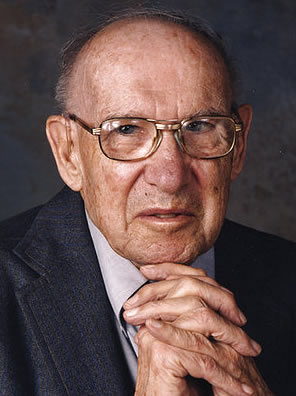
peter_drucker Peter Drucker

On her recent visit to the London School of Economics, perhaps the Mecca for high-level economic innovation, the Queen of England, Queen Elizabeth II, asked an unaccustomedly embarrassing question. 

“Why did no-one foresee the crisis?” she asked. She meant: Why did none of you brilliant academic economists tell us this tsunami was coming, so we could prepare? And why can none of you brilliant academic economists tell us what in the world to do about it, to get us out of this mess?

On a scale of 1 to 10, the economics profession merits a minus 6, in its approach to the recession. 

What can managers do, when those whose profession it is to forecast the future, are able to forecast (as Nobel Laureate in economics Paul Samuelson once said) minus one year in advance. That is, economists are now saying the U.S. began a recession in December 2007. This ‘call’ was made exactly one year later. Now they tell us! They tell us what happened a year ago. How useful is that?  

A major problem is that of denial. Many of us tend to be optimists. This is highly positive. Entrepreneurs and innovators have optimism in their DNA. But optimism can lead to denial – to the inability to see dark clouds forming. And when the economists fail to see them as well, the world is in trouble.

As Gary Hamel noted in a famous HBR (2003) article on resilience, it is not the unknowable that is the problem – it is the unthinkable. We know what can happen. But we prefer not to think about it.

Solution? Perhaps, scenario analysis. Ask yourself: What is the worst thing that could happen to me and to my organization? What would I do if it happened. Think the unthinkable. Then, what it happens, perhaps you will be better prepared mentally to deal with it, without panic.

In racing parlance, a ‘dark horse’ is a horse highly unlikely to win.

In innovation, dark horses have enormous energy, precisely because so little is expected of them and because they are under-rated by complacent incumbents.

Take, for instance, the three leading European football (soccer) leagues: England, Germany, and France.

In England, Hull City, a small club promoted from the 2nd league this year, is in 6th place, only 6 points behind league-leading Liverpool, a club with a budget many times that of Hull. Hull has beaten top teams this year, including Manchester United.

In France, little Nice is in 4th place, only 6 points behind perennial league-leaders Lyon, despite its miniscule budget of 35 million euros. 

And Germany? Well, the Bundesligue is led by Hoffenheim. Who? This small German town with only 3,300 inhabitants was also promoted from the lower league, and led by a more or less unknown coach has defeated top German teams. This weekend it plays the soccer empire of Bayern Munchen, led by Jurgen Klinsman. 

In all three leagues, these dark horses, have used teamwork to their advantage. Lacking the money to buy high-priced stars (some of whom might cost as much as the team’s entire annual payroll), they use hard work, team collaboration, and above all – the energy of the dark horse. Facing complacent rivals, they repeatedly win by playing hard, every moment of the game. 

Half of the season has been completed. Experts expect each of these teams to collapse in the second half.    Don’t bet on it. Count on the energy of the dark horse to prevail.

Innovators – you too are dark horses. Facing powerful incumbents, startups can prevail, in the same way that Nice, Hoffenheim and Hull City have.

“Strawberry Picker Buys $720,000 Home”

Remember Michael Lewis? As a young man, he got a job with Salomon Brothers, then a leading investment bank. When he quit, in 1989, he sat down and wrote a stunning book, Liar’s Poker, about what he saw and learned there. Liar’s Poker anticipates much of what has happened since July 2007.

I stumbled into a job at Salomon Brothers in 1985 and stumbled out much richer three years later, and even though I wrote a book about the experience, the whole thing still strikes me as preposterous—which is one of the reasons the money was so easy to walk away from. I figured the situation was unsustainable. Sooner rather than later, someone was going to identify me, along with a lot of people more or less like me, as a fraud. Sooner rather than later, there would come a Great Reckoning when Wall Street would wake up and hundreds if not thousands of young people like me, who had no business making huge bets with other people’s money, would be expelled from finance. When I sat down to write my account of the experience in 1989—Liar’s Poker, it was called—it was in the spirit of a young man who thought he was getting out while the getting was good. I was merely scribbling down a message on my way out and stuffing it into a bottle for those who would pass through these parts in the far distant future. Unless some insider got all of this down on paper, I figured, no future human would believe that it happened. 

Guess what. The book was a bestseller. But we still did not really believe him.

Michael Lewis is back. Writing in Portfolio.com, an on-line magazine, he has written a powerful essay titled “The end of Wall Street’s boom.” It is must reading. Tom Friedman quotes it in his column in the New York Times published today in the International Herald Tribune. 

Here is what Lewis writes about Long Beach Financial, owned by the mortgage bank Washington Mutual (now bankrupt, of course). 

Long Beach Financial specialized in asking homeowners with bad credit and no proof of income to put up no money down and defer interest payments for as long as possible. In Bakersfield, CA., a Mexican strawberry picker with an income of $14,000 and no English was lent every penny he needed to buy a home for $720,000.

A very large number of people knew this debacle, this destructive innovation, was going on. But huge bonuses kept them quiet. And now we have the $300 b. bailout of Citicorp. Friedman calls the senior Citicorp executives “some of America’s best-paid bankers…who were overrated dopes who had no idea what they were selling, or greedy cynics who did now and turned a blind eye.”

Citicorp had to be bailed out or risk what Friedman calls “a systemic crash.” 

“These are the wages of our sins,” Friedman says. These are the wages of destructive innovation.

Can a 72-year-old innovation save the world?

Of course.  Here is how.

In 1936 John Maynard Keynes, a Cambridge economics don, published his book The General Theory of Employment, Interest and Money, Keynes wrote the following ridiculous proposal to battle the ravages of the Great Depression:

If the Treasury were to fill old bottles with banknotes, bury them at suitable depths in disused coalmines which are then filled up to the surface with town rubbish, and leave it to private enterprise on well-tried principles of laissez faire to dig the notes up again… there need be no more unemployment. . . . It would indeed be more sensible to build houses and the like; but if there are political and practical difficulties in the way of this, the above would be better than nothing.”

What did Keynes have in mind?

Speaking to the Israel MIT Enterprise Forum on Nov. 20, Prof. Lester Thurow recalled Keynes’ prescription and urged governments everywhere to “flood the system with money.” This was Keynes’ innovative idea. When panic reigns and demand shrinks, governments must fill the gap, in any possible way, even through the “bury banknotes” scheme. Anything to get money and liquidity and demand into the system.

Keynes has for years been discredited, as free-market capitalist ideology reigned and government intervention was regarded as destructive. Now the same persons who preached this theory are now massively bailing out failed banks and insurance companies and, soon, automobile companies.  

Memo to old ideas: Never despair. You are like old clothes. If you wait long enough, soon you will come back into fashion.

[Eric Schmidt, CEO of Google, was interviewed by strategy guru Gary Hamel at the Management Lab Summit (which Hamel founded) on May 29, 2008 in Half Moon Bay, CA. You can find that interview on YouTube by doing a Google search on the above sentence. It is quite long, an hour, but fascinating and revealing].

_________

One of those obvious truths that needs constant restating is this:
To have an innovative organization, you need to hire – and keep – innovative people.
But how? Eric Schmidt reveals how in this remarkable one-hour interview.
Here is a brief abstract of the wisdom he conveys.

Culture defines an organization’s innovation. Google’s culture is a bit like a university. This could be fatal for many organizations. Who wants to have a business like a university? But Google makes it work. It hires people who love new ideas. Google has a Top 100 list of new ideas to work on. We call it that, even though there are more than 250 projects on the list! (How many companies are working on 250 new ideas??? S.M.).

Your talented people are your key stakeholders. Not your shareholders. When Google went public, the founders kept Class A (voting) shares. They now control the company’s destiny, even if they do not have a majority of the shares or anywhere near it. This will make the company ‘built to last’ rather than short-run myopic. 

We have a clear unique value proposition. Here it is. It has four parts.
1. End user happiness with search
2. End user happiness with advertising
3. Network of partners based on (1) and (2)
4. Grow and build the business based on (1) (2) and (3).

I much admire Rupert Murdoch. He has a sense for what his readers want to read in the newspaper. Murdoch is praised as a shrewd businessman, but I think the key is, is intimacy with his readers.

When people leave Google (and the retention rate is very high), we find out: What do they want to do at Google that they cannot do and are therefore leaving? And why is this so, and can it be changed or fixed?

Marissa Mayer is Google’s VP for search products. She has an uncanny ability to sense what people want, like Murdoch. Marissa helped create StreetView (street level view of your house). What good is it? Eventually it can be used for sophisticated devices to help you find your destination (such as an autopiloted car). Marissa is working on a database that will combine, integrate and organize your medical records. And she has a strong ability to sense which projects will succeed and which will not. And she is also an amazing talent finder.

In the end it is simple. Do the best brains in the world want to work for your company? Why? Or why not? If the answer is yes, then you will have the best brains, the best ideas, the best innovation, and the best management. If the answer is no, you must find out, why? 

Innovation, in the end, is about finding top talent and keeping it. We especially look for people who are good at doing things (implementing the ideas they have).

HR – Human Resources, or Hopeless Recycling (of tired old ideas)

Great innovators find dark corners, where the light of innovation rarely reaches. One of those dark corners is what is known as Human Resources, the function in companies that manages and develops talent. It is, in many cases, the dark side of the moon. HR managers are among the first to be fired in a downturn, even though managing people, talent and morale is perhaps the most crucial area of management in hard times. 

Why?

In my experience, HR executives rise in the ranks through the silo of organizational development, and rarely acquire the business acumen and strategic insights that make them a true part of the senior management team. I advise all my HR friends to do many horizontal moves and deployments, to gain understanding of the business, not just the people. 

What might be an innovation in HR?

Two ideas
1. Drop the name, forever and ever, of HR. Call yourselves Human Capital. Because people are indeed human capital, and are more important for most organizations than physical and financial capital. And capital, incidentally, depreciates, and needs reinvestment and modernizing. An HC department will from first principles build an investment program, and will prove, based on Return on Investment, that the investment is justified and pays high return. An HC department will invest in its people. An HR department is often viewed simply as the place where green slips and redundancy notices are formulated and managed. 

2. Reframe your hiring procedure. Hiring is among the most crucial decisions made by the organization, even at low levels. In this procedure, prospective new hires are subjected to questionnaires, tests and interviews, some more relevant and thorough than others.

Why not reframe this procedure? Why not first ask the application to interview the company? Is this a good company? Does it suit my needs? My passion? Will I learn and grow. Ask your applicants to interview you! I believe you will learn far more from their questions, than you may learn from your own.

Blog entries written by Prof. Shlomo Maital

Shlomo Maital

Pages