“Go Forth…and Find Your Authentic Identity”

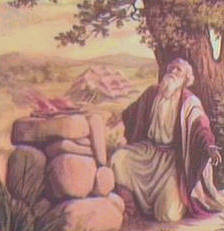
Each year, Jews read a chapter of the Five Books of Moses, in synagogue, completing the cycle over 52 weeks. This week we read the third chapter, known as Lech Lecha, which means “Go Forth.” This is what G-d tells Abraham. Leave your country, and go forth. “And I will make you a great nation, and I will bless you, and make your name great; and so you shall be a blessing.” Abraham gathers up his household and obeys, leaving the green pastures of Haran for an uncertain future.

Biblical commentators say “Go forth” means “Go forth and find your authentic identity, and then become it!.”   So even though he is 75 years old, Abraham sets out to find his true self, and when he does, he will become the founder of the most powerful innovation in history – the notion that there is only one G-d, along with the ethical principles that accompany that idea. He will be revered, not only as the forefather of the Jewish religion but Christianity and Islam as well.   

There is a useful message in this chapter. Innovators travel very great distances in their quest for relevant novelty. But the greatest distance they must travel is within themselves. Like Abraham, we must find and define our authentic inner selves, before finding and defining how we will change the world and discovering how we will, like Abraham, be “a blessing.”  

Sometimes, this inner journey is long. As Nietzsche counseled, “Become yourself!.” But how can we become ourselves, if we do not yet know who we are? And unless, like Abraham, we begin this journey, and go forth, we will never arrive.             

If Abraham could undertake it, at age 75, what about those who are only 25?   

Go forth, my friends, go forth. There is no time to waste.

abraham 
“And I will make you a great nation, and I will bless you, and make your name great; and so you shall be a blessing.”

Life is hard for you these days?  

Try these two situations on for size. Then, rethink the adjective “hard.” 

Bram Cohen has Asperger’s Disease. (Some may have read the wonderful book, The Curious Incident of the Dog That Died in the Night, about a boy with Asperger’s who solves a mystery, using his skill at making lists). Some psychologists view Asperger’s as a mild form of autism. According to Susan Berfield, writing in her blog in Business Week, Asperger’s is:

a condition that keeps him rooted in the world of objects and patterns, puzzles and computers, but leaves him floating, disoriented, in the everyday swirl of human interactions.

According to Berfield,  Cohen had an unhappy childhood. “I was picked on a lot,” he says. “There was something obviously wrong with me. But it wasn’t acknowledged until I was much older that something had always been off-kilter. Were I to have to redo high school, I would just drop out immediately.” He attended the State University of New York at Buffalo for one miserable year and then left. 

After miserable experiences working with startup companies, Bram headed for Silicon Valley. There he started BitTorrent. Here is the main idea:

Cohen sought an efficient way to share huge amounts of digital data. Napster and other peer-to-peer programs already allowed people to pass smaller music files from one computer to another. But big files would clog the system. The elegance of Cohen’s solution is that as more people join a network, data move faster rather than slower. His software breaks files into pieces and scatters them on users’ hard drives. When someone requests a movie, the software gathers the pieces from the nearest computers on the network and assembles them only once they reach their destination. This allows a file to download much more quickly. 

BitTorrent has run into difficulties. Bram is no longer CEO. But the mere fact it exists and survives, and the fact a person with Asperger’s launched it successfully, are inspirational. It is hard enough to start a company. But starting one with Asperger’s? And, you say your life is hard?  

One of the most popular recent YouTube downloads is one without any spoken words at all. I often show it to my students. It is about a young man with cerebral palsy, confined to a wheelchair, and his loving father, who had heart disease. 

“Dad,” he said (few except his father can understand his speech), “I want to run a marathon with you.”   

Marathon? But – how?

The father began to train, running and pushing his son in his wheelchair.  His fitness grew.  Eventually, they ran a 42-km. marathon.   

His son was ecstatic; his face lit up at the finish line. And soon they did another one.

Then… “Dad!” he said. “I want to do an Iron Man triathlon!”

Triathlon? Wait. That includes a 120 km. bike ride and a 4 km. swim, then a full marathon. Intense activity for 8-10 full hours. But how?

His father swam, towing him in a rubber dinghy. His father biked, with his son in a seat in front of the handlebars. And his father ran the marathon, pushing his son in the wheel chair. They crossed the finish line to the amazed cheers of the crowd.    

If you search “Iron Man” on YouTube, you’ll see them in this 6 minute video.  

We learn again that there is nothing the human spirit cannot overcome, there is nothing too ‘hard’ to overcome, if the will is strong enough.

Intel, like all companies that manage their human capital well, initiates a PDP (Personal Development Plan) for their employees, annually. The PDP states the employee’s personal goals for the year and how they are to be achieved, and, in addition, how the company will help with this, in terms of training, courses and other development programs.

Whether or not you work for Intel, every reader needs his or her own PDP. It is absolutely VDI (Very Damned Important). Recently, I have been asking my students to write such a PDP, stating first their own personal dream or passion, and then their PDP for achieving it, developing the skills, talents, allies and resources necessary to attain their dream.

Some students have a clear ‘road map’ in their mind. Others have only a vague idea, and writing the PDP clarifies it. Others have never even allowed themselves to pose the question, What is my dream? Whatever the case, the PDP is vital. And of course, it is subject to change, as we move along the paths of the roadmap, learn and grow. 

So, here are the two key questions that comprise the PDP.

* State clearly your personal life’s dream or passion. How will you change the world?

* What will it take in terms of personal skills, competencies, resources and teammates to achieve your dream?

* What is the roadmap (the step-by-step procedures) that will get you from here, where you are now,  to there (where you dream you will be one day)?

Nietzsche once said, “Become yourself.” Reading that, I wondered for years, what does he mean? 

Today, I know. He means, dream, search for your dream, search for ways to make it come true, and in doing so, truly find out who you are and what you want.

This is how we can use our PDP, which is VDI, to truly become ourselves.

Can you become an entrepreneur and start your business, and fulfill your dream, in an age when the world is tumbling down the slippery slope of recession, when banks refuse to lend to huge stable long-time customers (let alone small businesses), when the VC pipeline is dry because those who invest in VC’s have stopped…?

The answer is yes, of course. This is precisely the best time of all to start a business and become independent, because so few people are even thinking of doing this, and because it is very hard to find a promising job with learning potential, as companies downsize and lay workers off. 

But how?

Bootstrap! Self-fund your business by financing it with cash flow and with your own savings. It may take you longer, but you will retain control and there are huge advantages to that.  

Here are the 12 rules of bootstrapping, by Guy Kawasaki, legendary Apple co-founder and successful venture capitalist. Follow them carefully and, above all, do not give up your dream just because the world is temporarily screwed up. Kawasaki says: 

I could build a case that too much money is worse than too little for most organizations—not that I wouldn’t like to run a Super Bowl commercial someday. Until that day comes, the key to success is bootstrapping. The term comes from the German legend of Baron Münchhausen pulling himself out of the sea by pulling on his own bootstraps.  

Here is the art of bootstrapping.  

  • Focus on cash flow, not profitability. The theory is that profits are the key to survival. If you could pay the bills with theories, this would be fine. The reality is that you pay bills with cash, so focus on cash flow. 
  • Build around boostrapping. If you know you are going to bootstrap, you should start a business with a small up-front capital requirement, short sales cycles, short payment terms, and recurring revenue. It means passing up the big sale that take twelve months to close, deliver, and collect. Cash is not only king, it’s queen and prince too for a bootstrapper. Manage by cash flow, not P&L – you probably should do this anyway, for any business.
  • Forecast from the bottom up. Most entrepreneurs do a top-down forecast: “There are 150 million cars in America. It sure seems reasonable that we can get a mere 1% of car owners to install our satellite radio systems. That’s 1.5 million systems in the first year.” The bottom-up forecast goes like this: “We can open up ten installation facilities in the first year. On an average day, they can install ten systems. So our first year sales will be 10 facilities x 10 systems x 240 days = 24,000 satellite radio systems. 24,000 is a long way from the conservative 1.5 million systems in the top-down approach. Guess which number is more likely to happen.
  • Ship, then test. I can feel the comments coming in already: How can you recommend shipping stuff that isn’t perfect? Blah blah blah. ”Perfect“ is the enemy of ”good enough.“ When your product or service is ”good enough,“ get it out because cash flows when you start shipping.
  • Forget the ”proven“ team. Proven teams are over-rated–especially when most people define proven teams as people who worked for a billion dollar company for the past ten years. Hire young, cheap, and hungry people. People with fast chips, but not necessarily a fully functional instruction set.
  • Start as a service business.  
  • Focus on function, not form. The function is computing, getting from point A to point B, skating, shooting, and knowing the time of day. These functions do not require the  expensive form…  
  • Pick your battles. Bootstrappers pick their battles. They don’t fight on all fronts because they cannot afford to fight on all fronts.  
  • Understaff. Many entrepreneurs staff up for what could happen, best case. Bootstrappers understaff knowing that all hell might break loose. But this would be, as we say in Silicon Valley, a “high quality problem.” Trust me, every venture capitalist fantasizes about an entrepreneur calling up and asking for additional capital because sales are exploding. Also trust me when I tell you that fantasies are fantasies because they seldom happen. 
  • Go direct. The optimal number of mouths (or hands) between a bootstrapper and her customer is zero. 
  • Position against the leader. Don’t have the money to explain your story starting from scratch? Then don’t try. Instead position against the leader.  
  • Take the “red pill.” This refers to the choice that Neo made in The Matrix. The red pill led to learning the whole truth. The blue pill meant waking up wondering if you had a bad dream. Bootstrappers don’t have the luxury to take the blue pill. They take the red pill–everyday–to find out how deep the rabbit hole really is. And the deepest rabbit hole for a bootstrapper is a simple calculation: Amount of cash divided by cash burn per month because this will tell you how much longer you can live. And as my friend Craig Johnson likes to say, “The leading cause of failure of startups is death, and death happens when you run out of money.” As long as you have money, you’re still in the game. 

Guy Kawasaki


What is the right way to become an entrepreneurial innovator? Is there a theory?

Here is my ‘take’ on this issue, derived from a case study by U. of Virginia Darden School of Business Asst. Prof. Saras Sarasvathy, titled “The Entrepreneurial Spirit”.   

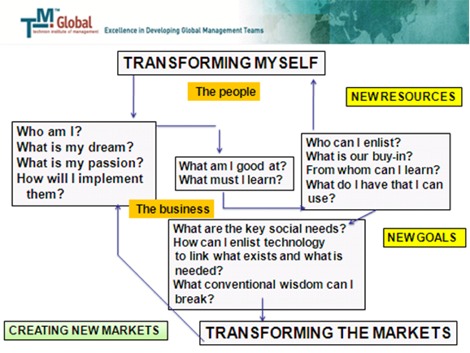
The entrepreneurial process is show below, in the Figure. 

• In the upper loop, you transform yourself, by looking inward and defining for yourself your dreams and your passions, and your skills, and how you must change in order to achieve them. And entrepreneurs always must change and adapt if they are to succeed.  

• In the bottom loop, you look outward, and examine the business environment, and global social economic and lifestyle trends, along with technology enablers. Successful entrepreneurship always combines the two loops.  

Identify key social needs that you feel passionate about and feel you can meet.

Identify competencies, skills and capabilities within yourself, identify flaws and gaps with yourself, and build your personal development path (PDP) to close them, while constantly looking outward to track the global environment.  

The key is the PDP. Intel has its employees build one yearly. Pretend you are Intel. Build yourself a PDP. What path shall I seek, that will help me achieve my dream? A key to the PDP: Always choose jobs that offer powerful learning experiences, rather than just paychecks. If you do not learn and grow, continually, it is not worth it. The gain in your human capital value through learning will be far greater, in a learning job, than any salary differential. 


The Entrepreneurial Spirit: The Double Loop. Look Outward, Look Inward

Source: S. Sarasvathy, U. of Virginia Darden School

Suppose a major financial innovation fails and causes enormous ‘creative’ destruction.

What do you do?

Such a creative innovation was the so-called CDS, credit default swaps. Huge losses were caused to bank’s balance sheets when the bonds and other investments insured by CDS’s went into default.

The losses appeared at once on the balance sheets of banks, because banks are required by accounting laws to “mark to market”. That is – to record a loss when the market value of an asset declines in its market price. 
These laws are widely applied in the United States, in Europe, and in so-called International Accounting Standards.

Bankers have complained about these rules, saying they make their balance sheets look worse than they really are, because when markets are not working, some assets are valued at zero, when (if given time) they are worth far more on a long-term basis. 

The international accounting regulatory body IASB (International Accounting Standards Board) that sets accounting rules for almost 100 countries made (almost unnoticed) a few changes last week, according to the Wall St. Journal (Monday Oct. 20, p. 19,  European edition). These changes may allow banks to reclassify assets like loans and receivables. They could broaden the change to include derivatives, which includes CDS’s. 

So – let us try to get this picture straight.

Investor trust is destroyed by the foggy murky ‘financial engineering’ that created risky assets few understood, hid them behind complexity, and distorted them with bond ratings of AAA.  

And now, investor trust is going to be restored. How? By allowing banks to better hide their toxic assets rather than disclose them fully and transparently.

Good thinking, IASB! Why not allow retrospective changes in financial reporting, that simply ignore the trillions of dollars in losses and in toxic assets and show that, well, the whole thing never happened! That will surely make everyone feel a lot better, right?

Hopefully screams of protests from scalped investors will set the IASB straight. Stop this before it goes any further. We need more transparency, not less. If a bank has lost money, we want to know about it. The job of financial reporting is to reveal the truth, not to hide it!

What is the best job in the world for an innovator?

Arguably, head of DARPA, the US Defense Advanced Research Projects Agency, headed for the past several years by a man named Tony Tether, whom few have heard of. Tether says that DARPA has triggered about a third of all developments in information technology and about 75-90 per cent of microelectronics developments began at DARPA. For instance, the Internet was born as a DARPA project. DARPA has a $3 b. annual budget. Tether has run the agency since 2001. DARPA is a branch of the Department of Defense, but it purposely headquarters in Arlington, VA, several miles from the Pentagon.

DARPA will celebrate its 50th anniversary this year. It will celebrate its contributions, including the GPS (global positioning system) and integrated circuit manufacturing.

Tether is innovative about innovation. For example: He funded a major competition for university students, to design a driverless robotic vehicle capable of piloting itself around a series of complex courses. This is known as a Grand Challenge. The prizes, $2m, $1m and $500k, respectively, were won by Carnegie Mellon, Stanford and Virginia Tech Universities. Tether says DARPA invested $20 m. in organizing these competitions, and got some $100-$200 m. worth of development work from the participants!

The key to DARPA creativity is rotation. “Program managers are not at DARPA for a career”, Tether says, “so they are willing to pursue high-risk technical ideas even if there is a reasonable risk that the idea will fail.” 

Half of DARPA’s work is open and non-secret. Most of this is done by universities. The secret stuff is done by industrial contractors. DARPA has a liberal patent policy. “The company or university doing DARPA research owns the patent,” he explains. “We demand a fully-paid-up license to the patent, but the commercial rights are totally owned by the developer”. 

Tether, despite his success, is a Republican appointee and will likely be replaced by the Democratic President. “I used to say no one has been at DARPA long enough to screw it up,” he laughs. “Now I have people saying, Tony, you’re getting there!”
________________________
Source: Financial Times, Monday Oct. 20, 2008, p. 14, “Business Life”.

How many countries can you name that have a Cabinet Minister whose title is Minister of Innovation?

UK Prime Minister Gordon Brown has appointed one. Last June 28, Brown appointed John Denham Secretary of State, head of the Department for Innovation, Universities and Skills. His post was created after the old ministry, Education and Skills, and Trade and Industry, was abolished. 

Denham’s mandate? “Make Britain one of the best places in the world for science, research and innovation”,  along with “development, funding and performance” of higher and further education. 

It will be fun to watch Denham’s progress, as he is already a year into his job, to see how innovative he is, at making Britain more….innovative. 

It will also be interesting to see which countries emulate Britain and appoint their own Ministers of Innovation. China? America? Israel? 
________________
*source: Wikipedia, “Secretary of State for Innovation, Universities and Skills”

Prof. Patrick George operates on brains 100 times a year. He also lectures at the Solvay Business School to MBA students.

What does he lecture about?

About his unique innovation, called “passion investing”. George has a company called Passion Investments. Here is how it works.

Each year the Michelin Guide is published listing Europe’s restaurants and grading them according to ‘one star’, ‘two star’, etc. George emails all the one-star restaurants, asking if they are interesting in investing the estimated 500,000 euros it will take to get a second star. Surprisingly about a third say yes! George then seeks a wealthy individual with a passion for food. They put up the cash, in return for a share in the business, plus added perks, like guaranteed bookings, special meals and cooking lessons.

The key to the model is simple. Put your money where your passion is. Combine your investments and your passion. Make money and have fun at the same time.

This is an example of what Gary Hamel calls a business innovation. George has for a decade applied his model, as a ‘virtual company’, with 20 other full-time academics from European universities and business schools, who seek unusual investments for wealthy clientele. George says his network has raised some 100 m. euros for restaurants, artists, films, museums, universities and business schools. 

“Passion Investing” is described in the Dow-Jones “Wealth Bulletin”, www.wealth-bulletin.com, which accompanies the European Wall Street Journal.

The latest issue of Business Week has two wonderful stories about how innovators overcome challenges.  One is about overcoming difficulties in raising money (external). The second is about overcoming the huge obstacle of a health problem – Asperger’s Disease, a form of autism. 

The first story by Spencer Ante tells about Fluidigm just missed a successful IPO (incidentally, there has been only one (1, uno) VC-backed company that did an IPO in the past two quarters in the US !)

Gajus Worthington has seen the effect of the financial meltdown on U.S. startups, and it’s not a pretty picture. The chief executive of Silicon Valley’s Fluidigm set out to take his chipmaker public about a month ago. On Sept. 5, the first day of the company’s road show, Worthington gave a standing-room-only presentation to blue-chip investors interested in buying Fluidigm stock. Three weeks later, after Lehman Brothers filed for bankruptcy and panic seized investors, he pulled the plug on the initial public offering. Worthington realized he couldn’t proceed after money managers he met with in San Francisco told him they didn’t even know how long they’d have jobs. “You could smell the fear,” he says.

Talk about bad timing! Worthington’s road show landed smack in the middle of the 1929-like panic.

Worthington had hoped to raise $80 million in the IPO, to give him a cushion of cash. Fluidigm originally priced the deal at 14 to 16 a share, but the offers from investors quickly dropped to single digits. At one point during the road show, Worthington checked into a hotel room and saw a newspaper lying at his feet. The headline, as he recalls it, read: “Worst Financial Crisis Since the Depression with No End in Sight.”

Worthington is not giving. According to the story, “the CEO laughs about the horrible timing now. Yet despite the risks of running low on cash, he’s determined to outrace the competition. He’s hiring sales and marketing executives to help find new customers in life sciences and other fields. Now, sales are concentrated with a small number of customers, including the Singapore Economic Development Board.”

A huge victim of the current global financial crisis and downturn will be the thousands of companies that brilliant innovators and entrepreneurs dreamed of starting, then abandoned.

Think different. Perhaps this is just the time to start a company (with a bootstrapping financial model), when everyone is rushing for the exits in panic. External constraints can be overcome with the same guts and ingenuity that launched your idea.

______________________________

The second story, by Susan Berfield, is about an entrepreneur who launched a company even though he has Asperger’s, a form of autism. (Many will recall the amazing novel, The Curious Incident of the Dog in the Night-time, about a young boy who had Asperger’s). 

Bram Cohen’s brain works differently from most people’s. He has Asperger’s syndrome, a condition that keeps him rooted in the world of objects and patterns, puzzles and computers, but leaves him floating, disoriented, in the everyday swirl of human interactions. When Cohen was in his late twenties he sat on a wooden chair with a Dell (DELL) keyboard on his lap for the better part of nine months writing a software program. In 2001 he introduced BitTorrent, an ingenious, disruptive, and controversial piece of technology that is available for free and lets people easily exchange huge amounts of digital information, from software upgrades to videos. Pirated movies have always been the most popular files shared. They, along with more legitimate files, now generate about half of all traffic on the Internet.

BitTorrent causes us to ask, wait! If Cohen can launch a successful startup, why not me? Here are some of the challenges he overcame:

For Cohen, this has been a fraught journey into the sometimes bewildering world of the office. The social conventions that ease everyday interactions can still elude him. He doesn’t like to shake hands or wear shoes or make small talk. He often plays with a Rubik’s Cube. Sometimes when he is outraged, or more often when he is fatigued, he bursts forth with unwelcome candor. He can be oblivious, lecturing on solar cells or economic theory or euphemisms until someone stops him.

Cohen’s childhood in Manhattan was one of isolation. He lived comfortably enough with his mother and father and younger brother, Ross, and they shared a vigorous intellectual life. But he had no friends. At 16, he could program in three languages. Yet he could not comprehend the social hierarchies of adolescence. “I was picked on a lot,” he says. “There was something obviously wrong with me. But it wasn’t acknowledged until I was much older that something had always been off-kilter. Were I to have to redo high school, I would just drop out immediately. “He attended the State University of New York at Buffalo for one miserable year and then left.

Charles de Gaulle once said (in a rather bitter put-down of America’s vision to put a man on the moon), “We may well go to the moon, but that is not very far – the greatest distance we have to travel lies within us”. 

For entrepreneurs and innovators, this is true. The external environment for launching a company, raising venture capital and launching an IPO are more challenging than they have been since 1929. Yet the biggest challenge, I find, lies within us. Can we overcome the barriers of fear and uncertainty that keep us from even trying? Bram Cohen shows that as always, the burning desire to become an entrepreneur can defeat our innermost fears.

Blog entries written by Prof. Shlomo Maital

Shlomo Maital

Pages