The Purpose of Life:  Ask Walt Disney?

By Shlomo   Maital
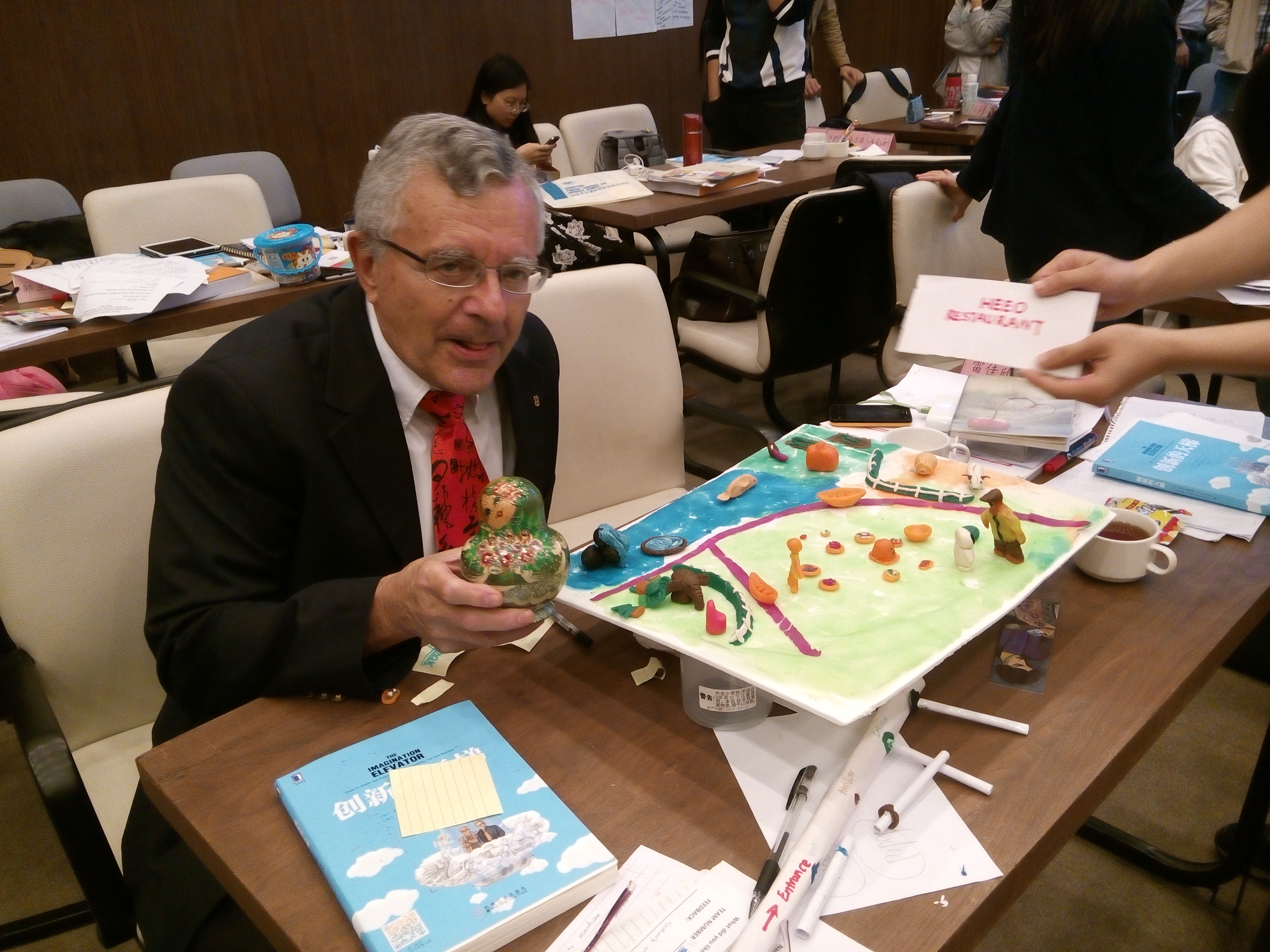
 plasticene restaurant


  Last month, I taught a one-week course on entrepreneurship and creativity to 43 dynamic Chinese students, mainly undergraduates studying at Shantou University, Shantou (Guangdong).   The course was in English; the students worked on business plans in teams, and made elevator-speech presentations (in English), prepared 2-minute videos, and wrote business plans (in English).   (The photo shows a Play-Do, or plasticene, model of one of the team’s ideas, for a novel restaurant – they stayed up all night to create it!).  

   I just received an email from one of my students.  I pasted it below, without correcting the syntax…   (Shantou University has a phenomenal English Learning Center, that provides each student with a tailored personal program for learning to read write and speak English)….

      I want to ask you a personal question, this question had confuse me for a very long time, the question is that “what do we live for?”, what’s the point of live? create value? make money? love? i not sure. now i just in my 20s age, i always feel there’s no a direction in my life, i’m not sure what is going on in my rest of life. but you have a lot of experience about life, you have make a lot of achievements in your life, so want to ask your answer about the question, i hope you can give me some suggestion.

 Dear readers:  How would YOU answer my wonderful student?

  My own answer was rather woeful – but, here it is.   Congratulations for just asking the question. Most of us ask it, at the end of our lives, when it is nearly too late to actually change anything.  I think the purpose of life is best defined by Walt Disney.  He set the mantra for Disneyland (later, Disney World):  “Make people happy”.   Create value.  Use your brains, your courage, your intellect, and above all, your CREATIVITY – to create value, by widening people’s range of choices, and thus, making them happy, or at least happier.  When you make other people happy (those around you, family, children, spouses, relatives, friends, total strangers),  you will make yourself happy as well.  If you only try to make yourself happy, in the end, you will be very alone.           


Anthony Ray Hinton: 28 Years on Death Row:

What He Teaches Us All

By Shlomo   Maital

Hinton

  The BBC World Service reports:    “A man released from prison after nearly 30 years on death row in Alabama has blamed his conviction on being black and poor.   Prosecutors dropped the case against Anthony Ray Hinton, 58, when new ballistics tests contradicted the only evidence that linked him to the murders of two restaurant managers in 1985.”

    The man is Anthony Ray Hinton.  And he has every reason to be bitter, angry and disconsolate.  Society took away his life, unjustly.  

     So, how does he really feel?  And how did he retain his sanity, while on Death Row for 28 years, beginning with when he was only 29 years old?  (He is twice that age today).  The BBC reports:    “Asked if he felt angry about the people who imprisoned him he said: “I am a joyful person. I have a good sense of humor and that’s what kept me for the 30 years I was locked up.    I couldn’t let them steal what I had left which was joy. They had robbed me of my 30s, my 40s and my 50s so if I get mad and hate them I’m letting them steal my joy.”  He said he was taking life “one step at a time” and wanted to “just try to live within my own means, try to bring joy to someone else, live a fruitful life and just be happy”.   

    I believe that if Anthony Hinton can still seek to “bring joy to someone else”, after nearly 3 decades on Death Row,  surely all of us can do the same!   

    And by the way – we learn one more thing from Hinton’s release, according to his lawyer:  “Mr Hinton is the 152nd person to be exonerated after being sentenced to death.   It’s a shocking rate of error. No system would tolerate that rate of error that cared about the people that were at risk but because most of the people on death row are poor or people of color we seem to not care as much that some of them are innocent.”

Reinventing the Automobile: GM & Ford vs. Startup Guy

By Shlomo  Maital   

Elio


  “In the ring, weighing in at about four ounces, is Silicon Valey startup guy Paul Elio.  Facing him, weighing in at 24,382 tons, is …General Motors, Ford, and VW.  12 rounds for the innovation championship in motor cars.”

    No contest.  A startup to make cars?    Non-starter, right?  Well, Paul Elio has done it.   There is a long LONG waiting list to buy the Elio automobile, a 3-wheeler, that gets…84 miles per gallon!  (Beats even the hybrids!).  The car is American made!   And its cost?  $6800.   (About the cost of 2.5  high-end Armani backpacks).   Here is what the Elio website says:

   “A few short years ago, automotive enthusiast Paul Elio sized up the prevailing status quo of personal transportation. He saw the soaring costs of the vehicles we drive. He saw fuel prices spike to record highs almost daily. He saw Americans struggling with an economy that was taking too much and giving back too little. Paul Elio decided that the world was ready for something radically new. The result? A three-wheeled masterpiece of automotive brilliance that bears his name.”    Elio’s vision?  “To provide a fun-to-drive, super-economical personal transportation alternative, that’s affordable, safe, and environmentally friendly. We are committed to the American dream, creating American jobs, and bringing American automotive ingenuity to every vehicle we build. This is, and will remain our mission at Elio.”

          The boxing match has begun.  It ends as soon as it begins.  Elio knocks out the automobile giants.  Why?   Big companies cannot innovate.  By definition.  They would never let a car like the Elio get past the drawing board.  Low margins.  Etc. 

        Elio Motors might yet fail. But like Tesla,  it could spur the car companies to actually try something innovative.   Innovation comes from rebels.  And rebellion is the last thing big companies seek or even allow. 

        Kudos to Paul Elio!   And Big Oil?    Think about trying another business.  

Methuselah Comes Back to Life!

By Shlomo  Maital

 Methuselah

    In the Bible, Methuselah  lived 969 years (Genesis 5:27), longer than anyone else recorded; his father was Enoch, who walked with G-d and went straight to heaven without dying.

     The modern Methuselah is much older – a Judean date palm over 2,000 years old!  And its products one day will be truly heavenly – dates that are identical to those enjoyed in Biblical times, in Judea and later exported to Rome, where the Romans loved them.

     How did this happen?    A decade ago, Sarah Sallon, an M.D., director of the Louis Borick Natural Medicine Research Center at Hadassah Medical Center,  had a wild idea.  Germination of Ancient Seed.  The idea is to use seeds found in archaeological digs, use modern techniques to germinate them – and recreate ancient plants that have medicinal properties.

     In the 1960’s the famous Israeli archaeologist Yigal Yadin excavated Massada, an outpost besieged by and conquered by the Romans, and discovered there date seeds.   Sallon asked the late archaeologist Ehud Netzer for seeds from Yadin’s excavation. Netzer thought the idea of germinating them was insane – but agreed.  Sallon brought the date seed to Dr. Elaine Solowey, a lecturer at the Arava Institute for Environmental Studies at Kibbutz Ketura in the Israeli Negev.  “They gave it to me because I was the only one crazy enough to give it a try”, Solowey says.  “I had to think very hard how I could sprout them, because you only get one chance.  ..The date seeds were perfect, they had no wormholes.” 

  She called the seed Methuselah.  

   Now ten years later, it worked!   Methuselah is a 10-year-old date palm. Turns out it is male. (Did you know date palms are male and female, separately – and the male ones fertilize the female ones with their pollen?).    Methuselah’s pollen is potent!  It can impregnate the right date palm female!  Now all that is needed is a female date palm, 2,000 years old.    Solowey will try to germinate a female date palm, 2,000 years old, and recreate the Judean date palm.  Not many 2,000 year olds marry and have kids, but I sure hope Methuselah finds a great mate and manages to knock her up.      


What I Learned from Lee Kwan Yew

By Shlomo  Maital   

  Lee Kwan Yew

Singapore’s legendary founding leader, Lee Kwan Yew, has passed away; he was 91. 

 I personally learned a great many  things from this wise and courageous man, who led Singapore to independence in 1965 and like the founding leader of my country, David Ben Gurion, knew the odds were strongly against survival.    He shaped a prosperous country with per capita GDP of over $60,000, double that of my country Israel. 

   I recall two things vividly.  First, in the early days of Singapore, he appealed to the mothers of Singapore, to “urge your children to study math”. Why? So they could study engineering in college. Why? So Singapore could build its wealth on knowledge, having no resources or land.  And it worked. They did, they did, and it did. 

  Second – he explained why America leads the world.  China has 1.4 billion people.  Among them are geniuses.  America has only some 340 million.  But America is a magnet. It attracts talent from the whole world – its talent pool is 7 billion, not 340 million.  That is a huge advantage.  My own parents migrated to Canada as immigrants from Bessarabia, now Moldova, worked hard, and passed their aspirations on to me.  Canada, I think, benefited.  

    Recently, Harvard Professor Joseph Nye wrote a book, with the title asking a question, is the American excellence and domination over?   His answer was, no.  But I’m not sure. Because many Americans (especially the Republican party) are anti-immigrant,  and I personally have waited hours and hours and hours to have my visa approved (in Toronto), just so I could go to Boston to teach a course FOR FREE. (Babson insisted I enter on a visa, rather than as a Canadian visitor).  Amusingly, I had to show my Princeton diploma to the immigration official; it was in Latin!  That took another few hours. 

     I know Singapore well, having taught there.  I got to know a very senior civil servant, a man of enormous wisdom.  I often wished my own country could have civil servants of such quality – and leadership like Lee Kwan Yew.  Very few countries do.  He will be missed.   

What I Learned in China

By Shlomo  Maital  

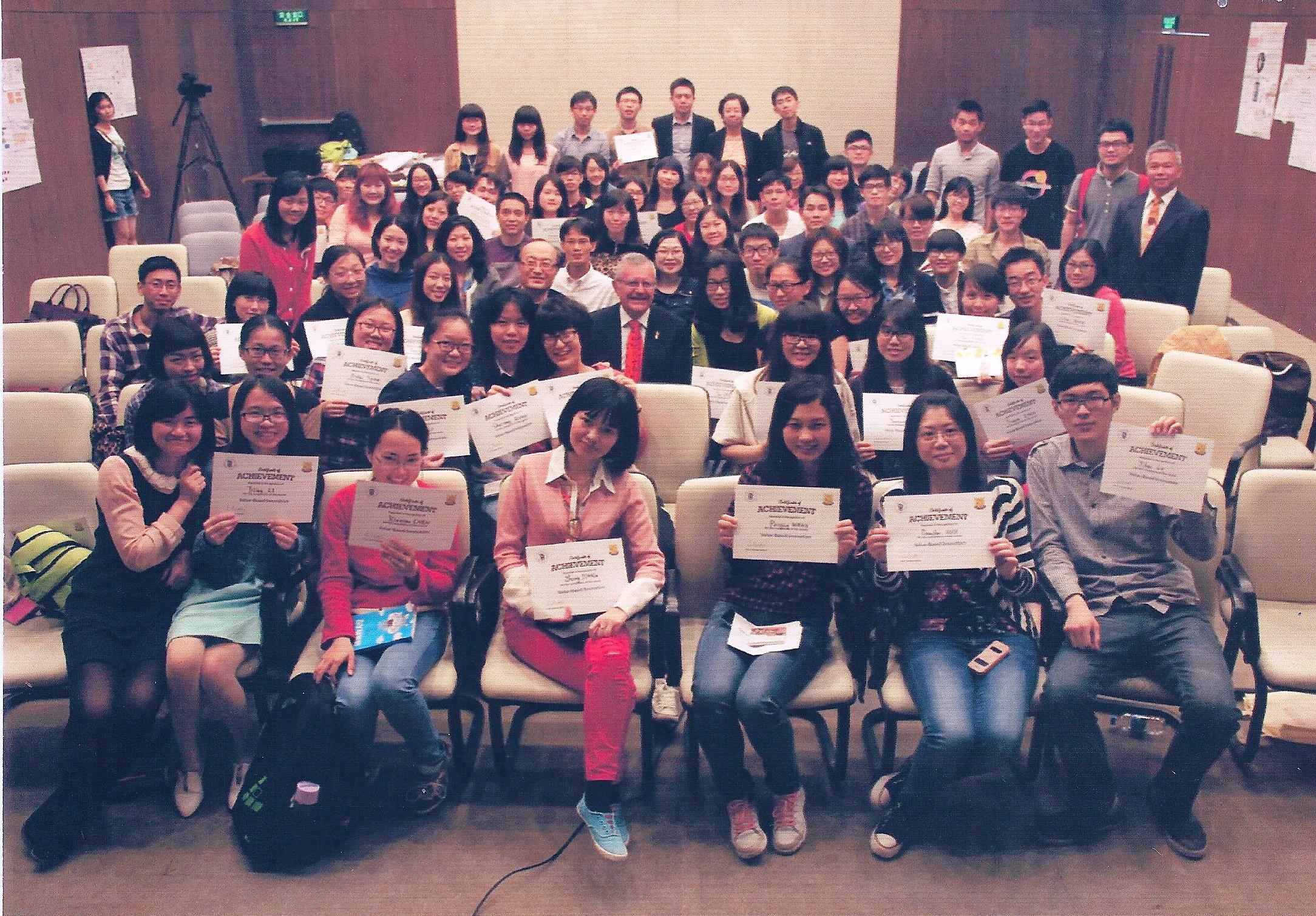
    Shantou Class Photo 2014

  I try to write a blog almost every day – knowing this keeps me ever alert for new ideas to share.  In this sense, blogs are as much for the benefit of the writer as for the reader. 

   I’ve been in Shantou China, for a week, teaching entrepreneurship to 43 eager young undergraduate business majors at Shantou University.  Shantou is in the northern part of Guangdong Province, north of the provincial capital Guangzhou, close to the coast, and two hours by fast train from Shenzhen, which is opposite Hong Kong, on the mainland.  My university, Technion, has a joint venture with Shantou Univ., to establish GTIIT – Guangdong Technion Israel Institute of Technology, now headed by Technion Nobel Laureate Dan Shechtman.  The initiative arose from a generous grant by Li Ka Shing and his Third Son Foundation;  Li Ka Shing, a Hong Kong billionaire, was born in Shantou and his foundation is active in supporting the city and its university.  His investment company has invested profitably in Israeli startups.  

    Supposedly you cannot teach entrepreneurship to undergraduates because “they are too young and lack experience”.  But Babson College does it highly successfully,  using the method developed by my late friend Ted Grossman, an action learning approach in which teams of students form a real company, make a real product and learn the tools of business through running their company, under the guidance of mentors like Ted (who first launched a successful software company before joining Babson). 

    I use the same method in Shantou.  And in one intensive week, the young students do amazing work; some of their ideas become reality, though not all.   The photograph shows last year’s class.

   Wages in China have risen dramatically, from about $100 a month in 2000 to $650 today  (this is still only one-fourth the average wage in America, and Chinese productivity is in many cases even higher).   But Philippines, for instance, has average wages of only one-sixth that of China.  So China in principle should be losing its manufacturing to low-wage countries like Vietnam, Indonesia, and Philippines.  And indeed it is, with shoes and textiles, low value added products, moving to those countries. 

    But China is keeping its high value-added jobs and enhancing them.  How?  China is the world’s biggest market for production robots, buying 20 per cent of worldwide production.  Labor productivity rose by 11 percent yearly (!) on average during 2007-12  (it barely budged in the West).  China uses its network of highly efficient suppliers to keep factories in China.  China has become the hub of a complex ecosystem, in which Asian countries specialize, make components and ship them to other Asian countries.  Asia now accounts for nearly half of all world manufacturing output, compared with 27 percent (about one quarter) in 1990. 

    Bottom line:  China’s strategy is:   Made in China 2025 (its official name) – boost productivity to keep competitive.  If wages rise by 12 percent year but productivity does too…the cost advantage stays.  But at the same time:  Created in China.  China is working to invent more of the products it makes.  Like Xiaomi, the innovative smartphone company.    And this is where I come in… teaching innovation to the young undergrads at Shantou University,  not even a tiny drop-in-the-bucket in huge China, but – China is all about scale, and good ideas spread with lightning rapidity.  

   I truly love my annual one-week courses in Shantou; the students are fiercely eager to learn and highly creative once their creativity machines are turned on.    These young people are literally eating our (Western nations’) lunch.  If we don’t wake up,  China’s living standards will continue to  grow by 11 or 12 per cent a year, the rate of growth of productivity, and our living standards will simply stagnate (the rate of growth of OUR productivity).   We need to save more, invest more, build better infrastructure, educate our young people better, and become more productive.  This is what I learned in my classroom from  43 eager young Chinese business-major undergraduates. 

Let’s All Celebrate Pi(e) Day

By Shlomo  Maital   

  pi

 It’s nearly midnight,  March 14, 2015,   or    3.1415 – yes, it’s still Pi Day, the day we celebrate pi, that incredible number, the ratio between the circumference of a circle and its diameter… 3.1415927   … and another 3.1415 won’t happen for a whole century, until 2115.    

   What can we learn from  pi and Pi Day?  New York Times columnist Manil Suri, a mathematician,  observes that an exceptionally simple idea – take the ratio of the circle’s circumference to its diameter —  can yield an ‘irrational’ number (that’s what the mathematicians call it, because you cannot express it as a ratio of two whole numbers, like 22/7) that is incredibly complex, one that has been calculated to trillions of digits, and those digits are simply random.  

    But this is not irrational at all.  For many ideas of great beauty, their utter simplicity generates rich complexity and interest.  Like Hemingway’s Old Man and the Sea, written in spare simple prose, but with infinite meanings.  Or the Bible and its stories. 

    The simpler your innovation, the more complex its potential uses,   because the more ‘stuff’ and ‘wrinkles’ you put on it, the more you limit the users’ imaginations. 

     So – follow John Maeda.  Simplify.  Follow Antoine de St. Exupery (author of The Little Prince) who said “perfection is not when nothing more can be added, but when nothing more can be taken away”.  And while you’re at it, have a piece of deep-dish apple Pi.  Simplicity?   Sliced apples (thinly sliced, so they taste better),  dab of sugar, cinnamon, and pie crust (I like crumble topping,  oatmeal and margarine and brown sugar).   There’s nothing better. 

      Happy Day-After-Pi(e) Day!

      And here, just for fun, is pi   to one thousand digits.  Who knows – you might need it some day!  3.1415926535897932384626433832795028841971693993751058209749445923078164062862089986280348253421170679 8214808651328230664709384460955058223172535940812848111745028410270193852110555964462294895493038196442881097566593344612847564823378678316527120190914564856692346034861045432664821339360726024914127372458700660631558817488152092096282925409171536436

 7892590360011330530548820466521384146951941511609433057270365759591953092186117381932611793105118548

 0744623799627495673518857527248912279381830119491298336733624406566430860213949463952247371907021798

 6094370277053921717629317675238467481846766940513200056812714526356082778577134275778960917363717872

 1468440901224953430146549585371050792279689258923542019956112129021960864034418159813629774771309960

 5187072113499999983729780499510597317328160963185950244594553469083026425223082533446850352619311881

 7101000313783875288658753320838142061717766914730359825349042875546873115956286388235378759375195778

  18577805321712268066130019278766111959092164201989  


Kids of All Ages (up to 100) Need to Play!

By Shlomo  Maital   

  play

   Hilary G. Conklin, Ph.D., is a fellow with the OpEd Project and an associate professor in the College of Education at DePaul University in Chicago. Writing in TIME magazine’s IDEAS on-line blog, she writes:  “Helicopter parents and teachers, stand down. Kids of all ages need time to learn through play in school.”   It’s time we got serious about the crucial importance of play.  (My wife brought this piece to my attention).

   She continues:   “In classrooms across the country, the countdown to summer vacation has begun. The winter doldrums have always taken a toll, but in the era of test-dominated schooling and the controversial Common Core, it seems increasingly that it’s not until summer that teenagers have any prospect for having fun any more. One of the casualties of current education reform efforts has been the erosion of play, creativity, and joy from teenagers’ classrooms and lives, with devastating effects. Researchers have documented a rise in mental health problems—such as anxiety and depression—among young people that has paralleled a decline in children’s opportunities to play. And while play has gotten deserved press in recent months for its role in fostering crucial social-emotional and cognitive skills and cultivating creativity and imagination in the early childhood years, a critical group has been largely left out of these important conversations. Adolescents, too—not to mention adults, as shown through Google’s efforts —need time to play, and they need time to play in school Early childhood educators have known about and capitalized on the learning and developmental benefits of play for ages.”    

   “To be sure,” she continues, “there are times to be serious in school. The complex study of genocide or racism in social studies classrooms, for example, warrant students’ thoughtful, ethical engagement, while crafting an evidence-based argument in support of a public policy calls upon another set of student skills and understandings. As with all good teaching, teachers must be deliberate about their aims. But, given that play allows for particular kinds of valuable learning and development, there should be room in school to cultivate all of these dimensions of adolescent potential.   Purposefully infusing play into middle and high school classrooms holds the potential for a more joyful, creative, and educative future for us all—a future in which kids have more interesting.”

      Dr. Conklin might have added that adults, too, of all ages, especially us senior citizens, need opportunities to fool around, imagine, create and play.   Creative ideas emerge from an ambience of fun, joking and just general fooling around.  And most important — play is fun.  When life is enjoyed, it is prolonged. 

Entrepreneur – Go Work for Government!

Really!

By Shlomo  Maital  

creative city

  The last place entrepreneurs think about, as an employer, is government.  Government is too slow, wasteful, doesn’t work, bureaucratic.  Right? 

   Harvard Business School Senior Lecturer Mitchell B. Weiss disagrees.  He is offering a Harvard course on Public Entrepreneurship.  He knows what he is talking about.  He worked as chief of staff to the late Boston mayor Thomas Menino, a great mayor.  He co-founded the Mayor’s Office of New Urban Mechanics, which invented America’s first big-city 311 app, in which citizens alert governments to potholes and graffiti. 

   Harvard’s on-line magazine Working Knowledge claims that cities around the world have increasingly become laboratories in innovation, partnering with outside businesses and nonprofits to solve thorny public policy problems.  State and local governments, too, are trying this. 

    Weiss says one reason we don’t have innovative people in government is because “we weren’t training them. In public policy schools we were not training young people to be entrepreneurial, and at business schools we were not prepping or prodding people to enter the public sector or even just to invent for the public realm.”

  He notes that governments should be naturals at crowdsourcing – who has a bigger crowd than government, essentially, everyone?   

   Weiss says, “in government we announce something and wait to get it perfect.  By using more experimental approaches, some public leaders are achieving success by testing and learning, instead of writing a plan in stone before executing it.”

   The Mayor of Jerusalem, Nir Barkat, is a former entrepreneur, founder of a successful starutp BRM that made and sold early anti-virus software.  The former Mayor of New York City Michael Bloomberg is a highly successful entrepreneur who founded the company named after him.  Both are, and were, highly creative in their terms of office. 

   Weiss says there is a huge opportunity in public entrepreneurship.  Note that this is not social entrepreneurship.  It is taking on operational roles in government, and bringing to the job creative ideas to make people’s lives better.  Why should creativity live and thrive only in the private sector?   

   How Legal “Front Running” Rips YOU Off –

Wall Street Strikes Again

By Shlomo  Maital  

Flash-Boys

   Remember Michael Lewis’ book Liars’ Poker?  The book that exposed Wall St. manipulations that eventually destroyed the world?  The book that MBA’s bought, massively, so that – they could learn how to make $250k  a year for doing nothing, as Lewis did briefly?  

   Lewis is back with Flash Boys, about another Wall St. ripoff.  OK, the book has been out for a whole year, I’m a bit late.  

   Here is how it works:

   “Front-running” is an illegal financial practice.  Suppose you order 100,000 shares of IBM.  (Some pension funds do).  Before the broker executes the ‘buy’ order, he buys 50,000 IBM shares for his own account.  Then, buys 100,000 shares for his client.  AT A HIGHER PRICE! Because his purchase has raised the demand and the price.  The pension fund loses money. Not a lot, but – it adds up.  Then – after executing the pension fund order, which raises the price of IBM shares, the broker SELLS the shares HE bought, at a profit.  This profit has come directly at the expense of the pension fund.  And – THIS PRACTICE IS ILLEGAL.  But, very hard to prove, hard to identify, and it’s done all the time.

    Now, Michael Lewis has shown us how to do it legally.  Buy orders for securities go to stock exchanges via fiber optic cables.  These orders travel at the speed of light.  But, still, if the cables are long, it takes a few milliseconds.  Suppose, you learned about the order to buy a security, ALL securities, and through a computer algorithm, and a SHORT fiberoptic cable, could BUY the security BEFORE the order is executed,  2 milliseconds before.  The order to buy would then be executed at a higher price, because…the price has gone up.  After the order to buy is executed, you sell the security, and pocket a few cents’ profit.  This is called High Frequency Trading,  all done with super computers and algorithms, without human intervention.  This is front running.  AND IT IS LEGAL.   It costs pension funds and other funds (OUR money)  billions, maybe $10 billion or more.  Who pockets the profit?  Wall St. high frequency traders.

    Who exposed this?  A single person, the chief trader for the Royal Bank of Canada, in Toronto, a young man named Brad Katsuyama.  Here’s how Wikipedia describes what he did (recounted in Flash Boys):

     While at RBC, he noticed that placing a single large order that can be fulfilled only through many different stock exchanges was being taken advantage of by predatory stock scalpers. Scalpers, noticing the order would not be able to be fulfilled by one single exchange, would instead buy the securities on the other exchanges, so that by the time the rest of the large order arrived to those exchanges the scalpers could sell the securities at a higher price. All these events would happen in milliseconds not perceivable to humans but perceivable to computers. He instead led a team that implemented THOR, a securities’ order-management system where large orders are split into many different sub-orders with each sub-order arriving at the same time to all the exchanges through the use of intentional delays.

Katsuyama quit his job at RBC,  and launched IEX, a new stock exchange that prevents all such high-frequency scalping.  IEX is still very small, but growing. Katsuyama took a huge risk.  As chief trader, he made a very high salary.  He had a hard time persuading his wife that he had to do this, to start IEX, at huge risk.  He has powerful  wealthy enemies who are doing everything to scuttle IEX.  And the regulators?   Basically, they are asleep, or out to lunch. 

Wall St. and the banks lost our trust totally in 2008.  In theory, they should be working to regain it. Instead, extreme greed has again destroyed whatever molecules of trust was left.   Lewis’ new book proves to me that in the battle between regulators and greedy speculators, regulators can never win.  Only courageous individuals like Brad Katsuyama, and authors like Michael Lewis, can fight back.  


Blog entries written by Prof. Shlomo Maital

Shlomo Maital

Pages