
You are currently browsing the category archive for the ‘Global Crisis Blog’ category.
Viral Shedding Peaks – BEFORE Symptoms!
By Shlomo Maital

The late Li Wenliang, China’s hero doctor who warned us
A very large number of research papers are now emerging from China, by Chinese scientists and scholars, related to biology, medicine, education, and other areas. China is sharing with the world what it has learned.
Yesterday’s Nature Medicine features a very important article by a large group of Chinese researchers, which shows this:
“We report temporal patterns of viral shedding in 94 patients with laboratory-confirmed COVID-19 and modeled COVID-19 infectiousness profiles from a separate sample of 77 infector–infectee transmission pairs.
We observed the highest viral load in throat swabs at the time of symptom onset, and inferred that infectiousness peaked on or before symptom onset. We estimated that 44% (95% confidence interval, 25–69%) of secondary cases were infected during the index cases’ pre-symptomatic stage, in settings with substantial household clustering, active case finding and quarantine outside the home. Disease control measures should be adjusted to account for probable substantial presymptomatic transmission.”
Meaning? Three rather scary words: substantial pre-symptomatic transmission. We spread the coronavirus even before we feel symptoms.
This is why social distancing will need to be enforced for quite some time, until tests are widely available and can provide results within hours. If you have no symptoms, then anybody can be a carrier and spreader. Anybody.
Finally, we are learning about this insidious enemy – is anyone expressing some gratitude to the Chinese for sharing?
Well, a small gesture – here are the names of the researchers who co-authored this paper: Xi He, Eric H. Y. Lau, Peng Wu, Xilong Deng, Jian Wang, Xinxin Hao, Yiu Chung Lau, Jessica Y. Wong, Yujuan Guan, Xinghua Tan, Xiaoneng Mo, Yanqing Chen, Baolin Liao, Weilie Chen, Fengyu Hu, Qing Zhang, Mingqiu Zhong, Yanrong Wu, Lingzhai Zhao, Fuchun Zhang, Benjamin J. Cowling, Fang Li & Gabriel M. Leung
The End of the Beginning
By Shlomo Maital
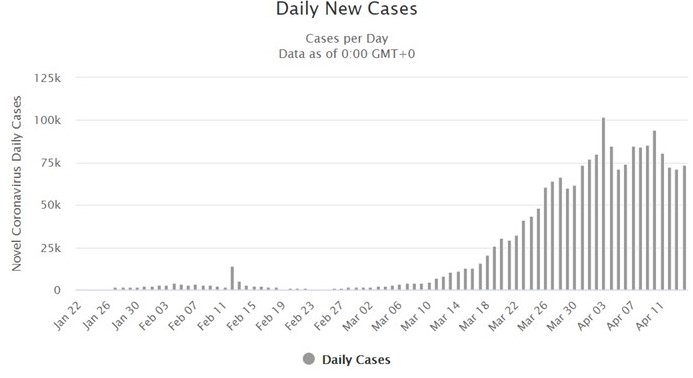
There is evidence that, to quote Winston Churchill, “we are not at the beginning of the end, but..at the end of the beginning.” Here are the daily totals of new cases worldwide, thanks to worldometer.com, and next to them, the % daily change:
| 3-Apr | 101736 | |
| 4 | 84821 | -16.6 % |
| 5 | 71502 | -15.7 |
| 6 | 74044 | 3.6 |
| 7 | 85116 | 15.0 |
| 8 | 84447 | -0.8 |
| 9 | 85638 | 1.4 |
| 10 | 94629 | 10.5 |
| 11 | 80963 | -14.4 |
| 12 | 72523 | -10.4 |
| 13 | 71572 | -1.3 |
| 14 | 73969 | 3.3 |
What this looks like, is a kind of ‘plateau’ levelling off — as the coronavirus spread globally, some countries were afflicted early, others later. So countries will reach their ‘apex’ at differing times… (the US is still not there yet)…. And this will produce a kind of plateau worldwide.
The reason this is important, is this — countries will begin to emerge from their ‘lockdown’ at different times, some sooner than others. Denmark is opening its kindergartens, China is sending Wuhan back to work in part.
But in terms of public health, we need to see this as a global system. If there are hot pockets in one country, no country is safe – because a return to normality will restart flights and travel. And we still do not fully understand the duration or extent of coronavirus immunity for those who had it.
How to Emerge from Lockdown: Speed is Vital!
By Shlomo Maital
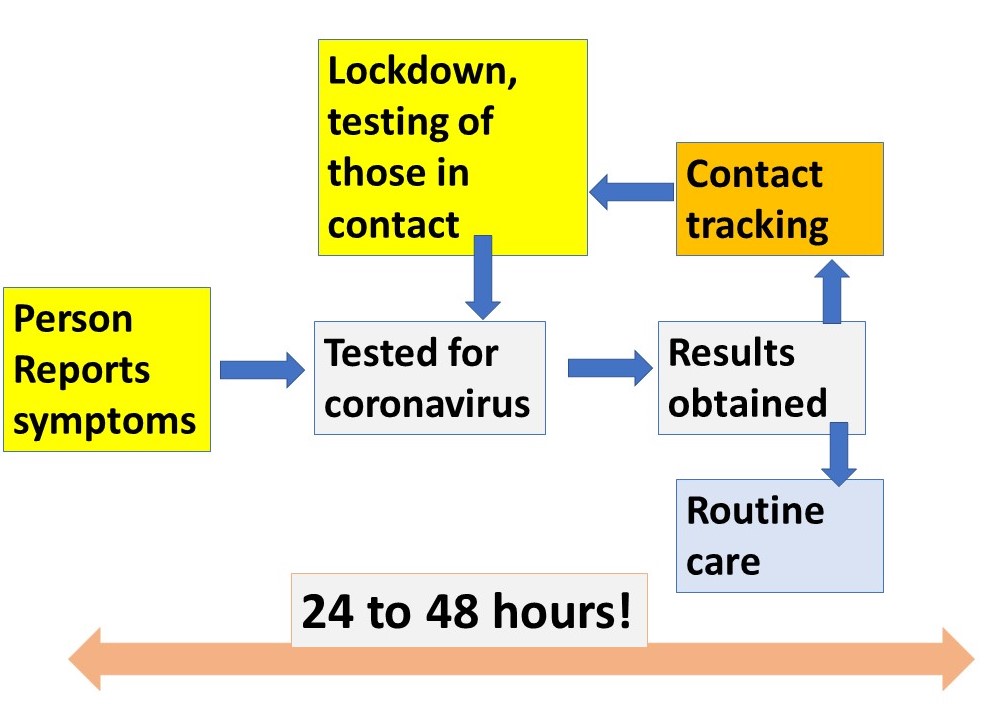
Question: how does coronavirus resemble standup comedy?
Answer: For both, timing is crucial.
As countries begin to emerge from lockdown (Denmark has opened its kindergartens, because 90% of families with children have both parents working), fears arise whether this is wise. One answer is, yes, but… The diagram above shows how emergence can best be done. And everything, EVERYthing, depends on timing and speed —
- test for virus among those with symptoms, and some who are asymptomatic,
- get the results super-fast, within hours (this is possible with some tests),
- track those in contact with persons testing positive,
- lock down those with the virus, and
- do this again and again.
All this depends on revising current testing procedures (some results have been lost, some take 6-8 days for results, far too long to be useful). Timing and speed are crucial. Why? Because, in the 6 days it takes now for results to be provided, the person potentially infected can infect many many other people, even unknowingly.
Does your country have test results within minutes or even hours? There are such tests. We need millions of them.
Political Leaders: Step Back! Let the Pros Do It!
By Shlomo Maital

Ladies and gentlemen, golf fans! Here we are, on the 18th green, at the legendary Master’s tournament. Byron Putput has a 30-foot put for birdie, to win the Green Jacket and the championship. He’s thinking. He’s looking. He’s planning… all his 24 years of golfing are going into this crucial put! The fans are silent. The tension is palpable.
But wait. Here comes… Donald Trump. Yes, Donald Trump. POTUS, he’s called, President of the United States. Yes, fans, he is shoving aside Byron. Executive privilege, he says. Trump himself will take the put. He pulls a putter out of the golf bag – but wait, it is not a putter, but an iron. He’s going to do the put with an iron!
Oh my gosh. Is this really happening?
……. No, it’s not. Or is it? Reopening the US economy is, “I would say, without a doubt, that it is the most important decision I have ever had to make,” Trump said three days ago. First person singular. I. Not ‘we’. And he doesn’t even have the authority to decide, it is really up to the state governors.
Let’s make some sense out of this. Giora Eiland is Major General (ret.) Israel Defense Forces. Eiland is a former head of the Israeli National Security Council. Speaking on Israeli Radio, he made this point:
In the pandemic, Israel (and every country) is at war. This requires mobilization of all our energy, skills, wisdom and resources. Israel has done this, alas, numerous times in the past. But how? As we do in wartime, as US and UK did in wartime. Set up a panel of experts. NOT politicians! In health, economy, education, psychology, science, medicine. Put them in a room. Let them define the issues, then divide up according to “comparative advantage” and work out alternatives and plans. Nonstop. Round the clock. Sleep on cots in the room or nearby.
Israel’s Ministry of Health has disastrously mismanaged the issue of performing COVID-19 testing. And testing, by all experts, is key to emerging from quarantine. The IDF (army) could have done it faster, better, more professionally. But internal political squabbles between Israel’s Prime Minister and the Defense Minister (whom the PM hates), Netanyahu’s nemesis, prevented this. Too bad. We are paying the price today.
Trump will not take the final put at the Master’s golf tournament. A pro golfer will do that. Why are we letting him, or Netanyahu, or Macron, or Johnson, take the lead in managing the epidemic? Step back politicians. Step aside. Let the professionals manage this war. Because you politicians do not have a clue.
One possible exception: NY State Governor Andrew Cuomo. In his amazing daily briefings, he shows a wonderful grasp of data, curves, expert opinion, trends, and illustrates his talks with informative slides and graphs. But this exception proves the rule.
How MIT Nurtured Entrepreneurs: by Ed Roberts
By Shlomo Maital

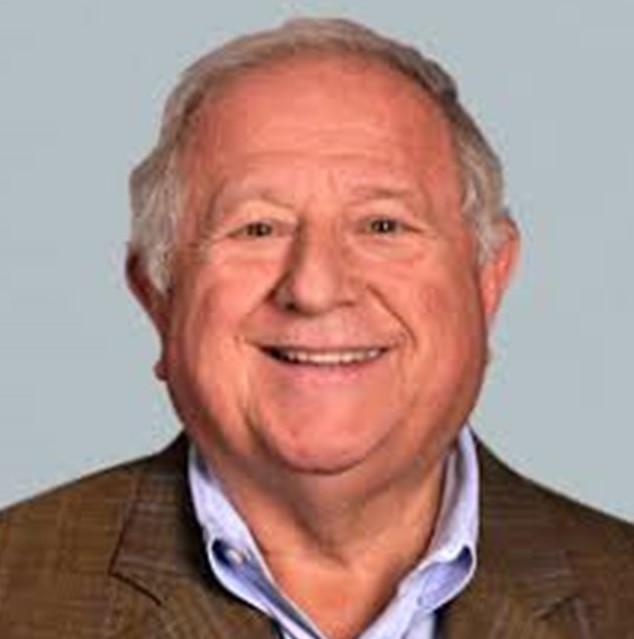
Professor Edward Roberts
Edward B. Roberts. Celebrating Entrepreneurs: How MIT Nurtured Pioneering Entrepreneurs Who Built Great Companies. Amazon website.
Life goes on. Scholars are still writing and publishing books. And this one, by my mentor and friend Ed Roberts, who founded and still chairs the MIT entrepreneurship program, is highly relevant. Because as we emerge from coronavirus, we will need to rebuild our economies. A major role will be played by high-energy creative entrepreneurs – of the kind Ed has nurtured, fostered, mentored, taught, cajoled, taught, reprimanded (he practices tough love), praised and energized.
You’ll find the book of great interest, especially its five chapters filled with in-depth interviews and background on the MIT “spinoff startups” who became the leaders of: the life sciences and biotechnology industry, the Internet, from CAD-CAM to robotics, and even “modern finance”, plus a host of other diverse firms. The book contains a major portion on MIT’s long engagements with several countries, including years with Israel, in helping to create and build its high-technology entrepreneurial sector.
Incidentally, Ed notes “ALL author proceeds from the sale of Celebrating Entrepreneurs will be donated directly to MIT endowment funds that support the Institute-wide MIT Entrepreneurship Pogram”, which will really help to sustain and further develop MIT’s ambitious efforts on behalf of future entrepreneurs.”
Inspired by Ed, I’ve joined others at my university, Technion, to foster entrepreneurship, ever since 1987, when I and 2011 Nobel Laureate Dan Shechtman launched a general studies course on startups, featuring entrepreneurs who came to tell their story (like Jewish meatballs, both sweet and sour). You can read my survey of research on fostering entrepreneurship in universities, download it at https://www.neaman.org.il/Can-universities-foster-students-intent-to-become-entrepreneurs or email me at smaital@tx.technion.ac.il
And a final note. Ed gave me the chance to teach MIT Management of Technology students, R&D engineers from all over the world, in 1984. I recall my first attempt was disaster. But Ed gave me a second chance the following summer. Ever since, inspired by Ed and MIT, I’ve pursued a passionate interest in creativity, innovation and entrepreneurship – the engines that have made the people of Israel prosperous. As consultant to some of Israel’s leading high-tech companies (including Iscar, now a global giant owned by Warren Buffett), Ed contributed directly to the birth and growth of Israeli hi-tech.
Thank you, Ed!
Hydroxychloroquine: Some Answers
By Shlomo Maital
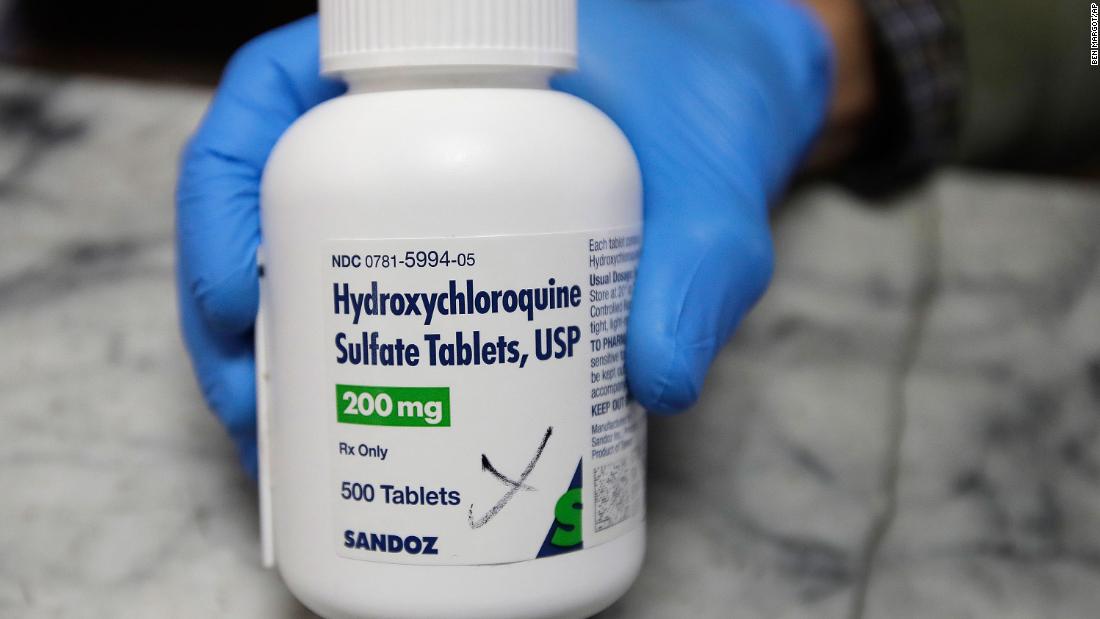
What is the truth about hydroxychloroquine, the drug that is alleged to be helpful in treating coronavirus? This piece from the New York Times may be helpful.
What is hydroxychloroquine?
Hydroxychloroquine is a prescription medicine that was approved decades ago to treat malaria. It is also used to treat autoimmune diseases like rheumatoid arthritis and lupus. It is sometimes referred to by its brand name, Plaquenil, and is closely related to chloroquine, which is also used to treat malaria.
Why has hydroxychloroquine even been considered as a possible treatment for the coronavirus?
There are several reasons. A promising laboratory study, with cultured cells, found that chloroquine could block the coronavirus from invading cells, which it must do to replicate and cause illness. However, drugs that conquer viruses in test tubes or petri dishes do not always work in the human body, and studies of hydroxychloroquine have found that it failed to prevent or treat influenza and other viral illnesses.
Reports from doctors in China and France have said that hydroxychloroquine, sometimes combined with the antibiotic azithromycin, seemed to help patients. But those studies were small and did not use proper control groups — patients carefully selected to match those in the experimental group but who are not given the drug being tested. Research involving few patients and no controls cannot determine whether a drug works. And the French study has since been discredited: The scientific group that oversees the journal where it was published said the study did not meet its standards.
A recent study from China did include a control group, and suggested that hydroxychloroquine might help patients with mild cases of Covid-19, the disease caused by the coronavirus. But that study had limitations: It was also small, with a total of only 62 patients, and they were given various other drugs as well as hydroxychloroquine. The doctors evaluating the results knew which patients were being treated, and that information could have influenced their judgment. Even if the findings hold up, they will apply only to people who are mildly ill. And the researchers themselves said more studies were needed.
Can hydroxychloroquine protect you from catching the virus?
There is no evidence that hydroxychloroquine can prevent coronavirus infection. However, researchers at the University of Minnesota are testing the drug in people who live with coronavirus patients to see whether it can protect them
Is hydroxychloroquine approved by the Food and Drug Administration?
Yes, but for malaria, lupus and rheumatoid arthritis, not for Covid-19. For decades, doctors have been legally allowed to prescribe it for any condition they think it might help, a practice called off-label use. However, because of hoarding and high demand for hydroxychloroquine, some states like New York have ordered pharmacists to fill prescriptions only for F.D.A.-approved uses of the drug or for people participating in clinical trials.
Is hydroxychloroquine being given to coronavirus patients now?
Yes. Many hospitals are giving it to patients because there is no proven treatment, and they hope it will help. Clinical trials with control groups have begun across the world. A nationwide trial began on April 2 in the United States; it is to enroll 510 patients at 44 medical centers. Researchers say those studies are essential to find out whether the drug works against the coronavirus. If it does not, time and money can be redirected to other potential treatments.
Is there any danger in taking hydroxychloroquine?
Like every drug, it can have side effects. It is not safe for people who have abnormalities in their heart rhythms, eye problems involving the retina, or liver or kidney disease. Other possible side effects include nausea, diarrhea, mood changes and skin rashes.
The leaders of three professional societies in cardiology warned on April 8 in the journal Circulation that hydroxychloroquine and azithromycin can each cause dangerous disruptions in heart rhythm, and they wrote, “There are very limited data evaluating the safety of combination therapy.”
If I can get hydroxychloroquine, should I take it to prevent coronavirus infection?
No, especially not without consulting a doctor who knows your medical history and what other medications you are taking. There is no proof that it works. And if it is being sold on the street or via the internet, it may be fake or unsafe.
An Arizona man in his 60s died last month after swallowing an aquarium cleaning product that had chloroquine on its label. He and his wife, who also became critically ill, had thought the product would protect them from the virus.
At this point, the best way to avoid infection is to practice the social-distancing and quarantine measures recommended by public health authorities. The Centers for Disease Control and Prevention also recommends that people wear cloth masks in public and wash their hands regularly.
Learn from Spain:
We WILL Err – but how?

By Shlomo Maital
Spain has suffered terribly from the new coronavirus. The numbers tell the tale:
Cases overview
Spain
| Confirmed
169,496 |
Recovered
64,727 |
Deaths
17,489 |
For a nation of 47 million, this is a terrible toll. It is explained in part by Spain’s late start in lockdown, and its Mediterranean open lifestyle, in the cafes and markets, during a warm spring.
But it seems to have peaked. The number of new cases peaked in Spain, at 8,000, daily, on April 2, and has now declined to about 4,000. So Spain is gradually beginning to emerge from lockdown, to revive the economy, in a planned careful and staged manner.
I think other countries should watch Spain carefully, talk to Spanish experts, learn about their plan, adapt the plan to their own nations’ needs and nature…and in general, we need a global brainstorming conference. An international Zoom of experts.
Take Korea. There has been a resurgence, there, a second wave, but not huge, 100 cases. OK – what happened? Is the immunity conferred by having the COVID-19 and recovering from it sufficient to give permanent immunity? Or can a huge dose of the virus come back and attack you again? Let’s find out from Korea.
How is Singapore handling the ‘track down those who spread it’? We will need to have a system for that, when we (many of us) return to work.
We should have a website clearing house for things countries have learned, but a credible one, with only vetted proven entries by real experts.
What do we know about this vicious viral enemy? Can we compile a COVID-19 handbook – here is what we know, and how we know it, and what the source of the data is.
And regarding emerging from the ‘shelter at home’ lockdown — Trump says this is the most important decision of his life. HIS decision? If I were an American, would I feel reassured in having TRUMP???? make the decision? When his ‘base’ is calling for the resignation of Fauci, a credible epidemiology expert, who urges caution?
We will make mistakes and already have. Trump’s January-February fumbling cost many lives. Maybe, it is best to err on the side of caution, as we emerge from lockdown. Let’s study Spain carefully.
Surprise: Germany Leads!
By Shlomo Maital
 source: IMF
Quiz: Which country in the world is highly conservative fiscally, avoids deficits like the plague (oops, sorry for that one), hassles spendthrift EU nations (like Greece) for excess debt, and in general has acted like Scrooge?
You got it. Germany.
Part two: Which country has seen the extent of the COVID-19 plague clearest and acted most decisively, including massive emergency spending?
Surprise. Germany. Never would have guessed it.
Lame duck Chancellor Angela Merkel, a trained scientist, trained well in the former East Germany, was among the first to predict massive deaths, and drew scorn at the time – but she is proving right, even though Germany, for many reasons, has the lowest relative death toll (relative to the number of cases).
And now, she has led Germany to implement the most extensive, massive emergency bailout plan including huge spending, covering salaries of employers and guaranteeing emergency loans for businesses. No other country comes close. (Alas, my own country is right there at the bottom – though, of course, we do not have as deep pockets as Germany does).
According to the International Monetary Fund, Germany’s bailout package is fully 28% of GDP! And Germany guarantees 90% of emergency loans. All this, to keep businesses afloat, so they can bounce back.
But I have on caveat, or quibble. Germany: all this largesse goes to Germans. How about Italians and Spaniards? Can you spare just a small slice of your luscious pie for fellow EU countries, suffering badly? They’re waiting.
Rule of 72: One More Time
By Shlomo Maital
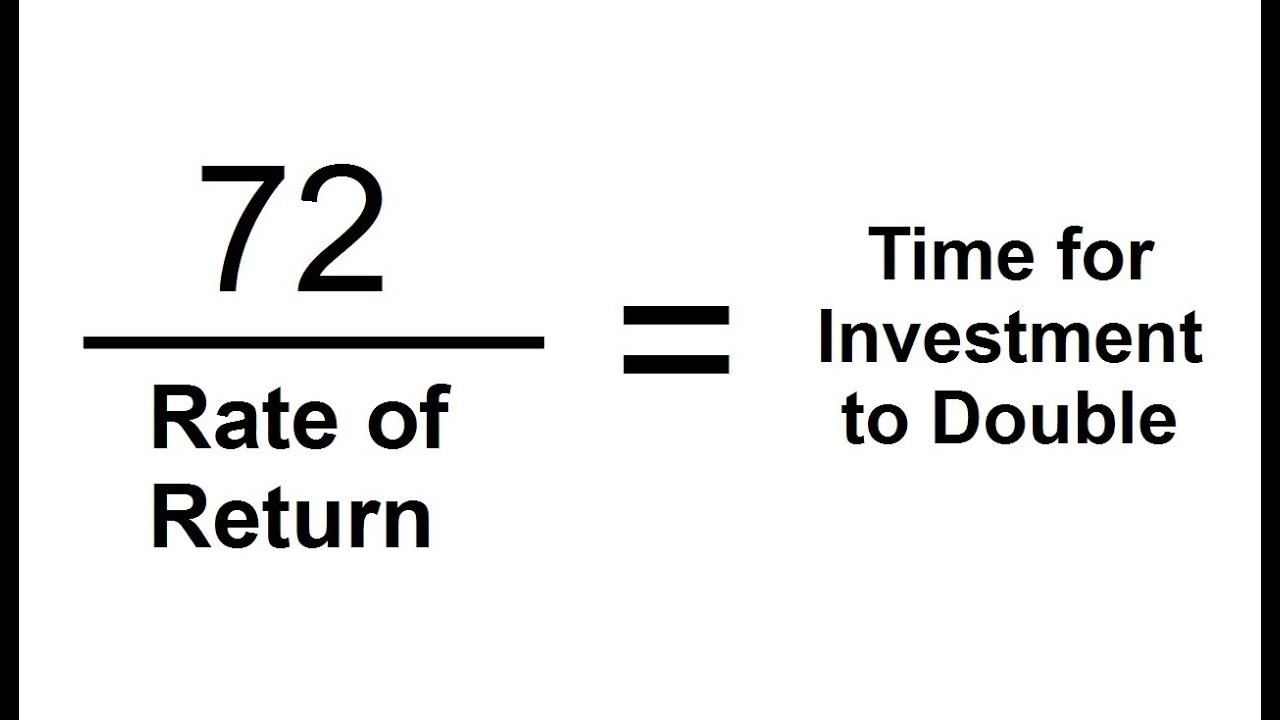
Sorry, but – one more time for the Rule of 72. Many print and cable journalists are rather innumerate – they took Philosophy 1 instead of Calculus 1 in college. So it is no wonder they struggle to interpret the COVID-19 numbers for us, and simply throw totals at us, without really explaining what they mean. So, it’s left to us citizens to “do the math”. And, alas, that math could involve logarithms.
(Someone I know well, recently asked me, is a logarithm the same as an algorithm? Because, high school teachers themselves don’t seem to know what logarithms) are).
So, first, a quibble. CNN, when you show your COVID-19 graphs, daily numbers, can you please do it on a logarithmic scale, not absolute numbers? (in Excel, you can use the log( ) function or the ln ( ) function, where ln is the log to base ‘e’ 2.71828 and log is the log to the base 10… ok, never mind about all that! But the reason for logs is, the steepness of the logarithmic curve shows the rate of change, and you can easily tell if the curve is getting steeper (rate of change is rising) or less steep (rate of change is slowing), and this is of course CRUCIAL!).
So, some of you, maybe very few, maybe VERY VERY few, want to know, where does this Rule of 72 come from? (Divide 72 by the daily rate of change of COVID-19 patients, and you get the number of days it takes for the number of those infected to double). If it’s 10%, it doubles every week – disaster. If it’s 2%, it doubles every 36 days, about monthly – phew…we made it.
So here is the basic equation:
(1+R/100)T = 2
Where R is the rate of (daily) change, in %, T is the number of days it takes to double, and 2, well, that’s the doubling, e.g. a 10% daily spread rate will double in 7 days: (1+0.1)7 = 2
If you take the logarithm of each side of the equation, you get this:
T ln(1+R/100) = ln 2 (trust me!)
So T, the number of days it takes for the virus to double the number infected, if the rate of spread growth is R, is equal to
T = ln2 / ln(1+R/100)
Now, mathematicians pull a neat trick out of their bag of tricks, and find a way to simplify this equation, so we don’t need calculators or log tables:
T = 72/R
Hence Rule of 72: divide 72 by the rate of spread, you get ‘days to double’. (One last word, skip this is you wish — you can do this approximation using a neat way to find approximations called a Taylor Function, neatly tailored by mathematicians to simplify our lives…).
Normally, we use Rule of 72 to see how many years it will take for our money to double. Well-heeled people get 8% interest on their money, or more, usually through the stock market, so their millions double on their own every 72/8 = 9 years.
Initially the virus was spreading at 25% growth rates daily, in many places, meaning the numbers infected were doubling every 72/25 = 3 days! Roughly. Yikes. Say 100 people were infected initially. At this rate, in 30 days, there will be 10 doublings. 10 doublings is 2 times 2 times 2, ten times, or 1,024. So those 100 infected become 100 x 1,000 or 100,000! THIS is why it was so absolutely crucial to jump on things early and lock everyone down. Alas, the US failed to do this. So did other nations.
So if TV and media fail to use Rule of 72 – do it yourself. Figure out the daily % rate of change of those infected with virus (come on, you can do it…. Today’s number / Yesterday’s number, minus 1 and then times 100. Then divide 72 by this number. Presto: Days to double. Big number? Worry. Small number? Yeah!
COVID-19 & Culture
By Shlomo Maital

All over the world, nations are undergoing lockdown – or versions of it, “shelter at home’ (a term used in the US for what you do when a possible tornado or hurricane threatens), quarantine (a French word for ‘40’, based on the 40 days people were closed off during plague), or even curfew.
It does seem that nations where quarantine was earliest, and most heeded, did the best. Places or countries that heeded quarantine the least and latest did worst.
In Israel, COVID-19 afflicts heavily the ultra-Orthodox, partly because in early March Purim celebrations brought masses of them together and spread the plague.
In Wuhan a 70-day lockdown, rigidly enforced, seems to have done the trick.
In Michele Gelfand’s new book (she is a professor at U. of Maryland), the difference between countries with rule breakers and rule makers is explored. This is highly relevant for our coronavirus dilemma.
Brazilians are rule breakers. Society is “loose” and relaxed. So is Israel. Try driving on our roads and highways. Rules here are made to be broken. This is somewhat strange, because countries that have lived under threat, invasion and natural disasters tend to be rule making and rule observing (Japan!). Not Israel.
Singapore is a rule maker. Don’t bring 200 packages of gum into the country. Don’t toss your old gum onto the street. You get fined. Singapore has handled the plague very well. So has South Korea, a rule maker society. Brazil’s new President seems to ignore it.
In Israel, the virus is reaching its apex, roughly around today. A severe police-enforced lockdown was declared just before Passover, because families in Israel always get together to observe and celebrate it. So police set up roadblocks and levied heavy fines, for those trying to travel. In rule breaking nations, to enforce a rule you really do need the police and fines, and even the Army (used in ultra-orthodox areas in Israel).
Is your country a rule maker or a rule breaker? And how is it dealing with the lockdown? Will it change the culture of your country? Will it become more submissive – or return to its old loose ways soon after?
New York City residents are definitely rule breakers. But strenuous efforts have kept them mainly locked down. In the southern parts of the US, political leaders seem to have barely even tried.
- – – – – – –
“Rule Makers, Rule Breakers provides an extremely insightful and increasingly important understanding of human cultures. It distills years of scientific research on the cultural differences in the strength of social norms, or tightness-looseness, in a cohesive and engaging way and shows how it informs politics, class differences, workplaces, and other facets of our world. Even more importantly, it shows how this cultural difference springs from the presence (or absence) of environmental instability and threat. If you’ve ever wondered why some cultural groups are so lax while others are so stringent or why working-class parents often tend to be stricter than middle-class parents, this book holds the answers. Ultimately, the best part of this book is that it provides a cohesive and informative framework for interpreting world events and human behavior that will prove useful for years to come. If you enjoyed Guns, Germs, and Steel or have an appreciation for the topics of social science, history, psychology, or culture, you’ll love this book”.
from an Amazon review

 TIMnovate