
You are currently browsing the category archive for the ‘Global Crisis Blog’ category.
How Israel Screwed Up: Anatomy of Catastrophe
By Shlomo Maital
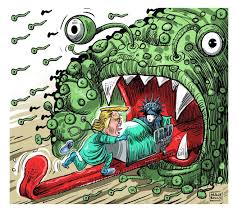
This is the story of how Israel, and its Prime Minister Benjamin Netanyahu, totally screwed up how it handled the pandemic. This, after congratulating itself for being a “model for all nations”. It is based on an article in today’s daily Haaretz by Ido Efrati. It will take me only 695 words. And they are almost too painful to write. Because it is my country, and it is unbearable to see what our leaders have done to it.
According to the Israeli government press office: as late as on May 7, “Prime Minister Benjamin Netanyahu, today, participated in a conference of the leaders of the countries at the forefront of dealing with the coronavirus pandemic, [whose leaders] sought to learn from the Israeli model for dealing with outbreak zones.” Really??
Ten costly mistakes that cost lives:
- Very few nurses have been assigned to do contact tracing. And they are not well coordinated. A new contact tracing center does not yet operate – it hasn’t yet received the necessary authority. It now takes 6 days or more to trace a patient’s contacts – it has to be 24-48 hours to stop an outbreak.
- PM Netanyahu decided to open all schools fully for all grades in mid-May. He scrapped the previous system of ‘capsules’, and small groups. And days later, the new Health Minister Y. Edelstein scrapped the requirement that kids wear masks. Too hot, he said. So much for getting adults to wear masks. Schools spread the virus and soon hundreds had to close and quarantine teachers and kids.
- It has taken many months for the Health Ministry to increase daily tests to 25,000. Only on May 31 did the Health Minister say that asymptomatic people should be tested, too, if they came in contact with someone infected. Only on June 22 did Dr. Sadetzki (Health Ministry official) order officials to test those quarantined within 48 hours. Result: Many carriers spread the virus widely before they were identified.
- Until a week ago, the Health Ministry used a strategy of declaring ‘red zones’ (local hotspots). But because the virus is now so widespread, this failed utterly. And under pressure, the Ministry backed down.
- Israelis are exhausted, hungry and jobless. After the PM and other leaders made empty promises and false claims, they no longer believe what they are told. Police are trying to enforce mask-wearing, with little success. Moreover, both the President of Israel and the Prime Minister of Israel broke quarantine laws during Jewish religious holydays, inviting relatives against then-strict lockdown rules – and the Press reported it. This infuriated many Israelis and led to widespread defiance. Now, only about a quarter of those who should be in quarantine actually do so, according to the Health Ministry.
- Five months after the pandemic broke out in Israel, critical information is missing. What proportion of Israelis are asymptomatic, with virus? We don’t know. How long does it take to trace patients’ contacts? We don’t know.
- Israel has a well-staffed professional experience organization that can best deal with the pandemic. It is the Israel Defense Forces’ Home Front command. It has almost infinite manpower, able to call up trained soldiers for reserve duty. Yet the Prime Minister stubbornly refuses to mobilize the Home Front Command. The reason is transparent. Home Front is under the Defense Ministry, and Netanyahu’s rival Benny Gantz is Defense Minister. What if, heaven forbid, the Home Front succeeded? Gantz would get the credit. No way. It will not happen. As with Trump, Bibi is only, and totally, about Bibi, and not Israel or its wellbeing.
- “Israel’s decision making, from the earliest stages of the crisis, has been influenced by only a handful of professionals. …Many professional associations are furious that they can’t even get a foot in the door to influence decision-making.”
- “The coronavirus crisis has laid bare years of neglect in the public health system, including its diagnostic laboratories.” The country’s 37 diagnostic labs have for months relied on student volunteers to help. There are too few doctors and too few hospital beds.

- And the previous Health Minister, appointed in July 2015, allowed the healthcare infrastructure to degrade – believe it or not, while most civilized nations appoint doctors or veteran healthcare managers to head the Health Ministry, Israel appointed an ultra-Orthodox Hassid who once came to a key pandemic press conference wearing his bear-fur hat in celebration of the Jewish festival Purim. During the pandemic, while in office, he persistently fought against lockdown restrictions on the ultra-Orthodox – and partly as a result, they have suffered disproportionately many cases and deaths.

(Un)Happy Birthday, America – There’s a Hole in your Bucket
By Shlomo Maital

Happy birthday, America; you are 244 years old today. But it’s an unhappy birthday. Here is why.
“New America” is falling behind “Old Europe”. The term Old Europe was used by Secretary of Defense Donald Rumsfeld in January 2003. It was used in scorn. President Trump continues to mock Europe, and even mock even its brilliant German leader Angela Merkel.
But guess what? Experts believe, as in this New York Times article, that “Europe may bounce back first” (July 3) – long before the US. But why? America spent relatively far more on relief measures – a staggering $2.7 trillion, or 13% of its GDP!, on economic relief to individuals, firms and states. And more will come soon.
What went wrong?
The US spent vast sums on those who did not need it – like big corporations. (Sound Republican to you? Remember the Trump tax cut?). Much money was thrown away through incompetence – thousands of dead people got checks in the mail. A lot of money went toward unemployment payments – companies laid off people so the government could save them money. So expanding unemployment caused layoffs, rather than prevent them. America has a terrible leaky bucket – a near-non-existent social safety net. Just when the pandemic really really needed one with no holes in it.
Europe? Unemployment rose relatively little. The German government reintroduced kurzarbeit– used after the 2008 crisis, in which work hours are shortened and spread around over workers rather than fire or lay off people. Most of Europe simply used its existing safety nets to help those in need, and the safety net expanded nearly automatically. Most people kept their jobs — which means you don’t have to rehire them, something US firms will be hesitant to do.
In the US, with Trump boasting about 11% unemployment (yes, it’s down from 14%), consumers are highly uncertain about their future. And they are just not spending. With consumption at 70% of GDP, no US recovery is possible without consumer confidence. And it is lacking, especially with an election looming on Nov. 3.
America’s bucket is leaky. Somehow it has not managed to create a waterproof bucket for its poor, its ill, its uneducated, its immigrants, etc., in 244 years. So it IS an unhappy birthday. And the specter of that terrible day in 1619, when the first African slaves landed in America, continues to haunt this troubled nation.
Now, a strong US leader could look across the ocean and figure out why Europe, old Europe, crusty old Europe, has done so well, and try to copy its social safety net.
But that would take vision and humility. Those qualities, too, seem to have leaked out of the bucket.
Build Back Better – Toward an Emergence Vision
By Shlomo Maital

In the US, Israel and other nations, we are seeing a disastrous collapse of leadership. There is no vision regarding the future, and how we are to emerge from the pandemic. Churchill once said, if you’re going through hell – keep going. But where? How? Our leaders shrink into the shadows and fall silent. Let someone else take the blame.
Here is a blueprint for emergence. Start with a mantra – three words. Build back better. No, we will not go back to the ‘good old days’, they actually weren’t that good, as the virus proved. We will build back – but better.
How? We start with a careful audit, by experts. What were the range of social, political, educational and economic failings before the pandemic? Inequality, apathy, ill health, poor schools… write the entire list.
Second, strategic plan. How can each of these ills be repaired? And most important, how can we use creativity, with minimal resources, to tackle the problem? Schools can shift to project-based learning – that won’t require huge new resources, kids will thrive.
The Bible says (Psalms) in Hebrew, without vision, a nation literally falls to pieces:
. אין חזון יפרע עם
So Give us a vision. Build a strategic plan. Tell every part of society where they fit into it and what they must do. Do it bottom up – canvas all of society for ideas. Get people to pull together. Today, in Israel, each interest group – small business, artists, performers – demonstrates on their own, with the guiding principle: the squeakiest wheel gets the most grease. A bad system.
Crises produce new leaders. I eagerly await the new leaders who will step and bring us their vision – and help us implement it.
One Terrible Picture – Worth Thousands of Words
By Shlomo Maital
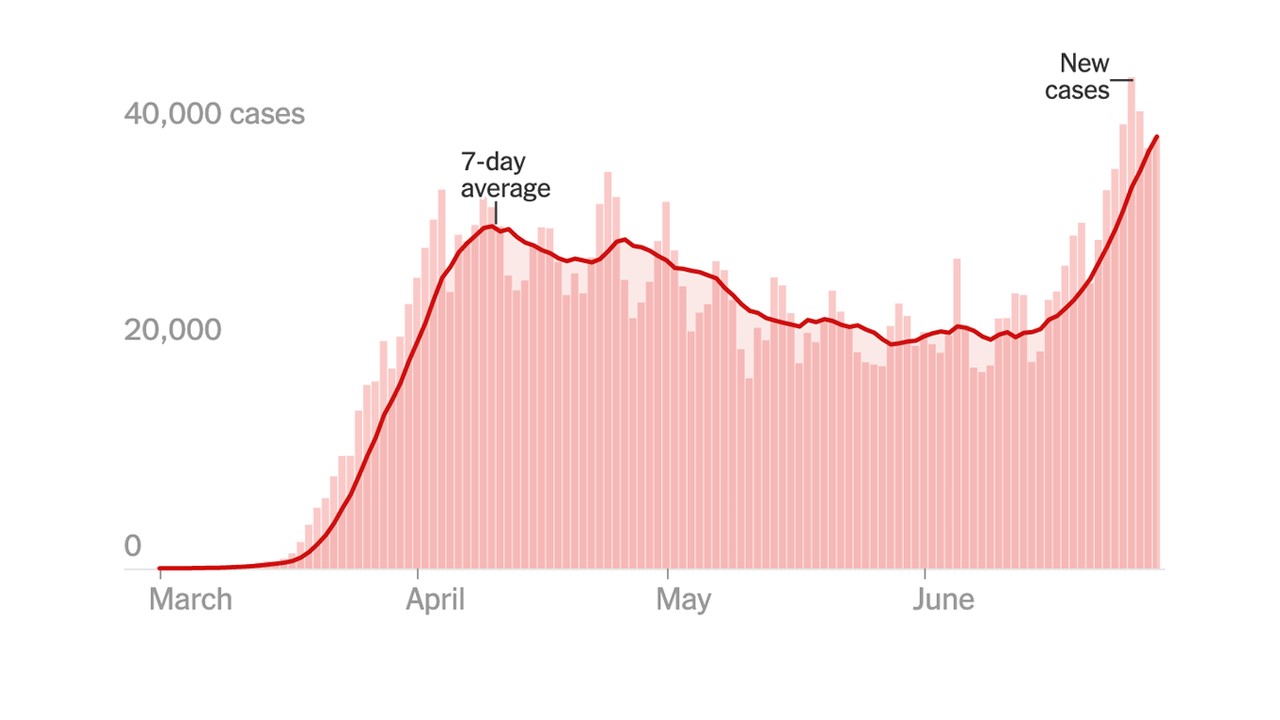
New COVID-19 cases in the United States, daily, from early March
The graph above shows new COVID-19 cases daily, for the United States, up to date. It speaks for itself. (The graph is from the New York Times).
This is what happens to a country with inept criminal leadership, or lack of leadership, and a politicized pandemic where wearing masks is ‘unconstitutional’, where political leaders buckle under popular pressure and open the economy too soon – and then find they can’t close it again. Go back to Memorial Day weekend, Monday May 25 – and the crowds that gathered at beaches and parks – and you can see the second wave 14 days later. And no, President Trump and Vice-President Pence, this is NOT because of increased testing!
So nations of the world! Look at this closely. If you make the mistakes the US has made, heaven forbid, this is what awaits you.
As I write this, new cases in Israel are exploding. But very little is being done.
The World is Unstable: Surprise!
By Shlomo Maital
In my previous blog, I quoted experts who warned that in a globalized world, an epidemic will spread quickly via travelers – quoted in a book published two decades ago by a brilliant science writer Mark Buchanan * and in an article published in the leading science journal NATURE in 1998.
It is worth another short blog to describe Buchanan’s main message in his book.
Economics is all wet; beware. The world is inherently unstable, including financial markets; markets are not efficient and no, supply does not always balance demand and no, prices do not always and everywhere reflect true underlying value. The opposite: There are frequent ‘avalanches’, and infrequent but massive huge crashes. Earthquakes are unpredictable; because the plate tectonics that cause them are unstable. So are financial markets. A vast industry, and an army of misguided economists, exist based on an enormous fallacy – prediction is possible. Data prove otherwise. Post hoc explanations of crashes are simply amusing; they are ad hoc, not just post hoc. Both physical and human systems are simply – inherently unstable. It is the way of Nature.
There is an important personal lesson in Buchanan’s fine book (he has a Ph.D. in theoretical physics). If the world is unstable, then be prepared to adapt to major, sudden crises. Keep a small reserve of resources on hand. Forewarned is forearmed; if you anticipate avalanches, if you are aware they happen, you may be less shocked when they occur. If you are head of a family or a parent, embrace this in your family setting. If you are a junior or senior manager, prepare your organization.
If you are a political leader, start now – with ‘build back better’, and ‘prepare for an avalanche’ — but, probably, given US, UK, and Brazilian loser-leaders, that is way too much to ask.
- Mark Buchanan: Ubiquity: Why Catastrophes Happen. Three Rivers Press, New York: 2001.
The Real Culprit of the Pandemic: Globalization
By Shlomo Maital
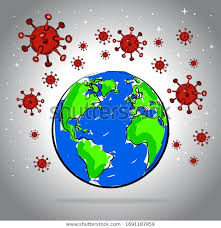
Nov. 9, 1989. The Berlin Wall falls. The two Germany’s unite quickly. The European Union expands. And the age of globalization begins.
December 2019. Wuhan. A novel coronavirus is identified. It spreads globally.
Has the age of globalization ended? And – is globalization the true underlying culprit?
I’ve been reading a remarkable book, two decades old, by a brilliant science writer Mark Buchanan: Ubiquity: Why Catastrophes Happen. Three Rivers Press, New York: 2001.
In Chapter 8, Buchanan recalls the “six degrees of separation” discovery of social psychologist Stanley Milgrom, in 1967 – in which any two people anywhere can be connected, by no more than six direct links, each link comprising someone you know personally. Based on Milgram’s work, Buchanan writes, two scholars, Watts and Strogatz, modeled such ‘networks’ as a tool for modeling the spread of infectious diseases. [Duncan Watts and Steve Strogatz. “Collective dynamics of small-world networks”, Nature 393, 1998, pp. 440-442.]
Their finding: (in 1998): “Watts and Strogatz also modeled the spread of infectious diseases on small-world networks, and found that they spread much faster than they would on ordered networks. What’s more, only a very few shortcut links are necessary to make this happen. This has disturbing implications for how dangerous diseases might be able to spread over the world, carried to or from remote places by just a few long-distance travellers”.
Explanation: “ordered networks” are regular ‘grids’, where your links are your immediate neighbors. Small-world networks are like ‘six degrees of separation’ disorderly ones, like the kind Milgrom discovered – in other words, real networks as they are in the real world.
Globalization has massively expanded trade and travel. The benefits have been massive. Emerging markets, especially in Asia, have grown wealthy. Western consumers have been flooded with inexpensive goods from Asia.
But apparently, the price is the current pandemic. When the whole world is interconnected by flows of goods, people and information, it grows wealthy and prosperous (though not everyone of course) – and also becomes highly vulnerable to pandemics.
I am, and have been, a big fan of the benefits of globalization. But as often happens, we ignored the attendant risks. We were told in 1998 and in 2001. I guess we were not listening too closely.
How Trump and America Screwed Up and Killed Thousands:
The Blow by Blow Account of Criminal Folly
By Shlomo Maital

This is the shocking story of how President Trump and America screwed up in confronting the pandemic. The result: Thousands and thousands of needless deaths. And today – a new record number of newly infected persons in the US. The account below is by the New York Times’ brilliant team of reporters.
Here is the awful story, blow by blow, almost too painful to put into words. If you can, read these 806 words about criminal folly and blind incompetence by political leaders.
¨ It started small. A man near Seattle had a persistent cough. A woman in Chicago had a fever and shortness of breath. By mid-February, there were only 15 known coronavirus cases in the United States, all with direct links to China. “The 15 within a couple of days is going to be down to close to zero,” President Trump said. The patients were isolated. Their contacts were monitored. Travel from China was restricted.
¨ None of that worked. Only a small part of the picture was visible. Some 2,000 hidden infections were already spreading through major cities. We traced the hidden spread of the epidemic to explain why the United States failed to stop it.At every crucial moment, American officials were weeks or months behind the reality of the outbreak. Those delays likely cost tens of thousands of lives.
¨ HOW THE VIRUS GOT IN: The China travel ban was a partial success: Only a handful of infected travelers from China are estimated to have made it into the country undetected before restrictions were imposed on Feb. 2.But it wasn’t enough. A vast wave of infected travelers — roughly 1,000, one model suggests — came from other countries in Asia, Europe and the rest of the world in February, each a dangerous spark that could set off a wider outbreak. Many of those infections died out. But by mid-February, a few caught fire and became outbreaks, spreading invisibly.
¨ The country was unaware of its own epidemic. Many tests released by the C.D.C. didn’t work, leaving only enough to test people who had visited China or had contact with a handful of known cases.Over the next two weeks, the invisible outbreaks doubled in size, then doubled three more times.
¨ Top federal health experts concluded by late February that the virus was likely to spread widely within the United States and that government officials would soon need to urge the public to embrace social distancing measures, such as avoiding crowds and staying home. But Mr. Trump wanted to avoid disrupting the economy. So some of his health advisers, at Mr. Trump’s urging, told Americans at the end of February to continue to travel domestically and go on with their normal lives. And they did. Millions moved across the country, cellphone data shows. Some unknowingly carried the virus with them.
¨ Researchers with the Seattle Flu Study ignored C.D.C. testing restrictions and uncovered a single case with no travel history in late February. This was the first sign that the outbreak had spun badly out of control.
¨ Over the two weeks that followed, people made about 4.3 million trips from the Seattle area. Thousands were contagious. Genetic samples linked to the Seattle outbreak appeared in at least 14 states, said Trevor Bedford, a professor at Fred Hutchinson Cancer Research Center and a leader of the flu study.
¨ Seattle was just the beginning. In New York City, where officials had found only a single case by March 1, roughly 10,000 infections had spread undetected. New Yorkers and visitors continued to travel out of the city. More than 5,000 contagious travelers left in the first two weeks of March, estimates suggest.
¨ “I’m encouraging New Yorkers to go on with your lives and get out on the town,” Mayor Bill de Blasio said on March 2. People leaving New York City made about 2.8 million trips to the Hudson Valley. Some carried the virus with them, and outbreaks there accelerated in mid-March, the likely result of travel from New York, a Times analysis found.
¨ People also made more than 25,000 trips to New Orleans, where genetic data suggests that a large early outbreak stemmed from infections from New York, according to Karthik Gangavarapu, a computational scientist at Scripps Research, and Dr. Bedford.
¨ Tracking signature genetic mutations of the virus allows researchers to estimate the influence of early outbreaks. Early on, variants prominent in Seattle’s outbreak were found more frequently. But later samples showed that a variant found often in New York City’s outbreak had become much more widespread. A new analysis of thousands of mutations also points directly back to New York, Dr. Bedford said. Travel from the city helped to spread that variant across the country.
¨ “New York has acted as a Grand Central Station for this virus,” said David Engelthaler of the Translational Genomics Research Institute. By the time President Trump blocked travel from Europe on March 13, the restrictions were essentially pointless. The outbreak had already been spreading widely in most states for weeks.
Can an Old Soviet-Era Idea Help Fight this New Virus?
By Shlomo Maital

Dr. Marina Voroshilova and Dr. Mikhail Chumakov, left
Sometimes, you battle a new foe, like the novel coronavirus, with an old idea – even one dating from Soviet Russia. Writing in today’s New York Times, Andrew Kramer describes a 60-year-old idea used by two virologists in the USSR, Marina Voroshilova and Mikhail Chumakov, that may be helpful in today’s pandemic.
It sounds preposterous – use, say, polio vaccine to fight COVID-19? Really?
Here is the basic idea:
“We formed a kind of line,” Dr. Peter Chumakov, who was 7 at the time, recalled in an interview. Into each waiting mouth, a parent popped a sugar cube laced with weakened poliovirus — an early vaccine against a dreaded disease. “I was eating it from the hands of my mother.” Today, that same vaccine is gaining renewed attention from researchers — including those brothers, who all grew up to be virologists — as a possible weapon against the new coronavirus, based in part on research done by their mother, Dr. Marina Voroshilova.
“Dr. Voroshilova established that the live polio vaccine had an unexpected benefit that, it turns out, could be relevant to the current pandemic: People who got the vaccine did not become sick with other viral illnesses for a month or so afterward. She took to giving the boys polio vaccine each fall, as protection against flu. Now, some scientists in several countries are taking a keen interest in the idea of repurposing existing vaccines, like the one with live poliovirus and another for tuberculosis, to see if they can provide at least temporary resistance to the coronavirus. Russians are among them, drawing on a long history of vaccine research — and of researchers, unconcerned about being scoffed at as mad scientists, experimenting on themselves.
“Experts advise that the idea — like many other proposed ways of attacking the pandemic — must be approached with great caution. “We are much better off with a vaccine that induces specific immunity,” Dr. Paul A. Offit, a co-inventor of a vaccine against the rotavirus and professor at the Perelman School of Medicine at the University of Pennsylvania, said in a telephone interview. Any benefits from a repurposed vaccine, he said, are “much shorter lived and incomplete,” compared with a tailored vaccine. Still, Dr. Robert Gallo, a leading advocate of testing the polio vaccine against coronavirus, said that repurposing vaccines is “one of the hottest areas of immunology.” Dr. Gallo, director of the Institute of Human Virology at the University of Maryland School of Medicine, said that even if the weakened poliovirus confers immunity for only a month or so, “it gets you over the hump, and it would save a lot of lives.”
The current pandemic has brought a tidal wave of creative ideas. Most fail. A few succeed. Even preposterous ideas, like enlisting polio vaccine, are worth a shot. The novel coronavirus is wily, clever, sneaky and in some places mutating; so we humans need to be at least half as smart as it is.
The Pandemic is NOT Over
By Shlomo Maital

The Pandemic is NOT over. We are getting farther away from conquering it, not closer. Here are two disturbing reports from Bloomberg News, a credible source:
First the United States:
“By most accounts, the U.S. has failed spectacularly at managing the coronavirus pandemic. American-made tests were first defective, then largely unavailable; misinformation about the virus was broadcast in politicized White House briefings; and lockdowns weren’t enforced quickly enough, all of which likely worsened the spread of a disease that’s already killed 120,000 Americans. Now, with restrictions lifted earlier than advised and infection rates predictably spiking, calamities suffered in the northeast and northwest are re-emerging inland. And come fall, it may get even worse. Federal officials led by Dr. Anthony Fauci warn that this year’s flu season could overburden the health care system. —David E. Rovella”
And the rest of the world:
“The number of new Covid-19 cases around the globe is accelerating, fueled by a surge in Latin America. Germany’s infection rate rose for a third day, lifted by local outbreaks, including one in a slaughterhouse. However, Beijing reported only nine new infections, a sign that a recent outbreak may be under control. Infections and deaths reported by Russian officials also flattened. The overall global surge, though, is putting a world economic recovery in greater jeopardy. “
And to make things worse: There is some evidence the novel coronavirus has mutated, and in some mutations has become more virulent and harder for the body to step.
I often hear the claim that the new cases are largely among the young, which are populating bars and restaurants and beaches, and that even though the number of infections rises, the number of deaths remains steady or declines. The danger is, as the coronavirus spreads among the young, it will mutate and become more dangerous. And we will not be prepared. Moreover, these mutations make it much harder to successfully develop a working vaccine.
Roots of US Racism: Read The Warmth of Other Suns
By Shlomo Maital

Every story has a ‘back story’ – background that is essential for our understanding. The current Black Lives Matter protests have a very long and old back story. It is found in the wonderful book by Isabel Wilkerson, The Warmth of Other Suns: the epic story of America’s great migration, by African-Americans, from the South to the cities of the North. This migration is in large part the back story of Black Lives Matter.
I heard about the book in a favorite NPR podcast, On Being, when Krista Tippett, podcast founder, interviewed author Isabel Wilkerson, in 2016. Here is an excerpt from this interview. It is very long. To save you time: African-Americans migrated from the South, after they were ‘liberated’, freed as slaves, to save their lives, literally, but found they were enslaved again, as sources of cheap exploitable labor, in the factories of the North, where the racism was if anything more fierce and more hypocritical. Warning: This blog is 1200 words, double the usual length.
Wilkerson: citing a source: “He wrote, “I was leaving the South to fling myself into the unknown… I was taking a part of the South to transplant in alien soil, to see if it could grow differently, if it could drink of new and cool rains, bend in strange winds, respond to the warmth of other suns and, perhaps — just perhaps — to bloom.”
Tippett: “You’ve said that the language of “political asylum” is absolutely apt here for what people were undertaking. And it’s just not — as much as we know a lot of these stories and a lot of the things that were wrong, that feels like a new recognition.”
Wilkerson: “It does. I think that because it happened within the borders of our own country, we don’t think about it as — first of all, it was a kind of immigration. Although, these were — this was the only group of Americans who had to act like immigrants in order to be recognized as citizens. They were forced to seek political asylum within the borders of their own country because they were living in a caste system in the South that did not recognize their citizenship. And some of them travelled farther than current day immigrants might, but that was really not the point. The point was that the country actually was kind of two countries in one, and that’s what they had to do.
“I often say that the book is viewed as being a book about the Great Migration, and over time, as I’ve talked about it over these years, I’ve come to realize that it’s not about migration. The Great Migration is not about migration, and really, probably no migration is about migration. It’s about freedom and how far people are willing to go to achieve it. This is the means that they feel they must take in order to find freedom wherever they can find it.
Tippett: “Yeah. And this book is such a — it embodies this paradox that writers know, that storytellers know, that radio actually knows, that the more particular you can get with your story, the more universally it can be received, that others can join their life and their imagination with what you have to share. And there were these moments for me in the book that were just so human, that were so relatable, that made all these other horrors come home.
And so one of them for me was George Swanson Starling. You asked him what he hoped for in leaving, and he said, “I was hoping I would be able to live as a man and express myself in a manly way” — I’m getting chills — “without the fear of getting lynched at night.” And even the way it comes across — he didn’t say it — it doesn’t sound like he said it with a lot of bitterness or drama. It was just matter of fact.
Wilkerson: “Not even that much emotion because it was — these were the facts of their lives. And at that time when they were growing up — and this time period was a very long time. I mean, it was the end of Reconstruction until the 1970s. It encompassed someone who was born in the 1880s and passed away in the ‘60s would’ve known nothing other than this. And so, these were the facts of their lives.
“And he didn’t — he was not emotional. He wasn’t bitter. It was just a matter-of-fact statement of what it was that he was up against and why he felt he had no choice but to go. I ran into a lot of people who said they don’t think they would’ve lived if they had stayed. There was actually a tremendous amount of fear that a lot of parents in the South had for their children if they were extroverted and opinionated.
Tippett: “If their children were?”
Wilkerson: “Yeah, if they were spirited and expressive, there was a need to reign that in. I mean, in other words, childhood itself had to be controlled and repressed because it could mean their very lives. And so he grew up under that. And his father said, “If you’re going to continue doing this work, the things you’re doing, it’s best that you go.”
“And one of the things that happened in this Great Migration is that it spread people all over this country. I mean, people — these places that they went, there had not been a significant African American population. So you look at the African American population of all of the cities in the North, Midwest, and West are a result of this. We’re seeing the manifestation of that, Seattle or Oakland or Los Angeles.
Tippett: Detroit wasn’t Detroit.
Wilkerson: “No, it wasn’t. None of these places were what they were at the time. And a lot of them are filled by people who felt they had no choice and that they would not have lived if they hadn’t gotten out.”
Tippett: “Something else, something that was disturbing about the dynamic is that, on the one hand, African Americans were being lured by the North as cheap labor. And the South, for the same reasons, was keeping people in. That’s shocking to me. I don’t know. I shouldn’t be shocked, but just …”
Wilkerson: “Well, I think that a lot of this actually is not — it’s out there, but it’s not commonly known. And one of the things I hear most often when I go out talking about this book — or people write to me constantly, and it’s the same phrase over and over again, “I had no idea.” I hear it over and over again from people who actually were alive at the time that some of these things were going on. Part of it, is that a lot of the people just didn’t talk about it.
“If you think about it on both sides of this caste system or this divide, there was not much incentive for anyone to talk about it. I mean, on the one side, people don’t want to really think about the awful things going on around them. And then those who were suffering from it and had escaped — they didn’t want to burden their children with it. It was like post-traumatic stress. They didn’t want to deal with it.”

 TIMnovate