
You are currently browsing the tag archive for the ‘China’ tag.
Rare Earths: How America Dropped the Ball
By Shlomo Maital

This is about how the United States (i.e. Trump, but also predecessors) badly dropped the ball on a crucial component of hi-tech manufacturing – especially, crucial powerful magnets, that require rare earths.
But what are rare earths? Note: They are not rare. Just hard to process. This is from Wikipedia:
The rare-earth elements (REE), also called the rare-earth metals or rare earths, are a set of 17 nearly indistinguishable lustrous silvery-white soft heavy metals. Compounds containing rare earths have diverse applications in electrical and electronic components, lasers, glass, magnetic materials, and industrial processes. The term “rare-earth” is a misnomer because they are not actually scarce, but historically it took a long time to isolate these elements.
This is from the New York Times’ The Daily podcast. It is an interview with Keith Bradsher, who has covered the subject for many years. This blog is 1,690 words long, three times longer than usual.
Background
Rare earths are needed to make powerful magnets. These magnets, it turns out, are ubiquitous in nearly every electronic product. This is a story of how free-market economies generate vast wealth – but driven solely by short-term profit margins, fail to strategize long-run needs, until it is too late.
In the ongoing trade war between the US and China, the biggest sticking point is a handful of metals that are extremely rare, essential to the US, and almost entirely under the control of China. The problem is, China has now cut off America’s access to those metals, threatening US industry and its military.
“…the most important and fastest growing uses are for very powerful magnets. You can make a rare earth magnet that is 15 times as strong as an old-fashioned steel magnet. Take a car, for example. If you went back quite a few years, you had to move the car seat back and forth manually. These days, a single luxury car seat may have 12 separate motors to do all kinds of little adjustments to that seat — your thigh adjustment, your lower back adjustment, the tilt of the back of the seat. All these things these days have little electric motors, and each of those has a rare earth magnet.”
“…there are seven rare earth elements that are considerably less common. China completely dominates the world’s supply of them. It mines most of them and processes almost a hundred percent of them. Those seven are dysprosium, gadolinium, lutetium, samarium, scandium, ytterbium, and yttrium.” Samarium is crucial for military hardware.
Root Problem
“What’s particularly striking is that it was the United States and a little bit Japan that invented these amazing magnet technologies using rare earths. The US HAD a rare earth mine. But in 1998, that mine was forced to close. It stopped production. It turned out that it had a pipeline that leaked traces of heavy metals and a faint radioactive residue in a desert area, including where there were a few rare tortoises. And the cost of the cleanup and of improving the environmental compliance was more than the owners of the mine could afford, so the mine shut down.
“And meanwhile, China had been ramping up its own rare earth production through the 1980s, through the 1990s, doing it very cheaply without a lot of environmental compliance at all. And many big businesses were welcoming China’s decision to join the World Trade Organization in 2001. And so the feeling was that this was the beginning of a closer economic integration with China.And it’s not just limited to cars. For example, the seventh of these rare earth elements, samarium, has lots of military applications, because it can stay strongly magnetic even at temperatures that will melt lead. And as a result, samarium magnets, you find 50 pounds of them in an F-35 stealth jet. You find them in missiles. You find them in drones. You find them in smart bombs. Really, these rare earths now are in critical both to the economy and to national security.
“This was the heyday of free-trade orthodoxy. I mean, this was the moment for optimism around this. And I’d imagine that the US closing its only mine for rare earths, ceding the field to China, makes for a pretty big business opportunity over there for businesses that want to get into this.
“A lot of people in China saw a chance to make money and set up their own mines and processing facilities, both legal businesses and also organized crime.
“These rare earths are not that hard to mine. It doesn’t take lots of big, sophisticated equipment. And they were being mined, in the case of the best ore deposits of all, in a poor province in South Central China with a reputation for corruption. Let me tell you how they mine them. You get a guy with a dirt bike, he carries them. This is where the dirt bikes come in. You get a guy with a dirt bike, and he drives up the side of a pine-covered red clay hill, digs a small hole in the dirt, dumps in a sack of cream-colored powder. It’s ammonium sulfate. In less concentrated versions, it’s actually a fertilizer. And then he dumps a bunch of water in it. And as it percolates down through the inside of the hill, it dissolves a lot of the rare earths with it. And it begins coming out the bottom of the hill, just because water eventually comes out somewhere. And that causes the rare earths to settle out as faintly pink crystals on the bottom of the clay pit. So then you dump out all the remaining acid and other liquid and contaminants into the creek, let the faintly pink crystals dry. Then from there, after the different rare earths are separated from each other, they’re taken to the magnet factories in Guangzhou and turned into these extraordinarily powerful magnets.
“What’s remarkable is that companies like Boeing, Lockheed Martin, General Motors, Toyota, Volkswagen, everybody depended on these very dubious rare earth value chains. But nobody was clear on where their rare earths were coming from, how much was from legal mines, how much was from illegal mines. At the same time, demand for these rare earths was exploding, as companies found more and more uses for them. So by 2004, China had acquired an almost complete grip on the entire supply chain for rare earths and rare earth magnets. But then in 2010, China shocked the world.
“In the East China Sea are at the heart of an escalating dispute between China and Japan. China suddenly imposed a total embargo on any shipments of rare earths to Japan, which at the time, really played the central role in making the magnets and many other technologies. But this incident, which really shook Japan and to some extent the US, resulted in both countries taking actions on rare earths, although what Japan did would prove much more effective than the American response.
“The Japanese government, in cooperation with one of the big trading companies of Japan, began providing the financing for a big mine to be dug in Australia and for mineral processing then to be done in Malaysia. So those moves reduced considerably Japan’s dependence on China. Interesting. So Japan decided to try to become self-sufficient because of all of this.
“What did the US do?”
“China released a flood of additional rare earths into world markets. And that flood of rare earths pushed the prices way down. It wasn’t possible for the rare-earth US Mountain Pass Mine to earn enough money selling rare earths at these low prices to pay back its debts. And so the mine ended up closing in 2015, and went bankrupt. The Japanese companies were willing to pay a little more to get production that they knew wouldn’t be interrupted from Australia. And the Japanese corporate and government alliance was willing to keep lending money to make sure that the Australians didn’t go out of business. What we’re talking about here is industrial policy. Japan showed a willingness to prop up an industry that may not be profitable, but is seen as critical to national interests. The United States tried to do the same. But after a few years, as sometimes happens, people began to lose interest. There wasn’t the same enthusiasm for maintaining a separate supply chain from China. So the US sort of lost track of this issue. And then when China suddenly halted supplies in April 4 this year, that failure to keep track of it came back to haunt the United States.
“Here we are today facing another situation in which China is restricting the export of rare earths, putting the US and a lot of countries in a really difficult position. So what does the US do now? What are the steps the administration has taken?
“It’s likely we’re going to see China resuming commercial supplies of rare earths to the West. The difficulty, however, is that China may not allow enough rare earths to be exported for people to build stockpiles, so that they know the next time China cuts off supplies, they won’t run out immediately. So we’ll likely see continued limits on the volumes, even for commercial.
“And then for national security uses, for military uses, it may be extremely difficult to persuade China to resume shipments of samarium, which are needed for all of these fighter jets, missiles and so forth. And are needed not just by the United States, but for weapons deliveries to places like Ukraine or Israel or Taiwan.
“One way you could look at this is that Trump kind of did the worst thing possible for the American manufacturers that he says he’s trying to help, which is that he essentially provoked China to hit them right at their Achilles heel where they’re most vulnerable, which is their reliance on China for these extremely rare and important metals. .”
- – – – – – – – – –
The US dropped the ball. Expect many more fumbles in future, as a shoot-from-the-hip President and a performance-art Cabinet lead America into more and more hot water.
Suppose your child needed regular supplies of a life-saving medicine. Would you hand that supply over, to a bitter enemy and rival who has sworn to take revenge on you, for past wrongs?
The US did it, under the President whose mantra is ‘common sense’.
Europe Is In (Big) Trouble
By Shlomo Maital

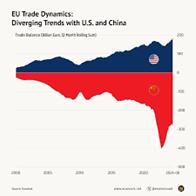
US trade deficit (top) EU trade deficit (bottom)
In her NYT Op-Ed today, March 10, Karen Karniol-Tambour clarifies President Trump’s murky tariff quirks.# I find the above diagrams helpful, along with her analysis and my own. The top diagram shows the US trade deficit (exports minus imports) since 1990, and the bottom one, the EU’s trade deficit, split between a large and growing surplus in its US trade, and a growing and very large deficit in its China trade. (Bottom diagram: Black is export surplus with the US; Red is import surplus with China). Source: Visual Capitalist.
Since 1990, and actually since 1970, the United States has consumed more than it produced. It does this by buying stuff abroad. To pay for it, it borrows and goes into debt. It can do this, because US money, the dollar, is the world currency and those who earn the dollars are willing to hold them or turn them into US bonds. (If you or tried this, it would not take long to go broke. When the US does it, it can print the money to enable it.) The infusion of US demand in the world economy has made Asia, specifically China, wealthy. There are 400 Chinese billionaires! In a Communist nation! But it also helped Europe. The EU sells more to the US than it buys.
Most of what the US consumes, above what it makes, is manufactured goods, mostly from China, but also, from Mexico, Vietnam, Japan and Germany.
The US gave away its manufacturing to China and the rest of the world, under Clinton, Bush, Obama…and Trump (2016-2020). Trump thinks it can return, by imposing high tariffs on imports. It will make us a fortune, he says. If it does, it means that imports remain very high. So – forget US manufacturing. If it doesn’t make a fortune, it means that imports become very expensive and import inflation, not just Chinese EV’s.
China has had 25 years to build its manufacturing supremacy. In a country that controls the economy directly. To get its manufacturing back, the US will need at least 25 years, probably more, in a free market economy, if, IF, all the right policies are put in place. But …of course, they are not. Tariffs are not the answer.
The EU is in huge trouble. For two reasons. Defense. And Economy.
Defense: The US is throwing Europe and Ukraine under the Russian bus. After years of sponging off the US $850 billion defense budget, Europe now has to defend itself. That will take large resources and a lot of time. And Russia is knocking on the door right now. The next few years will be very dangerous for Europe.
Economy: The US wants to shut down its big trade deficit with the EU. IF it does, through tariffs, it will hurt the EU economy, with Germany already in recession or nearly so. Meanwhile, the EU has a large and growing trade deficit in manufactures with China. Europe’s car industry is in desperate trouble. With technology shifting to electric vehicles, China is swamping the world with its EV’s, and Europe is way way behind. So Europe faces big challenges from BOTH the US and from China.
The economies of the US, EU, and China are roughly equal in size, and comprise 75% of world GDP. All three have big problems. China has a bloated construction, real estate and finance sector, deep in debt. US has an unpredictable president with wrong-headed ‘quick fixes’ that really are quick disasters. EU needs a rapid, smart, strategic U-turn, very unlikely in a group of 27 countries where you need unanimity to do anything – and outliers like Hungary are happy to put up roadblocks.
The US gave away its manufacturing to China, under four presidents, Democrats and Republicans. You cannot have a strong healthy growing economy without making stuff. The US stock markets are reflecting this.
Because the US consumed much more than it made, it has a heavy burden of debt, 110% of its GDP, and a trillion dollars in interest alone. And as Trump slashes taxes, the budget deficit grows and with it, US debt.
EU enjoyed trade surpluses with the US, offsetting in part its trade deficit with China. The US under Trump wants to end that.
In a EU economy already slowing, and with a Russian army on its flank, and with EU technology trailing that of the US and China, the EU is in deep hot water.
And, when 75% of the world economy is in some degree of trouble – we are all of us in hot water.
Friends: Set aside a bit more in saving. You may need it.
# “This Is Who Loses in a Trade War. Karen Karniol-Tambour, New York Times, March 10, 2025. The author is co-chief investment officer at Bridgewater, an investment management company.
Trudeau Socks It To Trump
By Shlomo Maital

I just watched Canadian Prime Minister Justin Trudeau sock it to Trump, a week before he leaves office. “Very smart”, Trudeau described Trump – but “ very dumb” to slap 25% tariffs on Canadian goods. Dumb, because the US and Canadian economies are highly integrated, through a trade agreement negotiated by Trump himself, in his first term. This is especially true of the automobile industry; a US car exec said this 25% US tariff on Canadian imports will “blow a big hole” in the US industry.
Trudeau is retaliating with 25% tariffs on a wide range of US imports.
Let’s face it. The US has a problem. It has imported about $50 b. more in goods per month than it exported, up to 2020. Since then, that monthly deficit has doubled, to about $100 b. a month. The US now has a $1.2 annual trillion trade deficit. Only the US can live so far beyond its means – because it pays in dollars, the international money, and it can create dollars (through credit) and borrow dollars by selling bonds to foreigners, who accumulate dollars through trade surpluses (e.g. China).
The US exports $349 b. yearly to the US, and iimports $412.7 b. That is a deficit of about $63 b., or just over 5% of America’s overall deficit. Mexico exports $505.3 b. to the US, and imports $334 b. That is a US trade deficit of $171 b., or just under 15% of America’s overall trade deficit.
China and the European Union are the big ones. China’s trade surplus with the US is $295.4 b., or 25% of the total US deficit, and the EU has a $235 b. trade surplus with the US, or roughly 20%.
What do these numbers mean? The US has leveraged the fact that the dollar is the world’s currency, to live beyond its means, buy much more than it sells abroad, and borrows to pay for it. America spends more in interest on its national debt than it spends on defense — $1 trillion!
Trump has a quick fix. Tariffs. Why won’t this work? Why is it dumb? He tariffs Canada at 25%. Canada responds in the same way. So nothing changes – US exports and Canadian exports each get 25% more costly, meaning their relative prices remain the same. So all that happens, is that US exports to Canada and Canadian exports to the US both decline, because they are more expensive – but no advantage accrues to either country. Trade declines. Both countries lose. Prices go up in each country.
There is a way to deal with the fact that the US has lived far beyond its means for years. Invest in education. In infrastructure. In productivity. In modernizing factories. In becoming more efficient and competitive. That takes government investment and smart policies, and a long run policy. Biden began, with an infrastructure bill that brought semiconductor factories to the US (Trump took credit on TV for bringing Taiwan’s powerhouse TSMC to the US, but that was done under Biden).
Tonight, in his speech to Congress, Trump will blame everybody else but the US for its trade deficit. But it is the US itself that is responsible. It has fallen far behind, by building a consumption society (70% of GDP), while China built an investment economy (nearly a third of GDP).
China is an ant. America is the grasshopper. It’s pretty simple. And pretty obvious. But – expect half of Americans to buy Trump’s snake oil pitch tonight and applaud him.
It’s a shame.
G7 vs BRICS: Lose Lose.
By Shlomo Maital
As Donald Trump prepares to be inaugurated as US President on January 20, a rather bleak picture emerges of a wrestling contest between two teams: BRICS and G7. And it will not end well, at least not initially.
BRICS is the group of anti-US anti-West countries: Brazil, Russia, India, China, South Africa. According to recent figures, their total Gross Domestic Product, measured by the true dollar value of their currency rather than the distorted market value, is $62 trillion.
Facing off against them is the G7: the group of pro-West economies led by the US. Their GDP comes in total to $53 trillion. (Note: China’s GDP, in $, is $33 trillion, more than $4 trillion above that of the US, at $29 trillion).
Together, these two groups command $120 trillion of the world’s $138 trillion GDP.
Trump plans to impose tariffs, including on key trading partners such as Canada and Mexico. They and others will doubtless retaliate. This will reduce the volume of world trade, which since the 1944 Bretton Woods agreement has made many poor countries much wealthier.
We have seen this movie before. In the 1930’s Depression, the US imposed a heavy tariff on imports, the Smoot-Hawley tariff, and its trading partners retaliated. In just a few years, world trade all but disappeared, making the Depression worse for all.
Somehow, humanity seems to have to relive its mistakes again and again, and relearn their consequences. “I can make you poorer, at my expense,” says country A, and country B says, “so can I”.
And they’re both right.
China – Newest Global Growth Engine?
By Shlomo Maital

source: Bloomberg
Once, when the world economy was in trouble, there was a locomotive to pull it out of stagnation – the US economy. After World War II, when the rest of the world was destroyed, the US supplied purchasing power through its imports. With frequent global recessions, again the US appetite for consumer goods supplied badly-needed demand for the world.
Today? With an incompetent xenophobic addled President (at least for the next 13 days, or 92 days until the Inauguration), and the pandemic worsening in the US in up to two-thirds of all states — the United States is not the locomotive but in fact the quicksand.
Enter China, vilified by Trump, but arguably emerging fastest and strongest from the pandemic. China’s quarterly GDP growth rate annualized, is nearly 5%…. and that means demand for imports, especially from the Asian ecosystem at which China is at the center. China can be at least a regional locomotive, and the effects will spread more widely.
Why has China’s economy done a “V-shaped” recovery, when the US recovery, and that of the EU, are far more likely to be flat-bottomed U-shaped?
China’s local authorities have poured easy credit and infrastructure projects into the economy; lockdown has virtually ended, and when the virus rears its head, China rapidly tests millions of people, to gain control.
It is possible to admire China’s economic resilience, while fiercely criticizing its flawed civil rights. Why cannot every nation learn from other nations, embracing the good, rejecting the bad?
Bloomberg News shows regularly how the US economy is lagging – and the conclusion is, you cannot jumpstart an economy without gaining nearly-full control of the virus. The failed US administration – not just the President, but the incompetent Cabinet and advisors he has appointed, including Dr. Atlas, who espouses ‘herd immunity’ and denigrates masks — will go down in history as one that outdid Calvin Coolidge (1928-32) in failing to see what was clearly written on the wall.
How Chinese Kids Return to School
By Shlomo Maital

US President Donald J. Trump wants American schools to open – now! He rejects the CDC guidelines to schools as expensive and burdensome. (For once, CDC refused to rewrite them, as he ordered). He offers no aid to schools, already facing huge deficits, for the costs of safely opening.
It is unthinkable for the US to learn from other countries – how can the greatest nation in the world learn anything from, say, Canada, Finland, Taiwan, Singapore, and, heaven forbid, China?! But in the unlikely event anyone in the US is listening – here is how the Chinese re-open their schools: * And keep in mind: China’s GDP per capita is $10,000, one-sixth that of the US ($62,000).
https://m.facebook.com/story.php?story_fbid=3654737014543735&id=1381450335205759
- Children enter the school one by one. Their hands are disinfected; their bodies; and the soles of their shoes.
- They have partitions between each desk. They practice social distancing.
- And they wear masks. Including small children.
- They disinfect again when they leave school – completely. Let’s face it. China is a rule-making society. Long before the Communist Party, China’s culture focused on ‘the greater good’ — collective responsibility. My friends in Asia simply cannot understand why Americans rebel against wearing masks, as an invasion of freedom. Schools should be re-opened. Kids need the social contact, more even than the knowledge. But it has to be done right. Israel did it – wrong. And we are now third in the world for new cases (as % of population).
- There is a simple point to be understood. You cannot save jobs, save the economy, restart the economy, while the novel coronavirus is raging. This will kill people. You have to support those who have lost all their income, restart very very cautiously, phase by phase, and first largely conquer the virus before you declare the economy open. IF you don’t, you get a second, third, fourth wave… and if we have a new wave on top of the Fall flu, which in Israel floods hospitals and puts people on beds in corridors – the bad news we have today will seem like a picnic in September. If you open schools stupidly, you will pay a very heavy price. We in Israel already are.
- America is a rule-breaking society. Proof? The gun laws, which allow automatic weapons. This has proved to be literally fatal, during the pandemic, when one rule-breaker can be a super-spreader. And basically, the POTUS, President of the United States, is metaphorically a super-spreader, denigrating masks, and spreading false optimism. Burdensome? Impractical? What in the world is so difficult, about making many thousands of plexiglass partitions, between school desks? Burger chain Shake Shack got $10 million in US emergency aid – the furor that resulted made them give it back, because, they did not need it in the least. Why can’t schools get the same deal that Shake Shack gets?
The Pandemic is NOT Over
By Shlomo Maital

The Pandemic is NOT over. We are getting farther away from conquering it, not closer. Here are two disturbing reports from Bloomberg News, a credible source:
First the United States:
“By most accounts, the U.S. has failed spectacularly at managing the coronavirus pandemic. American-made tests were first defective, then largely unavailable; misinformation about the virus was broadcast in politicized White House briefings; and lockdowns weren’t enforced quickly enough, all of which likely worsened the spread of a disease that’s already killed 120,000 Americans. Now, with restrictions lifted earlier than advised and infection rates predictably spiking, calamities suffered in the northeast and northwest are re-emerging inland. And come fall, it may get even worse. Federal officials led by Dr. Anthony Fauci warn that this year’s flu season could overburden the health care system. —David E. Rovella”
And the rest of the world:
“The number of new Covid-19 cases around the globe is accelerating, fueled by a surge in Latin America. Germany’s infection rate rose for a third day, lifted by local outbreaks, including one in a slaughterhouse. However, Beijing reported only nine new infections, a sign that a recent outbreak may be under control. Infections and deaths reported by Russian officials also flattened. The overall global surge, though, is putting a world economic recovery in greater jeopardy. “
And to make things worse: There is some evidence the novel coronavirus has mutated, and in some mutations has become more virulent and harder for the body to step.
I often hear the claim that the new cases are largely among the young, which are populating bars and restaurants and beaches, and that even though the number of infections rises, the number of deaths remains steady or declines. The danger is, as the coronavirus spreads among the young, it will mutate and become more dangerous. And we will not be prepared. Moreover, these mutations make it much harder to successfully develop a working vaccine.
Viral Shedding Peaks – BEFORE Symptoms!
By Shlomo Maital

The late Li Wenliang, China’s hero doctor who warned us
A very large number of research papers are now emerging from China, by Chinese scientists and scholars, related to biology, medicine, education, and other areas. China is sharing with the world what it has learned.
Yesterday’s Nature Medicine features a very important article by a large group of Chinese researchers, which shows this:
“We report temporal patterns of viral shedding in 94 patients with laboratory-confirmed COVID-19 and modeled COVID-19 infectiousness profiles from a separate sample of 77 infector–infectee transmission pairs.
We observed the highest viral load in throat swabs at the time of symptom onset, and inferred that infectiousness peaked on or before symptom onset. We estimated that 44% (95% confidence interval, 25–69%) of secondary cases were infected during the index cases’ pre-symptomatic stage, in settings with substantial household clustering, active case finding and quarantine outside the home. Disease control measures should be adjusted to account for probable substantial presymptomatic transmission.”
Meaning? Three rather scary words: substantial pre-symptomatic transmission. We spread the coronavirus even before we feel symptoms.
This is why social distancing will need to be enforced for quite some time, until tests are widely available and can provide results within hours. If you have no symptoms, then anybody can be a carrier and spreader. Anybody.
Finally, we are learning about this insidious enemy – is anyone expressing some gratitude to the Chinese for sharing?
Well, a small gesture – here are the names of the researchers who co-authored this paper: Xi He, Eric H. Y. Lau, Peng Wu, Xilong Deng, Jian Wang, Xinxin Hao, Yiu Chung Lau, Jessica Y. Wong, Yujuan Guan, Xinghua Tan, Xiaoneng Mo, Yanqing Chen, Baolin Liao, Weilie Chen, Fengyu Hu, Qing Zhang, Mingqiu Zhong, Yanrong Wu, Lingzhai Zhao, Fuchun Zhang, Benjamin J. Cowling, Fang Li & Gabriel M. Leung
European (Dis)Union: Shame on Them!
By Shlomo Maital

Italy is desperate. With more COVID-19 cases and deaths than China, it is now ‘triaging’ (selecting) those who get medical care and not treating those 60 years old and over. Don’t blame them – they have to, they lack medical equipment and doctors and hospital beds and ventilators.
Wait. Italy is part of the “European Union”, a union of 27 nations banding together to help one another and support one another.
Right?
Apparently, wrong. The nation coming to Italy’s rescue is not the other 26 EU nations, but Russia, which has sent medical supplies and personnel.
(And by the way, United States? Which used to help other nations? Not in the age of Trump… America First!)
Slovakia’s leader noted that his desperate requests for help from the EU were turned down cold. But China did come to the rescue, and it is China which is now sending medical aid to other nations. The press claims it is done to restore China’s image, badly damaged by the fact that COVID-19 originated in China. Maybe, too, it is done because China simply gets it.
European Union? It was not Brexit and Britain that has damaged European union, but the Europeans themselves. Whatever happens in this crisis, Europe will not be the same. If nations in a union do not help one another in time of need, then there is no union.
Shame on you, Europe. I can’t believe that none of the other 26 EU nations can spare any medical supplies or equipment, at all. Nor is there a single EU person in charge of EU overall policy.
It will be very hard for the Europeans to put Humpty together again, after pushing him off the wall and not even offering a bandage.
COVID-19: Lessons from Three Smart Small Asian Nations
Part 2. Hong Kong
By Shlomo Maital
Hong Kong is officially known as “the Hong Kong Special Administrative Region of the People’s Republic of China”. It has 7.4 million people and GDP per capita of some $46,000 – higher than that of Israel.
Here, according to the New York Times, is how Hong Kong dealt with the COVID-19 crisis, influenced strongly from its traumatic experience with SARS in 2003:
“ Hong Kong’s heavy death toll from SARS, nearly 300 people, has spurred residents in the semiautonomous Chinese territory to exercise vestigial muscles of disease prevention this time around, even as the local authorities initially dithered on whether to close the border with mainland China. Nearly everyone, it seemed, began squirting hand sanitizer. Malls and offices set up thermal scanners.”
“The most important thing is that Hong Kong people have deep memories of the SARS outbreak,” said Kwok Ka-ki, a lawmaker in Hong Kong who is also a doctor. “Every citizen did their part, including wearing masks and washing their hands and taking necessary precautions, such as avoiding crowded places and gatherings.”
“The Hong Kong government eventually caught up to the public’s caution. Borders were tightened. Civil servants were ordered to work from home, prompting more companies to follow suit. Schools were closed in January, until at least the end of April.”
“On Tuesday, the government of Hong Kong, where only 157 cases have been confirmed, announced a mandatory 14-day quarantine for all travelers from abroad beginning later this week.”
SARS outbreak occurred nearly 17 years ago, in 2003. Despite this, the memory of SARS and the measures adopted at that time are fresh in the minds of Hong Kong citizens. It was the people of Hong Kong who acted, even before the government and administrative officials took action, in the COVID-19 outbreak.
I am certain the same will be true of COVID-19. We will remain this for generations. And hopefully, in the next pandemic, we will act promptly, as Hong Kong did.

 TIMnovate