
You are currently browsing the tag archive for the ‘Trump’ tag.
Political Leaders: Step Back! Let the Pros Do It!
By Shlomo Maital

Ladies and gentlemen, golf fans! Here we are, on the 18th green, at the legendary Master’s tournament. Byron Putput has a 30-foot put for birdie, to win the Green Jacket and the championship. He’s thinking. He’s looking. He’s planning… all his 24 years of golfing are going into this crucial put! The fans are silent. The tension is palpable.
But wait. Here comes… Donald Trump. Yes, Donald Trump. POTUS, he’s called, President of the United States. Yes, fans, he is shoving aside Byron. Executive privilege, he says. Trump himself will take the put. He pulls a putter out of the golf bag – but wait, it is not a putter, but an iron. He’s going to do the put with an iron!
Oh my gosh. Is this really happening?
……. No, it’s not. Or is it? Reopening the US economy is, “I would say, without a doubt, that it is the most important decision I have ever had to make,” Trump said three days ago. First person singular. I. Not ‘we’. And he doesn’t even have the authority to decide, it is really up to the state governors.
Let’s make some sense out of this. Giora Eiland is Major General (ret.) Israel Defense Forces. Eiland is a former head of the Israeli National Security Council. Speaking on Israeli Radio, he made this point:
In the pandemic, Israel (and every country) is at war. This requires mobilization of all our energy, skills, wisdom and resources. Israel has done this, alas, numerous times in the past. But how? As we do in wartime, as US and UK did in wartime. Set up a panel of experts. NOT politicians! In health, economy, education, psychology, science, medicine. Put them in a room. Let them define the issues, then divide up according to “comparative advantage” and work out alternatives and plans. Nonstop. Round the clock. Sleep on cots in the room or nearby.
Israel’s Ministry of Health has disastrously mismanaged the issue of performing COVID-19 testing. And testing, by all experts, is key to emerging from quarantine. The IDF (army) could have done it faster, better, more professionally. But internal political squabbles between Israel’s Prime Minister and the Defense Minister (whom the PM hates), Netanyahu’s nemesis, prevented this. Too bad. We are paying the price today.
Trump will not take the final put at the Master’s golf tournament. A pro golfer will do that. Why are we letting him, or Netanyahu, or Macron, or Johnson, take the lead in managing the epidemic? Step back politicians. Step aside. Let the professionals manage this war. Because you politicians do not have a clue.
One possible exception: NY State Governor Andrew Cuomo. In his amazing daily briefings, he shows a wonderful grasp of data, curves, expert opinion, trends, and illustrates his talks with informative slides and graphs. But this exception proves the rule.
Learn from Spain:
We WILL Err – but how?

By Shlomo Maital
Spain has suffered terribly from the new coronavirus. The numbers tell the tale:
Cases overview
Spain
| Confirmed
169,496 |
Recovered
64,727 |
Deaths
17,489 |
For a nation of 47 million, this is a terrible toll. It is explained in part by Spain’s late start in lockdown, and its Mediterranean open lifestyle, in the cafes and markets, during a warm spring.
But it seems to have peaked. The number of new cases peaked in Spain, at 8,000, daily, on April 2, and has now declined to about 4,000. So Spain is gradually beginning to emerge from lockdown, to revive the economy, in a planned careful and staged manner.
I think other countries should watch Spain carefully, talk to Spanish experts, learn about their plan, adapt the plan to their own nations’ needs and nature…and in general, we need a global brainstorming conference. An international Zoom of experts.
Take Korea. There has been a resurgence, there, a second wave, but not huge, 100 cases. OK – what happened? Is the immunity conferred by having the COVID-19 and recovering from it sufficient to give permanent immunity? Or can a huge dose of the virus come back and attack you again? Let’s find out from Korea.
How is Singapore handling the ‘track down those who spread it’? We will need to have a system for that, when we (many of us) return to work.
We should have a website clearing house for things countries have learned, but a credible one, with only vetted proven entries by real experts.
What do we know about this vicious viral enemy? Can we compile a COVID-19 handbook – here is what we know, and how we know it, and what the source of the data is.
And regarding emerging from the ‘shelter at home’ lockdown — Trump says this is the most important decision of his life. HIS decision? If I were an American, would I feel reassured in having TRUMP???? make the decision? When his ‘base’ is calling for the resignation of Fauci, a credible epidemiology expert, who urges caution?
We will make mistakes and already have. Trump’s January-February fumbling cost many lives. Maybe, it is best to err on the side of caution, as we emerge from lockdown. Let’s study Spain carefully.
Coronavirus Genes Tell the Story!
By Shlomo Maital


COVID-19 genome Horseshoe bat
A saying in the Jewish Talmud: Know where you’ve come from, know where you are going. Based on a New York Times article on the virus genome:
Where did the novel coronavirus come from in the first place?
From a Chinese horseshoe bat…but “researchers found the virus infecting humans now split off from the bat decades ago and gained some unique mutations”. (Maciej Boni, Penn State U, using sophisticated computer programs analyzing genetic structures).
How do viruses mutate?
Sometimes two different coronaviruses enter a single cell, and the resulting copy made by the cell’s DNA is a combination of the two..a new mutation.
How different are the various coronaviruses?
In January a team of Chinese and Australian researchers published the first genome of the new virus. (Kudos to them! They distributed it instantly and widely!). Since then researchers worldwide have sequenced the genes of 3,000 coronaviruses. Some are identical, some are distinctive mutations.
Implication: For many years we will need to track this virus, lest it mutate viciously and ‘successfully’.
Where can researchers find the data on the virus genomes?
Look up the online database GISAID. Evolution experts are analyzing how the virus evolves, in a project called Nextstrain, and constantly update the virus ‘family tree’.
What did genome researchers learn about the spread of coronavirus in the US?
Dr. Trevor Bedford, U. of Washington, and team found that it was not spreading in the US “in December”. President Trump poured scorn on those warning about the spreading virus, calling it a ‘hoax’. Had quarantines been imposed earlier, many of the deaths could have been prevented. “A virus identified in a patient in late February (in New York) had mutation shared by one identified in Washington (state) on Jan. 20”. The current New York pandemic, deadly, could have been stopped if the experts’ warnings had been heeded. But “climate denial” and “science expert denial” seem to go together in the US Administration.
How many novel coronavirus versions have been found so far?
Researchers at Mt. Sinai Hospital, New York City, have “identified seven separate lineages of viruses that entered New York and began circulating.” They believe that …”we will probably find more”.
Is there any good news in all this research?
Yes! One piece of knowledge that has not been widely reported. “Some viruses evolve so quickly that they require vaccines that can produce several different antibodies”. (This makes producing a good vaccine really hard!). “But that’s not the case for COVID-19. Like other coronaviruses it has a relatively slow mutation rate compared to some viruses, like influenza. ..its mutation rate reveals, things could be a whole lot worse”.
Unemployment Insurance? Or Guaranteed Wages?
The Cost of Wrong Choices
By Shlomo Maital
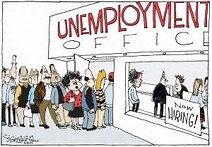
US politicians, led by POTUS (President of the United States) are congratulating themselves for the $2.2 trillion bailout (Care Act), bringing relief to Americans out of work.
But let’s look at this more closely. US unemployment has leaped from a 40 year low, to what the St. Louis Federal Reserve believes could be as high as 32% (higher than the 24% unemployment rate in the Great Depression of the 1930’s). So the right approach is: Extend unemployment benefits. Right?
Wrong!
A New York Times article by leading economists Emmanuel Saez and Gabriel Zucman makes this case:
“Instead of safeguarding employment, America is relying on beefed-up unemployment benefits to shield laid-off workers from economic hardship. To give just one example, in both the United States and Britain, the government is asking restaurant workers to stay home. But in Britain, workers are receiving 80 percent of their pay (up to £2,500 a month, or $3,125) and are guaranteed to get their job back once the shutdown is over. In America, the workers are laid off; they must then file for unemployment insurance and wait for the economy to start up again before they can apply for a new job, and if all goes well, sign a new contract and resume working.”
So clearly – the ‘extend unemployment insurance’ approach is NOT a solution. In the US, the right policy is to protect jobs. The wrong policy, the one adopted, is to pay pittances to those thrown out of work, in large part owing to government ‘shelter at home’ policy. The NYT continues:
“This dramatic spike in jobless claims [in the US] is an American peculiarity. In almost no other country are jobs being destroyed so fast. Why? Because throughout the world, governments are protecting employment. Workers keep their jobs, even in industries that are shut down. The government covers most of their wage through direct payments to employers. Wages are, in effect, socialized for the duration of the crisis.”
Socialized? SOCIALIZED!!!!???? Oh my, there’s that word, socialism. Yikes.
The US has a huge problem with semantics. Let’s be clear. Socialism is an economic and social and political system, in which the means of production, distribution, and exchange are owned by the government. By paying wages to employers, governments are NOT implementing socialism, but preserving capitalism, by keeping employers and their companies alive, for a few months. That’s it!
America, open your windows (how often have I said that!). Check out Europe, “Old Europe”, as US Presidents like to say.
“Some countries — like Germany, with its Kurzarbeit system, a policy aimed at job retention in times of crisis — already had the government infrastructure in place to send workers home while the state replaced most of their lost earnings. [Kurzarbeit, ‘short work’, shortens the work week for all to distribute the hours among more people]. But several nations with no experience in that area — like Britain, Ireland and Denmark — were able to introduce brand-new employment guarantee programs on the fly during the epidemic.”
There is a fundamental problem with using unemployment insurance as the main bailout tool:
“Even if unemployment is generously compensated — as it is in the $2.2 trillion bill Congress passed — there is nothing efficient in letting the unemployment rate rise to double digits. Losing one’s job is anxiety inducing. Applying for unemployment benefits is burdensome. The unemployment system risks being swamped soon by tens of millions of claims. Although some businesses may rehire their workers once the shutdown is over, others will have disappeared. When social distancing ends, millions of employer-employee relationships will have been destroyed, slowing down the recovery. In Europe, people will be able to return to work, as if they had been on a long, government-paid leave.”
There is a basic hidden assumption in the US Care (bailout) Bill. It is based on liquidation – let businesses go broke, they screwed up anyway, we’ll re-establish them when all this blows over. Wrong!!!
“A liquidationist ideology seems to have infected minds on both the left and the right. On the right, opposition to government grants to businesses is grounded in the view that markets should be left to sort out the consequences of the pandemic. Let airlines go bankrupt; shareholders and bondholders will lose but the airlines will restructure and re-emerge. The best way government can help is by slashing taxes, according to this view. The relief package includes more than $200 billion in tax cuts for business profits. This view is misguided. There is nothing efficient in the destruction of businesses that were viable before the virus outbreak. The crisis cannot be blamed on poorly managed corporations. Government support, in the case of a pandemic, does not create perverse incentives. Bankruptcies redistribute income, but in a chaotic and opaque way. And while bankruptcy might be a way to deal with the economic fallout of the pandemic for large corporations, it is not well adapted to small businesses. Without strong enough government support, many small businesses will have to liquidate.”
Wrong-headed American policy impacts us all. In the good old days of the global economy, from the 1950’s onward, whenever the world economy slowed, America’s economy was the locomotive. Burgeoning spending by eager US consumers created demand that pull other economies out of the mud, worldwide. That was a crucial role America played.
Today? We’re going to need America and China both, as locomotives, to pull us out of the Depression COVID-19 is causing. China seems to be coming out of it. Well done. But the US? Not under current policies. Sooner or later, policymakers will recognize their error. But the US President NEVER admits error and doubles down on wrongheaded statements and policies. So don’t count on the US correcting its fundamental MASSIVE mistake.
World, we’re on our own. America will sink, under a mountain of unemployment applications.
How the US Screwed Up:
A Litany of Fumbles
By Shlomo Maital

Ooops…fumbled the ball!
The United States, led by the Trump administration, has fumbled the ball in dealing efficaciously with the COVID-19 pandemic. Here is the terrible litany of fumbles, mistakes and bad decisions, which in the end cause the deaths of many people. Needlessly.
April 2018. Some nine or ten months before the crisis arose, Trump and his National Security Council advisor John Bolton (later fired himself…justice?) fire the NSC team charged with pandemic preparation; on April 8 Tim Bossert is fired, as Home Secretary Advisor, in charge of “comoprehensive defensive strategy against pandemics”. Bye bye strategy and plans. In May Rear Amiral Tim Ziemer, who headed a ‘health security team’ was fired and not replaced.
Fast forward: China experiences early COVID-19, and, rather late, in late December, informs the world of it, and warns. On Jan. 20 the Center for Disease Control, in the US, announces the first case, a traveler from Wuhan, China. “We shut it down”, Trump says on Feb. 2. In February the CDC sends out its COVID-19 test, to public health testing labs in the US states; it doesn’t work. The US, (pride? Ego?) fails to purchase tests that are proven to work, from South Korea and other countries. The test is fixed, finally – but valuable weeks are lost. The public health labs work at developing their own test, something that has never before happened.
“When the CDC rolled out its tests, a component in them turned out to be faulty. That was unfortunate, but it put a big spotlight on the CDC’s decision to use its own test kit instead of test kits other countries have used, reportedly in an effort to create a more accurate test.”
As of March 9, well into the US pandemic, only 4,300 COVID-19 tests had been carried out. Trump says, “the tests are perfect” (like his phone call to the Ukrainian President).
Press reports: “Testing is crucial to slowing epidemics. First, it lets public health officials identify sick people and subsequently isolate them. Second, they can trace that sick person’s recent contacts to make sure those people aren’t sick and to get them into quarantine as well. It’s one of the best tools we have for an outbreak like this. It’s also something that the federal government has done well before — recently, with H1N1 and Zika. “It’s been surprising to me that the administration’s had a hard time executing on some of these things,” Ashish Jha, director of the Harvard Global Health Institute, said. “
America dropped the ball on testing. Press reports: “In the months before the coronavirus outbreak, the administration cut a public health position that was meant to help detect disease outbreaks in China, where the pandemic began, Even without such cuts, experts and advocates argue the US generally underfunds disease outbreak preparedness and public health programs more broadly. Further cuts just deepen the risks of pandemics. The common refrain among experts is that other countries’ actions, such as China’s draconian measures, gave the US a bit of time to do something, but the federal government has failed to get even the basics right in that time.”
What was President Trump’s role in this? “Trump “did not push to do aggressive additional testing in recent weeks, and that’s partly because more testing might have led to more cases being discovered of coronavirus outbreak, and the president had made clear — the lower the numbers on coronavirus, the better for the president, the better for his potential re-election this fall.”
Hospitals, especially in New York City, complain they lack equipment. Why? There is a large US strategic stockpile of lots of useful things. However, “While the administration has said it’s using federal authorities and tapping into its stockpiles to get more of this gear to the places that need it, health care workers on the ground complain that they still don’t have enough — forcing them to reuse possibly contaminated equipment and choose between working in unsafe conditions or not show up to work at all. All of this at a time when the country needs to, according to experts, boost health care capacity.” There are rumors, Trump dislikes Washington state and New York State and that this is impacting federal shipments.
In a pandemic, preparedness is crucial. The US Defense Department has contingency plans for a huge variety of threats. What about the health area? “….. this reflects on the lack of preparedness: A shortage of medical equipment is one of the many problems government simulations and exercises warned about before the current outbreak. But Trump simply didn’t prioritize pandemic preparedness beforehand. The US … was not prepared … A good preparedness plan would have helped address this and had things in place to allow for that increased need to be met.”
US health care system is inadequate, even with Obamacare (imagine if Trump had succeeded in annulling it!?). “With the outbreak growing, the US’s lack of universal health care has become an even more obvious problem: If people can’t get testing, they’re less likely to find out they have Covid-19 and take precautions to avoid spreading the virus. If they can’t get treatment in case of complications, they’re more likely to suffer, potentially spread the disease, and die.”
Fighting the poor, rather than the virus: “The administration has pushed forward on measures that will kick people off food stamps. This will not only lead people to suffer if they lose their jobs as a result of a coronavirus-caused recession, but it could lead to sick people going to work and spreading the disease, because they won’t have a safety net if they don’t bring in a paycheck.”
Chasing immigrants, instead of virus: “Experts also pointed to the “public charge” rule, which effectively discourages immigrants from seeking public services, including health care, by threatening their immigration status if they are “likely to be a public charge” by relying on those services.”
Yes, the United States has dropped the ball – fumbled it. And this litany is very very partial – it’s only 1,000 words, it could fill a book.
And the sad part, again, is that when a halfback fumbles in football, worst case, his team loses the game. In the US, when the administration fumbles, people die. Many people. And then ? Excuses. Boy, are we going to hear excuses, all the way to November and beyond.
Dr. Anthony Fauci predicts, as many as 200,000 Americans could die in this pandemic. Many of these deaths could have been prevented, if the Administration had simply held onto the ball.
There has to be accountability. At the very least, at the ballot box in November.
Leadership in the Time of Plague
By Shlomo Maital

New York State Governor Andrew M. Cuomo
Even though I live in Israel, I find myself glued to the TV nightly, watching New York State Governor Andrew M. Cuomo’s addresses and press conferences on CNN. This is true of much of America, including President Trump, who schedules his own TV appearances in order not to conflict with Cuomo’s.
As I watch Cuomo, I ask myself, what is leadership? What are the key qualities of political leaders, in the time of plague? Why is Cuomo’s leadership so effective, in contrast with Trump’s and other political leaders, including my own here in Israel?
A few tentative answers. First, blunt honesty. Cuomo tells it like it is. His warnings carry weight and credibility. (Compare with, say, Trump, whose superlatives, great, terrific, perfect, ring hollow – remember, if a leader lies to us once, we will forever doubt ANYthing he or she says in future). Second, command. Cuomo has done his homework and he’s smart. He commands the numbers and the complexity of the situation and explains it clearly to people. Third, compassion. Cuomo is a touch leader, pragmatic, hard-nosed. But when he talks about his mother Matilda, and saving her if needed, and saving all us old people, he shows empathy and sympathy. Leaders have that combination of toughness and soft compassion, used in every case where appropriate. Fourth, pragmatism. Use common sense, figure out what is needed, get it done, no excuses (the Singapore formula). Fifth, Speed. Forget platitudes, we need ventilators now, hospital beds now, masks now. Look, New York State is not Trump’s favorite. We suspect he has withheld ventilators from the nation’s strategic stockpile. New York State prosecuted Trump’s so-called charity foundation. But Cuomo has not libeled or criticized Trump by name – only Federal agencies – and it has paid off. So leaders know how to pick their enemies, with care.
I want to share an approach I’ve found useful, for myself. I’m 77 years old and made lots of mistakes in my lifetime. So have we all. And it is painful to look back on some of them. So, today, perhaps a bit too late, I use this approach: When I need to make a decision, or decide how to behave, I ask myself: Shlomo, OK, how will you feel about this decision, in 10 years, when you look back on it? Will your chest swell with pride or will your stomach turn over with shame? Use this, and you can’t go wrong. This is the time for leadership – not just by our political leaders but by every single one of us, challenged by the situation and faced with choices – to help others effectively or hunker down and care only for ourselves.
And in conclusion, consider these words by Thomas Paine, written during the bitter days of the American Revolution – times that try people’s souls.
“THESE are the times that try men’s souls. The summer soldier and the sunshine patriot will, in this crisis, shrink from the service of their country; but he that stands by it now, deserves the love and thanks of man and woman. Tyranny, like hell, is not easily conquered; yet we have this consolation with us, that the harder the conflict, the more glorious the triumph. What we obtain too cheap, we esteem too lightly: it is dearness only that gives every thing its value. Heaven knows how to put a proper price upon its goods; and it would be strange indeed if so celestial an article as FREEDOM should not be highly rated” Thomas Paine 1776
Substitute “life” for freedom, as we battle the plague to save lives….
Donald Trump – Meet Nicola Machiavelli
By Shlomo Maital
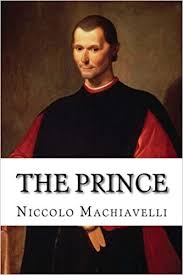
In 1513 an Italian politician and scholar named Nicola Machiavelli, living in exile on his farm, wrote a slim book, “Of Principalities”, which became known as The Prince. The book summed up Machiavelli’s 14 years of experience in the fraught political wars of Italian city-states and Medici rulers. In it, Machiavelli writes,
- “it is much safer to be feared than loved”,
- “people should either be caressed or crushed”, and
- “the new ruler must determine all the injuries that he will need to inflict” and
- “must inflict them once and for all.”
Wow. I read this in a New York Times book review by Jennifer Szalai, reviewing Patrick Boucheron’s new book Machiavelli: The Art of Teaching People What to Fear, written originally in French.
Now, US President Donald J. Trump is not an avid reader. I truly doubt he has read The Prince. But he doesn’t need to. Trump has applied every single political maxim in this amazing book, written 500 years ago. The same issue of the New York Times that carried this book review, also reported how Trump is purging his inner circle, and crushing his foes, ensuring far far fewer people listen in on his phone call conversations with world leaders. Trump lovingly caresses his supporters, like criminally-convicted Roger Stone, and viciously attacks and purges his opponents, like Lt. Col. Vindman. His Attorney General is his waterboy.
National Football League teams each have a playbook. President Trump has one, too, unwritten, and it is amazingly similar to that of Machiavelli. It has two plays only. Crush foes. Caress friends. Trump’s world is binary.
As Boucheron concludes: “If we’re reading [Machiavelli] today, it means we should be worried.”
I am. Because we are not just reading Machiavelli. We are living him. And maybe, as his Republican cult-followers chanted in the House of Representatives, during his State of the Union speech: for four more years???
p.s. this is blog # 1,600. Thanks for reading them.
The REAL American problem:
More Americans Are Dying
By Shlomo Maital

Rising US Morality Rates
What is wrong with America? Most news accounts focus on the US President, now featured on Twitter with the photo-shopped body of Rocky (check it out).
No, that is far from the only problem the US has. According to a new study in the leading medical journal JAMA, “increased death rates in midlife extended to all racial and ethnic groups, and to suburbs and cities.”
Suicides, drug overdoses and alcoholism were the main causes. But other illnesses, like heart disease, strokes, and chronic pulmonary disease, also contributed.
According to the New York Times, “the increase in deaths among people in midlife highlighted the lagging health measures in the US compared withother wealthy nations, even though the US has the highest per capita health spending in the world”.
And note: “fully a third of the ‘excess deaths’ (increased mortality) occurred in just four stats: Indiana, Kentucky, Ohio and Pennsylvania.
It seems that Trump is unavoidable. Those are key swing states that elected him. And his support there is still quite strong and resilient.
The Democrats made a key strategic error, by focusing Congress’s attention on impeachment, while people are dying. Impeachment will end in futility in the Senate. Meanwhile the Democrats’ resounding 2018 win, in gaining a House majority, came about largely because of the healthcare issue.
If Trump wins again in 2020, it will be the Dems’ own fault.
Understanding the Brexit Disaster:
Ask the Psychologists!
By Shlomo Maital

I’ve been glued to our TV, for weeks, watching the British debate in Parliament what to do next about Brexit. I’ve watched how the world’s oldest elected Parliament cannot find a majority for anything – except, maybe, NOT to crash out of the EU. I’ve watched how the Trump-like PM Boris Johnson tries to circumvent Parliament, in the name of democracy but instead mortally wounding it. I studied for a year in Manchester, and feel deeply sorry for the people of Britain – and am trying to understand how they got into this pickle.
Enter the psychologists. In the excellent podcast Hidden Brain, by Shankar Vedanta, the Harvard University psychologist Daniel Gilbert was recently interviewed. He spoke about this – we humans are incorrigibly bad at predicting the future,, specifically, in predicting how we will feel in future about a decision made in the present.
The British people voted narrowly (52 for, 48 against) to leave the EU, in 2016. Mainly they voted for “take our country back”, a slogan pushed by pro-Brexit politicians, driven by anger at the flood of migrants crossing the English Channel that under EU rules could not be stopped.
But what about other aspects of leaving the EU? What about the Ireland-Northern Ireland border? What about all the EU citizens living in Britain? What about trade, tariffs, customs? Then-PM David Cameron, who initiated the referendum, never believed it would pass, and never developed realistic future scenarios about how leaving the EU would be done. Former PM Theresa May stubbornly pushed the same leave-EU proposal to Parliament three times – despite zero chance of it passing.
Professor Gilbert explains, basically, that when we make a decision, we are pretty hopeless about predicting how we will feel about it. As the Brits learn more about what leaving the EU means – crashing out with no deal, in particular, as Johnson obsessively wants — I believe they regret their initial vote in 2016. In particular — if only 1.5 per cent of those who voted “leave” now change their mind and would vote ‘stay’ – the referendum would be reversed. Yet — cynics, in the name of democracy, say “the result of a referendum is set in stone” – even though Parliament, elected by the people, can change its mind a dozen times a day, also in the name of democracy.
Basically – people are flawed in how they predict how they will feel about a decision in the future. We know this from the work of psychologists, and from our own introspection.
Conclusion: Do another referendum on “leave or stay”. Take into account that humans are flawed. Give the British people another chance.
But Johnson and pro-Brexit politicians insist this is undemocratic. Wrong.
The 2016 referendum was terribly flawed. The British people were not told the full story. They voted on the basis of a narrow idea, ‘take our country back’. They weren’t told, how precisely this would be done.
So – do it again. Offer clear precise scenarios. And offer a clear ‘leave’ plan, including Ireland.
Why the World Economy is Slowing – And What You Should Do
By Shlomo Maital
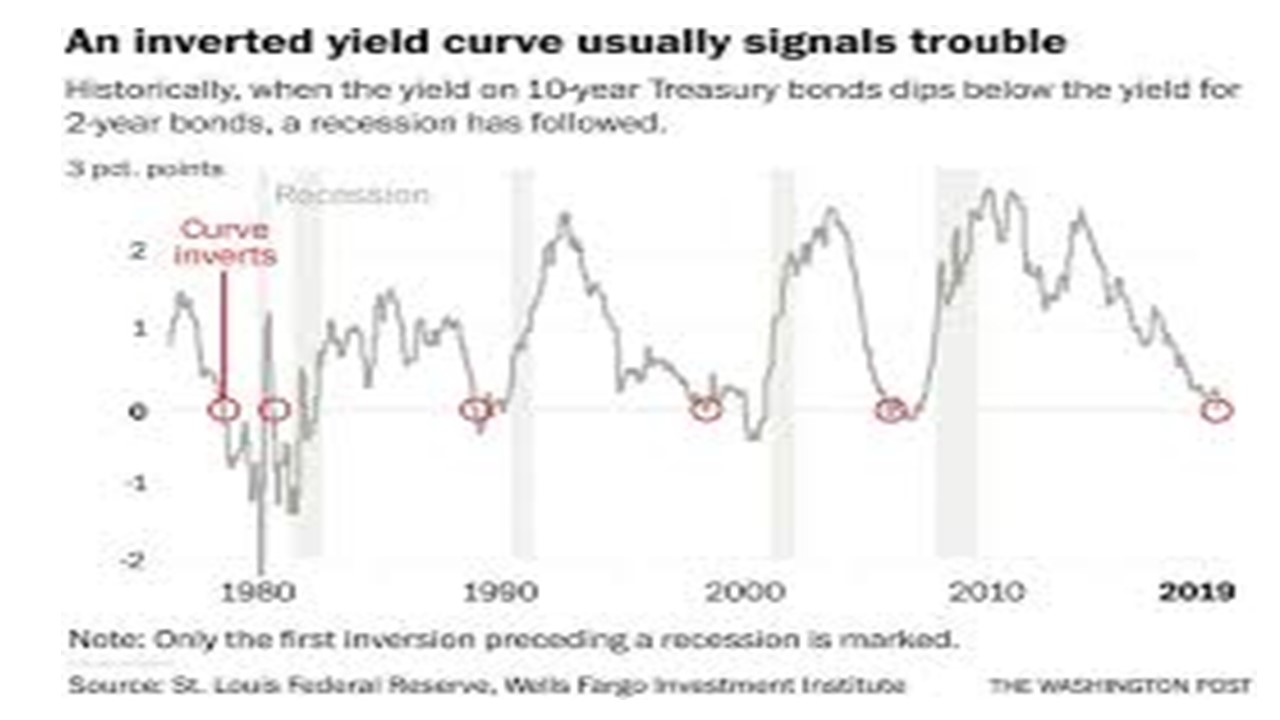
graph: Federal Reserve, Wells Fargo, Washington Post
What in the world is going on? It’s time to try to make some sense of it.
The Dow-Jones stock index takes its biggest plunge of the year. Bond markets are jumpy. And everyone talks about the inverted yield curve. What is going on?
Let’s try to understand all this.
The ‘yield curve’ is simply a chart or table, showing the rate of interest you make on your investment, and the length of time you invest the money. In normal times, the longer the time you commit your money, the higher the return or yield. It’s just natural. A longer time period means more risk.
But once in a while, the normal order of things gets turned upside down. And that is what is happening now. Why?
When investors are afraid that a recession – an economic slowdown — is brewing, they anticipate that Central Banks will have to lower interest rates in response. So they buy longer-term bonds to ‘lock in’ current higher rates, in the knowledge that soon those rates will come down.
That rise in demand for, say, 10-year bonds, raises the price of the bonds, by the law of supply and demand, and when the price of a bond goes up, then its rate of interest goes down. Why? If the bond coupon is $3 for a $100 bond, and if you pay $110 for the bond, your return is 3/110 or only 2.7%. Higher bond price, lower yield.
That is what is happening now. The last global recession was in 2008, after the financial crash and panic of 2007/8. The current global expansion has lasted 10 years. It’s one of the longest such expansions. It is long in the tooth. It is the nature of business that after booms, come busts, big or small. And it seems time for a bust.
As the graph above shows, since 1980 every single time the long-term yield or interest rate falls below the short-term rate, there has been a recession, within a few months.
Other signs confirm this. China’s economy is slowing, growing slower than it has for decades. Europe is slowing – Germany is in recession already, Britain will be in recession after a crash-out Brexit, Italy is again in deep hot water. The US economy is also slowing, buoyed only by consumer spending. Business investment is low, because of uncertainty over the trade war, and the belief China will hope for a Trump defeat in 2020 and is simply waiting it out. So when Europe, China AND the US economies slow – there are no locomotives to pull the global economy out of the mud.
This is bad news for President Trump. His overall approval rating is way below 50%. But his approval rating on the US economy alone is well above 50%. An economic slump could cost him re-election. And he knows it.
Trump has been fiercely critical of Jay Powell, Chair of the US Federal Reserve (central bank). For once, maybe only once, he is kind of right. Last September, the Fed raised interest rates slightly, by 25 basis points (0.25%) to current levels, the highest since April 2008. Whooops… not wise, when a slowdown is imminent, and when the Fed may hence have to do a sharp U-turn that lowers its credibility.
For us working people, what does all this mean? Cut back on your spending somewhat. Set aside some money. The recession may be short, it may be long, or it may not happen. But chances are it will. Good to have a cushion on hand, if it comes. You never know.

 TIMnovate