
You are currently browsing the category archive for the ‘Innovation Blog’ category.
COVID-19: The Economists’ Perspective
By Shlomo Maital

As readers know, I am an economist and have been super-critical of my fellow economists; I believe our prescriptions have done massive damage to the world, including the free-market greed-is-good credo that led to 2007/8. But in the current pandemic, I am hearing words of wisdom from brilliant economists like Nobel Laureate Paul Krugman, a New York Times columnist.
In his latest Op-Ed, in the New York Times (April 1) Krugman brings some serious wisdom. Let me summarize what he says.
“To simplify things, think of the economy as consisting of two sectors, nonessential services (N) that we can shut down to limit human interactions and hence the spread of the disease, and essential services (E) that we can’t (or perhaps don’t need to, because they don’t involve personal interaction.) We can and should close down the N sector until some combination of growing immunity, widespread testing to quickly find and isolate cases, and, if we’re very lucky, a vaccine let us return to normal life.
“For those (like me) still receiving their regular paychecks, this period of shutdown — call it the coronacoma — will be annoying but not serious. I miss coffee shops and concerts, but can live without them for however long it takes.
“Things will, however, be very different and dire for those who are deprived of their regular income while the coronacoma lasts. This group includes many workers and small businesses; it also includes state and local governments, which are required to balance their budgets but are seeing revenues collapse and expenses soar.
“How big is the N sector? Miguel Faria-e-Castro of the St. Louis Fed summarizes estimates that are as good as any: 27 to 67 million people, [for the United States], which he averages to 47 million. That’s a lot; we could be looking at a temporary decline in real GDP of 30 percent or more. But that GDP decline isn’t the problem, since it’s a necessary counterpart of the social distancing we need to be doing. The problem instead is how to limit the hardships facing those whose normal income has been cut off.
“What can be done to help those cut off from their normal incomes during this period of national lockdown? They don’t need jobs — we don’t want them working at a time when normal work routines can spread a deadly disease. What they need, instead, is money. That is, what’s needed now is disaster relief, not economic stimulus.”
So many ‘experts’ who tell us what should be done, are sitting pretty with large bank accounts and salaries that continue to flow. Krugman’s empathy for those without income – many many millions – is exemplary. THEY are the ones we need to worry about most.
So, as I’ve written elsewhere: Save Lives, yes…and save jobs, too, by writing checks. If needed, pay the salaries and wages of workers for businesses, to keep them afloat. Disaster relief…as Krugman says.
Testing holds the key. Why? Using Krugman’s terminology: Suppose we had sufficient tests, deployed rapidly, with quick results, to know if EVERY working person had COVID-19. Divide the populace into N (non-essential, or infected) and E (essential and clean). If you shut down N+E together, everyone, you lose output and jobs – you lose E times (average output or income of E), which is huge and unnecessary. If you shut down only N, you get all the jobs and output of E, and income. And you can use it to help pay survival incomes to the N.
This makes sense, right? And we CAN get those quick automated tests out the door if they are given priority.
Save the Theodore Roosevelt!
By Shlomo Maital

USS Theodore Roosevelt Aircraft Carrier
Many years ago, my son Ronen, then an officer and chief engineer on an Israeli missile boat, and I boarded an American Sea Stallion helicopter at Ben Gurion Airport, Tel Aviv, and were ferried to the enormous American nuclear aircraft carrier Theodore Roosevelt, anchored a few miles offshore. (The ship was far too big to enter Haifa Port).
This was made possible by my cousin Malcolm, then a nuclear sub commander. Thanks again, Mal!
Ronen and I were astounded. Eleven decks, 5,000 sailors, nuclear engines meant it could stay on duty for many months, 80 jet aircraft launched from the upper deck, and the ability to launch and receive planes at the same time – and the capability, practiced frequently, of launching and recovering in the dark of night (not done by other nations).
Wow.
Fast forward. COVID-19. A New York Times article reports: Captain of Aircraft Carrier Pleads for Help as Virus Cases Increase Onboard. “We are not at war,” the captain of the carrier Theodore Roosevelt wrote. “Sailors do not need to die. If we do not act now, we are failing to properly take care of our most trusted asset — our sailors.”
The ship was then in Guam. Hospital facilities there are very very limited.
In a four-page letter dated Monday, first reported by The San Francisco Chronicle on Tuesday, Capt. Crozier laid out the dire situation unfolding aboard the warship, the Theodore Roosevelt, which has more than 4,000 crew members. He described what he said were the Navy’s failures to provide him with the proper resources to combat the virus by moving sailors off the vessel. “We are not at war,” Captain Crozier wrote. “Sailors do not need to die. If we do not act now, we are failing to properly take care of our most trusted asset — our sailors.”
(The Acting Secretary of the Navy has responded that, well, nobody on the ship is really THAT ill… so — suck it up, guys!)
“Thomas B. Modly, the acting Navy secretary, told CNN in an interview that the Navy was working to move sailors off the ship — but that there were not enough beds in Guam to accommodate the entire crew.”
“We’re having to talk to the government there to see if we can get some hotel space, create some tent-type facilities there,” Mr. Modly said. “We’re doing it in a very methodical way because it’s not the same as a cruise ship.”
Speaking to reporters Tuesday night, the commander of the Pacific Fleet, Adm. John C. Aquilino, said that “we’re welcoming feedback” regarding the requests outlined by Captain Crozier. Admiral Aquilino said that crew members would be rotated off the carrier for testing and quarantine before returning aboard. The intent, he said, was to keep the ship ready to carry out its missions. He said that no crew members had been hospitalized thus far, but he declined to specify the number of infections.
“The problem aboard the Roosevelt highlights a central dilemma facing the military: Top officials, who have spent years placing readiness to fight the next war as a top priority, are now finding that maintaining that readiness during a pandemic can endanger the health, and even the lives, of service members. At the same time that Americans are being told to stay at home and practice “social distancing” in public, many service members are instead being told to continue doing their jobs.”
I find this episode infuriating! I’ve served in military reserves and trained hard. Be ready to fight, is the credo. True. But in times of pandemic plague? Save lives. And soldiers’ lives matter too.
Anyone want to start a Twitter account, Soldiers’ and Sailors’ Lives Matter? Because they do.
Wake up, Defense Secretary Mark Ester. You can save the lives of the sailors on the Theodore Roosevelt. These young men and women, some only 19 years old, spend long months at sea, away from their families. In normal times they defend America, all over the world. But now? It is urgent, top priority, to save their lives.
So – do something! DO SOMETHING! If you do not, their lives are your responsibility. And there will be no forgiveness.
Unemployment Insurance? Or Guaranteed Wages?
The Cost of Wrong Choices
By Shlomo Maital
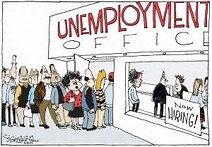
US politicians, led by POTUS (President of the United States) are congratulating themselves for the $2.2 trillion bailout (Care Act), bringing relief to Americans out of work.
But let’s look at this more closely. US unemployment has leaped from a 40 year low, to what the St. Louis Federal Reserve believes could be as high as 32% (higher than the 24% unemployment rate in the Great Depression of the 1930’s). So the right approach is: Extend unemployment benefits. Right?
Wrong!
A New York Times article by leading economists Emmanuel Saez and Gabriel Zucman makes this case:
“Instead of safeguarding employment, America is relying on beefed-up unemployment benefits to shield laid-off workers from economic hardship. To give just one example, in both the United States and Britain, the government is asking restaurant workers to stay home. But in Britain, workers are receiving 80 percent of their pay (up to £2,500 a month, or $3,125) and are guaranteed to get their job back once the shutdown is over. In America, the workers are laid off; they must then file for unemployment insurance and wait for the economy to start up again before they can apply for a new job, and if all goes well, sign a new contract and resume working.”
So clearly – the ‘extend unemployment insurance’ approach is NOT a solution. In the US, the right policy is to protect jobs. The wrong policy, the one adopted, is to pay pittances to those thrown out of work, in large part owing to government ‘shelter at home’ policy. The NYT continues:
“This dramatic spike in jobless claims [in the US] is an American peculiarity. In almost no other country are jobs being destroyed so fast. Why? Because throughout the world, governments are protecting employment. Workers keep their jobs, even in industries that are shut down. The government covers most of their wage through direct payments to employers. Wages are, in effect, socialized for the duration of the crisis.”
Socialized? SOCIALIZED!!!!???? Oh my, there’s that word, socialism. Yikes.
The US has a huge problem with semantics. Let’s be clear. Socialism is an economic and social and political system, in which the means of production, distribution, and exchange are owned by the government. By paying wages to employers, governments are NOT implementing socialism, but preserving capitalism, by keeping employers and their companies alive, for a few months. That’s it!
America, open your windows (how often have I said that!). Check out Europe, “Old Europe”, as US Presidents like to say.
“Some countries — like Germany, with its Kurzarbeit system, a policy aimed at job retention in times of crisis — already had the government infrastructure in place to send workers home while the state replaced most of their lost earnings. [Kurzarbeit, ‘short work’, shortens the work week for all to distribute the hours among more people]. But several nations with no experience in that area — like Britain, Ireland and Denmark — were able to introduce brand-new employment guarantee programs on the fly during the epidemic.”
There is a fundamental problem with using unemployment insurance as the main bailout tool:
“Even if unemployment is generously compensated — as it is in the $2.2 trillion bill Congress passed — there is nothing efficient in letting the unemployment rate rise to double digits. Losing one’s job is anxiety inducing. Applying for unemployment benefits is burdensome. The unemployment system risks being swamped soon by tens of millions of claims. Although some businesses may rehire their workers once the shutdown is over, others will have disappeared. When social distancing ends, millions of employer-employee relationships will have been destroyed, slowing down the recovery. In Europe, people will be able to return to work, as if they had been on a long, government-paid leave.”
There is a basic hidden assumption in the US Care (bailout) Bill. It is based on liquidation – let businesses go broke, they screwed up anyway, we’ll re-establish them when all this blows over. Wrong!!!
“A liquidationist ideology seems to have infected minds on both the left and the right. On the right, opposition to government grants to businesses is grounded in the view that markets should be left to sort out the consequences of the pandemic. Let airlines go bankrupt; shareholders and bondholders will lose but the airlines will restructure and re-emerge. The best way government can help is by slashing taxes, according to this view. The relief package includes more than $200 billion in tax cuts for business profits. This view is misguided. There is nothing efficient in the destruction of businesses that were viable before the virus outbreak. The crisis cannot be blamed on poorly managed corporations. Government support, in the case of a pandemic, does not create perverse incentives. Bankruptcies redistribute income, but in a chaotic and opaque way. And while bankruptcy might be a way to deal with the economic fallout of the pandemic for large corporations, it is not well adapted to small businesses. Without strong enough government support, many small businesses will have to liquidate.”
Wrong-headed American policy impacts us all. In the good old days of the global economy, from the 1950’s onward, whenever the world economy slowed, America’s economy was the locomotive. Burgeoning spending by eager US consumers created demand that pull other economies out of the mud, worldwide. That was a crucial role America played.
Today? We’re going to need America and China both, as locomotives, to pull us out of the Depression COVID-19 is causing. China seems to be coming out of it. Well done. But the US? Not under current policies. Sooner or later, policymakers will recognize their error. But the US President NEVER admits error and doubles down on wrongheaded statements and policies. So don’t count on the US correcting its fundamental MASSIVE mistake.
World, we’re on our own. America will sink, under a mountain of unemployment applications.
COVID-19: Logarithms Hold the Key
By Shlomo Maital

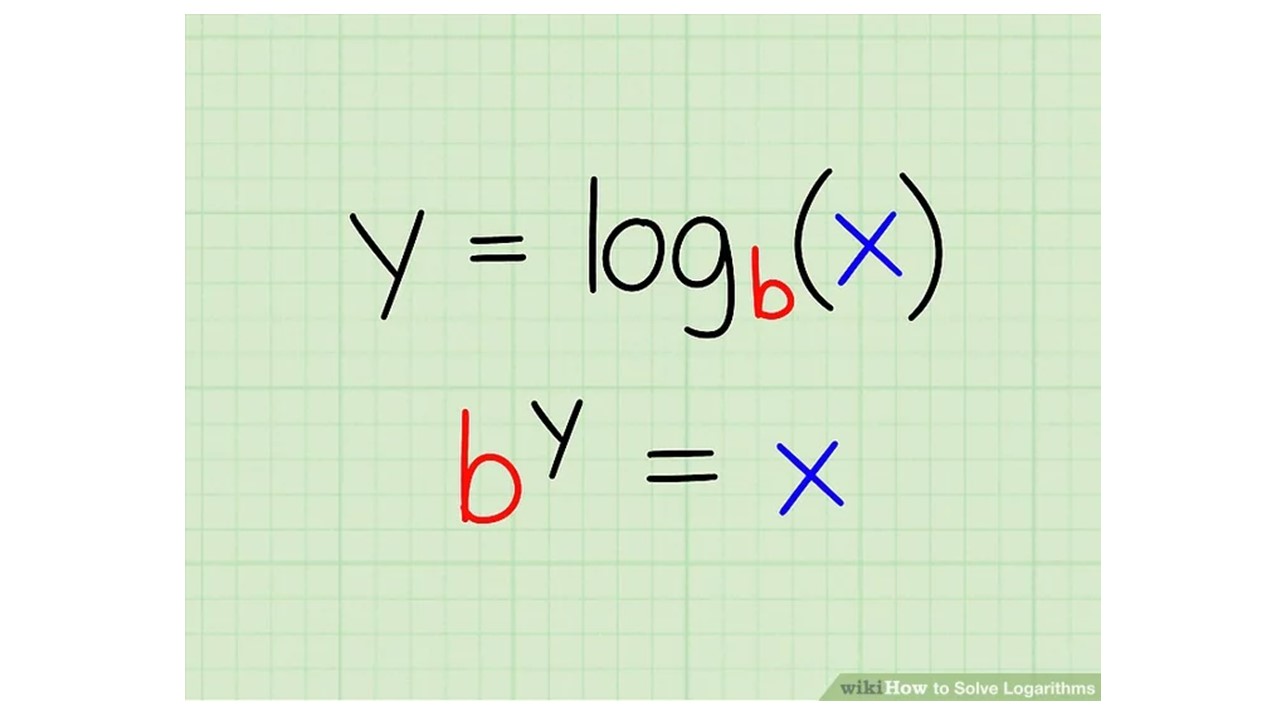
Warning: This blog could be harmful to your health…because it’s about… logarithms. (Logs). And plague. What in the world?
Well, let’s give it a shot. Nothing to lose.
A logarithm is a number, such that when its ‘base’ (usually, the number ten, or the number ‘e’, 2.71828 (we do NOT have to go into the black depths of THAT number), is raised to the value of the log, you get the value of your starting number, x.
For instance, 102 = 100. So the logarithm of 100 (using the ‘base’ of 10) is 2.
Clear?
Why are logarithms useful? Well, they have fallen into massive disuse lately, because of computers and calculators. But once they were crucial. Because, suppose you need to multiply two big numbers. On paper. Ouch! But wait! If you knew the logarithms of the two numbers? Add them! Because? The value of by times bz equals bz+y — so, we have converted multiplying (hard!) to addition (easy!).
Logarithms was publicly proposed by John Napier in 1614, an English mathematician. Generations of school children (like my mother) had to learn the secrets of logs.
But what has this to do with COVID-19. So – there is a wonderful magical property of logs. Suppose there is a key number that you are tracking. E.g., the number of people in your country or your city or community, who have COVID-19. You can graph it, look at it, inspect the curve, it is rising, OK, but – what does it mean?
So here is what John Napier would recommend, 400 years ago. Take the logarithm of the number. Graph THAT, not the number itself.
Why? Because – trust me on this — the gradient, (steepness, or slope) of the logarithm graph tells everything. If the slope of the log is RISING, then the RATE of increase is increasing. If the slope is getting less steep, FALLING, the rate of increase of COVID-19 is declining. And this is crucial, to know how we’re doing. And you CANNOT tell this is you graph the number itself.
So, here in Israel, the slope of the logarithm of the number infected with COVID-19 has been declining. Yay! The rate of increase is declining. We’re getting toward the apex. It’s a ways off…but once we reach the top of THAT hill, the slope of the log will turn from positive to negative…and that’s a KEY point. Because that’s when the number infected begins to fall….cause of celebration.
Clear? Clear as mud? So here is a sample graph. This is the total number of cases outside China. On a log scale. You can see a constant slope – constant rate of growth, as the virus spreads. Reflecting, maybe, a very slow response in Europe and the US.
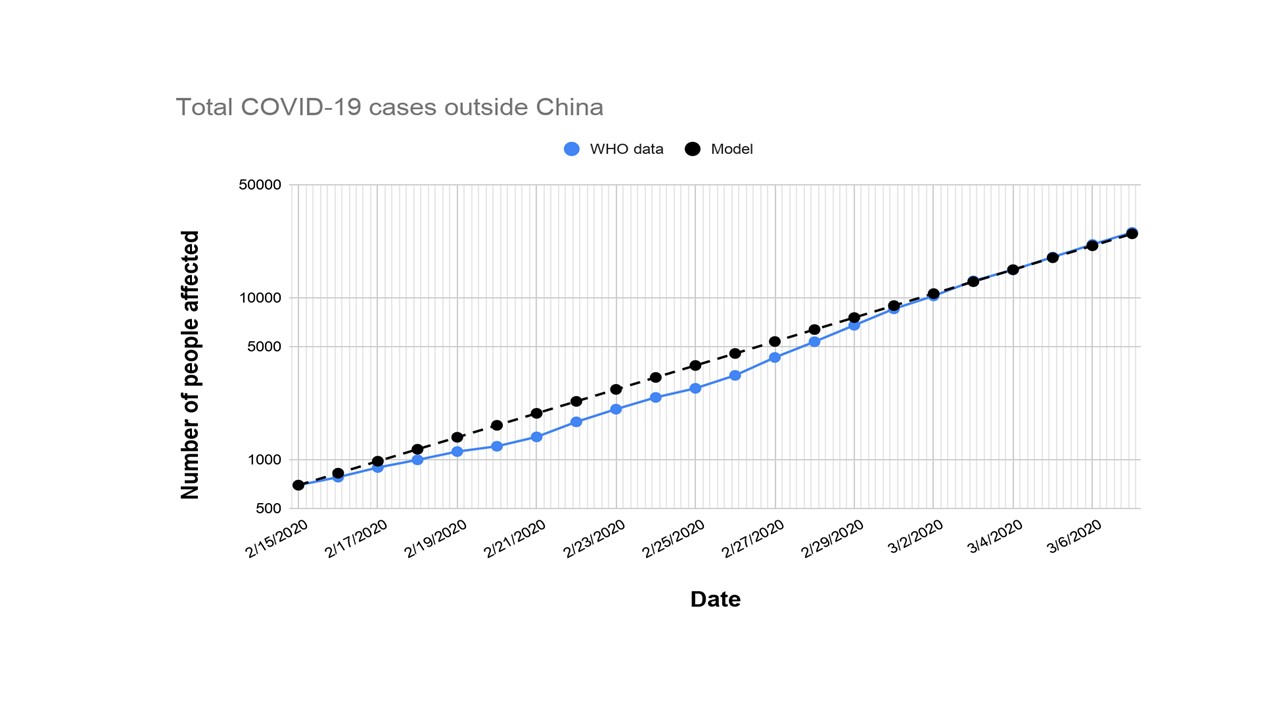
So – in your country or city, track the logarithm of the number of cases, and measure the slope. That tells you whether it is speeding up or slowing down. I don’t think our political leaders are quite up to that difficult mental exercise.
The Big Winners: Dogs
By Shlomo Maital

SAMSUNG
There is one big winner in the COVID-19 “shelter at home”: Our dogs. Like Pixie, our mixed-breed part-Yorkshire. We’re always at home, so any time is play time, and she brings us her rope and her weasel, to throw and play fetch. Then it’s walk time – it’s legal under partial ‘shelter at home’ to walk dogs, so she gets many daily walks, and we benefit from the fresh air.
When it’s TV time, she curls up on our laps, and as an equal opportunity dog, divides her presence between myself and my wife. She does her little circle – legacy of her wolf origins, who circle before lying down to sleep – and tucks in at our feet, her right ear straight in the air, alert and listening even when she sleeps. All this, in 4 kilograms (8.8 pounds).
Dog cognition expert Alexandra Horowitz, Barnard College, writing in today’s New York Times, observes, “[Dogs’] simple presence, and their willingness to be touched, is viscerally satisfying. Time spent reading on the couch is massively improved by a dog’s head resting on my leg, a warm snuffling muzzle directed at me is instantly calming. …there are some 90 million dogs in the US and in some ways we have treated dogs as quasi-people all along. “.
Horowitz notes that normally dogs experience social isolation, as the owners are at work. They stay alone for most of their days. Now that WE are in ‘social isolation’, we are giving dogs ‘more of what they deserved all along – our companionship’.
One of the benefits of COVID-19 is a major rise in dog adoption. “…shelters that recently put out calls seeking foster care for homeless animals reported being inundated with applicants…”.
Concludes Horowitz: “I hope we will maintain some of our current abnormal condition, giving our dogs the companionship they need. I hope we will come out of this with a fuller appreciation of the privilege that it is to keep the company of animals.”
Pixie: Thanks! We love and need you.
How the US Screwed Up:
A Litany of Fumbles
By Shlomo Maital

Ooops…fumbled the ball!
The United States, led by the Trump administration, has fumbled the ball in dealing efficaciously with the COVID-19 pandemic. Here is the terrible litany of fumbles, mistakes and bad decisions, which in the end cause the deaths of many people. Needlessly.
April 2018. Some nine or ten months before the crisis arose, Trump and his National Security Council advisor John Bolton (later fired himself…justice?) fire the NSC team charged with pandemic preparation; on April 8 Tim Bossert is fired, as Home Secretary Advisor, in charge of “comoprehensive defensive strategy against pandemics”. Bye bye strategy and plans. In May Rear Amiral Tim Ziemer, who headed a ‘health security team’ was fired and not replaced.
Fast forward: China experiences early COVID-19, and, rather late, in late December, informs the world of it, and warns. On Jan. 20 the Center for Disease Control, in the US, announces the first case, a traveler from Wuhan, China. “We shut it down”, Trump says on Feb. 2. In February the CDC sends out its COVID-19 test, to public health testing labs in the US states; it doesn’t work. The US, (pride? Ego?) fails to purchase tests that are proven to work, from South Korea and other countries. The test is fixed, finally – but valuable weeks are lost. The public health labs work at developing their own test, something that has never before happened.
“When the CDC rolled out its tests, a component in them turned out to be faulty. That was unfortunate, but it put a big spotlight on the CDC’s decision to use its own test kit instead of test kits other countries have used, reportedly in an effort to create a more accurate test.”
As of March 9, well into the US pandemic, only 4,300 COVID-19 tests had been carried out. Trump says, “the tests are perfect” (like his phone call to the Ukrainian President).
Press reports: “Testing is crucial to slowing epidemics. First, it lets public health officials identify sick people and subsequently isolate them. Second, they can trace that sick person’s recent contacts to make sure those people aren’t sick and to get them into quarantine as well. It’s one of the best tools we have for an outbreak like this. It’s also something that the federal government has done well before — recently, with H1N1 and Zika. “It’s been surprising to me that the administration’s had a hard time executing on some of these things,” Ashish Jha, director of the Harvard Global Health Institute, said. “
America dropped the ball on testing. Press reports: “In the months before the coronavirus outbreak, the administration cut a public health position that was meant to help detect disease outbreaks in China, where the pandemic began, Even without such cuts, experts and advocates argue the US generally underfunds disease outbreak preparedness and public health programs more broadly. Further cuts just deepen the risks of pandemics. The common refrain among experts is that other countries’ actions, such as China’s draconian measures, gave the US a bit of time to do something, but the federal government has failed to get even the basics right in that time.”
What was President Trump’s role in this? “Trump “did not push to do aggressive additional testing in recent weeks, and that’s partly because more testing might have led to more cases being discovered of coronavirus outbreak, and the president had made clear — the lower the numbers on coronavirus, the better for the president, the better for his potential re-election this fall.”
Hospitals, especially in New York City, complain they lack equipment. Why? There is a large US strategic stockpile of lots of useful things. However, “While the administration has said it’s using federal authorities and tapping into its stockpiles to get more of this gear to the places that need it, health care workers on the ground complain that they still don’t have enough — forcing them to reuse possibly contaminated equipment and choose between working in unsafe conditions or not show up to work at all. All of this at a time when the country needs to, according to experts, boost health care capacity.” There are rumors, Trump dislikes Washington state and New York State and that this is impacting federal shipments.
In a pandemic, preparedness is crucial. The US Defense Department has contingency plans for a huge variety of threats. What about the health area? “….. this reflects on the lack of preparedness: A shortage of medical equipment is one of the many problems government simulations and exercises warned about before the current outbreak. But Trump simply didn’t prioritize pandemic preparedness beforehand. The US … was not prepared … A good preparedness plan would have helped address this and had things in place to allow for that increased need to be met.”
US health care system is inadequate, even with Obamacare (imagine if Trump had succeeded in annulling it!?). “With the outbreak growing, the US’s lack of universal health care has become an even more obvious problem: If people can’t get testing, they’re less likely to find out they have Covid-19 and take precautions to avoid spreading the virus. If they can’t get treatment in case of complications, they’re more likely to suffer, potentially spread the disease, and die.”
Fighting the poor, rather than the virus: “The administration has pushed forward on measures that will kick people off food stamps. This will not only lead people to suffer if they lose their jobs as a result of a coronavirus-caused recession, but it could lead to sick people going to work and spreading the disease, because they won’t have a safety net if they don’t bring in a paycheck.”
Chasing immigrants, instead of virus: “Experts also pointed to the “public charge” rule, which effectively discourages immigrants from seeking public services, including health care, by threatening their immigration status if they are “likely to be a public charge” by relying on those services.”
Yes, the United States has dropped the ball – fumbled it. And this litany is very very partial – it’s only 1,000 words, it could fill a book.
And the sad part, again, is that when a halfback fumbles in football, worst case, his team loses the game. In the US, when the administration fumbles, people die. Many people. And then ? Excuses. Boy, are we going to hear excuses, all the way to November and beyond.
Dr. Anthony Fauci predicts, as many as 200,000 Americans could die in this pandemic. Many of these deaths could have been prevented, if the Administration had simply held onto the ball.
There has to be accountability. At the very least, at the ballot box in November.
Find Meaning in Plague
By Shlomo Maital

New York Times Op-Ed columnist David Brooks reminds us, today, that there is “moral meaning to plague”. He quotes Victor Frankl, whose book Man’s Search for Meaning has influenced millions; in it Frankl describes how he survived the Holocaust death camps. He found meaning.
How can each of us find meaning, in this plague epidemic?
“Frankl saw three possible sources for meaning: in work (doing something significant), in love (caring for another person) and in courage during difficult times. Suffering in and of itself is meaningless; we give our suffering meaning by the way in which we respond to it.” (Wiki)
Work. Love. Courage. Pretty straightforward.
Work – we do what we normally do, only at home and online. Amazing how adaptable many people are, in their work. Special kudos to moms (and dads), who also care for young children.
Love. Care for others. Let’s follow a formula I find useful, that I have borrowed: When you wake, ask 2 questions: What shall I do for myself today? (If you are not happy, strong, healthy, fit, effective, it’s hard to help others). What shall I do for others today? And, when you fall asleep, ask, What did I do for myself today? And – what did I do for others today?
Courage. This may involve facing danger, opposition, humiliation. What is going wrong, that you can see, understand, and try to fix, or at least bring attention to it?
There IS meaning in this epidemic. I see it everywhere, everyone, every day. Let’s all work hard to find it and leverage it.
Meet Andrea Ray: Heroine
By Shlomo Maital

In our pandemic crisis, there are a huge number of unsung everyday heroes. Truck drivers who continue to drive the long hauls, delivery people, supermarket workers, police, Israel’s Home Front soldiers….
And, in particular, Andrea Ray, featured on Channel 12 this evening. Andrea was born in Venezuela and made Aliyah to Israel when she was 16. She studied hotel management and had a senior job in the Dan Hotels system.
Israel has taken over some of the Dan Hotels in Tel Aviv, and brought those who have tested positive for COVID-19, especially those flown home from abroad, to hotels. The area housing these patients is of course strictly quarantined, and the hotel is run jointly by the Home Front soldiers and Dan management.
Why is Andrea a hero? Who will care for the corona patients? Seriously? Spend many hours of the day mingling with those ill with the deadly virus?
You cannot tell someone to do this. You can only ask for volunteers.
And Andrea volunteered. This is what she does, every day, for hours and hours – cares for the needs of the patients, cheers them up, laughs with them, and brings them joy with her smile.
What if she falls ill? Well, I’ll get the virus and then I’ll get better, she says.
So, you’ve met Andrea Ray, heroine. Do you know other such heroes and heroines?
Unpacking the COVID-19 Stats: Four Measures
By Shlomo Maital

The COVID-19 statistics can be very confusing, and the press has not been great at dispelling the fog. Here is how the New York Times explains the four key measures:
- By Nate Cohn, Josh Katz, Margot Sanger-Katz and Kevin Quealy March 27, 2020
- 1. Cases per 1,000 people. This is a measure of the prevalence of coronavirus in the community. Confirmed Cases per 1,000 residents. An imperfect measure, because of spotty testing – are there few cases because of limited testing, or few cases because testing has shown this to be true? Hard to know.
- Confirmed cases per 1,000 by metro area
- New York City, at 2.15, is just below #1, Wuhan, China, 4.59, and Lombardy Region, Italy, 3.48, but Albany Ga. And New Orleans are surprisingly high, too, as ‘hot spots’, at 1.35, and 1.32, respectively.
- * HOW WIDESPREAD IS THE CORONAVIRUS IN THE COMMUNITY OR CITY?
- Each measure answers a different question.
| METRO AREA | POPULATION | CASES | PER THOUSAND |
| Wuhan, China | 11.1 mil. | 50,821 | 4.59 |
| Lombardy region, Italy | 10 mil. | 34,889 | 3.48 |
| New York | 20 mil. | 43,016 | 2.15 |
*HOW DEADLY IS THE VIRUS? WHAT IS THE DEATH RATE?
- Deaths per 1,000 people. This measure is likely to be more accurate, alas, than other measures. But this measure lags the number of infections by several weeks…
Deaths per capita are currently higher in the New York City area than in most other places.
| METRO AREA | POPULATION | DEATHS | PER THOUSAND |
| Lombardy region, Italy | 10 mil. | 4,861 | 0.48 |
| Wuhan, China | 11.1 mil. | 2,535 | 0.23 |
| Albany, Ga. | 153,000 | 10 | 0.07 |
| New Orleans | 1.3 mil. | 65 | 0.05 |
| Seattle | 3.9 mil. | 133 | 0.03 |
| Burlington, Vt. | 221,000 | 6 | 0.03 |
| New York | 20 mil. | 500 | 0.03 |
HOW FAST IS THE CORONAVIRUS SPREADING?
- Growth Rates Over Time.
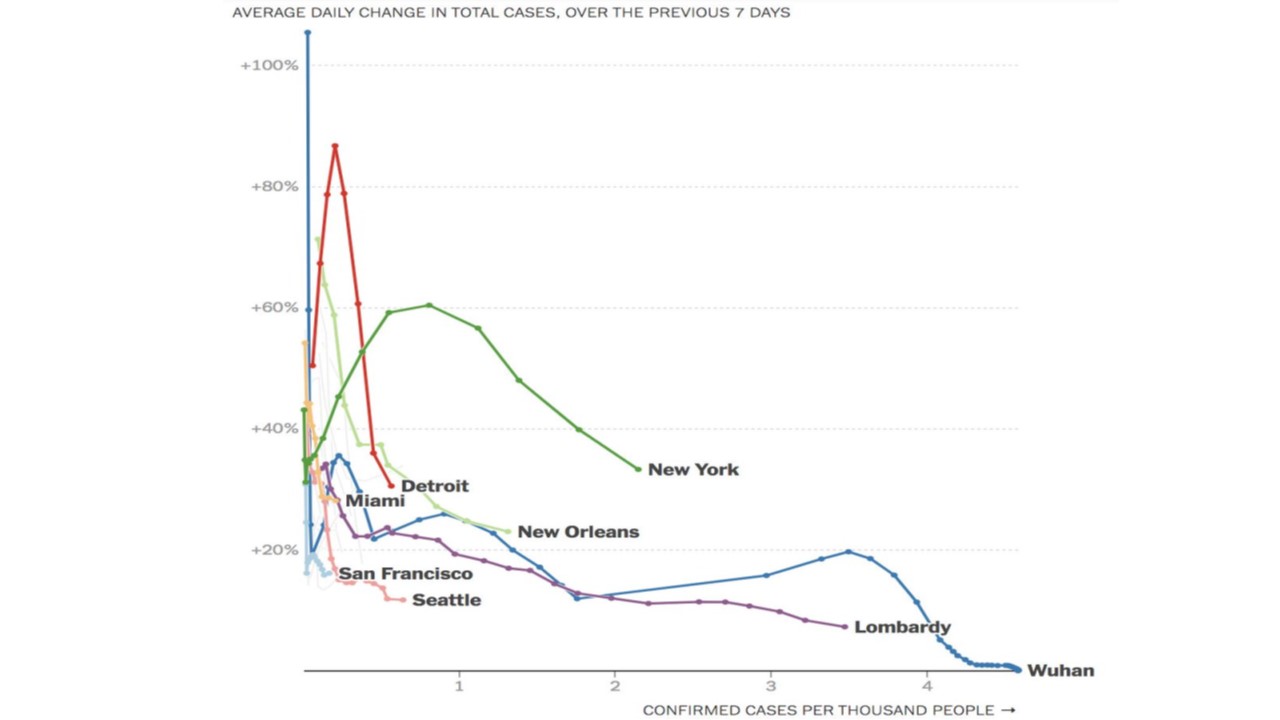
Measure: the rate of cumulative cases over time, averaged over the previous week. This helps us learn, is the epidemic getting better or worse? Are we at the ‘apex’ (worst is behind us) or before it?
A growth rate of 40 percent on this chart means the cumulative number of cases is growing by 40 percent every day. A rate of 100 percent would mean that the number of cases was doubling daily.

March 1 March 8 March 22
HOW WELL HAS THE COMMUNITY OR CITY DONE, IN SLOWING DONE THE RATE AT WHICH THE CORONAVIRUS IS GROWING?
- Growth Rates by Case Count.
This measure is the rate of growth of the number of cases in a given place – it measures whether a community has slowed the rate of growth, before there is many cases. I.e., is the community flattening the curve?
Seattle and San Francisco succeeded in flattening the curve. How come? These measures help us ask the right questions
AVERAGE DAILY CHANGE IN TOTAL CASES, OVER THE PREVIOUS 7 DAYS
CONFIRMED CASES PER THOUSAND PEOPLE
= = = = = =
We need to be cautious when interpreting coronavirus statistics. And a wide variety of stats are being tossed at us, often by those who do not fully understand them.
Roubini’s Black Swan, Coronavirus Variety
By Shlomo Maital

Black swan cartoon vector illustration isolated on white background

Nuriel Roubini
Nuriel Roubini is famous for his book on Black Swans – totally unexpected events, whose possibility is denied (as people denied there were such things as black swans) and which occur with massive impact on our lives. COVID-19 is definitely the blackest of black swans….
Roubini is massively pessimistic. While I myself am far more optimistic – I see the ‘apex’ of the plague coming fairly soon, and then as the curve declines, optimism, stock prices and businesses recover and bounce back and spend to ‘catch up’ — I feel I should bring you readers the other side of the moon, the dark side, the black (swan) side. So, here is Roubini’s ‘take’. Everybody should figure out their own personal scenario… [Warning, this blog is twice as long as usual]
NEW YORK – The shock to the global economy from COVID-19 has been both faster and more severe than the 2008 global financial crisis (GFC) and even the Great Depression. In those two previous episodes, stock markets collapsed by 50% or more, credit markets froze up, massive bankruptcies followed, unemployment rates soared above 10%, and GDP contracted at an annualized rate of 10% or more. But all of this took around three years to play out. In the current crisis, similarly dire macroeconomic and financial outcomes have materialized in three weeks.
Earlier this month, it took just 15 days for the US stock market to plummet into bear territory (a 20% decline from its peak) – the fastest such decline ever. Now, markets are down 35%, credit markets have seized up, and credit spreads (like those for junk bonds) have spiked to 2008 levels. Even mainstream financial firms such as Goldman Sachs, JP Morgan and Morgan Stanley expect US GDP to fall by an annualized rate of 6% in the first quarter, and by 24% to 30% in the second. US Treasury Secretary Steve Mnuchin has warned that the unemployment rate could skyrocket to above 20% (twice the peak level during the GFC).
In other words, every component of aggregate demand – consumption, capital spending, exports – is in unprecedented free fall. While most self-serving commentatorshave been anticipating a V-shaped downturn – with output falling sharply for one quarter and then rapidly recovering the next – it should now be clear that the COVID-19 crisis is something else entirely. The contraction that is now underway looks to be neither V- nor U- nor L-shaped (a sharp downturn followed by stagnation). Rather, it looks like an I: a vertical line representing financial markets and the real economy plummeting.
Not even during the Great Depression and World War II did the bulk of economic activity literally shut down, as it has in China, the United States, and Europe today. The best-case scenario would be a downturn that is more severe than the GFC (in terms of reduced cumulative global output) but shorter-lived, allowing for a return to positive growth by the fourth quarter of this year. In that case, markets would start to recover when the light at the end of the tunnel appears.
But the best-case scenario assumes several conditions. First, the US, Europe, and other heavily affected economies would need to roll out widespread COVID-19 testing, tracing, and treatment measures, enforced quarantines, and a full-scale lockdown of the type that China has implemented. And, because it could take 18 months for a vaccine to be developed and produced at scale, antivirals and other therapeutics will need to be deployed on a massive scale.
Second, monetary policymakers – who have already done in less than a month what took them three years to do after the GFC – must continue to throw the kitchen sink of unconventional measures at the crisis. That means zero or negative interest rates; enhanced forward guidance; quantitative easing; and credit easing (the purchase of private assets) to backstop banks, non-banks, money market funds, and even large corporations (commercial paper and corporate bond facilities). The US Federal Reserve has expanded its cross-border swap lines to address the massive dollar liquidity shortage in global markets, but we now need more facilities to encourage banks to lend to illiquid but still-solvent small and medium-size enterprises.
Third, governments need to deploy massive fiscal stimulus, including through “helicopter drops” of direct cash disbursements to households. Given the size of the economic shock, fiscal deficits in advanced economies will need to increase from 2-3% of GDP to around 10% or more. Only central governments have balance sheets large and strong enough to prevent the private sector’s collapse.
But these deficit-financed interventions must be fully monetized. If they are financed through standard government debt, interest rates would rise sharply, and the recovery would be smothered in its cradle. Given the circumstances, interventions long proposed by leftists of the Modern Monetary Theory school, including helicopter drops, have become mainstream.2
Unfortunately for the best-case scenario, the public-health response in advanced economies has fallen far short of what is needed to contain the pandemic, and the fiscal-policy package currently being debated is neither large nor rapid enough to create the conditions for a timely recovery. As such, the risk of a new Great Depression, worse than the original – a Greater Depression – is rising by the day.
Unless the pandemic is stopped, economies and markets around the world will continue their free fall. But even if the pandemic is more or less contained, overall growth still might not return by the end of 2020. After all, by then, another virus season is very likely to start with new mutations; therapeutic interventions that many are counting on may turn out to be less effective than hoped. So, economies will contract again and markets will crash again.
Moreover, the fiscal response could hit a wall if the monetization of massive deficits starts to produce high inflation, especially if a series of virus-related negative supply shocks reduces potential growth. And many countries simply cannot undertake such borrowing in their own currency. Who will bail out governments, corporations, banks, and households in emerging markets?
In any case, even if the pandemic and the economic fallout were brought under control, the global economy could still be subject to a number of “white swan” tail risks. With the US presidential election approaching, the COVID-19 crisis will give way to renewed conflicts between the West and at least four revisionist powers: China, Russia, Iran, and North Korea, all of which are already using asymmetric cyberwarfare to undermine the US from within. The inevitable cyber attacks on the US election process may lead to a contested final result, with charges of “rigging” and the possibility of outright violence and civil disorder.1
Similarly, as I have argued previously, markets are vastly underestimating the risk of a war between the US and Iran this year; the deterioration of Sino-American relations is accelerating as each side blames the other for the scale of the COVID-19 pandemic. The current crisis is likely to accelerate the ongoing balkanization and unraveling of the global economy in the months and years ahead.2
This trifecta of risks – uncontained pandemics, insufficient economic-policy arsenals, and geopolitical white swans – will be enough to tip the global economy into persistent depression and a runaway financial-market meltdown. After the 2008 crash, a forceful (though delayed) response pulled the global economy back from the abyss. We may not be so lucky this time.

 TIMnovate